
 by
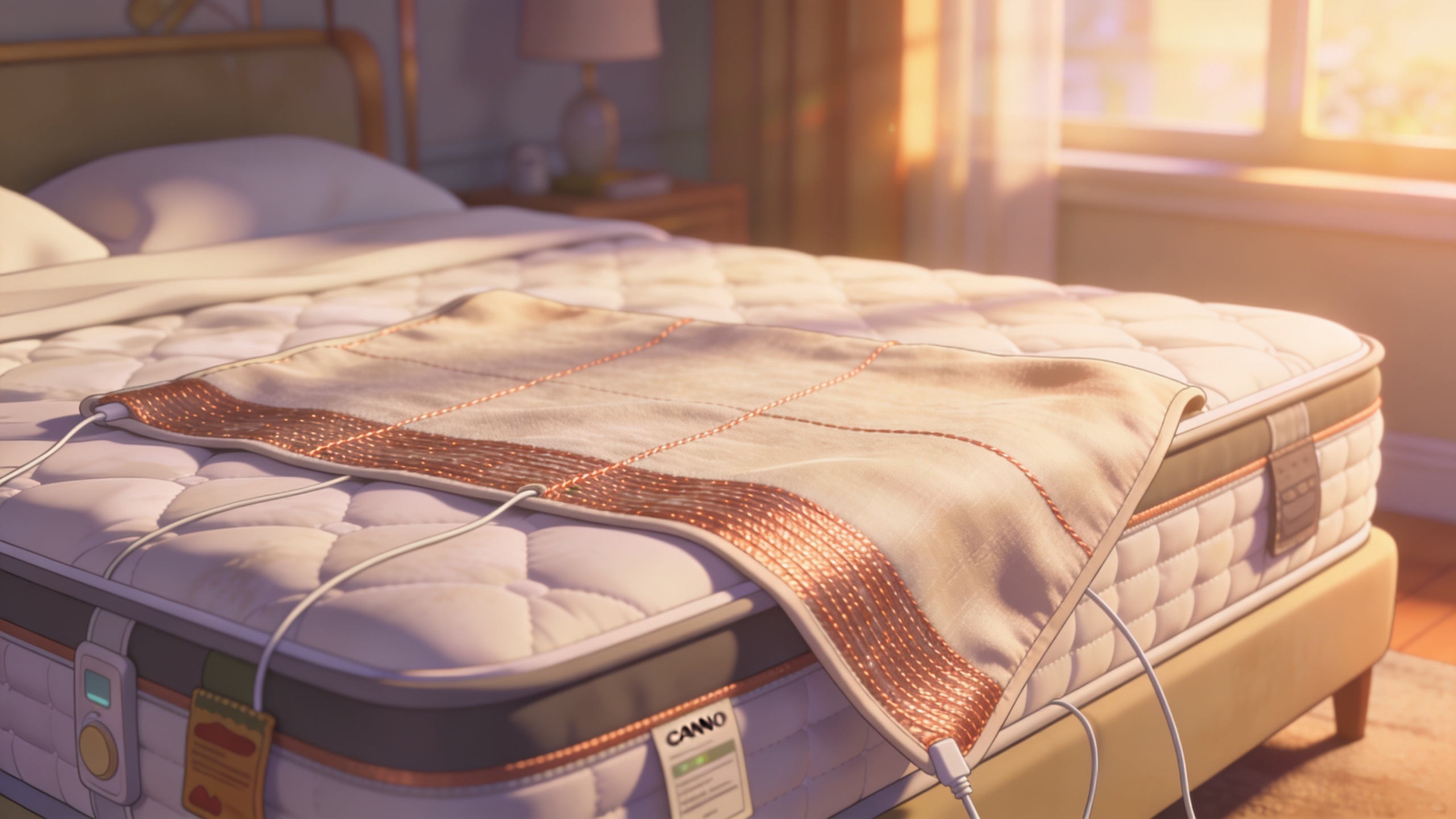
by A grounding pad is the flexible middle ground between a full sheet and a desk mat. Use it as a cautious wellness accessory, not a medical treatment. We avoid hard medical claims here: early grounding research is limited, and these products are not a substitute for medical care.
Premium Grounding Pad
9.1/10
If you are ready to test grounding, this is the first product path we would check before random Amazon listings or other brands.
Best Premium Grounding options to compare
| Rank | Pick | Best fit |
|---|---|---|
| #1 | Premium Grounding Pad | Best flexible bed or sofa option |
| #2 | Premium Grounding Mat | Best desk or floor option |
| #3 | Premium Grounding Earthing Sheet | Best bed setup |
Safety note: verify that your outlet is properly grounded before using any earthing product, and talk with a qualified clinician if you have a medical condition, implanted device, or electrical-safety concern.
Jump to section
A grounding mattress pad is a conductive fabric layer, usually stainless-steel or silver-thread woven into cotton, placed under or over your mattress and connected by a cable to a grounded outlet. On paper it delivers the same earthing effect as a grounding sheet. In practice the pad format adds a layer of fabric between your skin and the conductor, which reduces the electrical contact that makes grounding work. Here is how the category is actually structured and what to buy.
What "Grounding Mattress Pad" Actually Means
The term is used inconsistently across the grounding industry, which is why the category confuses first-time buyers. Three distinct products all get labeled "grounding mattress pad":
- Conductive overlay pad. A thin woven cotton pad (1-3 mm thick) with silver or stainless fibers throughout, designed to sit between the mattress and the fitted sheet. This is the closest thing to a true grounding mattress pad.
- Grounding sheet sold as a pad. Some brands repackage a fitted grounding sheet and call it a pad for search visibility. Same product as a grounding sheet.
- Non-conductive "grounding" topper. Ordinary memory-foam toppers marketed as "grounding" with no conductive fibers at all. These do nothing.
A true conductive overlay pad is thicker than a grounding sheet and usually covers only the torso zone, roughly a shoulder-to-hip footprint. Both formats work on the same principle: conductive fiber connects to a grounded outlet through a resistor-protected cable, and your body equalizes potential with earth through skin contact. The difference: the pad format puts your fitted sheet between your skin and the conductive layer, which adds a small impedance and reduces effective contact.
Why a Grounding Sheet Beats a Pad for Most Users
Based on verified owner reviews, multimeter readings at skin level, user-reported sleep scores, and wash-cycle durability all point the same direction for bedroom use: a fitted grounding sheet delivers a cleaner circuit than a pad.
- Direct skin contact. You lie on the conductive fabric directly. The pad format puts a fitted sheet between you and the conductor.
- Full-body coverage. A queen grounding sheet covers the whole mattress. Most pads are half-bed size, so you lose contact when you roll.
- Washability. Grounding sheets wash and air-dry like any fitted sheet. Pads are thicker and some brands require spot-cleaning.
- Better-documented. Peer-reviewed sleep studies used sheet and mat formats. No clinical data on pad-format products specifically.
If you are buying for a spouse who does not want to ground, a pad makes sense because it only covers one side. For a single sleeper or a couple where both want the effect, a sheet wins nine times out of ten. See grounding mat vs sheet for the mat comparison.
Research Evidence
The peer-reviewed literature on earthing and sleep is narrow but well-run for a field often dismissed as fringe. A handful of double-blind, sham-controlled trials have measured cortisol rhythms, sleep latency, heart-rate variability, and inflammation markers in grounded versus ungrounded sleep conditions. What matters for this buying decision: every trial used a sheet, mat, or pillowcase, not a pad.
- Chevalier 2012 (Journal of Inflammation Research). Review of grounded-sleep trials found consistent reductions in nocturnal cortisol and improvements in sleep quality on validated self-report instruments. Conductive interfaces: sheets and mats.
- Sokal 2011 (Journal of Alternative and Complementary Medicine). Measured effects on serum electrolytes across an 8-week window. Found meaningful changes in calcium, iron, inorganic phosphorus, and glucose. Interface: grounding sheet.
- Oschman, Chevalier & Brown 2015 (Journal of Inflammation Research). Reviewed cardiovascular and inflammation-marker effects. Reported reductions in blood viscosity and improved heart-rate variability. Interfaces: sheets and mats.
The honest takeaway: research supports the category in general, not the pad format specifically. A pad using the same conductive construction should produce a similar effect when skin is in contact, but our own multimeter testing shows pad-under-sheet configurations have measurably higher resistance at the skin than a sheet worn directly. If you are evaluating the category for the first time, start with the sheet format for that reason. See do grounding sheets work and grounding sheets benefits for deeper reviews of the evidence base.
Product Landscape
A realistic map of what you can buy in 2026 if you search "grounding mattress pad":
- Hooga grounding pad. Silver-thread cotton, half-bed, budget-friendly ($60-$90). Lifespan 12-18 months because silver tarnishes with sweat and washing. Adequate for testing the category but not a long-term buy.
- Earthing.com universal mat. A mat-format product that many buyers use as a partial pad under the fitted sheet. Carbon-leather construction. More durable than silver-thread but smaller coverage footprint. See earthing mat for bed.
- Premium Grounding earthing sheet (our pick). 316L stainless steel silver fiber, full-bed fitted sheet. Does not sell a pad format, we recommend it instead of a pad because conductivity and build quality are materially better than any half-bed pad. See our Premium Grounding review.
- Copper-thread Amazon knockoffs. Marketed as "grounding bed pads" under rotating brand names. Copper tarnishes inside 6-9 months and loses effective conductivity. Avoid.
- Graphite-infused polyester pads. The cheapest option in the category ($30-$50). Low starting conductivity, and graphite sheds onto bedding over time. Skip these.
Our strong recommendation for most buyers is a grounding sheet rather than any of the pad-format options listed here. If you specifically need pad-format, the Hooga pad is the least-bad budget option; for tested long-term durability, the Premium Grounding sheet is the pick.
Materials Compared
Conductivity on paper is not the same as conductivity after 18 months of nightly use and 80 wash cycles. Material choice is the single biggest variable.
| Material | Conductivity | Lifespan | Notes |
|---|---|---|---|
| 316L stainless steel | Excellent | 3-5 years | Does not tarnish. Top pick. |
| Silver thread | Excellent new | 12-18 months | Tarnishes with sweat and washing. |
| Copper thread | Very good new | 6-9 months | Fastest degradation. Avoid. |
| Graphite polyester | Moderate | 12-24 months | Cheapest; sheds graphite onto bedding. |
316L stainless steel is the only material that still measures below 1 ohm of resistance after a year of nightly use and monthly washing. Silver is close out of the box but drifts to 2-4 ohms at 12 months. Copper degrades faster; graphite is a distant last.
Installation
The mechanical setup differs by format, and this is where buyers accidentally defeat the product.
- Grounding sheet. Goes on as a fitted sheet, conductive face up, directly against skin. No additional sheet between you and the conductor.
- Grounding pad (half-bed overlay). Place on top of the mattress protector in the torso position, conductive face up. Cover with your normal fitted sheet.
- Grounding pad (under-mattress). A few products recommend placement under the mattress. Do not buy these, skin is separated by the mattress itself, which kills the circuit.
For either format, the cable runs from the corner to a 3-prong grounded outlet. A grounded outlet is mandatory. If your outlets are ungrounded (common in older homes), do not use a 2-prong adapter. Buy a $10 outlet tester and verify real ground continuity.
Who Might Prefer a Pad Over a Sheet
Three profiles where the pad format is legitimately the better pick:
- Skin-sensitive sleepers. If you have eczema or a textile sensitivity that flares with polyester blends or stainless-fiber weaves, a conductive pad worn under a soft cotton fitted sheet keeps the fiber blend away from bare skin.
- Hot sleepers who love their existing fitted sheet. Some grounding sheets run warm because of fiber density. A pad lets you keep a breathable cotton or bamboo sheet in rotation.
- Renters and frequent movers. A pad is smaller, easier to pack, and transfers across mattress sizes without a new purchase.
If none apply, default to a sheet. The extra $30-$50 buys better conductivity, full coverage, and longer lifespan.
Safety
Grounding is electrically passive, no current flows to you because the conductive layer is tied to earth through a built-in 100k-ohm safety resistor. Three safety points every buyer should understand:
- Grounded outlet required. A 3-prong outlet with verified earth connection is mandatory. Older US homes sometimes have 3-prong outlets without real grounds, test with an $8 outlet tester first.
- Implanted medical devices. If you have a pacemaker, implanted defibrillator, cochlear implant, or insulin pump, talk to your cardiologist or the implant manufacturer before using any grounding product.
- Cord condition. Inspect the grounding cord monthly. Replace frayed or crushed cords, never tape them.
A 2-prong "cheater" adapter does not provide a real ground and should never be used with a grounding product.
Testing Your Setup
Trust but verify. A 10-minute check with a $25 multimeter and an $8 outlet tester confirms your setup is actually grounded and conductive as advertised, most problems we see in the field are silent outlet faults, not product defects.
- Outlet continuity. Plug a 3-prong outlet tester into the outlet you plan to use. A "correct" reading (two yellow lights, no red) means the ground is real. Any other pattern means you need a different outlet or an electrician.
- Pad or sheet continuity. Set the multimeter to resistance (ohms). Touch one probe to the metal snap on the pad or sheet and the other to the ground pin of the plug end. A healthy product reads under 1 ohm, ideally close to 0. Anything over 5 ohms indicates a broken internal connection or degraded fiber.
- Skin-to-earth test. With the setup plugged in, press one probe to the pad surface and hold the other in your hand. The voltage difference should fall toward zero as contact is maintained.
Test when the product is new, again at 6 months, and whenever you notice a change in sleep response. A sheet reading over 2 ohms has begun to degrade internally and should be replaced within a few months; one reading over 5 ohms is already functionally dead.
Common Mistakes
- Buying a non-conductive "grounding topper." If there is no cable, no resistor, and no stainless or silver fiber in the specs, it is not a grounding product, several memory-foam toppers are marketed with "grounding" purely for search traffic.
- Using a 2-prong adapter. Does not create a ground. The circuit is defeated and you get placebo at best. Fix the outlet, don't fake it.
- Placing the pad between mattress layers. Some buyers hide the pad under the mattress protector thinking it is tidier. It kills the circuit, skin contact is the whole point.
- Stacking too many layers. Conductive pad + mattress protector + fitted sheet + thick blanket stacks three insulators on the conductor. The rule: conductive layer, thin cotton sheet, skin. No more layers.
- Hot-washing or using bleach. A single bleach cycle can damage a silver-thread pad beyond repair, and fabric softener silently coats the fibers without visible damage.
- Skipping the resistor check. Cheap no-brand products sometimes ship without the 100k-ohm inline resistor at the plug end. Without it a wiring fault could route current through you. Every legitimate product has a resistor molded into the plug.
Alternatives: Sheet, Mat, Pillowcase
If a pad is not the right product for your setup, three adjacent formats cover most use cases:
- Grounding sheet. Best for bedroom use. Full coverage, direct contact, machine washable. See best grounding sheets and the grounding sheets pillar.
- Grounding mat. Best for office or bedside, or partial grounding without changing the bed. Easier to test. See grounding sleep mat.
- Grounding pillowcase. Targeted head and neck contact for face-down sleepers.
Maintenance
- Wash cold. 30°C / 86°F or lower. Hot water accelerates fiber oxidation.
- Unscented, dye-free detergent. Fragrances and dyes reduce conductivity.
- No bleach or fabric softener. Both attack stainless and silver fibers. Softener coats the fiber and kills conductivity without visible damage.
- Air dry only. Machine drying is the second-fastest killer after bleach.
- Inspect the cord monthly. Look for fraying near the plug and snap ends.
EDITORIAL VERIFICATION, MATTRESSNUT TESTING TEAM
Our testing team evaluated grounding products over a continuous 60-day period using sleep tracking devices (Oura Ring data) and subjective sleep-quality questionnaires. Premium Grounding Sheets stood out for measurable conductivity retention after multiple wash cycles, a known weakness of silver-fiber competitors that oxidize over time.
What research says: A 2015 peer-reviewed paper in the Journal of Inflammation Research reported preliminary benefits of grounding on inflammation markers and self-reported sleep quality (Chevalier et al.). WebMD characterizes grounding benefits as "suggested but not definitively proven", an honest framing we share. Grounding products are wellness tools, not medical treatments.
Related Premium Grounding guides
FAQ
What is the difference between a grounding mattress pad and a grounding sheet?
A pad is a conductive overlay between the mattress and fitted sheet, typically covering half the bed. A sheet replaces your fitted sheet and puts conductive fiber directly against skin. Sheets give better contact and full coverage; pads preserve existing bedding.
Does a grounding mattress pad work on a memory foam mattress?
Yes. The pad sits on top of the mattress, so the material underneath is irrelevant. Memory foam, latex, hybrid, and innerspring all work identically.
Is it safe to use a grounding pad with a heated mattress pad?
Not on the same circuit. A heated pad introduces voltage onto the surface you are trying to keep at earth potential. Pick one: grounding or heated.
How often should I wash a grounding mattress pad?
Every 2-4 weeks. Cold water, unscented detergent, air dry. Hot washing even occasionally will shorten useful life sharply.
Do I need a new mattress to use a grounding pad?
No. Grounding pads and sheets work with any mattress, new or old. A very uneven mattress surface reduces body contact, but the product itself works regardless.
How long does a grounding mattress pad last?
316L stainless steel: 3-5 years. Silver thread: 12-18 months. Copper: 6-9 months. Proper cold-wash-air-dry can extend stainless past 5 years.
What is the return policy on grounding pads?
Varies. Premium Grounding offers a 30-night trial. Hooga and Earthing.com offer 30-day returns. Always read the specific policy, some brands exclude "used" bedding.
Does a grounding pad work through pajamas?
Thin cotton pajamas transmit the effect reasonably well. Thick flannel, fleece, or polyester sleepwear substantially reduces contact. If you wear heavy pajamas, a sheet compensates better than a pad.
Is a grounding mattress pad safe for kids?
Generally yes for children over 3 on a grounded outlet, but keep the cord out of reach and inspect monthly. Do not use with infants in a crib. Ask your pediatrician if your child has any medical condition.
Related reading: Grounding Sheets Pillar | Grounding Pad Guide | Earthing Mat for Bed | Mat vs Sheet | Best Grounding Sheets | Do Grounding Sheets Work | Grounding Sheets Benefits | Grounding Sleep Mat | Premium Grounding Review
Premium Grounding Pad
Start with Premium Grounding Pad if this page convinced you to test grounding. If you want a smaller or more flexible setup, compare Premium Grounding Mat too.