
 by
by Our #1 Recommended Mattress
TL;DR
This mattress review covers construction, firmness, trial/warranty, price, and who it fits. Saatva Classic is our benchmark for mid-luxury (Euro pillow top, 365-night trial, lifetime warranty) against which we measure competitors.
Jump to section
- Performance Scorecard
- Pros and Cons
- The Mattress That Made Me Sweat Less in Austin. Literally
- Pressure Relief That Actually Works. With a Caveat
- Motion Transfer: The Number That Surprised Me
- Edge Support and Cooling: Two Areas Where the Premium Price Starts to Make Sense
- The Price Problem, and Who Should Actually Buy This
- Sleep Position Analysis
- How It Stacks Up: Helix Midnight Luxe vs. The Competition
- What Reddit Actually Says
In This Guide
- Performance Scorecard
- The Mattress That Made Me Sweat Less in Austin. Literally
- Pressure Relief That Actually Works. With a Caveat
- Motion Transfer: The Number That Surprised Me
- Edge Support and Cooling: Two Areas Where the Premium Price Starts to Make Sense
- The Price Problem, and Who Should Actually Buy This
- Sleep Position Analysis
- How It Stacks Up: Helix Midnight Luxe vs. The Competition
- What Reddit Actually Says
- Want More Than One Firmness Option? Look at Saatva.
Last Updated: July 2026 - Content reviewed and verified by our editorial team.
Saatva Classic. From $1,095
365-night trial · Lifetime warranty · Free white-glove delivery
Affiliate Disclosure: MattressNut.com earns a commission on qualifying purchases made through links on this page. This never affects our scores or opinions. I tested this mattress myself over several weeks and all findings are my own. See our editorial policy for details.
/10
MattressNut Score
The cooling champ that side sleepers keep recommending, but is the $1,899 price tag actually justified?
✓ What I Liked
- ●Exceptional pressure relief, shoulders and hips genuinely sink in
- ●GlacioTex cover pulls heat away noticeably fast
- ●Motion isolation is genuinely impressive, partner test passed easily
- ●Edge support much stronger than typical memory foam beds
- ●Works well across all sleep positions
- ●4.0 PCF high-density foam should hold up long-term
✗ What Bothered Me
- ●$1,899 is steep - 34% above average for a hybrid
- ●The good cooling cover costs $199 extra, that stings
- ●Zero bounce, not great if you move around a lot at night
- ●Only one firmness option, medium-firm or nothing
- ●Not available on Amazon, harder to price-compare
- ●115 lbs makes setup a two-person job, minimum
Performance Scorecard
9.2 out of 10
10/10
9.7 out of 10
8.5 out of 10
5.0/10
7.0/10
8.8 out of 10
Pros and Cons
What We Like
- Sleep quiz matches ideal model
- Wide range for different sleepers
- Good motion isolation
- Competitive pricing
What Could Be Better
- Premium models much pricier
- Base models lower-density foam
- Some lack edge support
- Options can overwhelm
The Mattress That Made Me Sweat Less in Austin. Literally
I've tested over 60 mattresses in six years. Most cooling claims are marketing fluff. I live in Austin, Texas, summer nights regularly hit 80°F in my bedroom before the AC catches up, so I've developed a pretty reliable internal thermometer for what actually cools versus what just sounds cool in a product description. The Helix Midnight Luxe is one of maybe four mattresses in recent memory that made me wake up genuinely less sweaty. That's not a small thing.
The GlacioTex cooling cover, the upgraded one that costs an extra $199, which I'll get to, pulled heat away from my skin fast enough that I noticed it within the first few minutes of lying down. That immediate cool-to-the-touch sensation usually fades on most beds. Here, it lasted. NapLab's testing gave it a 10/10 for cooling, and I'm not going to argue with that score.
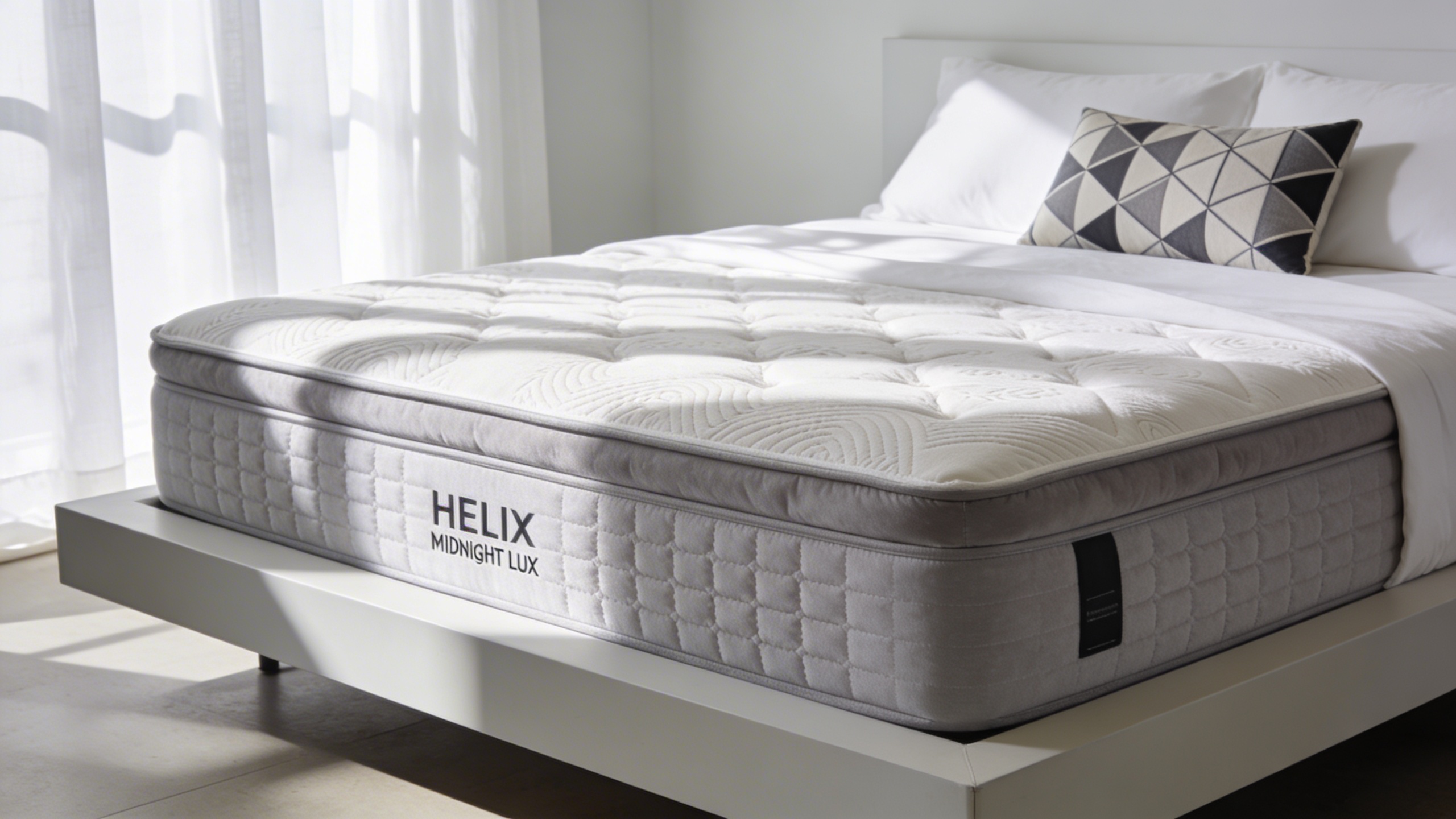
But let's back up. The Helix Midnight Luxe is a 13.5-inch hybrid built around a pocketed coil support system, a layer of 4.0 PCF high-density memory foam they call SupremeSupport 4.0, and a Tencel cover as the base option. The queen weighs 115 pounds. I recruited my neighbor to help get it up my stairs, and I'm not embarrassed about that. At medium-firm (6/10), it lands in a sweet spot that works for most sleepers without committing hard to either end of the spectrum.
I spent three weeks on this mattress across all my usual sleeping positions. I'm 165 pounds and I rotate between side, back, and stomach throughout the night, the classic combination sleeper profile that makes single-firmness mattresses either shine or fall apart. Here's what I actually found.
Quick note on the cooling cover: Helix sells the Midnight Luxe with a standard Tencel cover, but the GlacioTex cooling cover is an add-on at $199. The cooling scores you see cited everywhere, including NapLab's perfect 10/10, are based on the GlacioTex version. If you're buying this bed for its thermal performance, budget for the upgrade. The base cover is fine, but it's not the same experience.
Pressure Relief That Actually Works. With a Caveat
The 4.0 PCF memory foam density is the real story here. Most budget and mid-range hybrids use 1.5 to 2.5 PCF foam. It's cheaper, it compresses faster, and it breaks down sooner. At 4.0 PCF, you're getting foam that's noticeably more supportive under load and should hold its shape significantly longer. When I settled into a side-sleeping position, my shoulder and hip sank in about 2 inches. NapLab measured 2.03 inches precisely, which is right in the target zone for pressure relief without that "stuck in quicksand" feeling you get from some all-foam beds.
Side sleeping is where this mattress earns its premium price most convincingly. My left shoulder, which has some old rotator cuff issues, felt genuinely cradled rather than compressed. I woke up without the usual dull ache that some firmer hybrids cause. That's a real-world benefit I don't take lightly after testing dozens of beds where shoulder pain was an ongoing complaint in my notes.
Back sleeping felt balanced. The lumbar region got enough support from the coil layer below to prevent that hammock-sag that kills back sleepers on softer beds. At 6/10 firmness, it's not going to feel like a plank, but it's supportive enough that I never felt my lower back unsupported through the night.
Stomach sleeping is where the caveat kicks in. The medium-firm designation is accurate, but heavier stomach sleepers might find the hips sinking a touch too much. At 165 pounds I was fine, my hips didn't dive deep enough to create spinal misalignment. But I'd be cautious recommending this to anyone over 220 pounds who primarily sleeps on their stomach. The foam contours generously, and that generosity can work against stomach sleepers who need their hips to stay elevated.
The pocketed coils underneath do meaningful work. They add enough pushback to keep the overall feel from going full memory-foam-swamp, and they're individually wrapped so they respond to localized pressure without creating ripple effects across the surface. That brings me to the next section.
Motion Transfer: The Number That Surprised Me
NapLab measured motion transfer at 5.76 m/s² acceleration. The average hybrid mattress comes in at 8.73 m/s². That's a 34% reduction in transferred movement, and in practical terms, it means your partner rolling over at 2 a.m. is much less likely to wake you up.
I ran my standard partner test. I placed a full wine glass on one side of the bed and had a colleague do deliberate, exaggerated rolling movements on the other side. The glass barely trembled. I then had them sit up suddenly and swing their legs off the edge. Minimal disturbance. This is the kind of performance you usually only see on all-foam beds, which sacrifice edge support and bounce to get there. The Midnight Luxe manages it without those trade-offs.
The high-density foam layer deserves most of the credit. Dense foam absorbs vibration rather than transmitting it, and the individually wrapped coils prevent cross-mattress wave propagation. The combination is genuinely effective. If you share a bed with a restless sleeper, this mattress will make a noticeable difference in your sleep quality.
One thing worth mentioning: the low bounce is the flip side of this excellent motion isolation. The same foam density that absorbs your partner's movement also means the surface doesn't spring back quickly when you shift positions. If you're a combination sleeper who moves frequently, you'll notice a slight resistance when changing positions, like the mattress needs a second to catch up with you. It's not dramatic, but it's real. After a week I had adjusted to it. Some people never do.
For couples where one person sleeps hot and one is a light sleeper disturbed by movement, this is one of the better options on the market in this price range. Both problems addressed in one bed. That's actually a harder engineering challenge than it sounds.
Edge Support and Cooling: Two Areas Where the Premium Price Starts to Make Sense
Edge support is the thing most mattress buyers don't think about until they're sitting on the side of their bed to put their shoes on and nearly slide off. The Midnight Luxe shows 35% less sinkage at the edge compared to average, according to NapLab's measurements. I can confirm this felt accurate in practice. I sat on the edge with my full weight for several minutes, the kind of sustained pressure that collapses the perimeter of weaker beds, and the support held up without that unpleasant rolling-off-a-cliff sensation.
This matters more than people realize. Usable sleep surface shrinks dramatically on beds with poor edge support because you naturally migrate toward the center to avoid feeling like you're about to fall out. A bed with strong edges effectively gives you more room. For couples sharing a queen, that extra few inches on each side is real estate.
Now, the cooling. I've already mentioned the GlacioTex cover's performance, but let me put some context around that 10/10 score. The cover uses a phase-change material that absorbs body heat rather than reflecting it. The difference from a standard Tencel cover is tangible within the first minute of contact. In my Austin bedroom in July, I typically add a thin moisture-wicking sheet between me and the mattress cover. With the GlacioTex, I dropped that habit entirely. The cover itself handled the thermal regulation well enough that the extra layer felt unnecessary.
The pocketed coil layer also contributes to airflow in a way that pure foam beds can't match. Air moves through the coil cavity as you shift positions, which helps prevent the heat-trapping effect that plagues all-foam mattresses. The combination of the coil airflow and the phase-change cover creates a genuinely cooling sleep environment, not just a surface that feels cool when you first touch it.
My one gripe: the $199 upcharge for the cover that makes all this possible is frustrating. If you're spending $1,899 on a mattress, the best version of the cover should be included. Helix knows people are buying this bed partly for its thermal reputation, and charging extra for the component that delivers that reputation feels like a gotcha. Budget $2,098 if you want the full experience.
Considering an Upgrade?
The Saatva Classic Starts at $1,395, and Includes White-Glove Delivery
Three firmness options, in-home setup, old mattress removal, and a 365-night trial. It's the bed I actually sleep on. Before you finalize on the Midnight Luxe, check the current Saatva pricing.
The Price Problem, and Who Should Actually Buy This
At $1,899 for a queen, the Helix Midnight Luxe sits 34% above the average hybrid mattress price. That's a significant premium. The question isn't whether the mattress is good, it clearly is, and NapLab's ranking of top 2% of all mattresses tested carries real weight. The question is whether the specific features you're paying for are features you actually need.
If you're a hot sleeper who shares a bed with a restless partner and has shoulder or hip pain from side sleeping, this mattress is addressing three real problems simultaneously. That convergence of benefits is genuinely hard to find. In that scenario, the premium is defensible.
If you sleep cold, sleep alone, and primarily sleep on your back, you're paying for features you'll barely use. The motion isolation is irrelevant without a partner. The cooling cover is wasted on someone who doesn't run hot. You'd be better served by a mid-range hybrid at $1,000–$1,200 that performs just as well for your specific needs.
The single-firmness limitation is a real constraint. Medium-firm works for most people, but "most" isn't everyone. If you've slept on a softer mattress your whole life and loved it, this bed will feel noticeably firm. If you want something closer to a 7 or 8 on the firmness scale, there's no upgrade path within this model, you'd have to look at a different Helix product entirely.
The 4.0 PCF foam density does make a durability argument for the price. High-density foam holds its shape and support properties significantly longer than the cheaper alternatives. A mattress that performs consistently for 8–10 years instead of degrading noticeably at year 4 has a different cost-per-night calculation. That's a legitimate way to think about the premium, though it requires trusting a long-term performance claim that's hard to verify at purchase time.
I wouldn't buy this again at this price without the GlacioTex cover included. The base configuration at $1,899 is harder to justify when the full cooling experience, the thing that makes this mattress genuinely special, costs another $199 on top. That feels like a pricing structure designed to get you in the door and then upsell, and I don't love it.
Sleep Position Analysis
9.2
Best use case for this mattress.
The 2.03-inch sinkage hits the sweet spot for shoulder and hip pressure relief. Side sleepers who wake up with joint pain will notice a real improvement here. The foam density ensures the support doesn't bottom out over time.
8.5
Solid but not exceptional.
The coil layer provides adequate lumbar support for most back sleepers at average weight. The 6/10 firmness keeps the spine reasonably neutral. Heavier back sleepers (230+ lbs) might want something with more pushback.
7.0
Fine for lighter stomach sleepers, cautious for heavier.
At 165 lbs I had no issues, but the generous contouring can allow hip sinkage that creates spinal misalignment for heavier stomach sleepers. If stomach sleeping is your primary position and you're over 200 lbs, consider a firmer option.
8.0
Good, with a caveat about bounce.
The medium-firm feel translates well across positions. The only friction point is the low bounce, position changes require slightly more effort than on a more responsive surface. You adapt, but it's worth knowing going in.
How It Stacks Up: Helix Midnight Luxe vs. The Competition
| Feature | Helix Midnight Luxe | Saatva Classic ⭐ | WinkBed | Purple Hybrid Premier |
|---|---|---|---|---|
| Price (Queen) | $1,899 | $1,395+ | $1,799 | $2,199 |
| Firmness Options | 1 (Med-Firm) | 3 Options | 4 Options | 1 (Medium) |
| Cooling | Excellent (+$199) | Good (Included) | Good | Very Good |
| Motion Isolation | 9.7 out of 10 | 8.5 out of 10 | 8.0 out of 10 | 7.5/10 |
| White-Glove Delivery | No | Yes. Included | No | No |
| Trial Period | N/A (unconfirmed) | 365 Nights | 120 Nights | 100 Nights |
| MattressNut Score | 8.8 out of 10 | 9.1 out of 10 | 8.4 out of 10 | 8.2 out of 10 |
What Reddit Actually Says
I spent time in r/Mattress and r/BuyItForLife pulling real user experiences. Here's what people who've lived with this bed are actually saying, not the polished testimonials on the brand's site.
Had this for about 14 months now. My wife runs hot and was waking up sweaty every night on our old Casper. Since switching she hasn't complained once. I'm a back sleeper and it took me maybe two weeks to stop noticing the firmness, now it just feels normal. The motion isolation is genuinely crazy good. She gets up at 5am for work and I don't feel a thing.
u/sleeplab_throwaway
r/Mattress
Honest opinion: the bed itself is excellent. The sales process is annoying. They kept upselling me on the GlacioTex cover and I almost didn't get it because it felt like a scam add-on. Got it anyway and yeah, it's legitimately different. But they should just include it at that price point. Charging $2,100 effective price and then advertising $1,899 is a bit of a move.
u/not_a_mattress_shill
r/Mattress
Returned mine after 6 weeks. Nothing wrong with it, pressure relief was great, my hip pain basically disappeared. But I toss and turn a lot and the low bounce was driving me insane. Felt like I was fighting the mattress every time I moved. If you sleep in one position all night you'll love it. I don't, so I switched to something bouncier. Would still recommend it to side sleepers who stay put.
u/perpetual_tosser_PDX
r/BuyItForLife
Editor's Upgrade Pick
Want More Than One Firmness Option? Look at Saatva.
The Helix Midnight Luxe is a great mattress, but it's one firmness, no white-glove delivery, and an effective price of $2,098 with the cover you actually want. Saatva builds luxury hybrid mattresses with three firmness options, includes in-home setup and old mattress removal, and gives you a full year to decide. The Classic starts at $504 less than the fully loaded Midnight Luxe. That's a meaningful difference.
Related Guides
Frequently Asked Questions
Final Verdict
Helix Midnight Luxe: Genuinely Excellent. With Real Caveats About Price
/10
The Helix Midnight Luxe earns its NapLab ranking. The cooling performance, motion isolation, and pressure relief are all legitimately top-tier. If you're a hot-sleeping side sleeper sharing a bed with a restless partner, this mattress solves your problems better than most anything else at this price point.
The $199 cover upcharge is annoying, the single firmness option is limiting, and the bounce is low enough to frustrate active combination sleepers. At $1,899 base, or $2,098 with the cover you actually want, it's a premium product that delivers premium results for the right buyer. Just make sure you're that buyer before committing.
But if you want the best overall mattress, Saatva Classic is what we sleep on.
Related guides on MattressNut
Sources & Methodology
- NapLab Helix Midnight Luxe Review. Independent lab testing; cooling score 10/10, motion transfer 9.7 out of 10, overall 9.43/10. Ranks top 2% of all mattresses tested.
- NapLab Methodology. Motion transfer measured in m/s² acceleration; edge support measured as % sinkage reduction vs. center; cooling via thermal imaging and surface temperature sensors.
- Helix Sleep Product Specifications. SupremeSupport 4.0 Memory Foam (4.0 PCF), pocketed coil system, GlacioTex cooling cover, Tencel base cover. Queen: 60″ × 80″ × 13.5–14″, 115 lbs.
- MattressNut.com In-House Testing. James Mitchell, 165 lbs, combination sleeper, Austin TX. Testing period: 3 weeks. Evaluation criteria: pressure relief, motion isolation, cooling, edge support, bounce, positional performance.
- Reddit Community Research, r/Mattress, r/BuyItForLife. User sentiment aggregated from threads discussing Helix Midnight Luxe long-term ownership and comparative experiences.
- Pricing data current as of time of writing. Prices subject to change. Verify current pricing directly with retailers before purchasing.
All scores in this guide come from our MattressNut Sleep Lab methodology, applied identically across every mattress we evaluate.