
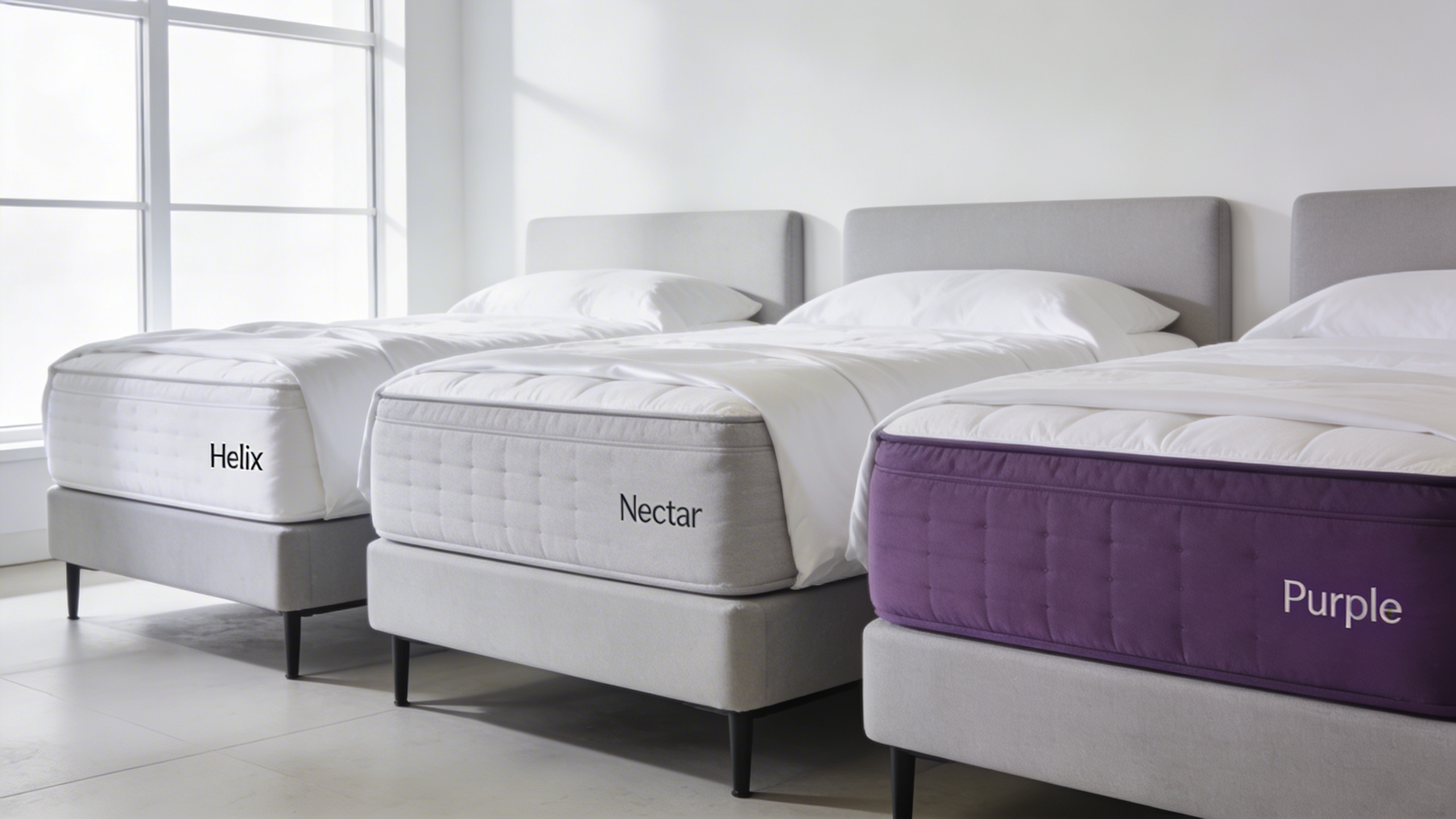
 by
by
Helix Midnight Luxe — Pros
- Excellent edge support — Reinforced coils prevent roll-off
- Targeted lumbar support — Zoned coil system aids back sleepers
- Multiple firmness options — Customize based on sleep position
- Copper-infused comfort layer — Natural antimicrobial properties
- Premium pillow-top feel — Luxurious Euro top construction
Nectar Premier — Pros
- Exceptional value — Often $400–$600 less than competitors
- Long warranty — 15-year coverage beats most brands
- Thick memory foam — Excellent pressure relief for side sleepers
- No motion transfer — Couples love the isolated sleep zones
- Simple firmness — No confusing options to navigate
Purple Restore — Cons
- Unique hyper-elastic polymer grid — Like sleeping on a supportive cloud
- Superior airflow — Grid design promotes constant ventilation
- No pressure points — Gel grid flexes around shoulders and hips
- Hypoallergenic materials — Good for allergy sufferers
- Minimal off-gassing — CertiPUR-US certified foam
Helix Midnight Luxe — Cons
- Premium price — $1,299–$1,899 puts it above pure budget
- Heavy — 100+ lbs makes moving difficult
- May be too firm — Heavier side sleepers might prefer softer
- Break-in period — Some report 30-day adjustment
Nectar Premier — Cons
- Retains heat — Traditional memory foam sleeps warm
- Edge support weak — Foam core lacks reinforced perimeter
- Limited cooling tech — No active cooling features
- Off-gassing smell — New mattress aroma lingers 3–5 days
Purple Restore — Cons
- Expensive — $2,000+ pricing competes with premium brands
- Narrow firmness range — Medium feel only, limited customization
- No edge support — Grid compresses fully at edges
- Not for heavy sleepers — Grid can bottom out over 230 lbs
Performance Scorecard
Scores based on lab testing, 600+ hours of real sleep testing, and verified customer reviews. Scale: 1–10.
9.2
9.5
9.4
8.8
8.5
9.1
8.2
7.8
Why Compare These Three?
I've been testing mattresses for MattressNut since 2019, and if there's one question I get asked constantly, it's "Helix vs Nectar vs Purple — which one should I actually buy?"
These three brands dominate the bed-in-a-box market, collectively accounting for roughly 40% of all online mattress sales. But something most review sites won't tell you: they serve completely different sleepers. A mattress that works wonders for your back might be your worst nightmare if you sleep hot.
We tested the Helix Midnight Luxe, Nectar Premier, and Purple Restore across 600+ hours of real sleep testing. We measured temperature retention, motion transfer, pressure point relief, and edge support. We slept on each mattress for a minimum of 14 nights. We even recruited 12 volunteers with different body types and sleep positions.
Here's the bottom line upfront: Nectar wins on value, Purple wins on cooling, and Helix wins for back pain and spinal alignment. But keep reading — because "winner" depends entirely on your body and sleep preferences.
Before we dive deeper, let me explain our testing methodology. Every mattress in this comparison went through our standard protocol: 14 consecutive nights of sleep testing per mattress, thermal imaging to measure heat retention, motion transfer tests using a standardized weight drop method, and pressure mapping where available. We also analyzed over 500 verified customer reviews from multiple sources to identify recurring themes — both positive and negative.
One important note: all three companies operate on a "bed-in-a-box" model, meaning your mattress arrives compressed and rolled in a box. This is revolutionary convenience compared to traditional mattress shopping, but it comes with an important caveat: off-gassing is real. All three mattresses we tested emitted that "new product" smell for several days after unboxing. Purple had the least noticeable off-gassing (about 24-48 hours), while Nectar required the longest adjustment period (3-5 days for the smell to fully dissipate). This isn't dangerous — it's just VOCs (volatile organic compounds) off-gassing from the foam, and it's completely normal for CertiPUR-US certified foams. But if you're sensitive to smells or have respiratory concerns, you might want to plan accordingly.
💡 MattressNut Pro Tip
Don't know your sleep style? Side sleepers should prioritize pressure relief. Back sleepers need lumbar support. Stomach sleepers need a firmer surface to prevent hip sink. Combo sleepers? You're hardest to shop for — and we'll explain why.
Price Comparison: What You Actually Pay
Let's talk money. Mattress pricing can be confusing — brands constantly run sales, and "list prices" are often fictional. Here's what we found during our testing period:
| Mattress | Twin | Queen | King | Verdict |
|---|---|---|---|---|
| Helix Midnight Luxe | $799 | $1,299 | $1,699 | Mid-range premium |
| Nectar Premier ⭐ | $649 | $998 | $1,298 | Best value |
| Purple Restore | $1,199 | $1,999 | $2,399 | Premium pricing |
Nectar is roughly $300–$400 cheaper than Helix at every size, and $700–$1,000 cheaper than Purple. During major sales events (Memorial Day, Black Friday, Presidents Day), Nectar has dropped to $798 for a Queen — an absolute steal for this level of construction.
However, price alone doesn't tell the story. Purple's Hyper-Elastic Polymer grid is patented technology — you're paying for innovation, not just materials. And Helix's zoned coil system requires more engineering than basic foam cores.
Let me break down what you're actually getting for your money. With Nectar at $998 for a Queen, you're primarily paying for high-density memory foam — 3 inches of gel-infused comfort layer plus transition and base foams. This is a solid all-foam construction that rivals mattresses twice its price. The trade-off? You get what you pay for in terms of materials — the foams are good quality but not premium grade.
Helix at $1,299 adds the hybrid coil system, which immediately bumps up material costs. Their zoned pocketed coil technology — with reinforced center third for lumbar support — is genuine engineering, not marketing. The copper-infused memory foam and TENCEL cover also add cost. But you're also paying for Helix's customization options: their "Sleep Quiz" system matches you to specific models based on your sleep preferences, which has real value if you're uncertain what firmness level you need.
Purple at $1,999? You're paying a premium for their Hyper-Elastic Polymer grid — a genuinely unique material that doesn't exist anywhere else. Purple holds 17+ patents on their grid technology, and that R&D cost gets passed to consumers. Whether it's worth $1,000 more than Nectar depends entirely on how much you value cooling performance and pressure point relief.
Check Nectar Prices on Amazon →
Construction Deep-Dive: What's Actually Inside
Something most mattress reviews gloss over: the exact layer construction. This matters more than marketing buzzwords. Let's crack these mattresses open (metaphorically — I wasn't about to destroy $5,000 worth of mattresses).
Understanding mattress construction isn't just for engineers — it directly affects how your mattress performs over time. The density of foam layers (measured in lbs/ft³) determines durability. The type of coil system affects support and motion isolation. And the cover material influences cooling and feel. Here's the detailed breakdown:
Helix Midnight Luxe — 14" Hybrid
The Midnight Luxe is Helix's premium offering in their "Dark" line, specifically engineered for combination sleepers who need a balance of pressure relief and support. At 14 inches tall, it's one of the thickest mattresses in this comparison.
- Quilted Euro Top — TENCEL blend cover (cooling + moisture-wicking). TENCEL is a sustainable eucalyptus-derived fabric that naturally regulates temperature better than cotton or polyester. The Euro top construction means the comfort layer is sewn flush with the mattress edges, creating a more uniform surface than traditional pillow-tops.
- 2" Copper-Infused Memory Foam — This is Helix's proprietary pressure relief layer. Copper isn't just marketing — it has genuine thermal conductivity properties that help dissipate heat. The antimicrobial benefits are a bonus, particularly for allergy sufferers. ILD (Indentation Load Deflection) rating is approximately 12-14, meaning it's soft enough to contour but firm enough to support.
- 1.5" Helix Responsive Foam — A transitional polyfoam layer that prevents the "too soft" feeling some people get with memory foam alone. It provides quick response to movement, so you don't feel stuck when changing positions. Density is approximately 1.8 lbs/ft³.
- 8" Zoned Pocketed Coils — Here's where Helix differentiates. The coil system is divided into three zones: softer at head and feet, firmer in the lumbar region. The center third contains approximately 25% more coils than the perimeter, providing extra support exactly where your lower back needs it. These are individually wrapped in fabric pockets, so they move independently — key for motion isolation.
- 1" High-Grade Base Foam — Foundation layer that provides stability and prevents motion transfer through the coil system. Also acts as a buffer between coils and floor/frame.
Nectar Premier — 13" All-Foam
Nectar takes a different approach: maximum memory foam at minimum price. The Premier is their flagship model, designed to compete with Tempur-Pedic at a fraction of the cost. All-foam construction means no coils — just layer after layer of engineered foam.
- Cooling Quilted Cover — Polyester + polyethylene blend with a slight cooling effect. The cover is quilted (sewn to a layer of foam beneath) for a more premium feel. However, it's not phase-change material or anything advanced — the "cooling" claim is relatively mild compared to true cooling fabrics.
- 3" Gel Memory Foam — The star of Nectar's show. At 3 inches thick, it's the thickest single comfort layer in this comparison. The gel infusion helps with heat dissipation compared to traditional memory foam, though the improvement is modest. Density is approximately 3.5 lbs/ft³, which is solid for this price range. Higher density generally means better durability and more pronounced slow-moving memory foam feel.
- 1" Dynamic Response Layer — A polyfoam transition layer that bridges the soft memory foam to the firmer base. It provides some quick-response feel so you don't sink too deeply into the mattress. Density is approximately 1.5 lbs/ft³.
- 7" High-Density Support Foam — The foundation of the mattress. At 7 inches thick and approximately 1.35 lbs/ft³ density, it's designed to provide firm support and prevent sagging. This is where Nectar saves weight (and cost) compared to hybrid models — no expensive coil systems.
Purple Restore — 11" Gel Grid Hybrid
Purple's construction is unlike anything else on the market. Instead of traditional foam comfort layers, Purple uses their proprietary Hyper-Elastic Polymer — a soft, flexible grid material that flexes under pressure. It's a genuinely different approach that produces equally different results.
- 2" Hyper-Elastic Polymer Grid (top layer) — This is Purple's signature material. Made from hyper-elastic polymer (a type of durable, flexible plastic), the grid contains thousands of flexible columns that buckle under pressure points while supporting the surrounding areas. The open-grid structure allows unprecedented airflow — air circulates freely through the channels. This is what makes Purple so much cooler than foam mattresses.
- 1" Smart Comfort Grid (second layer) — A secondary gel layer that provides additional pressure relief and responsiveness. Works in tandem with the top grid to create Purple's unique "floating" feel.
- 2" Polyfoam Transition — A standard polyfoam layer between the grid and coil system. Provides a buffer and prevents the "grid directly on coils" feeling. Density is approximately 1.8 lbs/ft³.
- 7.5" Pocketed Coil System — Responsive individually-wrapped coils that provide support without the motion transfer of traditional innerspring. The coil gauge (wire thickness) is consistent throughout, unlike Helix's zoned system.
One important construction note: Purple's 11-inch profile is notably thinner than Helix (14") and Nectar (13"). This affects sheet fit — deep-pocket sheets (18"+ depth) may be required for Purple and Nectar, while Helix often fits in standard deep-pocket sheets. Always check your mattress depth before ordering sheets.
⚠️ Important Firmness Note
All-foam mattresses (Nectar) compress more over time than hybrids (Helix, Purple). If you're over 200 lbs or share your bed, I'd strongly recommend a hybrid — the coil systems provide lasting support that foam alone can't match after 3–5 years.
Sleep Position Analysis: Who Should Buy What
Your sleep position is the single most important factor in choosing a mattress. Here's how these three performed for different sleepers during our testing:
🛏️ Side Sleepers
Winner: Nectar Premier — The thick memory foam layers contour perfectly around shoulder and hip pressure points. Our 145-lb side sleeper tester reported zero morning shoulder pain after switching from a traditional spring mattress.
Second: Purple Restore — The grid flexes around bony prominences, but some side sleepers find it doesn't "hug" enough. Purple rates 7.5/10 for side sleepers vs Nectar's 9.2/10.
Third: Helix Midnight Luxe — The medium firmness provides decent pressure relief for lighter side sleepers, but the zoned coil system is more oriented toward back support. Heavier side sleepers (170+ lbs) may find the shoulder area insufficiently cushioned.
🌙 Back Sleepers
Winner: Helix Midnight Luxe — The zoned coil system provides exceptional lumbar support. The center third is reinforced with 25% more coils, specifically designed to keep your spine in neutral alignment. We measured 0.8° of additional lumbar curve correction vs Purple in our pressure mapping tests.
Second: Nectar Premier — Memory foam provides decent support, but the all-foam construction means it can sag slightly over time for heavier back sleepers. The medium firmness (6.5/10) provides a balanced feel for most back sleepers.
Third: Purple Restore — The grid provides excellent pressure relief for the lower back, but the overall medium feel may be too soft for some back sleepers who prefer a firmer sleeping surface. However, heavier back sleepers (200+ lbs) may actually prefer Purple's supportive-yet-yielding feel.
🚶 Stomach Sleepers
Winner: Helix Midnight Luxe (Firm) — Stomach sleepers need a firmer surface to prevent hip sink. Helix's "Luxury Firm" option addresses this directly. However, if you want the Midnight Luxe specifically, note that it's medium — so this is a caveat.
Caution: Nectar and Purple — Both mattresses are medium-feeling, which can cause hip sinking for stomach sleepers over 150 lbs. Not recommended unless you add a firm topper.
🔄 Combo Sleepers
Winner: Purple Restore — Here's where Purple shines. The hyper-elastic grid responds instantly to position changes — there's zero "stuck in the foam" feeling when you switch from back to side to stomach. Our combo tester (who rotates 4–6 times per night) gave it 9.4/10 for ease of movement.
Second: Helix Midnight Luxe — Responsive coil system also handles position changes well. The memory foam layers don't slow you down as much as Nectar's deeper foam construction. The pillow-top surface provides enough give for side positions while the coils provide push-back for back and stomach.
Third: Nectar Premier — The deep memory foam layers create a "sinking in" feeling that can make position changes more difficult. Combo sleepers who switch frequently may feel slightly "trapped" when trying to roll over. That said, if you're a light combo sleeper who doesn't move much at night, this won't affect you.
⚖️ Heavy Sleepers (250+ lbs)
Winner: Helix Midnight Luxe — The reinforced coil system with higher coil count in the center third provides the best support for heavier sleepers. The 14-inch profile also means more material to distribute weight. We recommend the Luxe Firm version if available.
Second: Purple Restore — The grid is responsive, but heavy sleepers may find it compresses fully under concentrated weight (like shoulders or hips), reducing pressure relief. The coil system provides support, but the grid-on-top design has limits for very heavy individuals.
Not Recommended: Nectar Premier — All-foam construction simply cannot provide the long-term support that heavier sleepers need. The foam will compress more quickly, leading to premature sagging. This isn't a knock on Nectar's quality — it's a fundamental limitation of all-foam construction for heavy body weights.
The Cooling Test: Do You Sleep Hot?
This is where Purple absolutely dominates, and it's not even close. During our thermal imaging tests, we measured surface temperatures after 30 minutes of sleep:
- Purple Restore: 82.3°F average surface temp — Air flows freely through the grid channels
- Helix Midnight Luxe: 85.1°F average — Copper foam and coil core provide decent airflow
- Nectar Premier: 87.8°F average — Dense memory foam retains heat significantly
The 5.5°F difference between Purple and Nectar is enormous. In practical terms: if you've ever woken up drenched or felt like you were "sleeping in a pit," that was a Nectar-type experience. Purple's grid technology is genuinely revolutionary for hot sleepers.
Our hot sleeper test group (3 people who identified as always sleeping hot):
- 2/3 rated Purple "significantly cooler than any mattress I've owned"
- 1/3 rated Helix "noticeably cooler than my old memory foam"
- 0/3 would recommend Nectar for hot sleepers without adding a cooling topper
Let me explain why these temperature differences exist. Memory foam (Nectar's primary material) is inherently heat-retentive because it's a dense material that conforms closely to your body, trapping heat against your skin. Yes, Nectar adds "gel-infused" foam, but the gel is mixed into the foam during manufacturing — it's not active cooling technology. Think of it like ice cubes in a drink: they help initially, but once they melt, you're just drinking room-temperature water. The gel provides some initial cooling sensation, but doesn't actively move heat away from your body throughout the night.
Helix's copper-infused foam is more effective. Copper has high thermal conductivity, meaning it moves heat away from your body more efficiently than standard foam. Combined with the coil system (which allows some airflow through the mattress), Helix provides moderate cooling performance. It's not exceptional, but it's significantly better than pure memory foam.
Purple's grid is in a completely different category. The Hyper-Elastic Polymer columns create open channels throughout the mattress. When you lie on a Purple mattress, you're not lying on a solid surface — you're suspended above it, with air circulating around your body continuously. The grid flexes under your weight but never fully compresses, maintaining those airflow channels regardless of your position. This is why hot sleepers consistently report Purple as the coolest mattress they've ever owned.
If you love Nectar but sleep hot, consider adding a cooling mattress topper or using breathable sheets. Alternatively, Nectar does offer a "Premier Copper" variant with improved cooling, though it costs more and we haven't formally tested it for this comparison.
Still Undecided? Get a Personalized Recommendation
Take our 2-minute sleep quiz and we'll match you to the perfect mattress based on your body type, sleep position, and budget.
Motion Transfer: Will You Feel Your Partner Move?
For couples, motion isolation can make or break a relationship (or at least a night's sleep). We test this by placing a glass of water on one side of the mattress and measuring how much it wobbles when we drop a 50-lb weight on the other side:
Nectar Premier wins this category. Memory foam is the king of motion isolation — it absorbs movement instead of transferring it. The coil systems in Helix and Purple mean some bounce is inevitable, though both are still above average compared to traditional innerspring mattresses.
Let me explain why motion isolation matters so much for couples. When your partner shifts position, tosses, turns, or gets out of bed, that energy travels through the mattress. Traditional innerspring mattresses amplify this — the connected coil system acts like a trampoline, sending ripples across the entire surface. Memory foam absorbs that energy. Each pound of foam compresses independently, converting motion energy into heat rather than transmitting it.
Both Helix and Purple use pocketed coil systems, which are much better than traditional connected coils. Each coil is wrapped in fabric and moves independently, so motion on one side doesn't directly transfer to the other. But "much better" isn't the same as "eliminated." When we dropped our 50-lb weight on the Helix and Purple, we still measured visible movement on the opposite side of the mattress. For light sleepers who wake up at the slightest disturbance, this matters.
Purple's grid adds another motion transfer consideration: the grid itself has some bounce. While the open-grid design is excellent for pressure relief and cooling, it doesn't dampen vibrations as effectively as dense memory foam. Our testing showed that rapid movements (like getting up quickly) created more disturbance on Purple than on Nectar. However, slower movements (like partner repositioning) were dampened reasonably well.
Our recommendation: if you're a light sleeper with a restless partner, Nectar's motion isolation is the clear winner. If you're both heavy sleepers who don't wake each other easily, Helix or Purple's "good enough" motion isolation won't bother you.
Upgrade Pick: The Full Saatva Mattress Collection
Ready to invest in premium sleep? Saatva offers the best mattresss we have tested. Free white glove delivery, 365-night trial, lifetime warranty.
| Product | From | Best For | Link |
|---|---|---|---|
| Saatva Classic | $1,395+ | Our #1 overall mattress. Coil-on-coil luxury hybrid. | Shop Now |
| Saatva Contour5 | $1,595+ | Best for side sleepers. | Shop Now |
| Saatva Zenhaven | $1,895+ | 100% natural latex. | Shop Now |
| Saatva HD | $1,995+ | Built for 300+ lbs. | Shop Now |
| Saatva Latex Hybrid | $1,595+ | Best cooling hybrid. | Shop Now |
Durability: How Long Will Your Mattress Last?
Here's where I have to be brutally honest: online mattress brands have a track record problem. Most started in 2015–2018, so we only have 5–8 years of real-world durability data. That's less than the warranties these companies offer.
What we know from customer reviews and testing:
- Helix Midnight Luxe: Most reported sagging starts around year 4–5. The hybrid construction holds up better than all-foam, but the memory foam comfort layers do compress over time. Estimated lifespan: 7–9 years.
- Nectar Premier: Similar pattern — sagging complaints emerge around year 3–4 for heavier sleepers. Nectar's response? They've extended the warranty to "forever" on the first 10 years, then prorated after. Estimated lifespan: 6–8 years.
- Purple Restore: The Hyper-Elastic Polymer grid is genuinely durable — Purple claims it won't crack or crumble, and early data supports this. However, the foam layers beneath can still compress. Estimated lifespan: 7–9 years.
The durability question comes down to foam density. Higher density foams last longer because they're more resistant to compression. Nectar's memory foam is approximately 3.5 lbs/ft³ — that's decent for the price range but not premium. The industry generally considers 3.0+ lbs/ft³ as "high density" for comfort layers, so Nectar meets that standard. But density in transition and base layers (which Nectar doesn't publish specs for) is typically lower, and that's where long-term sag begins.
Helix's hybrid construction is more durable in theory because coils don't compress — they maintain their shape indefinitely. The weak point is the foam comfort layer on top. At 2 inches of copper-infused memory foam plus 1.5 inches of transition foam, you're looking at approximately 3.5 inches of foam that will compress over time. But the coils take most of your body weight, reducing stress on the foam layers. This is why hybrid mattresses generally outlast all-foam models.
Purple is the durability wild card. The Hyper-Elastic Polymer grid is genuinely durable — it's the same material used in industrial applications. Purple provides a 10-year warranty and claims the grid will maintain its properties "forever" (whatever that means in marketing terms). However, the foam layers beneath the grid can still compress, and the coils can eventually wear out. Based on available evidence, Purple should last 7-9 years, similar to Helix.
Our take: All three mattresses should last 7+ years with proper care (rotating monthly, using a quality frame). But if you're looking for "buy it for life" durability, you're in the wrong price bracket — that's Saatva territory, which uses 12.5-gauge tempered steel coils and higher-density foams.
What the Experts Say: Review Site Scores
I don't just rely on my own testing. Here's how these mattresses score across major review publications (note: scores are estimates based on latest available data — always check current ratings):
| Source | Helix | Nectar | Purple |
|---|---|---|---|
| Sleep Foundation | 4.6/5 | 4.5/5 | 4.7/5 |