
 by
by Quick answer: A lion commonly sleeps or rests for about 16 to 20 hours during a 24-hour day. That range is more useful than a single exact total because many observations combine true sleep, light dozing, and quiet inactivity.
If you need one plain-spoken answer, use 16 to 20 hours a day. Just don’t read that as a fixed sleep requirement. A lion may spend longer awake on an active hunting day and more time resting after feeding or during hot weather.
The wording matters here. People often say a lion is “sleeping” whenever it is lying still with its eyes closed. Wildlife observations may not always distinguish deep sleep from dozing or alert rest, so the familiar daily estimate usually describes a broad inactive period rather than hours measured by a sleep monitor.
How to understand the 16-to-20-hour estimate
The 16-to-20-hour range describes a large part of the daily cycle, but it does not mean a lion sleeps continuously for that entire stretch. Lions generally move between sleep, light rest, grooming, social contact, feeding, watching their surroundings, and more demanding activity.
Some rest periods may be brief. Others can last much longer, especially when conditions are hot or the pride has recently fed. A sleeping lion can also wake quickly in response to another animal, an unfamiliar sound, or movement nearby.
That makes the daily total an estimate rather than a precise schedule. It is better understood as a broad pattern of energy conservation. Individual days can look different even for the same lion.
- Useful shorthand: Lions commonly spend about 16 to 20 hours sleeping or resting.
- Not one continuous block: That time can be divided into multiple bouts.
- Not all deep sleep: Quiet rest and light dozing may be included.
- Not identical every day: Heat, feeding, disturbance, and activity can shift the total.
The most accurate short answer therefore needs both the number and the qualification. Saying only that lions sleep for a set number of hours makes their behavior sound much more rigid than it is.
Why lions spend so much of the day resting
A lion’s low-activity periods make sense when you look at how it uses energy. Chasing, grappling with, and controlling prey can be physically demanding. Rest between those efforts helps conserve energy for the moments when force and speed matter.
Hunting success is not constant, either. A lion may investigate prey, reposition, wait for a better opportunity, or abandon an attempt. Remaining inactive between useful opportunities can cost less energy than roaming continuously.
Heat also affects the rhythm of the day. Moving or hunting during the hottest conditions can be taxing, so lions often reserve more activity for cooler periods. Shade and airflow can make a resting place more attractive while the temperature is high.
The key point: Long rest periods are not a sign that lions have nothing to do. They are part of an energy budget shaped by hunting, feeding, temperature, and opportunity.
A recent meal can change that budget. After feeding, a lion may have less immediate reason to search widely for food and may settle for an extended period. On another day, hunger or movement by prey animals may keep it active for longer.
Social living can support rest as well. Members of a pride do not all have to face the same direction or perform the same activity at once. Some may rest while others remain more alert, interact, move, or respond to activity around the group.
Lions do not follow a simple bedtime
The daily pattern is usually broken into several periods rather than one human-style overnight sleep. A lion can sleep, wake to change position, interact with another lion, scan the area, and settle again without beginning a major active period.
Activity often increases as conditions become cooler, but that is not an inflexible rule. Lions can move, feed, defend space, or hunt during daylight when circumstances favor it. Weather, prey behavior, human disturbance, and the needs of the pride can all alter the timing.
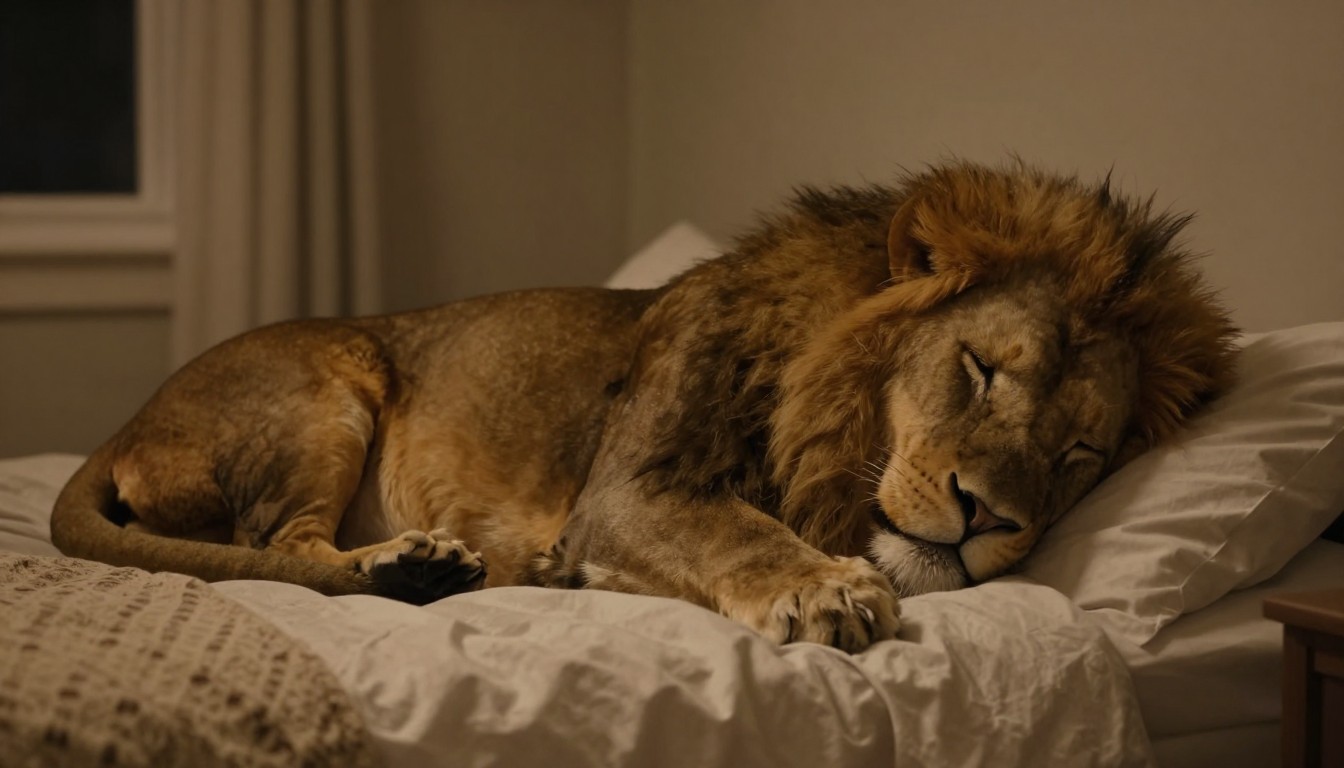
This flexible rhythm explains why a single photograph is weak evidence for a daily total. A picture of a lion lying down confirms only what it was doing at that moment. It says nothing about how long the animal remained there or what happened during the rest of the daily cycle.
Think in bouts, not bedtime: A lion’s sleep and rest are distributed around feeding, movement, social behavior, environmental conditions, and interruptions.
The same caution applies to short videos. A clip may make an animal appear unusually sleepy or unusually active simply because it captures one narrow part of the day. A full daily estimate requires a much wider observation window.
What can change how long a lion sleeps?
The common range is broad because lion behavior is responsive to conditions. The largest differences are not necessarily signs that one estimate is wrong. They may reflect different animals, settings, seasons, definitions, or observation methods.
Temperature and weather
Hot conditions tend to make sustained daytime activity less appealing. A lion may seek shade and remain still until conditions improve. Cooler, windy, or otherwise changing weather can alter when it moves and how long it remains in one place.
Food and recent activity
A lion that has recently fed may settle for a long rest. One that is hungry, following prey, moving with its pride, or responding to a territorial concern may remain active for a larger part of the daily cycle.
Age and individual condition
Cubs, mature adults, and older lions do not have identical routines. Growth, play, social learning, physical condition, and recovery can all influence how inactive an individual appears. That is one reason a single animal should not be treated as the template for every lion.
Role within the group
Different pride members may be occupied by different demands. Caring for cubs, maintaining contact with the group, monitoring nearby activity, feeding, and territorial behavior can interrupt or rearrange rest. The balance can shift from one day to the next.
Disturbance and perceived safety
A quiet resting area can support longer uninterrupted bouts. Nearby competitors, prey movement, people, vehicles, unfamiliar sounds, or conflict within the group may produce shorter bouts and more frequent alertness.
- Recent feeding may encourage a longer inactive period.
- Heat can shift activity toward cooler parts of the day.
- Hunting and territorial demands can interrupt rest.
- Age and individual condition can change the pattern.
- Noise or nearby activity may keep a resting lion alert.
These factors interact. A hot day after a successful feed may look very different from a cool period in which the pride is moving or searching for an opportunity to hunt.
Does captivity change a lion’s sleep?
A lion under managed care lives with a different set of pressures from a wild lion. Feeding schedules, enclosure design, visitor activity, enrichment, relationships with other lions, and daily care routines can shape when it rests and when it becomes active.
That does not support a simple claim that every captive lion sleeps more or less. A predictable food schedule may reduce the need to search for prey, while noise or scheduled activity may interrupt rest at times that would otherwise be quiet.
Wild lions also live in varied conditions. Prey availability, habitat, temperature, competition, pride structure, and human activity differ by location. “Wild” is a setting category, not one universal routine.
Comparison rule: A result observed under managed care should be described as such. It should not automatically be presented as the daily pattern of every wild lion.
The best comparison keeps the setting attached to the observation. If two reports use different environments and different definitions of sleep, a difference between their totals is not surprising.
Sleeping, dozing, and resting are not identical
A lion stretched out with closed eyes may be asleep, but posture alone does not reveal the depth or continuity of that sleep. It may be lightly dozing and capable of reacting immediately. It may also be awake but conserving movement.
This distinction is the biggest reason I would not treat the 16-to-20-hour range as a clinical sleep measurement. In everyday wildlife writing, “sleep” often serves as convenient shorthand for a wider block of inactive behavior.
Behavioral observation can still be useful. Repeatedly recording posture, movement, responsiveness, and changes in activity can reveal a daily pattern. The limitation is that visible behavior does not always separate every sleep state cleanly.
- Sleeping: The animal shows behavior classified as sleep under the observer’s method.
- Dozing: The animal appears lightly asleep and may remain responsive.
- Resting: The animal is inactive but may still be awake.
- Unobserved: The animal’s behavior during that period is not known and should not be silently filled in.
If one account combines all inactive behavior while another counts only clearly identified sleep, they are measuring different things. Their totals should not be compared as though the definitions were interchangeable.
This also explains why the related guide about how long lions sleep a day should be read as an estimate of typical behavior, not a stopwatch rule for an individual animal.
How to judge a lion-sleep number
A useful estimate should tell you more than the final number. It should make clear what counted as sleep, which lions were observed, where they lived, and how much of the daily cycle was actually covered.
The observation window matters. Watching only during daylight may miss activity after dark. Watching only during an especially active or inactive period may also distort the apparent daily balance.
Population matters just as much. An estimate based on one animal, one pride, one age group, or one managed setting has a narrower meaning than a broad claim about lions as a species.
- Check whether the material concerns lions directly.
- Look for a definition of sleep, rest, and inactivity.
- Identify whether the lions were wild or under managed care.
- Check whether observation covered a complete daily cycle.
- See whether the result is an average, a range, or one individual observation.
- Keep any stated uncertainty attached to the final claim.
Repetition across websites does not add much if every version traces back to the same unexplained statement. A number becomes more useful when the method and setting are visible, not merely when the wording sounds confident.
Species comparisons need the same discipline. A discussion of how long whales sleep may help illustrate that animal sleep varies widely, but it cannot establish a lion’s schedule. Each species needs evidence matched to its own behavior and environment.
My practical check: If a precise total comes with no definition, setting, observation period, or indication of variation, read it as a rough summary rather than an exact biological rule.
The answer worth remembering
A lion commonly spends about 16 to 20 hours of a 24-hour day sleeping or resting. That is the useful general answer to the question.
The qualification is just as important. The estimate can include light dozing and inactive rest, it is usually divided into several bouts, and it can shift with temperature, feeding, age, activity, social demands, and setting.
Bottom line: Use 16 to 20 hours as a practical daily range, not an exact quota. A particular lion on a particular day may spend more or less time inactive.
FAQ
How many hours a day does a lion sleep?
A lion commonly sleeps or rests for about 16 to 20 hours in a 24-hour period. The figure is a general range because wildlife accounts may group actual sleep, dozing, and quiet rest together.
Do lions sleep for 20 hours straight?
Usually, the reported total represents multiple bouts across the daily cycle rather than one uninterrupted sleep. A lion may wake to feed, move, groom, interact with its pride, or respond to activity nearby before settling again.
Why do lions sleep so much?
Long inactive periods help lions conserve energy between demanding activities such as hunting and territorial movement. Heat, recent feeding, and the availability of a secure resting place can also encourage extended rest.
Do lions sleep more during the day or at night?
Lions often rest through hotter daytime periods and become more active as conditions cool. Their schedule remains flexible, however, and feeding opportunities, disturbance, weather, and pride activity can produce daytime movement or nighttime rest.
Are lions actually asleep whenever they lie down?
No. A lion may be deeply asleep, lightly dozing, or awake while lying still. Unless an observation method explains how those states were classified, it is safer to interpret a daily sleep figure as an estimate of sleep and rest combined.