

 by
by Our #1 Recommended Mattress
Sleep Lab Pick · Current Sale
Amerisleep's Current Sale: $500 off every mattress. The AS3 — plant-based Bio-Pur® foam, sleeps cooler than memory foam, 100-night trial, 20-year warranty.
Last Updated: March 2026. Content reviewed and verified by our editorial team.
Saatva Classic. From $1,095
365-night trial · Lifetime warranty · Free white-glove delivery
We earn a commission if you make a purchase through our links, at no extra cost to you. Full disclosure.
For many years, common advice from mattress manufacturers was to rotate or flip your mattress regularly. Doing so will help you extend its overall lifespan, and you will be able to improve its overall comfort and performance (check 10 amazing mattresses for great comfort). Modern mattresses have changed almost entirely, and this advice no longer holds any ground.
We have developed this guide to understand why you should flip your mattress even in today's world and how it helps even with all the recent developments in the mattress industry (also check 10 amazing mattresses).
Do You Still Need to Flip Your Mattress with All Those Modern Designs?
Mattresses have come a long way in recent times. We have all types of mattresses now. Different materials are used in their construction with diverse designs. Some have a highly intricate design, while others have a much simpler structure.
You have to make sure you are going for a mattress that needs to be flipped or not when you are buying a mattress. Manufacturers provide all the details about their design and how they have constructed their mattresses.
These mattresses also have all the details to maintain and make them last longer. You can always get in touch with the customer support of the brand that you have bought for further assistance in this regard.
But in response to the question of whether you need to flip your mattress or not, even with all the modern designs, the answer to this question entirely depends upon the type and design of the mattress you own. You need to rotate most mattresses regularly, but you don't have to flip them.
You should follow some general guidelines when rotating or flipping your mattresses. And we will explore them in detail in the following text.
Flipping vs rotating your mattress
With both these techniques, you can even out the wear and tear of your mattress to use it for a longer period. But mattresses vary, so you don't have to flip or rotate all of them.
Flipping
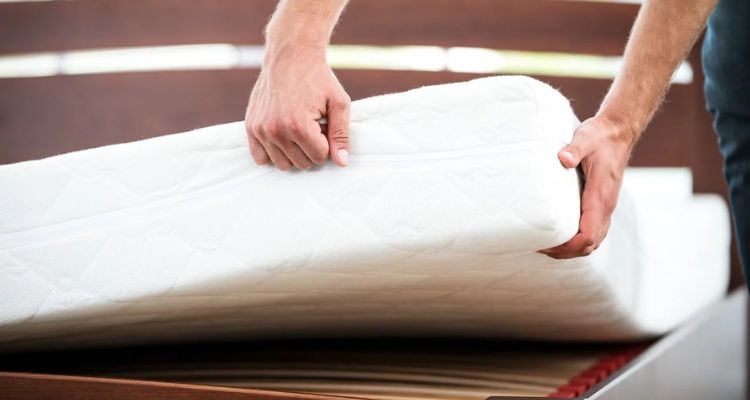
It means tuning it over to use the other side of the mattress. So, you can use both sides of the mattress when you flip.
Rotating
Turning your mattress to 180 degrees means you are using the other side without flipping. It is just the direction of the mattress. The section of your mattress that had supported your head previously will support your feet after rotating your mattress.
Flipping your mattress
Most modern mattresses don't need any flipping. But you need to go through the instructions with your mattress. And if these instructions specifically mention that you need to flip your mattress, you should certainly do that.
Single-sided mattresses
Most modern mattresses today have a one-side design. It means their construction is not for flipping. The primary design and construction of these mattresses are as follows:
- Right at the bottom of the mattress is the base layer to keep the mattress stable, and most of the support within a particular mattress comes from this layer. This base layer either has metal springs if it is an innerspring mattress, or it might feature high density (HD foam) if it's an all-foam mattress.
- Above the base layer, there can be multiple layers of foam and other materials. These support or transitional layers come in different firmness levels and densities. They are there within a mattress to form its comfort system.
- And right at the top is the comfort layer which usually features a latex or a traditional or gel-infused memory foam layer. Apart from that, a cooling and breathable cover are sewn in.
As you can see, the mattress design is trying to achieve something here, and if you flip it, the design will be a failure. Such construction offers tremendous comfort and support.
Right at the top is the comforting layer that ensures pressure relief, while at the bottom is the base layer for maximization of support and stability. After flipping such a mattress, your top layer will be the base layer that will provide no comfort and support.
In other words, it will be too firm, and the softer top layer that is not at the bottom, after flipping, won't provide the mattress with the stability that it needs. As a result, you will be in for a pretty uncomfortable night's sleep and get up with pain and aches in your back and joints (check 10 amazing mattresses for back pain).
Double-sided mattresses
Now, double-sided mattresses have a different construction altogether. These mattresses are flippable and have two different firmness levels on each side.
For instance, an all-foam mattress might have a plush firm configuration on one side and a medium firm configuration on the other (check 10 top rated medium firm mattresses). Other double-sided mattresses might have the same firmness configuration on both sides to increase their overall lifespan.
These mattresses have a stone base layer between the two court systems on each side. Of course, the base layer won't be as thick in these mattresses as in a single-sided mattress. But you can use such a mattress on both sides so that you will have to flip it.
Rotating your mattress
Rotating your mattress is something entirely different from flipping a mattress. Even with the design and construction of most modern mattresses, you need to rotate them more, even if they don't need a flip.

Rotating is important because it enables you to prevent any premature damage to your mattress. By rotating your mattress, you spread out the wear and tear on your mattress with regular use. It happens because you more or less sleep on the same side every night.
The areas of your mattress that have intense pressure daily can result in mattress sagging. These are the areas where you place your shoulders and hips while laying on your mattress.
Now, if you rotate your mattress regularly, this premature sagging won't occur (also check the best selling toppers for sagging mattress). And the pressure you put on the mattress will stay even. This way, you will be able to extend the overall lifespan of your mattress.
How Often Should You Flip or Rotate Your Mattress?
You've got to flip because sleeping on the same side every night will create big imprints on it. To distribute your weight evenly throughout the mattress; you need a flip
First, you have to look at what type of mattress you have. If it's a single-side mattress, you can't flip it, but you can rotate it. And for that, you will have to go through the instructions that came with it.
If it's a double-side mattress, you can flip it, and you will have to do this every 6 months. But it's better to follow the instructions with your mattress and follow them strictly.
Now, there are different recommendations for rotating your mattress as well. But if you can't find these instructions directly from your manufacturer, here are a few points to keep in mind.
- Latex and memory foam mattresses should be roasted at least once or twice annually.
- Rotate Innerspring mattresses once or twice every year.
- Rotate older innerspring mattresses 2 to 5 times annually.
How to Flip the Mattress?
It is always a good idea to flip and rotate your mattress simultaneously. Here are a few guidelines on how to do that effectively.
- You should remove any adjacent furniture, floor lamps, or nightstands.
- Then eliminate the accessories from your bed, including mattress toppers, pillows, and other bedding items.
- After that, you can rotate the mattress 90 degrees, so its longer side remains parallel to the frame design.
- The next step is to raise your mattress on its side.
- Now, vacuum your mattress along the bed base and those hard-to-reach areas of your bed.
- And in the end, flip your mattress gently and lower it upside down on your base.
- Now, rotate the mattress 90 degrees again and align it to the bed base.
Mattress Types That Shouldn't Be Flipped
One rule of thumb here is that you don't need to flip a single-sided mattress, as we have explained above. But to simplify it, you must remember that hybrids (check the best selling hybrid mattresses), latex, memory foam mattresses, and pillow-tops are all one-sided, and you should flip them regularly.
But by design, you will understand whether your mattress is designed for flipping or not. It can be rotated no matter what, but you shouldn't flip it.
Mattress manufacturers specifically mention that their mattresses are flippable. These mattresses have a sandwiched base layer between the two comforting layers at each side, and they are meant to be used with foundations and bed frames too. All these details are available in the instructions that come with your mattress.
How Often Should You Flip or Rotate a Mattress?
Most modern mattresses should be ROTATED (head-to-foot) but NOT flipped (upside-down). Here is why and how often.
Flip vs Rotate
| Action | Modern Mattresses | Two-Sided Mattresses |
|---|---|---|
| Flip (upside-down) | NEVER (one-sided design) | Every 3–6 months |
| Rotate (head-to-foot) | Every 3–6 months | Every 3–6 months |
Why You Cannot Flip Most Mattresses
Modern mattresses are one-sided: comfort layers on top, support base on bottom. Flipping puts the hard base against your body. Pillow tops, Euro tops, and zoned designs are all one-sided by construction.
Rotation Schedule
- First 6 months: Rotate every 2 months (accelerated break-in period)
- After 6 months: Rotate every 3–6 months
- Single sleepers: More important (one-sided wear pattern)
- Couples: Still important but wear is more distributed
Mattress care: indentation guide | lifespan data | pillow top care.
Try Saatva risk-free →