
 by
by
Editor's pick, mattress review category
Saatva Classic
From $1,174 (Twin) · Saatva's #1 bestseller · Euro pillow top · 3 firmness · 365-night trial · Lifetime warranty
TL;DR
This mattress review covers construction, firmness, trial/warranty, price, and who it fits. Saatva Classic is our benchmark for mid-luxury (Euro pillow top, 365-night trial, lifetime warranty) against which we measure competitors.
Jump to section
Our #1 Recommended Mattress
After testing 20+ mattresses across every category, this is the one we recommend first.
Saatva Classic. From $1,095
365-night trial · Lifetime warranty · Free white-glove delivery
A clean mattress lasts 2-3 years longer than a neglected one. More importantly, the average mattress accumulates 1.5 million dust mites within two years - plus dead skin cells, sweat, body oils, and allergens. Regular cleaning eliminates these without voiding your warranty or damaging the materials.
This guide covers every scenario: routine maintenance, spot stains, deep cleaning, and material-specific instructions for memory foam, hybrid, and latex mattresses.
How Often Should You Clean Your Mattress?
- Routine deodorize: Every 3 months (or monthly if you have allergies)
- Full deep clean: Every 6 months
- Spot treatment: Immediately after any spill or accident
- Flip/rotate: Every 3-6 months (unless one-sided)
What You'll Need
Cold water, white distilled vinegar, baking soda, mild dish soap, hydrogen peroxide (3%), enzyme cleaner for biological stains, clean white cloths and towels, vacuum with upholstery attachment, spray bottle, and optionally a handheld steam cleaner.
Step 1: Strip and Wash All Bedding
Remove and wash all sheets, pillowcases, mattress covers, and protectors. Wash on hot (60°C/140°F) to kill dust mites. This should be a weekly habit regardless of mattress cleaning schedule.
Step 2: Vacuum the Entire Mattress
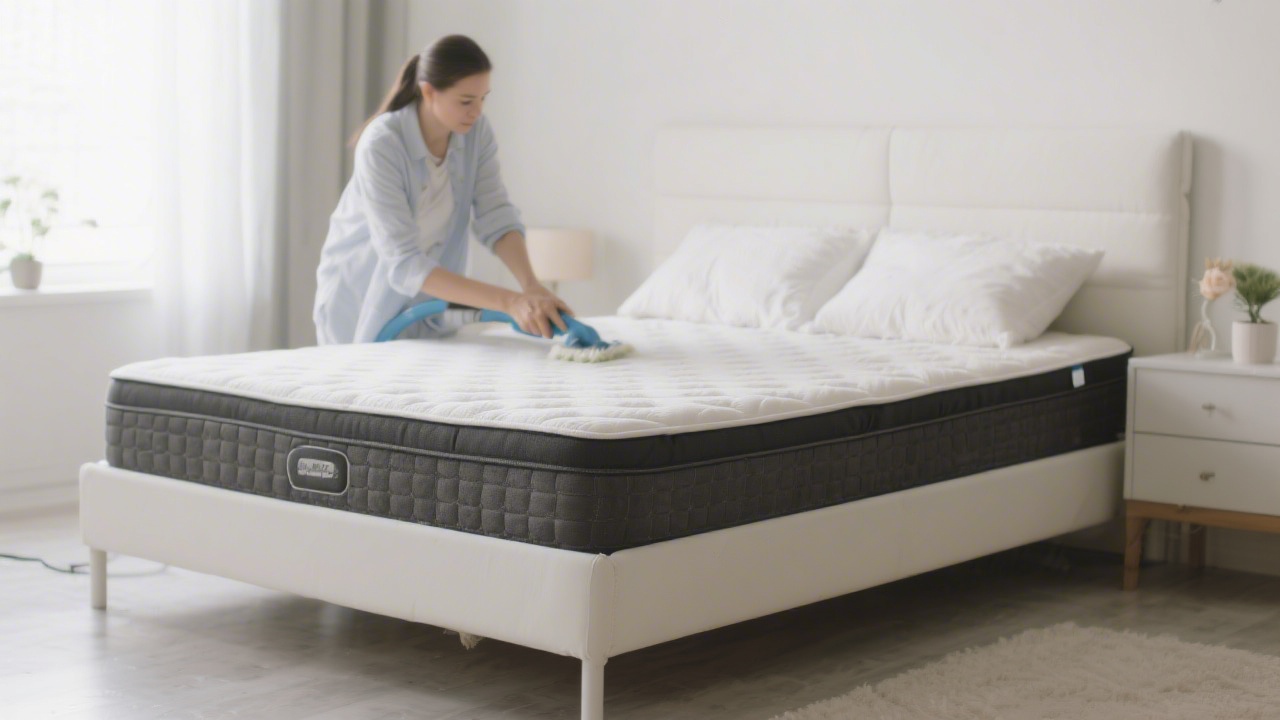
Use an upholstery attachment to vacuum the entire top surface, sides, and if accessible, the bottom. Go slowly - two passes in overlapping directions. Pay particular attention to seams and borders where dust mites concentrate. This step removes the bulk of dry debris before any wet treatment.
Step 3: Spot Treat Stains
Identify stain types before treating - different stains need different approaches:
- Urine/biological: Enzyme cleaner (see our full urine removal guide)
- Blood: Cold water only - never hot. Mix cold water with a small amount of dish soap. Blot, never rub.
- Sweat/yellowing: Hydrogen peroxide + baking soda + dish soap mixture. Apply, let sit 15 minutes, blot dry.
- Coffee/wine/food: Diluted dish soap in cold water. Blot from the outside of the stain inward to prevent spreading.
Golden rule: always blot - never rub. Rubbing spreads the stain and drives it deeper into foam layers.
Step 4: Deodorize with Baking Soda
- Once all wet stains are treated and the surface is dry (or after light vacuuming), sprinkle a generous, even layer of baking soda across the entire mattress surface.
- Work it lightly into the fabric with a soft brush.
- Leave for a minimum of 30 minutes - 8 hours is ideal, overnight is best.
- The baking soda absorbs odors, moisture, and neutralizes acids left by sweat and body oils.
- Vacuum up thoroughly. Every grain of baking soda removed = absorbed odor gone.
Step 5: Air Dry Completely
This is the most critical step people skip. Never put bedding back on a damp mattress. Use a fan, open windows, or a portable dehumidifier. If possible, let the mattress air out for at least 4-6 hours. Trapped moisture leads to mold and mildew - which is far harder to eliminate than any stain.
Memory Foam: Special Instructions
Saatva Classic
Saatva's #1 bestseller · Euro pillow top · 3 firmness · 365-night trial · Lifetime warranty. Saatva is one of the few mattress brands to pair a multi-hundred-night home trial with a lifetime-scale warranty.
- Price: From $1,174 (Twin)
- Free white-glove delivery & old-mattress removal (US)
- 365-night home trial on mattresses
- ID.me discount for military, veterans, first responders, teachers, seniors
- GREENGUARD Gold certified construction
Disclosure: we may earn a commission from this link at no extra cost to you.
Memory foam requires extra care. It cannot be soaked - the dense foam structure takes days to dry internally, promoting mold growth. Use minimal liquid. Never put memory foam in a washing machine. Spot treat only with lightly dampened cloths. Use a fan for faster drying. Steam cleaning is possible on the lowest setting with continuous movement - never hold the nozzle in one place.
Hybrid Mattress Cleaning
Hybrids combine innerspring coils with foam layers. The same low-moisture approach applies to the foam comfort layers. The coil system is not affected by moisture but can rust in extreme cases. Keep cleaning limited to the surface layers and ensure full drying before reassembling.
Latex Mattress Cleaning
Natural latex is naturally antimicrobial and resistant to dust mites - a significant advantage. However, latex degrades in UV light and can be damaged by harsh chemicals. Clean with mild soap and cold water only. Never use hydrogen peroxide or bleach on latex. Allow full air drying away from direct sunlight.
What Never to Do
- Never use hot water - sets protein stains permanently.
- Never soak memory foam or latex - internal moisture causes mold.
- Never use bleach - damages fabric and materials.
- Never machine wash the mattress cover unless it's explicitly labeled removable and washable.
- Never put bedding back on a damp mattress.
Protect It: The Last Step That Actually Works
Mattress care & maintenance FAQ
If replacement is overdue
Saatva Classic, from $2,229 queen
If cleaning isn't fixing the problem, a 15-20 year lifespan hybrid is the long-term answer. 365-night home trial, lifetime warranty, free white-glove delivery + free old-mattress removal.
How often should you actually clean a mattress?
Every 3 months: vacuum the surface with an upholstery attachment. Every 6 months: deep clean (baking soda + vacuum). Every 12 months: rotate the mattress (180° if flippable, or head-to-foot if not).
What's the fastest way to remove urine/stains from a mattress?
Blot with cold water + mild dish soap, then apply white vinegar to neutralize odor. Avoid hot water (sets proteins) and bleach (damages fabric/foam). Baking soda for 6-12 hours after drying pulls residual moisture and smell.
When is it actually time to replace a mattress?
Signals: visible permanent indentation > 1.5", waking up with pain/stiffness that fades during the day, noticeable age-related smell, age beyond 8-10 years for most hybrid/foam mattresses. If a new topper doesn't solve it, it's a mattress problem. The Saatva Classic runs a 15-20 year expected lifespan, double most foam-only mattresses.
Can you vacuum a mattress with a regular vacuum?
Yes, upholstery attachment, slow passes, no beater bar. Start at the seams (where dust mites concentrate) and work the full surface. 10-15 minutes for a queen.
Why does a mattress smell musty?
Usually moisture trapped under the mattress from the floor or an unventilated frame. Fix: sprinkle baking soda, vacuum after 6-12 hours, then add a breathable mattress protector. If the smell returns, the frame/floor is still trapping moisture, add a slatted base or risers.
Saatva Mattress Pad - Waterproof Protection
A quality mattress protector is the single most effective maintenance investment. Waterproof barrier + breathable cotton surface. Keeps dust mites, spills, sweat, and allergens from ever reaching your mattress. Fits up to 18" depth.
Frequently Asked Questions
Can I use a carpet cleaner or steam machine on my mattress?
A handheld steam cleaner on low heat is acceptable for most mattress types. Avoid carpet cleaning machines that inject and extract water - they soak the mattress far too deeply, especially memory foam. If you use steam, keep the nozzle moving constantly and allow 12-24 hours to dry before use.
How do I get yellow stains out of a white mattress?
Yellow stains are typically from sweat and body oils. Mix 8 oz hydrogen peroxide with 3 tablespoons baking soda and a few drops of dish soap. Apply to the stained area, leave for 15-20 minutes while it fizzes, then blot dry. For stubborn yellowing, repeat 2-3 times. Complete drying is essential before remaking the bed.
How long does a mattress take to dry after cleaning?
Minimum 4-6 hours with good air circulation (fan + open window). Memory foam can take 12-24 hours to dry completely. Never rush this - put a dry towel on top and press firmly to check for residual moisture before replacing bedding.
Will cleaning my mattress void the warranty?
Gentle cleaning per manufacturer guidelines does not void warranties. What voids most warranties is soaking, liquid damage that reaches the core, or using harsh chemicals like bleach. A mattress protector prevents any liquid from reaching the warranty-sensitive materials.
How do I know if my mattress has mold?
Black, green, or white spots on the surface or underside. A musty, earthy smell that persists after cleaning. If you find mold, the mattress is usually unrecoverable and should be replaced - mold penetrates foam and cannot be safely extracted. Prevention through a mattress protector and proper drying is critical.
Related guides: How to Get Pee Out of a Mattress • When to Replace a Mattress • Saatva Classic Review 2026