
 by
by Buying the wrong mattress size because of a measuring mistake is one of the most common and preventable furniture purchase errors. This guide covers the full measurement process — room, clearances, furniture, and delivery path — before you commit.
Quick pick: If you already know your size, the Saatva is our top recommendation — available in all standard sizes with white-glove delivery.
What You Need
- 25-foot tape measure (never use laser-only for this)
- Graph paper or a free room planner app
- Pencil and notepad
- Optional: blue painter's tape to mark mattress footprint on the floor
Step 1: Measure the Room Dimensions
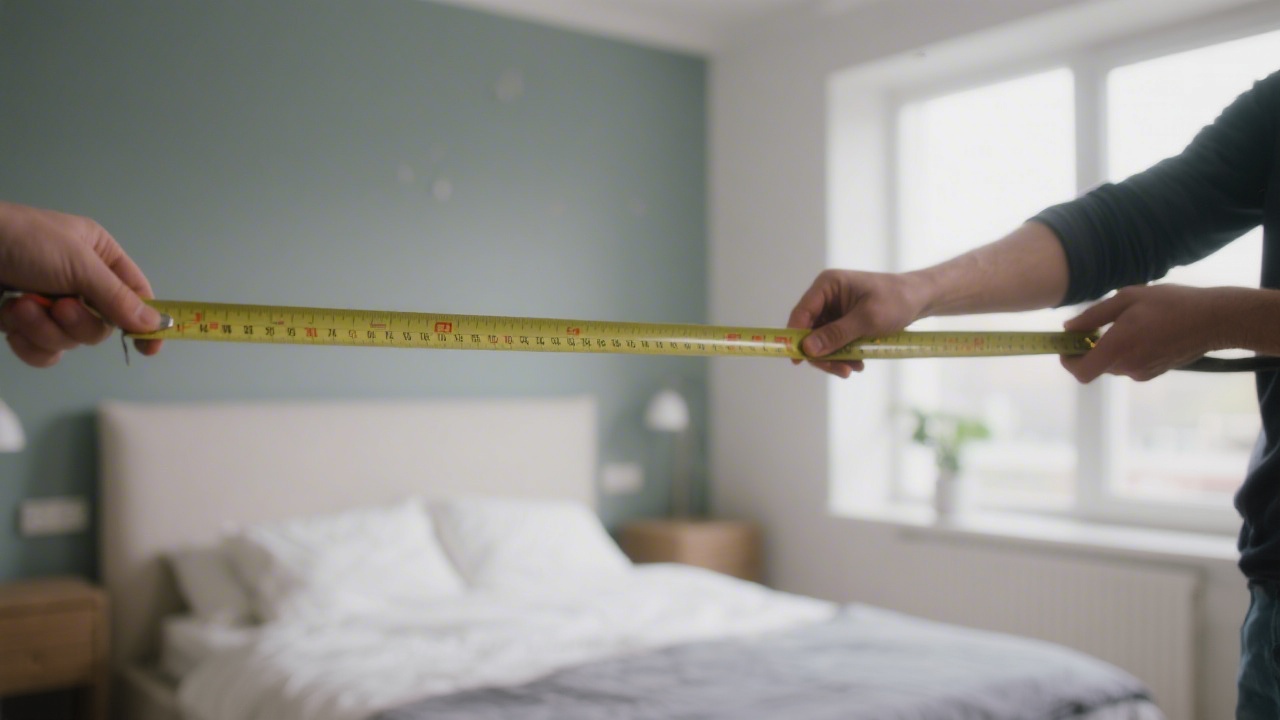
Measure the room at floor level. Measure wall-to-wall on both the length and width. Write both measurements down. Then measure the room a second time from a different starting point to confirm — rooms in older homes frequently have out-of-square walls that make one dimension read differently depending on where you measure.
Note any alcoves, closet door swings, or radiators that reduce usable floor space.
Step 2: Identify Fixed Obstacles
Mark the location and swing direction of every door and window. Doors require clearance equal to their width plus 12 inches of swing arc. Windows close to the floor affect where a headboard can sit (typically a window should clear the headboard by at least 6–12 inches above the headboard top).
Locate electrical outlets — placing a bed directly over a floor outlet creates safety hazards. HVAC vents in the floor or wall affect where the bed can sit without blocking airflow.
Step 3: Subtract Furniture Footprints
List every piece of furniture staying in the room. Standard dimensions to work with:
| Furniture | Typical Footprint |
|---|---|
| Nightstand (small) | 18×16 in |
| Nightstand (standard) | 24×18 in |
| 3-drawer dresser | 36×18 in |
| 6-drawer dresser | 60×18 in |
| Armoire | 48–60×24 in |
| TV stand | 48–60×18 in |
Step 4: Apply Clearance Rules
Using your room dimensions and furniture footprints, subtract clearances. Use these as minimums:
- 24 inches on each walkable bed side
- 24 inches between bed foot and any furniture or wall
- 36 inches in front of any dresser or closet with swinging doors
- 18 inches minimum main traffic path
What remains in the center of the room after subtracting walls, clearances, and furniture footprints is the maximum mattress footprint that fits comfortably. See the furniture spacing guide for the full clearance table.
Step 5: Use Painter's Tape to Visualize
Before ordering anything, tape the mattress footprint on the floor using blue painter's tape. Live with it for 24–48 hours. Walk around it in the morning when you're groggy. Make sure the clearances feel adequate, not just mathematically sufficient.
Step 6: Measure the Delivery Path
A mattress in a box can navigate any standard doorway. But bed frames, box springs, and headboards often cannot. Measure:
- Front door width (standard 32–36 inches)
- Any hallway width (critical — 36 inches minimum for most furniture)
- Staircase width and any turn radius at landings
- Bedroom doorway width
For tight stairwells, note the ceiling height at the lowest point of the staircase — tall headboards or mattress-in-box frames may not clear the corner. If you're ordering a Saatva or similar white-glove delivery, call ahead with hallway dimensions — their delivery teams are trained on tight-entry workarounds but need to know in advance.
Common Measurement Mistakes
- Measuring the mattress size instead of the frame size (frames add 3–6 inches to each dimension)
- Forgetting door swing arcs
- Not measuring the hallway corner radius for large frames
- Measuring in inches then ordering in feet (or vice versa)
- Assuming the room is a perfect rectangle without checking corners
Our Pick: Saatva Classic
If your measurements confirm a queen, king, or California king fits comfortably, the Saatva Classic is available in all standard sizes with white-glove delivery that includes in-room positioning. View Saatva Classic →
Related Guides
- Queen vs king room size chart
- Standard bedroom clearance measurements
- California king room requirements
- Twin bed minimum room size
Frequently Asked Questions
How do I measure a room for a mattress?
Measure wall-to-wall length and width at floor level. Subtract door swing arcs and window positions, then subtract furniture footprints. Apply minimum clearances (24 inches on walkable sides, 36 inches in front of dressers). What remains is your maximum mattress footprint.
Does mattress size include the frame?
No. Mattress size refers to the sleeping surface only. Bed frames typically add 3–4 inches to width and 3–6 inches to length. Always measure the full frame footprint when planning clearances.
How wide does a hallway need to be to move a mattress?
A mattress-in-a-box can navigate any hallway wider than 30 inches. Traditional mattresses need at least 36 inches and can usually be tilted vertically to get around corners.
What is the best way to visualize a bed size in a room?
Use blue painter's tape to mark the mattress footprint on the floor. Walk around it at different times of day, especially morning. This physical test catches clearance problems that diagrams miss.
Should I measure in inches or feet?
Measure rooms in inches, not feet, to avoid conversion errors. A 10-foot room is 120 inches — keeping everything in inches prevents the common mistake of confusing 10'6" with 10.6 feet.