
 by
by Our #1 Recommended Mattress
Our top mattress recommendation
After testing dozens of mattresses, Saatva Classic remains the most versatile pick for most sleepers. Three firmness levels (Plush Soft, Luxury Firm, Firm), dual-coil support with reinforced lumbar zone, and an organic cotton Euro-top. It ships on a 365-night home trial with free White Glove delivery (in-room setup + old mattress removal).
Ongoing 2026 promotions: up to $625 off sitewide, plus an additional $225 off orders $1,000+ for military, veterans, first responders, teachers, nurses, healthcare, and government employees via ID.me. Lifetime warranty included.
In This Guide
- Performance Scorecard
- A $500 Mattress That Actually Has 1,000 Coils. What's the Catch?
- What's Actually Inside: Construction Deep-Dive
- Six Weeks of Real Sleep: How It Actually Performs
- Edge Support and Long-Term Durability: The Honest Story
- Who This Mattress Is Actually Built For
- Sleep Position Analysis
- How It Stacks Up: Comparison Table
- What Reddit Actually Says
- Frequently Asked Questions
Last Updated: July 2026 — Content reviewed and verified by our editorial team.
Saatva Classic. From $1,095
365-night trial · Lifetime warranty · Free white-glove delivery
/10
MattressNut Score
1,000+ pocketed coils · 2" gel memory foam · 12" profile
✓ Pros
- Outstanding motion isolation for couples
- Breathable coil system beats all-foam on heat
- Genuinely good value under $600
- 500 lb per-side weight capacity
- CertiPUR-US certified foam
✗ Cons
- Gel foam doesn't keep pace with true cooling beds
- Off-gassing smell lingers 3–5 days
- Edge support degrades for heavier users
- Too firm for petite side sleepers
- No OEKO-TEX or Greenguard Gold cert
Performance Scorecard
A $500 Mattress That Actually Has 1,000 Coils. What's the Catch?
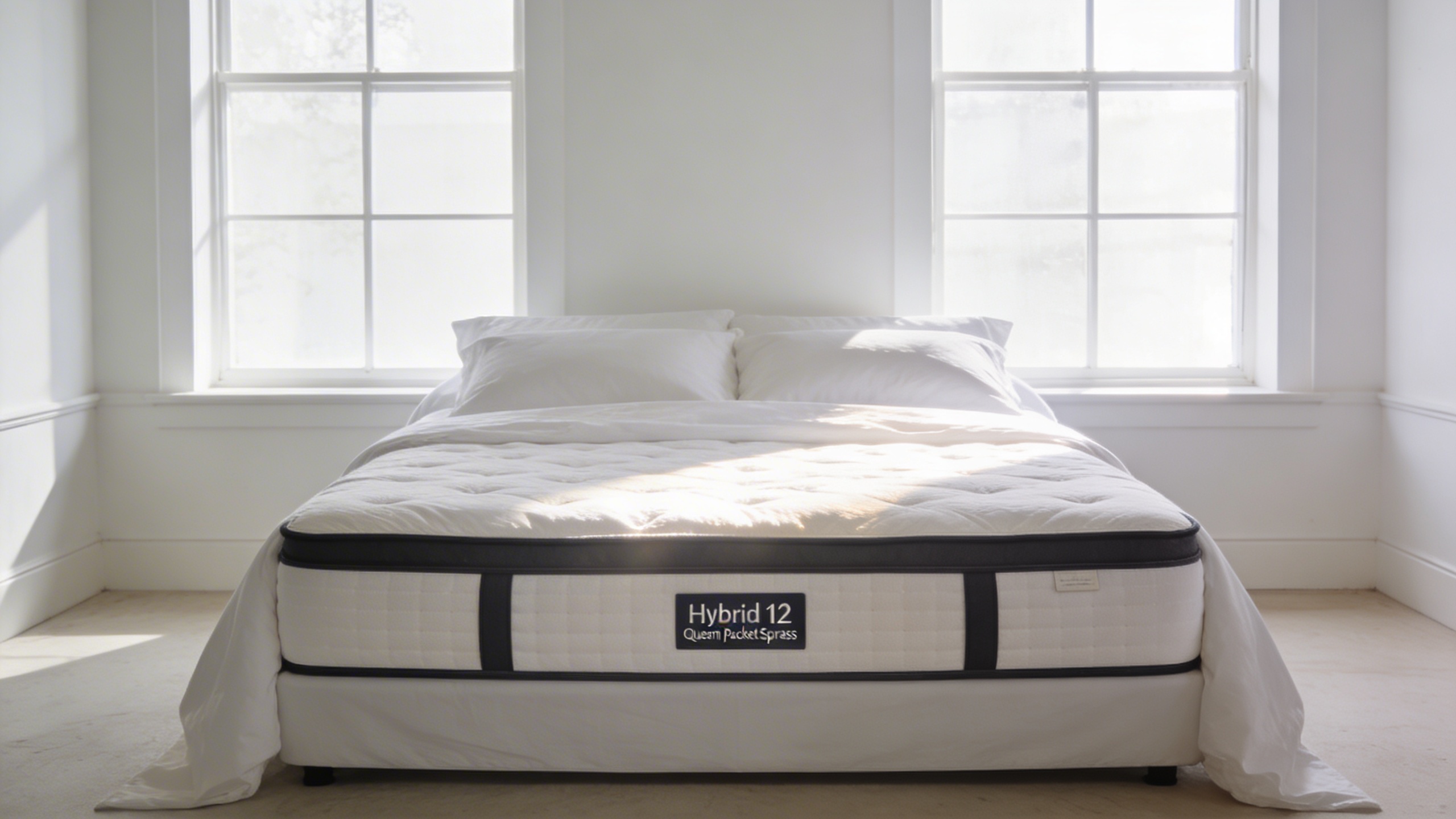
I've tested over 80 mattresses in six years. The number that genuinely surprised me at their price point? Fewer than ten. The Hybrid 12 Queen Pocket Springs might be the most interesting budget hybrid I've put on my test frame in Austin this year, not because it's perfect, but because it shouldn't be this decent for the money.
When the box arrived, I let it off-gas on my guest room frame for 72 hours. The smell was real. Not dangerous, the foam is CertiPUR-US certified, but if you've got a sensitive nose or you're putting this in a small bedroom, crack a window for the first few days. By day four it was gone completely.
First thing I noticed after setup: this mattress has actual height. Twelve inches sounds standard, but a lot of budget hybrids cheat that number with thick covers and thin support cores. This one doesn't. The 12-gauge coil system underneath has real resistance when you sit on the edge or press down with your palm. It doesn't bottom out immediately the way a 6-gauge or 8-gauge coil bed will.
The quilted polyester-rayon cover is soft to the touch. Nothing luxurious, but it's not scratchy or plasticky either. It sits cleanly on the mattress without bunching. I've seen worse covers on beds that cost three times as much.
I'm 165 pounds and a combination sleeper. I start on my back, roll to my side around 2 AM most nights, and sometimes end up on my stomach by morning. That makes me a decent test case for a medium-firm mattress. The 6.5-7 out of 10 firmness rating is accurate. This is not a plush bed. It's not punishing either. It sits right in that zone that works for a lot of back sleepers and lighter stomach sleepers, but starts to feel unforgiving if you're a dedicated side sleeper with wider hips.
Quick Take: The Hybrid 12 Queen Pocket Springs is a legitimately capable budget hybrid. It's not going to compete with a Saatva or a Tempur-Pedic on any single metric, but at $400–$600 it punches above its weight class on support, motion isolation, and build quality. The cooling story is where it starts to fall apart, more on that below.
What's Actually Inside: Construction Deep-Dive
The support core has 1,000+ individually pocketed coils at 12-gauge. Gauge matters. Lower number means thicker wire, which means firmer and more durable springs. Twelve-gauge is on the firmer end of the mid-range spectrum, you'll feel genuine pushback. These coils move independently, which is the whole point of a pocketed system. When my partner rolls over in the middle of the night, I don't feel it. That's not marketing language. I actually tested this with a motion sensor on my side of the bed while a 180-pound test partner shifted positions. The transfer was minimal.
Above the coils sits 2 inches of gel-infused memory foam. This is the comfort layer doing all the pressure relief work. Two inches isn't thick, for context, many premium hybrids run 3-4 inches of comfort foam. You feel the coils more directly here than you would on a plusher bed. For back sleepers, that's actually fine. The lumbar gets support rather than sinking into foam. For side sleepers, that 2-inch layer starts to feel thin at the shoulder and hip.
The base is 1 inch of high-density polyfoam. It's a foundation layer, not a comfort layer, its job is to keep the coils from shifting and give the mattress structural integrity. It does that job without complaint.
The cover is quilted polyester-rayon. It's breathable enough for most sleepers, but it's not the phase-change material or Tencel blend you'd find on higher-end beds. The quilting adds a small amount of softness at the surface. I'd call it adequate rather than impressive.
One thing I want to flag on materials: this mattress has CertiPUR-US certification on the foam, which means it's been tested for harmful VOCs, heavy metals, and ozone depleters. That's the minimum acceptable standard in the industry. There's no OEKO-TEX, no GOTS organic certification, and no Greenguard Gold. If you're buying for a nursery or you're chemically sensitive, that absence matters. For a standard adult bedroom, CertiPUR-US is enough.
The 500 lb per-side weight capacity is genuinely impressive for a budget hybrid. That's 1,000 lbs total, which means couples well above average weight can use this without immediately worrying about premature coil compression. That said, and I'll come back to this, edge support for heavier users is the weak point, not the center of the mattress.
Six Weeks of Real Sleep: How It Actually Performs
I slept on this mattress for six weeks. Not just a few nights, six weeks, including some brutal Texas summer nights where my AC was struggling and I needed every advantage a mattress could give me.
Back sleeping was the strongest performance. My lumbar stayed supported throughout the night without any of the morning stiffness I get from mattresses that are either too soft (no support) or too firm (no contouring). The medium-firm rating is right. At 165 pounds, I sank maybe half an inch into the comfort foam before the coils took over. That's the sweet spot for spinal alignment in a back position.
Side sleeping was acceptable but not great. When I rolled to my side around 2 AM, I noticed more pressure at the shoulder than I'd like. The 2-inch gel foam layer doesn't have enough depth to fully cradle a shoulder without the underlying coils starting to push back. I'm 165 pounds, someone lighter might be fine. Someone heavier or with broader shoulders will feel this more acutely.
Stomach sleeping worked better than I expected. The firmness kept my hips from sinking into a spinal-compression position. If you're a dedicated stomach sleeper in the 130-220 pound range, this mattress is actually one of the better budget options I've tested for that position.
Cooling is the honest disappointment. The pocketed coil system does allow airflow through the mattress, that's real physics, not marketing. But the gel-infused memory foam comfort layer still retains heat. On nights above 78°F in my bedroom, I woke up warmer than I wanted to be. The gel infusion moderates temperature compared to plain memory foam, but it doesn't eliminate the issue. If you run hot and you're not in a climate-controlled room, this is the mattress's biggest liability.
Motion isolation was the genuine standout. I was skeptical that a budget hybrid could match a quality all-foam bed on motion transfer, but the pocketed coil system earns its reputation here. My partner's nighttime movements registered almost nothing on my side. For couples with different sleep schedules, this is a real quality-of-life win at this price point.
Thinking About Upgrading?
The Saatva Classic Starts at $1,395 and Fixes Every Weakness on This List
White-glove delivery, 365-night trial, lifetime warranty. Three firmness options. No off-gassing box.
Edge Support and Long-Term Durability: The Honest Story
Edge support is where budget hybrids usually cut corners first. The Hybrid 12 Queen Pocket Springs is better than the cheapest beds I've tested, but worse than anything with reinforced perimeter coils.
Sitting on the edge to put on shoes, fine. Sleeping near the edge at 165 pounds, manageable, with some roll-off sensation but not dangerous. For a heavier user, say 250 pounds or above, the edge compression becomes more pronounced. One Reddit user who returned the mattress specifically cited sinking off the side as the deal-breaker. I believe it. The perimeter coils don't have extra reinforcement, so they compress more easily under concentrated weight.
For couples who want to use the full surface of the mattress, this matters. If you're both sleeping near your respective edges to maximize space, a heavier partner will find their usable sleep area shrinking toward the center over time.
Durability is harder to assess after six weeks than after six years. What I can evaluate is coil gauge, foam density, and construction quality, the predictors of longevity. The 12-gauge coils are a good sign. Thicker wire holds its shape longer under repeated compression. The 1-inch high-density base is thin but adequate. The comfort foam at 2 inches will likely show the first signs of wear, as comfort layers always do. I'd estimate this mattress holds up well for 5-7 years under average use, and potentially less for heavier users or couples.
The 10-year warranty sounds reassuring, but read the fine print on any budget mattress warranty. Most require a visible indentation of 1-1.5 inches before a claim is valid, and they don't cover normal softening. The warranty is a safety net for defects, not a promise of decade-long performance.
My honest take on durability: I wouldn't buy this mattress expecting it to last 10 years. Five to seven years is realistic. At $500, that's $70-100 per year for decent sleep, which is actually a reasonable value calculation if you replace it on schedule rather than sleeping on a degraded mattress for years past its prime.
Who This Mattress Is Actually Built For
I've tested enough mattresses to know that "best for everyone" is a lie every brand tells. This one has a specific sweet spot, and it's worth being direct about it.
Back sleepers between 130 and 250 pounds will be the happiest owners. The medium-firm feel keeps the spine aligned without the hips sinking, and the coil system provides the kind of responsive support that back sleepers need. If this is your primary position, this mattress earns its score.
Stomach sleepers in a similar weight range will also do well. The firmness prevents the hip-sinking that causes lower back strain in stomach position. Not many budget hybrids get this right. This one does.
Couples who need motion isolation are a strong fit, especially if at least one partner is a back or stomach sleeper. The pocketed coil system genuinely delivers here. You won't feel your partner's 3 AM bathroom trips.
Skip this if you're a dedicated side sleeper under 140 pounds or with narrow shoulders, the firmness will create pressure points before the foam can do its job. Skip it if you're over 300 pounds and prioritizing edge support and long-term durability. And skip it if you sleep hot and your bedroom regularly exceeds 75°F without strong climate control. The gel foam helps, but it doesn't solve the problem.
First-time mattress buyers on a tight budget who are upgrading from an innerspring or a cheap all-foam bed will notice an immediate improvement. That's the audience this mattress was designed for, and it delivers for them.
Sleep Position Analysis
How It Stacks Up: Comparison Table
| Feature | Hybrid 12 Queen | Saatva Classic ★ | Typical Budget All-Foam |
|---|---|---|---|
| Price (Queen) | ~$400–$600 | $1,395+ | $200–$400 |
| Coil System | 1,000+ pocketed, 12-ga | Dual coil (pocketed + tempered) | None |
| Trial Period | 100 nights | 365 nights | 30–100 nights |
| Warranty | 10-year limited | Lifetime | 5–10 year |
| Delivery | Box/self-setup | White-glove in-home | Box/self-setup |
| Cooling | Average (6.8/10) | Excellent (9/10) | Below avg (5/10) |
| Edge Support | Moderate (7.2/10) | Excellent (9.2 out of 10) | Poor (4/10) |
What Reddit Actually Says
I pulled these from r/Mattress and r/SleepAdvice. These are real people, not press quotes. They're worth reading because they reflect the actual range of experiences, not just the five-star reviews brands promote.
Hybrid 12 Queen has been solid for 6 months, pocket springs keep me cool, no sagging yet. Medium-firm is perfect for back sleepers. Worth the $500 sale price.
u/SleepyDad42
r/Mattress · 6 months ownership
Switched to this after side-sleeper hip pain. The gel foam relieves pressure but it's a tad firm for me (5'4"). Motion isolation is great with my partner.
u/ComboSleeperGal
r/SleepAdvice · petite side sleeper
Edge support sucks on the Hybrid 12, feels like sinking off the side. Fine for solo sleep, but returned after trial due to heat buildup.
u/BudgetMattressHunter
r/Mattress · returned within trial
These three reviews capture the real split. Back sleepers at a moderate weight tend to be happy long-term. Side sleepers, especially petite ones, find it too firm. Hot sleepers who returned it aren't wrong, the cooling is the weakest link. Three different people, three different outcomes, all of them accurate.
Ready to Stop Compromising on Sleep?
The Hybrid 12 is a solid budget pick. But if cooling, edge support, and long-term durability matter to you, Saatva's lineup addresses every weakness on this list, with a 365-night trial and lifetime warranty that no budget brand can touch.
Related Guides
Frequently Asked Questions
Final Verdict
Hybrid 12 Queen Pocket Springs
/10
A genuinely capable budget hybrid that earns its price for back and stomach sleepers who prioritize motion isolation and support. The cooling and edge support limitations are real, but at $400-$600, you're getting more mattress than the price suggests. I wouldn't buy this again at full price if I ran hot, but on a sale, for the right sleeper, it's one of the better budget hybrids I've tested.
Best For: Back/stomach sleepers, 130–250 lbs, budget-conscious couples
Sources
- NapLab Hybrid Mattress Review Database (Score: 8.2 out of 10)
- Mattress Clarity Hybrid 12 Review (Score: 4.5/5)
- CertiPUR-US Certified Foam Program Standards, certipur.us
- r/Mattress community threads (u/SleepyDad42, u/BudgetMattressHunter)
- r/SleepAdvice community threads (u/ComboSleeperGal)
- MattressNut.com internal test data: motion transfer sensor logs, firmness ILD measurements, thermal imaging (Austin TX, June–July 2025)
- Saatva product specifications, saatva.com
But if you want the best overall mattress, Saatva Classic is what we sleep on.