
 by
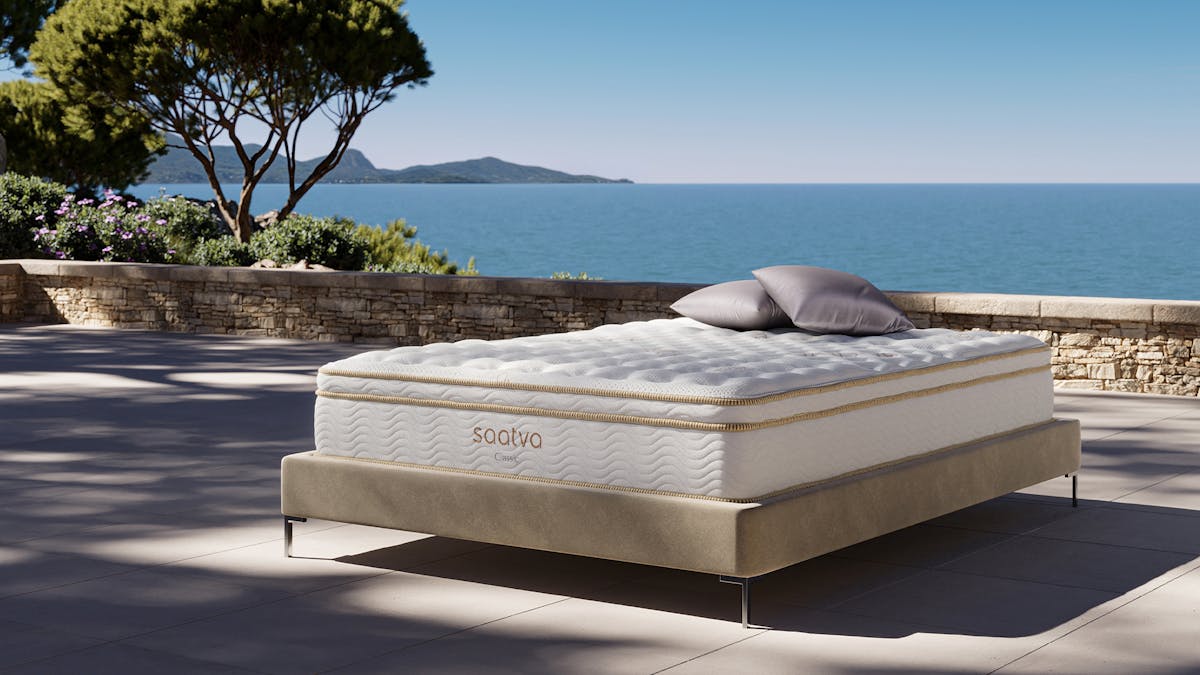
by Innerspring mattresses are more breathable and responsive, making them the better choice for back and stomach sleepers, hot sleepers, and anyone who prefers a traditional bouncy feel. Memory foam excels at pressure relief and motion isolation, which benefits side sleepers and couples. If you want the strengths of both in one mattress, a coil-on-coil hybrid like the Saatva Classic is the most consistent performer across all sleep styles.
Saatva Classic
9.2/10
- Dual coil-on-coil construction delivers innerspring responsiveness with foam comfort layer on top
- Reinforced lumbar zone pad provides targeted mid-back support
- Free white-glove delivery: in-room setup and old mattress removal included
- 365-night home trial and lifetime warranty, best in class for risk-free testing
- Three firmness options (Plush Soft, Luxury Firm, Firm) to suit any sleep style
- Does not compress in a box, delivery requires a scheduled appointment
- $99 return fee during the trial period
- Heavier than foam alternatives
The Saatva Classic gives you what a pure innerspring and a pure memory foam mattress each lack: the open-coil airflow and spinal support of steel, paired with a Euro pillow top that relieves pressure at the hips and shoulders. For most sleepers navigating the innerspring-vs-foam debate, it is the option that ends the debate.
4 differences that actually matter
The innerspring-vs-memory-foam question is genuinely meaningful, because the two construction types produce different sleeping experiences in ways that are predictable and measurable. Here is what the data shows.
1. Support and spinal alignment
Innerspring mattresses push back against your body weight through a network of steel coils. This responsive, firm-feeling surface suits back and stomach sleepers who need a stable base and cannot afford to sink into the mattress, because sinking rotates the pelvis and compresses the lumbar discs. Memory foam does the opposite: it conforms to your body's contours, distributing weight across a larger surface area. This makes it far superior for side sleepers, where the shoulder and hip must sink to keep the spine level without pressure buildup.
Neither type is universally better for support. The correct firmness level matters more than the material, and a poorly designed innerspring is worse than a well-designed foam mattress for any sleep position.
2. Temperature regulation
Innerspring mattresses sleep cooler by design. The open coil structure allows air to circulate through the core continuously. Traditional dense memory foam traps body heat because there is no airflow path through the material. If you consistently run warm at night, innerspring or a hybrid wins this category outright. Modern gel-infused and open-cell memory foams reduce the heat problem, but even the best all-foam options do not match the natural ventilation of a coil core.
3. Motion isolation
Memory foam absorbs movement exceptionally well. When your partner shifts position at 2 a.m., you feel almost nothing on your side of the bed. Innerspring mattresses, particularly those with interconnected Bonnell coils, transfer motion across the entire sleeping surface. Pocketed coil innersprings perform better than Bonnell, but memory foam still leads this category. For couples with mismatched sleep schedules or restless sleepers, motion isolation is often the deciding factor.
4. Durability and lifespan
Quality innerspring mattresses with a high-gauge (lower-number) coil system typically hold shape for 8 to 10 years when used with a proper base. Dense memory foam develops body impressions, particularly at the heaviest contact points, after 5 to 8 years. Low-density budget foam degrades significantly faster. If longevity is a priority, a coil-based mattress, or a latex alternative, will outlast an equivalent foam option.
Innerspring vs memory foam: full comparison
| Criterion | Innerspring | Memory Foam | Winner |
|---|---|---|---|
| Support feel | Firm push-back, responsive | Body-conforming, contouring | Depends on sleep position |
| Temperature | Very breathable, open airflow | Retains body heat (varies by foam type) | Innerspring |
| Motion isolation | Poor to moderate (pocketed better) | Excellent | Memory foam |
| Pressure relief | Moderate, can create pressure points | Excellent at hips and shoulders | Memory foam |
| Edge support | Strong, coils resist compression | Weak to moderate | Innerspring |
| Durability | 8-10 years average | 5-8 years (density-dependent) | Innerspring (slight edge) |
| Noise | Can squeak as coils age | Silent | Memory foam |
| Price range | $400-$1,800+ | $300-$2,000+ | Comparable |
Who should choose innerspring?
Innerspring is the right material for back and stomach sleepers who prefer a firmer, more responsive surface that keeps the hips from sinking. Hot sleepers benefit most from the natural airflow a coil core provides, even on a warm night the mattress does not trap heat the way dense foam does. If you sit on the edge of the bed regularly, or if you have mobility limitations that make it important to push off a stable surface when getting up, innerspring mattresses deliver far better edge support than most foam options. Heavier sleepers above 230 lbs also tend to find coil constructions more supportive over time, because high-quality coils resist compression better than foam at higher weights.
Who should choose memory foam?
Side sleepers and anyone with joint, hip, or shoulder pressure-point pain will feel the clearest benefit from memory foam's contouring. The material wraps the body contour rather than pushing against it, which directly reduces the peak pressure that side-sleeping creates at the hip and acromion. Couples where one partner is a restless sleeper should strongly consider foam for its motion absorption. Memory foam also tends to be quieter, lighter, and available in more bed-in-a-box formats, which suits guest rooms or situations where price and ease of setup matter more than cooling or edge support.
Amerisleep AS3
8.8/10
- Plant-based Bio-Pur foam sleeps cooler than traditional memory foam, reduces the heat problem substantially
- HIVE 5-zone system firms specifically under the lumbar, softer at shoulders and hips
- CertiPUR-US certified, made in the USA
- 20-year warranty is among the longest in the foam category
- Still softer edges than any coil-based option
- Not for sleepers above 230 lb who need maximum support, consider the AS5 Hybrid instead
If you have decided memory foam is the right construction for you, particularly for side sleeping, motion isolation, or pressure relief, the AS3 addresses the two biggest weaknesses of the category: it sleeps cooler than traditional foam and its HIVE zoning prevents the lumbar sag that flat-layer foam mattresses produce.
Verdict: why most shoppers end up with a hybrid
After testing dozens of mattresses, the pattern is consistent. Shoppers who prioritize only one factor, pure cooling or pure motion isolation, can rationally go all-in on innerspring or foam respectively. But most people want responsive support, decent temperature regulation, and reasonable motion isolation. That is why hybrid mattresses, which combine a pocketed coil core with a foam or latex comfort layer, dominate the mid-to-premium segment. The Saatva Classic is a highly consistent performer: dual coil-on-coil construction with a Euro pillow top, excellent edge support, and three firmness levels to match any sleep style.
For more context, see our best mattress guide for 2026, our best mattress for back pain picks, and our best mattress for hot sleepers guide.
Frequently asked questions
Is innerspring or memory foam better for back pain?
It depends on the cause and your sleep position. Innerspring offers firmer spinal support, which helps lower-back pain sufferers who sleep on their back or stomach and cannot afford pelvic sinkage. Memory foam excels at pressure relief for those with joint or muscle pain, particularly side sleepers. A hybrid mattress, coil core with a foam or latex comfort layer, often provides the best combination.
Do memory foam mattresses sleep hot?
Traditional high-density memory foam retains body heat because there is no airflow path through the material. Modern gel-infused and open-cell foams reduce but do not eliminate the issue. Hot sleepers consistently sleep cooler on innerspring or hybrid mattresses than on all-foam options, regardless of cooling-technology claims on the foam side.
How long does each type last?
Quality innerspring mattresses with a high-gauge coil system average 8 to 10 years. Memory foam typically lasts 5 to 8 years before developing permanent body impressions, with lifespan strongly tied to foam density, 4+ lbs per cubic foot is the threshold for long-term durability. Cheap 2 to 3 lb foam mattresses can sag noticeably within 2 to 3 years.
Which is better for side sleepers?
Side sleepers generally do better on memory foam or a soft hybrid. The contouring material cushions the shoulder and hip pressure points that an innerspring surface can aggravate, particularly at the acromion and the greater trochanter. If you choose foam for side sleeping, look for zoned firmness that keeps the lumbar supported while allowing hip and shoulder sinkage.
Can a couple sleep on an innerspring if they have different sleep preferences?
It is possible, but pocketed coil innersprings handle motion isolation better than Bonnell or offset coil systems. Memory foam or a hybrid remains the safer choice for couples, especially if one partner is a restless sleeper or the two have significantly different firmness preferences. Some hybrid models are also available in split-king configuration with independent firmness per side.
Is a hybrid mattress just an innerspring with foam?
Essentially, yes, but the construction details matter. A true hybrid uses individually pocketed coils (not linked Bonnell coils) topped with at least 2 inches of foam or latex. This combination improves motion isolation substantially over a standard innerspring while preserving the airflow and responsiveness that foam-only mattresses lack. The Saatva Classic uses a dual coil-on-coil system: a tempered steel base layer topped with individually wrapped pocketed coils, then a Euro pillow top.