
 by
by Hybrid mattresses win for most sleepers — thicker comfort layers (3 to 5 inches of foam or latex) over individually wrapped pocketed coils deliver better pressure relief, motion isolation, and spinal alignment than a traditional innerspring. Innerspring mattresses hold one real advantage: price and breathability. If budget is the constraint, a quality innerspring can work; otherwise, a hybrid gives you meaningfully better sleep.
Amerisleep AS3
9.2/10
- HIVE 5-zone support system firms under the lumbar and softens at the shoulder
- Plant-based Bio-Pur foam runs cooler than standard memory foam
- CertiPUR-US certified, made in the USA
- 20-year warranty (full replacement years 1 to 10, 50% off years 11 to 20)
- No coil bounce, not suited to sleepers who dislike a foam feel
- Softer edges than a coil hybrid
If you want the pressure relief and motion isolation of a foam mattress without the heat that older memory foams run, the AS3's open-cell Bio-Pur foam and HIVE zoning deliver it at a lower entry price than most quality hybrids. Good for solo side sleepers who determine they do not need coil bounce.
What is a hybrid mattress?
A hybrid mattress combines a coil support base with a comfort system of 3 inches or more of foam or latex on top. The coils are almost always individually wrapped (pocketed), meaning each spring responds independently to movement. This is what makes hybrids better at motion isolation than a traditional innerspring, where the springs are connected and bounce together.
The comfort layers in a quality hybrid typically include memory foam, latex, or gel foam. Some use two or three distinct layers: pressure relief close to the body, a transition layer for support, then the coil base below. The result feels responsive and bouncy like an innerspring, but also conforming like foam.
What is an innerspring mattress?
An innerspring mattress is built almost entirely around a steel coil system, with a thin comfort layer (typically 1 to 2 inches) of foam, cotton, or basic padding on top. Before memory foam became mainstream in the 1990s, this was the dominant mattress design, and budget-focused manufacturers still produce them widely.
Coil type matters. Bonnell coils (hourglass-shaped, connected by a wire frame) are the cheapest and transfer motion readily. Offset coils are quieter and more durable. Continuous coils are a single wire bent into rows. Pocketed coils appear in premium innersprings and many hybrids, and the distinction between a premium innerspring with pocketed coils and a hybrid is mainly the comfort layer thickness.
Hybrid vs innerspring: side-by-side
| Feature | Hybrid | Traditional Innerspring |
|---|---|---|
| Coil type | Individually wrapped (pocketed) | Connected Bonnell, continuous, or offset |
| Comfort layer thickness | 3 to 5 inches (foam or latex) | 1 to 2 inches (basic padding) |
| Pressure relief | Good to excellent | Fair (thin layers limit contouring) |
| Motion isolation | Good (pocketed coils + foam) | Poor (connected coils transfer movement) |
| Spinal alignment | Good to excellent | Fair to good (depends on firmness) |
| Airflow / cooling | Good (coils circulate air) | Very good (thinner foam means more airflow) |
| Edge support | Good (foam encasement + coils) | Varies (better on quality models) |
| Durability | 7 to 10 years | 5 to 8 years |
| Price range (Queen) | $500 to $3,000+ | $200 to $1,200 |
| Best for | Couples, side sleepers, combo sleepers | Budget buyers, back/stomach sleepers, hot sleepers |
Where hybrids clearly win
Pressure relief. Side sleepers feel this most. The shoulder and hip contact points need 3 or more inches of foam to fully decompress. An innerspring with a 1-inch pad puts more direct pressure on those points, which shows up as numbness or soreness by morning. Hybrids close this gap entirely.
Motion isolation. Pocketed coils in a hybrid compress individually, so your partner's movement on one side of the bed barely registers on the other. Traditional innerspring coils are mechanically connected, so a move on one side transmits energy across the whole surface. For couples who wake each other up, this alone is worth the price difference.
Durability. The thick comfort layers in a hybrid slow the rate at which you feel the coils beneath. Innersprings with thin padding tend to feel noticeably stiffer and more worn after three to four years as the padding compresses. A well-made hybrid typically holds its feel for two to three years longer.
Where innersprings hold their own
Cooling. Less foam on top means more direct airflow through the coil system. An innerspring with a thin cotton or polyester pad runs cooler than most hybrids. If you run very hot on a tight budget, a quality innerspring can outperform a basic hybrid in this respect. Quality hybrids with gel foam and latex address the heat issue well.
Price. A solid innerspring queen can be found for $400 to $700. Entry-level hybrids start around $500 to $700, but quality hybrids with real pocketed coils and thick comfort layers tend to run $900 to $1,500 or more. For a guest room or a short-term purchase, an innerspring makes financial sense.
Feel preference. Some back and stomach sleepers genuinely prefer the firm, direct-response feel of a traditional innerspring. The thin comfort layer keeps hips from sinking too deep, which is actually correct alignment for stomach sleepers.
Who should choose which
Choose a hybrid if you share the bed with a partner, sleep on your side or switch positions through the night, have shoulder or hip pressure points, or plan to use this mattress for 7 or more years. The investment pays for itself in comfort and longevity.
Choose an innerspring if you sleep alone, run hot and want maximum airflow, prefer a very firm surface for back or stomach sleeping, or need to keep the purchase under $600. A quality mattress pad or topper can extend the comfort life meaningfully.
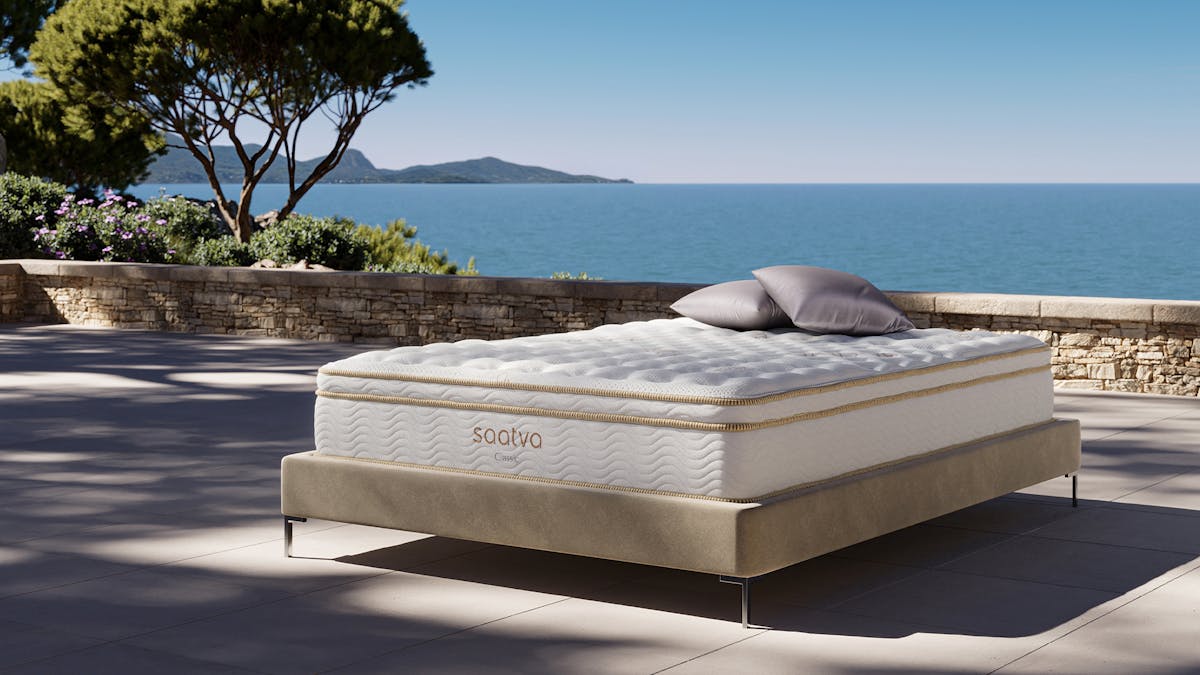
The Saatva Classic sits between both categories by design. Its dual-coil construction gives it the responsive, airy feel of an innerspring, while the Euro pillow-top and reinforced lumbar zone deliver the contouring and support of a hybrid. It is the strongest single pick for sleepers who want an innerspring feel without the pressure-relief shortfall.
Saatva Classic
8.9/10
- Dual-coil construction: individually wrapped comfort coils over a tempered steel support coil base
- Reinforced lumbar zone pad for spinal support
- Organic cotton Euro pillow-top for pressure relief without deep foam sinkage
- Free White Glove delivery: in-room setup and old mattress removal
- 365-night home trial and lifetime warranty
- Heavy and ships flat, not roll-packed in a box
- $99 return processing fee during the trial
- Higher starting price than budget innersprings
The Saatva Classic is essentially the answer to the hybrid vs. innerspring debate: it takes the responsive feel and airflow of an innerspring and adds pocketed comfort coils plus a Euro pillow-top to deliver pressure relief and motion isolation that a basic innerspring cannot match. Three firmness options (Plush Soft, Luxury Firm, Firm) cover every sleep position.
Frequently asked questions
Is a hybrid mattress better than an innerspring?
For most sleepers, yes. Hybrids deliver better pressure relief, motion isolation, and longevity. The main exceptions are hot sleepers on a tight budget or back/stomach sleepers who actively prefer a very firm surface with minimal foam.
What is the main difference between hybrid and innerspring?
Comfort layer thickness. An innerspring has 1 to 2 inches of basic padding over its coils. A hybrid has 3 to 5 inches of foam or latex. The coil type also differs: hybrids almost always use individually pocketed coils for better motion isolation, while traditional innersprings use connected Bonnell or continuous coils.
Do hybrid mattresses sleep cooler than innersprings?
Traditional innersprings with thin foam tops allow more direct airflow and can run cooler than budget hybrids with dense foam layers. Quality hybrids close this gap with gel-infused foam, open-cell foam, or latex comfort layers. The Saatva Classic's dual-coil construction and cotton Euro-top keep it cooler than most all-foam hybrids.
How long does a hybrid mattress last compared to an innerspring?
A well-made hybrid typically lasts 8 to 10 years before meaningful comfort degradation. A traditional innerspring usually shows wear at 5 to 8 years, earlier if the comfort padding is thin. Pocketed coils in a hybrid also tend to outlast connected innerspring coils because the springs are not working against each other.
Is the Saatva Classic a hybrid or an innerspring?
It is a dual-coil design that sits between both categories. The lower tempered steel support coils give it the responsive bounce of an innerspring; the upper individually wrapped comfort coils and organic cotton Euro pillow-top provide the pressure relief and isolation closer to a hybrid. Saatva describes it as a luxury innerspring.
For most people, a hybrid is the better long-term purchase. The Saatva Classic resolves the hybrid vs. innerspring tension by combining both coil systems with a Euro pillow-top: three firmness options, 365-night trial, lifetime warranty, free White Glove delivery.