
 by
by Affiliate disclosure: MattressNut earns a commission on purchases made through links on this page, at no extra cost to you. Our editorial opinions are independent.
Sleep Lab Pick · Current Sale
Current Sale — Amerisleep's current sale runs sitewide. Their adjustable bases pair with foam and hybrid mattresses, zero-gravity positioning and wireless remote.
TL;DR — Japanese Bed Frame in 5 Bullets
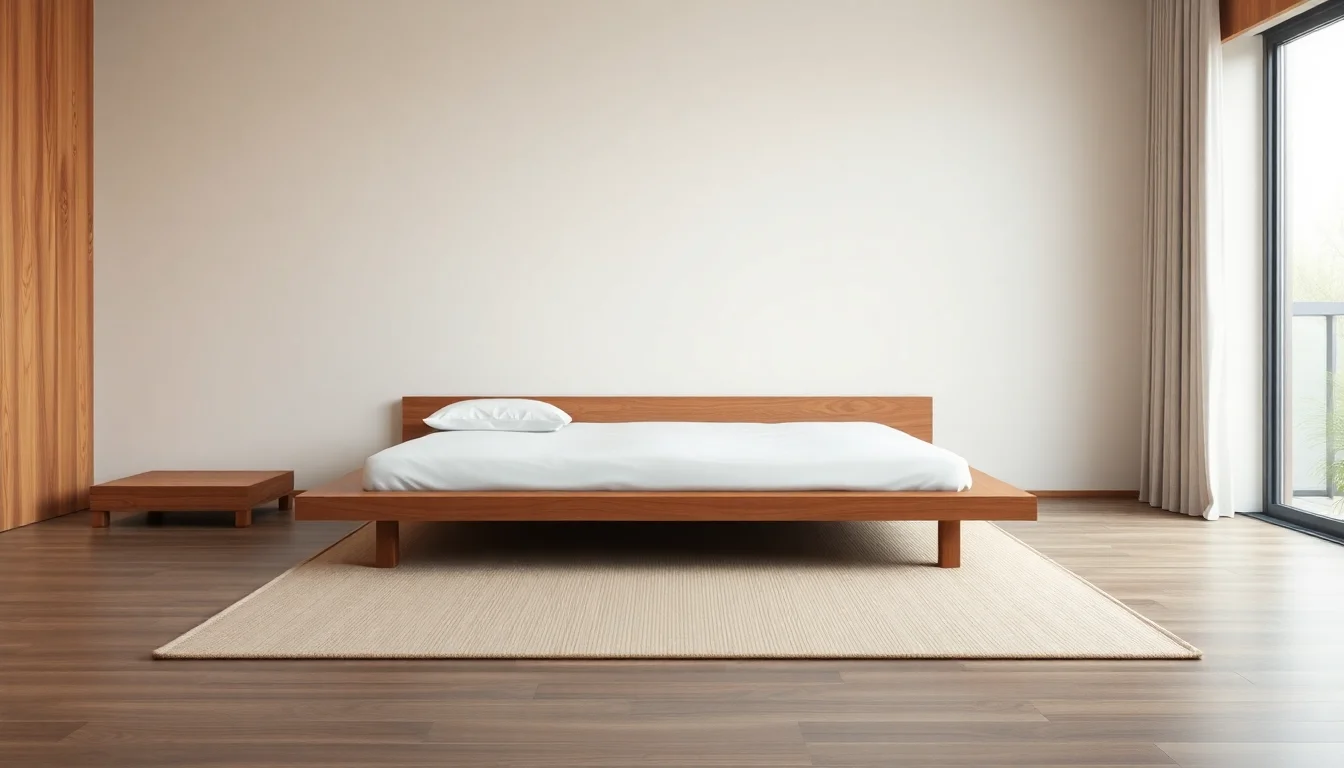
- Japanese bed frames sit 4 to 14 inches off the floor, creating a low-profile silhouette that anchors a room without visual weight.
- Traditional Japanese sleeping culture is rooted in the tatami mat and foldable shikibuton futon — modern platform frames adapt that floor-level aesthetic for Western bedrooms.
- Solid-slat decks eliminate the need for a box spring; slat spacing of 2.75 inches or less prevents mattress sagging and preserves foam or latex warranties.
- Materials follow wabi-sabi principles — kiln-dried oak, paulownia, and cedar age gracefully, avoiding lacquers that crack over time.
- Price range spans $180 for entry pine platforms to $1,295 for the Saatva Santorini, a Western minimalist interpretation built with a lifetime warranty.
Quick Top Picks
| Frame | Height (in.) | Material | Slat Type | Storage | Price (queen) | Aesthetic |
|---|---|---|---|---|---|---|
| Saatva Santorini | 12 | Kiln-dried solid wood | Solid wood planks | No | $1,295 | Minimalist / Japandi |
| Tatami Platform (Traditional) | 4–6 | Paulownia / rush mat | Tatami panels | Optional hinged | $300–$700 | Traditional Wa-style |
| Low-Profile Oak Platform | 8–10 | White oak | Solid hardwood slats | No | $450–$900 | Japandi / Scandinavian |
| Storage Platform (Western) | 14 | Engineered wood / MDF | Sprung or flat slats | Drawers / lift | $350–$800 | Contemporary |
Japanese Frame Heritage: Tatami, Shikibuton, and Modular Floor Culture
The Japanese bed frame as sold in Western furniture markets is an interpretation — not a direct import — of a sleeping tradition that developed over more than a thousand years. Understanding the source culture clarifies what makes a frame authentically Japanese-influenced versus merely low to the ground.
The Tatami Foundation
Tatami mats are compressed rush grass (igusa) panels laid over a rice straw or polystyrene core, typically 90x180 cm in traditional sizing. They serve as the flooring, the surface for seated living, and the sleeping base. A standard room in a traditional Japanese house is measured in tatami units — a 6-jo room (six mats) equals roughly 99 square feet. The mat itself functions as a shock absorber, a humidity regulator, and an air purifier; igusa absorbs volatile organic compounds at rates measured in laboratory studies conducted by Kumamoto University, though results vary by mat density and room ventilation.
On tatami, a shikibuton — a thin cotton floor mattress averaging 3 to 4 inches thick — is unrolled at night and folded or rolled into a closet (oshiire) each morning. This cycle keeps bedding aired out, prevents mold, and makes the bedroom a multipurpose space during daylight hours. No frame is involved in traditional practice. The floor itself is the platform.
The Transition to Platform Frames
As Western furniture infiltrated Japanese interiors during the Meiji era (1868–1912) and accelerated through post-war American cultural influence, raised beds entered Japanese homes alongside Western chairs and dining tables. The response was not to adopt the full Western box spring and headboard stack. Instead, Japanese furniture makers produced low wooden platforms — typically 6 to 10 inches — that preserved the visual relationship between the sleeper and the floor while adding the hygiene and back-support benefits of slight elevation.
Contemporary Japanese apartment bedrooms often feature these semi-platform frames because tatami rooms are rarer in modern construction. The platform replaces tatami function: it elevates slightly for air circulation under the mattress, and it often lacks a headboard to maintain the clean-line aesthetic that carries forward from traditional room design.
Korean Low-Profile vs. Japanese Low-Profile
A common confusion in the Western market is conflating Korean ondol-culture floor beds with Japanese tatami-culture platforms. Korean ondol (radiant floor heating) historically kept floors warm, making direct floor sleeping practical without the moisture concerns that affect Japanese tatami rooms. Korean platform beds therefore tend to sit even lower — often 3 to 5 inches — with heavier wood construction reflecting the industrial design traditions of Korean furniture craft. Japanese-style platforms at 6 to 12 inches lean more heavily on the aesthetic of negative space, lighter wood tones, and absence of visible hardware. Both styles reject the tall footboard and ornate headboard of Victorian European beds, but their material vocabularies differ: Korean frames frequently use walnut or pine with darker finishes, while Japanese frames favor the natural grain of paulownia, cedar, and increasingly white oak.
Low-Profile Design Benefits
The case for a low-profile Japanese-style frame is not purely aesthetic. There are measurable practical benefits that make this category worth examining even for buyers who have no particular attachment to Japanese design tradition.
Visual Calm and Perceived Space
Interior designers working in small apartments — studios and one-bedrooms under 600 square feet — consistently cite low furniture as a tool for visual expansion. A bed frame at 12 inches from floor to mattress top positions the largest piece of furniture below the horizon line of a standing person, allowing the eye to travel across the room unobstructed. A standard Western bed at 24 to 30 inches total height bisects the visual field, making the same room feel divided. This is a documented principle in Scandinavian and Japanese interior design traditions, both of which prioritize horizontal lines and open floor area.
Accessibility for Certain Users
Low-profile frames suit average-height adults well and are increasingly used in children's rooms as floor-adjacent sleeping environments. However, they present genuine challenges for users over 65, those with knee osteoarthritis, or anyone recovering from hip or knee surgery. Getting out of a bed positioned 8 to 12 inches off the floor requires more core engagement and ankle flexion than a standard 24-inch height. This is not a theoretical concern: physical therapists at the American Physical Therapy Association recommend bed heights between 16 and 22 inches for post-surgical patients. Anyone with mobility limitations should measure carefully before committing to a low-profile platform.
Stability and Reduced Risk of Frame Tip
A low center of gravity reduces the risk of a bed frame tipping if load is applied to one side — relevant in households with children who climb. Low platforms also eliminate the gap between frame and floor that becomes a collection zone for dust, toys, and lost items. This is a practical advantage or disadvantage depending on the user: the same gap in a standard frame provides underbed storage that a floor-level platform eliminates.
Temperature Regulation
Hot sleepers sometimes favor floor-adjacent beds under the assumption that cooler air pools near the floor. In rooms without forced-air circulation, this can be accurate: convection currents in a still room push warm air upward, and floor-level temperatures can be 2 to 4 degrees Fahrenheit cooler than ceiling level. However, the effect is minimal in air-conditioned rooms with good airflow. What matters more is mattress material — memory foam sleeps significantly hotter than latex regardless of bed height.
Traditional Materials: Cedar, Paulownia, and Oak
The wood species used in Japanese furniture are selected for properties that go beyond appearance. Each has a practical rationale rooted in Japan's humid climate and the demands of floor-adjacent furniture.
Paulownia (Kiri)
Paulownia is the lightest commercially available hardwood — roughly 280 kg/m3 when kiln-dried, compared to 600–900 kg/m3 for oak. Japanese cabinetmakers have used it for centuries in tansu chests and clothing storage precisely because it resists humidity-driven warping. Its low thermal conductivity means it feels warm to the touch in winter, and it repels insects naturally through secretions in the grain. A paulownia-framed bed can weigh 40 to 60% less than an equivalent oak or pine construction, making it practical for small apartments where moving furniture frequently is necessary. The tradeoff is softness: paulownia dents under point loads and will show wear faster than harder species in high-traffic areas of the frame surface.
Japanese Cedar (Sugi)
Sugi (Cryptomeria japonica) grows fast, absorbs and releases humidity efficiently, and carries a faint scent that persists for years. It is denser than paulownia but still considered a softwood at roughly 380 kg/m3. Cedar oil has demonstrated antifungal properties in controlled studies, which explains why cedar-lined storage spaces inhibit mold in humid climates. For a floor-adjacent bed frame in a bedroom without dehumidification, the natural moisture management of sugi is a material benefit, not just a tradition.
White Oak
White oak dominates contemporary Japandi furniture in Western markets. At 770 kg/m3 it holds joinery — mortise-and-tenon, dowel, and dovetail — far better than paulownia or cedar. The grain pattern of white oak (ray fleck, visible in quarter-sawn cuts) aligns visually with Japanese aesthetic preferences for natural variation. Most Western-market "Japanese-style" bed frames in the $450–$900 range use a white oak veneer over an engineered wood core rather than solid construction; solid white oak frames in queen size typically start above $800.
Bamboo
Bamboo is not a wood — it is a grass, processed into engineered panels through lamination. Strand-woven bamboo reaches 1,200 kg/m3, harder than most tropical hardwoods. It appears in Japanese-market furniture as a sustainability statement; Japanese brands cite bamboo's growth rate (3 to 5 years to harvest versus 20–80 for oak) as its primary advantage. In Western bed frame construction, bamboo panels are usually used for the deck or headboard face rather than the structural legs and rails.
Slat Support — No Box Spring Required
Japanese-style platform frames are designed to be used without a box spring. This is both a philosophical and a structural choice. The philosophy mirrors the tatami base: the platform itself is the foundation, and adding a separate spring layer would raise the total bed height above the intended low-profile range. The structural reality is that solid-slat or closely spaced-slat platforms distribute mattress weight well enough to replace a box spring for every current mattress type.
Slat Spacing Standards
The critical specification is center-to-center slat spacing. Most foam, latex, and hybrid mattress warranties specify a maximum gap of 3 inches; some manufacturers (including Saatva for foam models) specify 2.75 inches or less. A platform with 4-inch gaps will cause a foam mattress to belly through the gaps over time, accelerating body impression wear and voiding the warranty. Before purchasing any Japanese-style platform frame, confirm the slat spacing specification in the product data sheet. Frames listed as "mattress ready" or "compatible with memory foam" should always provide a numeric measurement — be skeptical of listings that do not.
Solid Deck vs. Sprung Slats
Two distinct platform types exist. A solid wood deck (continuous panels with no gaps, or gaps under 1 inch) provides maximum support and the firmest feel. Some sleepers find solid platforms make their mattress feel harder, because the mattress cannot flex independently. Sprung slats — slightly arched wooden strips that flex under load — allow the mattress to respond more dynamically to weight distribution, simulating some of the motion isolation that a box spring provides. Traditional Japanese frames used solid tatami panels as the sleeping surface; modern platform frames in the Japandi style more often use solid or near-solid hardwood slat systems rather than sprung European-style slats.
Center Support
For queen, king, and California king frames, a center support leg or beam is structurally necessary. Without center support, a queen platform will deflect 0.3 to 0.8 inches at midspan under a 250-pound load, depending on rail material and thickness. This deflection is not immediately visible but creates a sleeping surface that is not level. Look for frames with at least one center support leg that contacts the floor — not just a rail running the length of the frame without floor contact.
Saatva Santorini: A Western Take on Minimalist Style
Saatva is an American brand, and the Santorini Bed Frame ($1,295 queen) is not marketed as a Japanese product. However, it represents the closest analogue in the Saatva lineup to the design principles that define Japanese minimalist furniture: low profile, solid wood construction, absence of a traditional headboard, and clean joinery without visible hardware.
The Santorini uses kiln-dried solid wood throughout the rail and leg construction. Kiln-drying reduces moisture content to 6–8%, significantly below the 12–15% moisture content of air-dried lumber, which minimizes future warping and cracking. This is the same moisture standard applied by Japanese craftmakers working in paulownia and cedar, though the Santorini uses wood species sourced for the Western market rather than traditional Japanese species.
The frame sits at 12 inches from floor to mattress deck — within the low-profile range of Japanese-market platforms but above traditional tatami height (4–6 inches). This makes it accessible to adults of all heights without the mobility challenges of the very low traditional configuration. The platform deck uses solid wood planks rather than slats, providing full mattress support without requiring a box spring.
At $1,295 queen, the Santorini is positioned well above the midmarket. The lifetime warranty distinguishes it from all competitors in the under-$1,000 Japanese-style frame category, where warranties are typically 5 years or limited to structural defects. Free white-glove delivery — including assembly and removal of old furniture — removes the logistics friction that makes large furniture purchases complicated.
Compared to the Saatva Halle Bed Frame (a storage-platform model with a more conventional Western profile and underbed drawers), the Santorini is the cleaner, lower-profile choice. The Halle prioritizes function — storage — and runs taller with a more traditional headboard and footboard vocabulary. If the goal is a Japandi-adjacent aesthetic without drawer hardware and a taller silhouette, the Santorini is the appropriate Saatva selection.
Mattress Compatibility
Japanese-style platform frames work with the full range of current mattress types. The absence of a box spring is the only structural difference from a traditional Western bed setup, and every major mattress category performs appropriately on a solid-slat or solid-deck platform.
Memory Foam and All-Foam
Memory foam mattresses are the most sensitive to slat spacing. As noted above, gaps exceeding 2.75 to 3 inches allow foam to sink between slats, accelerating compression-set wear. Solid-deck platforms, including the Santorini, present no risk. For sprung-slat platforms, verify gap measurement in the product specification before purchase. Do not rely on marketing language such as "foam friendly" without a numeric slat gap measurement.
Saatva Classic on a Platform
The Saatva Classic ($1,295 queen) is a dual-coil hybrid with a built-in foundation layer. It is designed to perform without a box spring on any solid-deck or closely spaced slat platform. The Classic's 14.5-inch height adds to the frame height: on the Santorini at 12 inches deck height, total bed height is approximately 26 inches — within the standard accessible range. The Euro pillow top does not require additional height accommodation. Saatva explicitly approves platform use for the Classic.
Saatva Loom and Leaf
The Loom and Leaf ($1,795 queen) is an all-foam mattress with 5-pound density memory foam layers. It is fully compatible with platform bases and performs best on a solid deck or slat system with gaps no wider than 2.75 inches. The Loom and Leaf adds 12 inches of height; on the Santorini, total bed height is approximately 24 inches. This combination sits at the low end of accessible standard height, which works well for average-height adults.
Latex and Hybrid Models
Natural latex mattresses are heavier than foam — a queen Saatva Latex Hybrid ($1,995 queen) averages 90 to 100 pounds. The added weight is not a structural problem for solid wood platforms engineered to 800-pound total load ratings, but it does affect ease of setup. Latex is also more resilient than foam, reducing the risk of sagging between slats even at slightly wider gap measurements. Hybrid mattresses with coil systems are the least sensitive to platform gap measurement because the coil perimeter provides lateral rigidity.
Traditional Japanese Futon (Shikibuton)
A 3 to 4-inch cotton shikibuton on a Japanese platform frame performs differently from a Western mattress. The futon is designed to rest on solid tatami panels; a sprung slat system provides too much give for the thin futon to distribute weight correctly. If using a traditional shikibuton on a modern platform, select a solid-deck platform. Note that a 3-inch cotton futon on a 12-inch platform produces a total sleeping surface height of 15 inches — close to the floor in absolute terms, though above traditional tatami height. For the closest traditional experience, a 4 to 6-inch frame with a solid deck is more appropriate.
Care and Maintenance
Solid wood platforms require less maintenance than upholstered frames but are more sensitive to moisture and impact. Following a consistent care protocol will extend the functional life of a Japanese-style frame significantly beyond the 5 to 10-year lifespan of MDF or particleboard alternatives.
Moisture Control
Humidity is the primary threat to solid wood joinery. In climates with seasonal humidity swings — common in the southeastern United States, the Pacific Northwest, and most of coastal Asia — wood expands in summer and contracts in winter. This cycle stresses mortise-and-tenon joints and can cause audible creaking or, over years, joint loosening. Maintaining indoor relative humidity between 35% and 55% year-round prevents most wood movement damage. A whole-home humidifier or dehumidifier calibrated to this range costs less than one frame replacement.
Cleaning Wood Surfaces
Paulownia and cedar should be cleaned with a barely damp cloth — excessive moisture raises grain and leaves permanent marks. Avoid silicone-based furniture sprays, which fill grain pores and prevent the wood from breathing. A diluted solution of mild castile soap (1 teaspoon per quart of water) on a microfiber cloth removes most surface contamination without damaging the finish. For unfinished or oiled wood surfaces, reapplication of natural wood oil (Danish oil, tung oil) every 12 to 18 months maintains surface protection without building up film layers that crack.
Hardware and Joinery
Check rail connection points every 6 months. Wood joinery expands and contracts; bolts in metal bracket systems can loosen slightly after seasonal cycles. Snugging connections with a wrench — not over-tightening — keeps the frame silent under load. Stripped bolt holes in wood frames can be repaired with wooden toothpicks and wood glue before re-threading, a technique that restores holding strength to near-original if performed before significant stripping occurs.
Tatami Panel Maintenance (Traditional Setups)
If using a frame with authentic tatami panels instead of wood slats, tatami requires specific care. Igusa rush absorbs moisture readily; tatami should be lifted, aired, and vacuumed seasonally to prevent mold growth on the bottom face. Traditional Japanese practice involves airing tatami outdoors twice per year. In Western climates without seasonal airing culture, a dehumidifier running in the bedroom during humid months is the practical substitute. Tatami panels typically need replacement every 5 to 15 years depending on use intensity and climate.
Verdict
Japanese-style bed frames occupy a design category that rewards deliberate selection. The aesthetic is cohesive and proven — the low-profile platform has been refined across centuries of practical use — but the Western market for these frames is uneven. The $200–$500 range is dominated by MDF constructions with thin veneer and slat systems that have inadequate spacing for modern foam mattresses. The $500–$900 range includes solid oak and bamboo options that are structurally sound but often assembled with visible hardware that undercuts the minimalist vocabulary.
Above $1,000, the Saatva Santorini ($1,295 queen) stands as the strongest Western-market option for buyers who want the minimalist low-profile platform with professional-grade construction. It is not a Japanese product, but it adheres to the same design principles — solid wood, low profile, clean lines, no box spring required — while adding a lifetime warranty that no Japanese-market competitor at this price provides. For buyers committed to an authentic tatami-integrated setup, a traditional paulownia frame with tatami panels in the $300–$700 range is the correct choice, with the understanding that tatami maintenance is a commitment.
The slat gap question is non-negotiable. Whatever frame you select, confirm the exact measurement before purchase if you are using a foam or latex mattress. A $250 frame with 4-inch slat gaps will void a $1,500 mattress warranty within 18 months.
FAQ
What is the difference between a tatami bed and a platform bed?
A tatami bed uses woven rush grass panels (tatami mats) as the sleeping surface, typically sitting 4 to 6 inches off the floor. A platform bed uses wood slats or a solid wood deck and ranges from 6 to 14 inches in height. Traditional Japanese sleeping practice did not use a raised frame at all — the shikibuton futon rested directly on tatami floor mats. The modern tatami platform frame is a hybrid: it incorporates tatami panels into a raised wooden frame structure, making it accessible for Western users who want authentic materials without floor-level sleeping.
Will a mattress sag through the slats on a Japanese platform frame?
Mattress sagging through slats depends entirely on slat spacing. For memory foam and all-foam mattresses, slat gaps must not exceed 2.75 to 3 inches (center to center). Most major foam mattress manufacturers specify this limit in their warranty documents. A solid-deck platform (continuous panels with gaps under 1 inch) eliminates this risk entirely. Hybrid and innerspring mattresses are more tolerant of wider slat gaps because the coil perimeter provides lateral rigidity. Always obtain the exact slat gap measurement from the manufacturer before purchase — do not rely on "foam compatible" marketing language without a number.
How does a Japanese platform bed compare to a European platform frame?
European platform frames typically use sprung slat systems — slightly arched individual slats that flex under load, providing motion isolation and a softer feel. They generally sit at 12 to 16 inches and often feature a headboard. Japanese-style platforms favor solid decks or closely spaced flat slats, sit lower (6 to 12 inches), and omit headboards or use very minimal slatted headboards. The Japandi aesthetic — a blend of Japanese and Scandinavian design principles — has merged some European sprung-slat functionality into low-profile Japanese silhouettes, creating a hybrid category that dominates the Western market for "Japanese-style" frames.
Are Japanese bed frames suitable for elderly people?
Low-profile Japanese frames (under 12 inches deck height) are generally not recommended for adults over 65 or anyone with knee, hip, or ankle mobility limitations. Getting out of a bed at 8 to 10 inches from the floor requires significantly more lower-body strength and joint flexion than a standard 22 to 24-inch bed height. The American Physical Therapy Association recommends bed heights between 16 and 22 inches for older adults and post-surgical patients. A higher-profile platform frame at 14 to 16 inches, or the Saatva Santorini at 12 inches with a mattress that adds another 12 to 14 inches for a total of 24 to 26 inches, may be more practical for older users who prefer the minimalist aesthetic.
Is the Saatva Santorini considered a Japanese-style bed frame?
Saatva does not market the Santorini as a Japanese product. However, it shares the core design principles of Japanese minimalist furniture: solid wood construction (kiln-dried), low-profile silhouette (12 inches), clean joinery without ornamental hardware, and compatibility with any mattress without a box spring. In the Japandi design category — which merges Japanese wabi-sabi principles with Scandinavian minimalism — the Santorini is a strong fit. Among Western-market options, it offers the best structural warranty (lifetime) in this aesthetic category. Buyers looking for authentic Japanese materials such as paulownia or tatami panels should source from specialty importers rather than mainstream American furniture brands.
What is the return policy on Japanese-style bed frames?
Return policies vary significantly by retailer and manufacturer. Saatva offers a 365-night trial period on mattresses; the Santorini Bed Frame is covered by a lifetime warranty against structural defects but does not include a trial return window in the same way as mattresses — confirm current frame return terms directly with Saatva at the time of purchase. Mid-market Japanese-style frame retailers (Wayfair, Amazon third-party sellers) typically offer 30-day return windows, though returning a disassembled bed frame can incur significant restocking and return shipping fees. Always check whether the return window begins at purchase date or delivery date, and whether the item must be in original packaging.
Related Sleep Lab Guides