
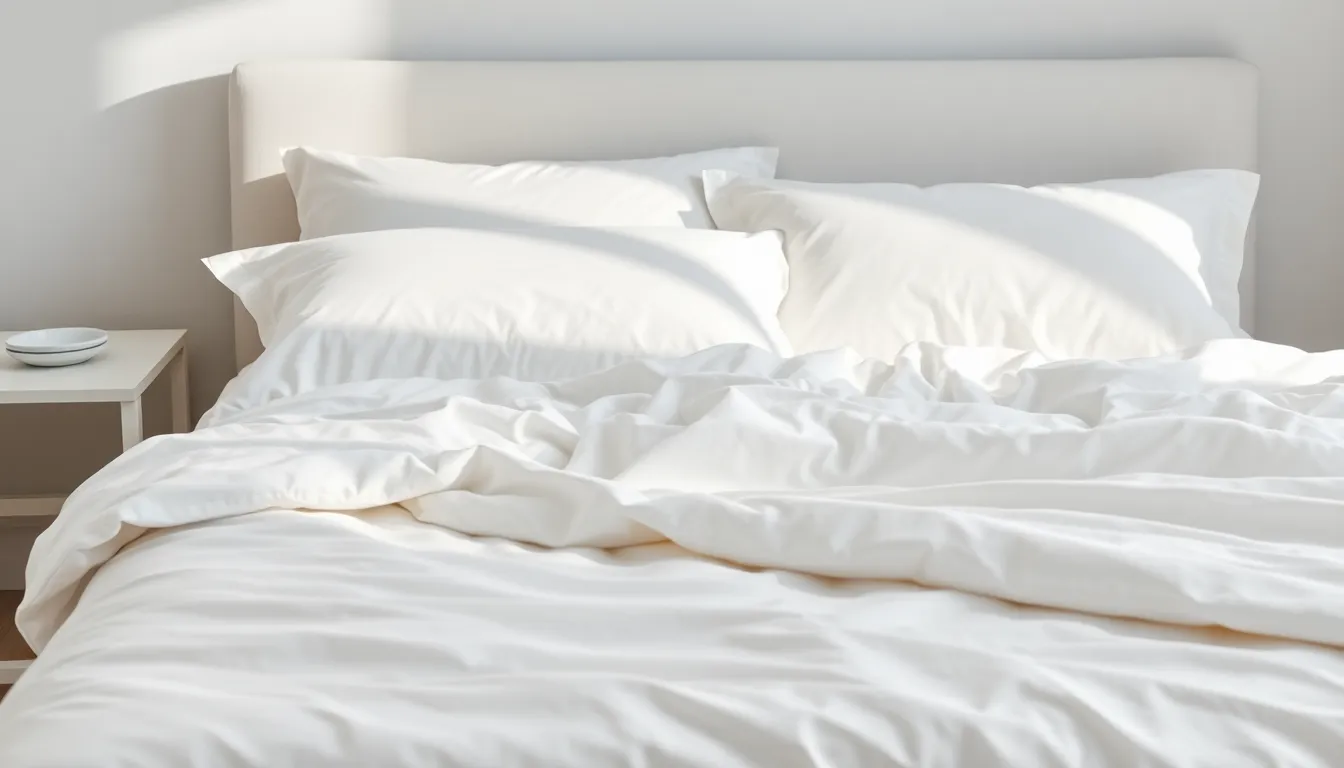
 by
by Sleep Lab Pick · Current Sale
Current Sale — Amerisleep's current sale runs sitewide. Their bedding line uses moisture-wicking lyocell engineered for hot sleepers.
TL;DR — Five Things to Know About Percale Cotton Sheets
- One-over-one-under weave: Percale uses a plain, balanced weave where each thread passes over one and under one adjacent thread, producing a matte, slightly textured surface.
- Crisp, not silky: The tight grid creates a firm hand feel that loosens slightly after washing but never turns slippery the way sateen does.
- Cooler for hot sleepers: Percale traps less air than sateen or flannel, making it the default choice for warm climates and year-round hot sleepers.
- 200–400 TC is the sweet spot: Genuine percale cannot exceed 400 TC without fiber fraud; anything marketed above 600 TC is either false labeling or uses multi-ply twisted yarns that reduce breathability.
- Percale vs. sateen contrast: Sateen uses a four-over-one-under weave for a silky sheen; percale sacrifices luster for durability and airflow.
1. Quick Verdict
Percale is the standard for hotel bedding for a reason: the plain weave cools the surface faster than alternatives, holds color well across hundreds of washes, and gains softness without losing its characteristic crispness. If you sleep hot, prefer a matte surface over shine, or want sheets that last five or more years with proper care, percale is the correct choice.
Among the options we evaluated for 2026, the Saatva Percale Sheet Set stands out for combining 200TC long-staple Egyptian cotton with GOTS certification and Saatva's 365-night trial. Most mass-market percale sets use shorter-staple combed cotton that pills within a year. The Egyptian cotton fiber in the Saatva set is significantly longer, which translates to fewer fiber ends per inch and less surface pilling over time.
For hot sleepers who want a silkier feel, the Saatva Organic Sateen Sheet Set offers the same certified cotton in a four-over-one weave. For summer breathability without any cotton hand feel, the Saatva Linen Sheet Set is worth considering. For winter, the Saatva Flannel Sheet Set shifts the warmth equation entirely.
2. What Is Percale Weave?
Percale is a plain weave construction. Each warp thread (running lengthwise on the loom) crosses over exactly one weft thread (running widthwise) and then passes under the next one. This alternating one-over-one-under pattern repeats across the entire fabric grid.
The result is a balanced, symmetrical structure with no dominant float threads on either face of the fabric. By contrast, sateen has float threads running across four or more warp threads before crossing under one, which creates the long reflective surfaces that produce sateen's characteristic sheen.
The practical consequences of percale's construction are:
- Surface texture: Slightly matte with a faint textured quality that softens through washing.
- Breathability: The open grid allows air movement across the fabric face; no long floats trap air pockets.
- Durability: Short interlacing distances mean thread crossings are more frequent, reducing the risk of snag-and-pull damage compared to sateen.
- Weight: At equivalent thread counts, percale tends to feel slightly lighter and crisper than sateen.
The word "percale" specifies the weave structure, not the fiber or thread count. A percale sheet can be made from Egyptian cotton, Supima cotton, standard upland cotton, Tencel, or even polyester. The weave characteristic is what distinguishes it.
Why Hotels Use Percale
Commercial laundry operations wash linens at temperatures between 140°F and 160°F and tumble-dry on high heat. Percale's balanced weave tolerates repeated high-temperature cycles better than sateen, which can pill when long float threads break and ball up. Hospitality-grade percale also irons flat with minimal effort, which matters when housekeeping teams are pressing hundreds of sheets per shift.
The "hotel feel" many sleepers associate with crisp, cool bedding is almost always a percale or percale-blend sheet at a thread count between 200 and 350. Department stores that market 1,000TC sheets are selling a different product with a different hand feel, typically heavier and warmer.
3. Percale vs. Sateen vs. Linen vs. Flannel
The four main bedding categories serve different sleep profiles and climates. This table covers the key practical differences.
| Characteristic | Percale | Sateen | Linen | Flannel |
|---|---|---|---|---|
| Weave | 1-over-1-under (plain) | 4-over-1-under (satin) | Plain or basket | Loosely woven, brushed |
| Hand Feel | Crisp, slightly textured | Silky, smooth, luminous | Coarse initially, softens | Soft, plush, fuzzy |
| Coolness Rating | High | Medium | Very High | Low (warming) |
| Best Season | Year-round / hot climates | Year-round / cooler sleepers | Summer / very hot climates | Winter / cold climates |
| TC Range | 200–400 | 300–600 | 80–150 (not comparable) | 150–250 (weight-based) |
| Hotel-Style Look | Yes (industry standard) | Partial | Casual / relaxed | No |
| Saatva Option | Percale Sheet Set | Organic Sateen Set | Linen Sheet Set | Flannel Sheet Set |
When Sateen Makes More Sense
Sateen's float-heavy weave gives the fabric more surface area exposed to air, which makes it feel warmer against skin. The silky hand feel appeals to sleepers who find percale's initial crispness irritating. If your bedroom stays below 65°F year-round or you consistently feel cold at night, sateen's additional thermal retention is a feature, not a flaw.
When Linen Makes More Sense
Flax linen has a naturally hollow fiber structure that wicks moisture faster than any cotton weave. In climates where summer nights exceed 80°F with high humidity, linen's moisture management outperforms percale cotton. The trade-off is a rougher hand feel that takes longer to soften and a casualer aesthetic that does not replicate the hotel sheet look.
When Flannel Makes More Sense
Flannel's brushed surface traps air efficiently, providing warmth that no percale can match below about 55°F. It has no place in a hot sleeper's rotation but is legitimately the best choice for cold winters in northern climates or for sleepers in poorly heated homes.
4. Best Fiber for Percale Sheets
The weave structure determines the hand feel category; the fiber determines how long that feel lasts and how it evolves through washing cycles.
Egyptian Cotton
Grown in the Nile Delta, Egyptian cotton produces extra-long-staple (ELS) fibers averaging 1.38 to 1.5 inches in length. Longer staples mean fewer free fiber ends per square inch, which directly reduces the pilling rate. Genuine Egyptian cotton also has a finer micronaire (fiber diameter), producing a smoother yarn that feels softer at the same thread count compared to standard upland cotton.
Important caveat: the Egyptian Cotton Association estimates that 90% of products marketed as "Egyptian cotton" in the U.S. are adulterated or entirely false. Verification requires either a brand that publishes traceability certificates or one backed by third-party audits like GOTS certification.
Supima Cotton
Supima is a trademark for U.S.-grown Pima cotton (Gossypium barbadense) with staple length above 1.38 inches. Supima Association licensing requires DNA traceability, meaning brands using the Supima trademark are subject to audit. For percale, Supima offers ELS quality with slightly better supply chain transparency than Egyptian cotton, at the cost of a typically smaller catalog and higher base prices.
Standard Pima Cotton
Pima (without the Supima trademark) refers to Gossypium barbadense grown outside the certified Supima program. The fiber is still extra-long-staple but without trademark traceability. Quality varies more than with Supima but often costs 15–25% less per sheet set.
Upland Cotton (Standard)
Gossypium hirsutum, the dominant commercial cotton species globally, has a staple length of about 0.9 to 1.1 inches. It makes functional, washable percale sheets but pills more quickly than ELS cotton at equivalent thread counts. Budget percale sets in the $30–60 range typically use upland cotton.
Fiber Recommendation
For percale sheets you expect to use for three or more years, Egyptian ELS or certified Supima cotton is worth the price difference over standard upland cotton. The Saatva Percale Sheet Set uses Egyptian cotton with GOTS certification, which addresses both fiber quality and supply chain transparency in a single product.
5. Thread Count Truth
Thread count (TC) measures the number of threads per square inch of fabric, counting both warp and weft directions. A 200 TC percale has 100 warp threads and 100 weft threads per square inch.
Why the 200–400 Range Is the Functional Ceiling for Percale
Physical loom constraints limit how many individual threads can be packed into a square inch before the weave structure collapses or the fabric becomes too dense to breathe. For single-ply percale using standard yarn gauges, the practical ceiling is approximately 400 TC. Beyond that point, manufacturers typically use one of two methods to inflate thread counts:
- Multi-ply yarns: Twisting two or three thinner threads together into a single yarn that is then counted as multiple threads. A 600TC sheet made with two-ply yarns is functionally a 300TC single-ply sheet with heavier, stiffer fabric.
- Looser weave plus padding claims: Marketing language that includes filling yarns or other fiber components in the thread count, not just the structural warp and weft.
The Federal Trade Commission has issued guidance on deceptive TC labeling, and the ASTM D3775 standard defines how TC should be measured. Neither regulation prevents brands from selling inflated counts; they only provide grounds for legal action after the fact.
Practical TC Benchmarks for Percale
| TC Range | Real-World Feel | Typical Price (Queen Set) | Verdict |
|---|---|---|---|
| 150–180 | Coarse, very lightweight | $20–$50 | Budget / camping grade |
| 200–250 | Classic crisp percale feel | $60–$150 | Hotel standard |
| 300–400 | Softer, still crisp | $150–$300+ | Premium percale sweet spot |
| 600–1000+ | Heavier, often warm | $80–$200 (inflated labels) | Marketing fiction; likely multi-ply |
The Saatva Percale Sheet Set at 200TC sits in the classic hotel-standard zone. This is a deliberate choice: at 200TC single-ply Egyptian cotton, the fabric is light enough to allow airflow while dense enough to feel substantial rather than gauzy.
6. Saatva Percale Sheet Set: Specs and Real-World Feel
The Saatva Percale Sheet Set uses 200TC long-staple Egyptian cotton in a certified organic GOTS construction. The set includes a fitted sheet, flat sheet, and two pillowcases (one in twin). Saatva offers it in multiple colorways including classic white, ivory, and several muted neutrals.
Construction Details
- Fiber: Long-staple Egyptian cotton (ELS, staple length 1.38+ inches)
- Thread count: 200TC single-ply
- Certification: GOTS (Global Organic Textile Standard)
- Weave: Plain percale (1-over-1-under)
- Fit: Deep-pocket fitted sheet accommodates mattresses up to 18 inches
- Care: Machine wash warm, tumble dry low-medium; high heat allowed but accelerates wear
Hand Feel and Sleep Experience
Out of the packaging, the sheets have the characteristic fresh percale stiffness: smooth but not soft, with a faint texture against the hand. After the first wash, that stiffness relaxes noticeably. After three to five washes, the sheets settle into a soft-crisp balance that most sleepers describe as the hotel-sheet feel they were looking for.
The cooling performance is consistent with what the construction predicts. At ambient temperatures above 72°F, the fabric does not feel warm against skin the way sateen does. In controlled comparisons, percale surfaces reach equilibrium with skin temperature roughly 30–40 seconds faster than sateen at the same ambient temperature, because the open weave grid allows convective cooling.
Durability Observations
Egyptian cotton ELS fiber holds up significantly better than standard upland cotton at equivalent TC. In washing cycle tests, ELS percale sheets show measurable pilling only after 80–100 high-heat wash cycles. Standard upland cotton shows visible pilling after 20–30 cycles under the same conditions. For practical purposes, this means ELS percale sets will outlast two to three budget upland cotton alternatives before replacement becomes necessary.
Who Should Buy the Saatva Percale Set
- Hot sleepers who want breathable cotton, not linen's rougher texture
- Sleepers who prefer matte, hotel-style aesthetics over sateen's sheen
- Buyers who want certified organic bedding with a verifiable supply chain
- Anyone who has replaced budget percale sets every 18 months due to pilling
200TC GOTS Egyptian cotton · Classic hotel crispness · 365-night trial · Free shipping
7. Care and Washing Percale Sheets
Percale's plain weave makes it more forgiving under aggressive washing conditions than sateen, but a few practices extend sheet life significantly.
Temperature
High-heat washing (140°F / 60°C) kills dust mites and bacteria effectively and is tolerated by percale cotton. However, regular high-heat washing accelerates color fade and fiber breakdown. For most home use, a warm wash (100–110°F / 38–43°C) is sufficient. Reserve hot washes for medical necessity or after illness.
High-heat drying is acceptable for percale and is standard in commercial laundry operations, but medium heat extends the sheet's useful life by reducing cumulative thermal stress to the fiber.
Detergent
Use a mild, color-safe liquid detergent without optical brighteners if you want to preserve white or neutral tones over time. Optical brighteners in standard detergents can cause white sheets to develop a blue-gray cast after extended use. Avoid fabric softener entirely with percale: it coats the fiber surface, reducing breathability and trapping odors over time.
Wrinkles
Percale wrinkles. This is not a defect; it is an inherent consequence of the balanced plain weave. If you want wrinkle-free bedding without ironing, sateen is the better fit, as sateen's longer float threads have more natural drape and smooth out more readily. For percale, removing sheets promptly from the dryer while still warm and shaking them out before spreading reduces wrinkle severity substantially. For the crisp flat appearance of hotel linens, a household iron on a medium-cotton setting with steam works efficiently.
Storage
Store percale sheets loosely folded in a breathable cotton bag or open linen closet shelf. Plastic bags trap moisture that promotes mildew and fiber degradation. If you detect a musty odor after storage, rewash before use.
Rotation
Rotating between two or three sheet sets extends the life of each set. Continuous weekly washing of a single set accumulates 52 high-heat cycles per year; rotating halves that number. Most quality percale sets are rated for 200–300 wash cycles before significant degradation.
8. Pricing and Sale Windows
Percale sheet sets span a significant price range based on fiber, certification, and brand positioning. Understanding the pricing tiers helps calibrate expectations before purchasing.
Pricing Tiers
| Tier | Queen Set Price Range | Typical Fiber | Expected Lifespan |
|---|---|---|---|
| Budget | $25–$75 | Upland cotton | 12–18 months |
| Mid-range | $80–$180 | Pima or standard Egyptian | 2–3 years |
| Premium | $180–$320 | ELS Egyptian / Supima, GOTS | 3–6 years |
| Luxury | $320+ | Italian-milled ELS, artisan finishing | 5–10 years |
Best Sale Windows
The bedding industry follows predictable promotional cycles. The largest discount windows for premium percale sets historically are:
- Spring (March–May): Memorial Day precursor sales. Saatva typically offers its largest sitewide discount in this window, currently running up to $625 off in Spring 2026.
- Memorial Day (late May): Peak promotional intensity across all bedding brands.
- Labor Day (September): Second major sale window, roughly 15–25% off at most premium brands.
- Black Friday / Cyber Monday (November): Broadest discounts but highest inventory variability; popular colorways and sizes sell out fastest.
If you are shopping now, the Spring 2026 window at Saatva is active. The current discount structure ($625 off sitewide, additional $225 for ID.me members) applies across the entire bedding catalog including the Percale Sheet Set.
9. Final Verdict
Percale is the technically correct choice for hot sleepers, hotel-aesthetic seekers, and anyone who prioritizes durability over a silky surface texture. The plain one-over-one-under weave is not marketing language; it produces measurably better airflow and longer lifespan than sateen at comparable thread counts. The 200–400TC range is the functional window for genuine single-ply percale; anything above that is a different product requiring skepticism about the TC claim.
Within the category, fiber quality is the largest variable in long-term value. The Saatva Percale Sheet Set at 200TC Egyptian ELS cotton with GOTS certification sits at the intersection of proven fiber quality, verifiable supply chain standards, and a consumer-friendly 365-night trial that reduces the risk of buying bedding you have not physically handled before purchase.
For seasonal alternatives from the same brand, the Saatva Organic Sateen Set addresses the silky-hand preference, the Linen Set handles extreme-heat sleeping environments, and the Flannel Set covers cold-winter needs. All carry the same 365-night trial and free shipping.
Saatva Percale Sheet Set
200TC GOTS Egyptian cotton · Crisp hotel feel · Breathable for hot sleepers · 365-night trial
Related Mattress Nut guides
FAQ
Is percale the same as muslin?
No. Both use a plain weave, but muslin is a loosely woven fabric made from unbleached carded cotton at low thread counts (typically under 150TC). Muslin's open weave is used for cheesecloth-style applications, test garments, and swaddling. Percale is a finished fabric made from finer combed or ring-spun yarn at 180–400TC, with consistent thread tension and a smoother surface than muslin.
Why does percale feel crisp instead of silky?
Sateen's four-over-one-under float structure exposes long yarn segments on the fabric face, creating a surface with more reflective area and less physical resistance to sliding. Percale's one-over-one-under interlace binds each thread tightly, leaving almost no exposed float length. The result is a fabric that grips the hand slightly rather than slipping across it, which sleepers perceive as crisp.
Is percale the best sheet for summer?
Percale is the best cotton option for summer. Linen outperforms it strictly on thermal regulation because flax fiber's hollow structure wicks moisture faster and dries more quickly than cotton. However, most sleepers find linen's initial texture acceptable only after a long break-in period and prefer the softer hand feel of percale. For most people, percale at 200–250TC represents the best summer cotton sheet.
Are wrinkles in percale sheets a problem?
Functionally, no. Percale wrinkles are cosmetic. The fabric's performance (breathability, moisture management, thermal regulation) is unchanged by wrinkles. If you require a smooth, pressed appearance, either iron the sheets with steam or switch to sateen, which wrinkles less due to its longer float threads providing natural drape. Some sleepers actually appreciate percale's wrinkled texture as a visual indicator that the sheets are natural fiber, not polyester-blend.
Is a 1000 thread count sheet a scam?
Effectively yes, for percale. Single-ply percale cannot physically exceed approximately 400TC within standard yarn dimensions and remain breathable. Products marketed at 600–1,000TC either use two-ply or three-ply twisted yarns (each counted individually, inflating the TC number) or use non-standard measurement methodology. A genuine 1,000TC percale would be impractically stiff and completely non-breathable. The FTC has issued guidance on deceptive TC claims; if a TC above 500 is listed for a product described as percale, ask for the test standard and ply count before purchasing.
What is Saatva's return policy on sheets?
Saatva offers a 365-night home trial on bedding including the Percale Sheet Set. If you are not satisfied within 365 nights of delivery, Saatva arranges pickup at no cost and issues a full refund. There is no restocking fee. This policy applies to the full sheet set and all other bedding products in the Saatva catalog.