
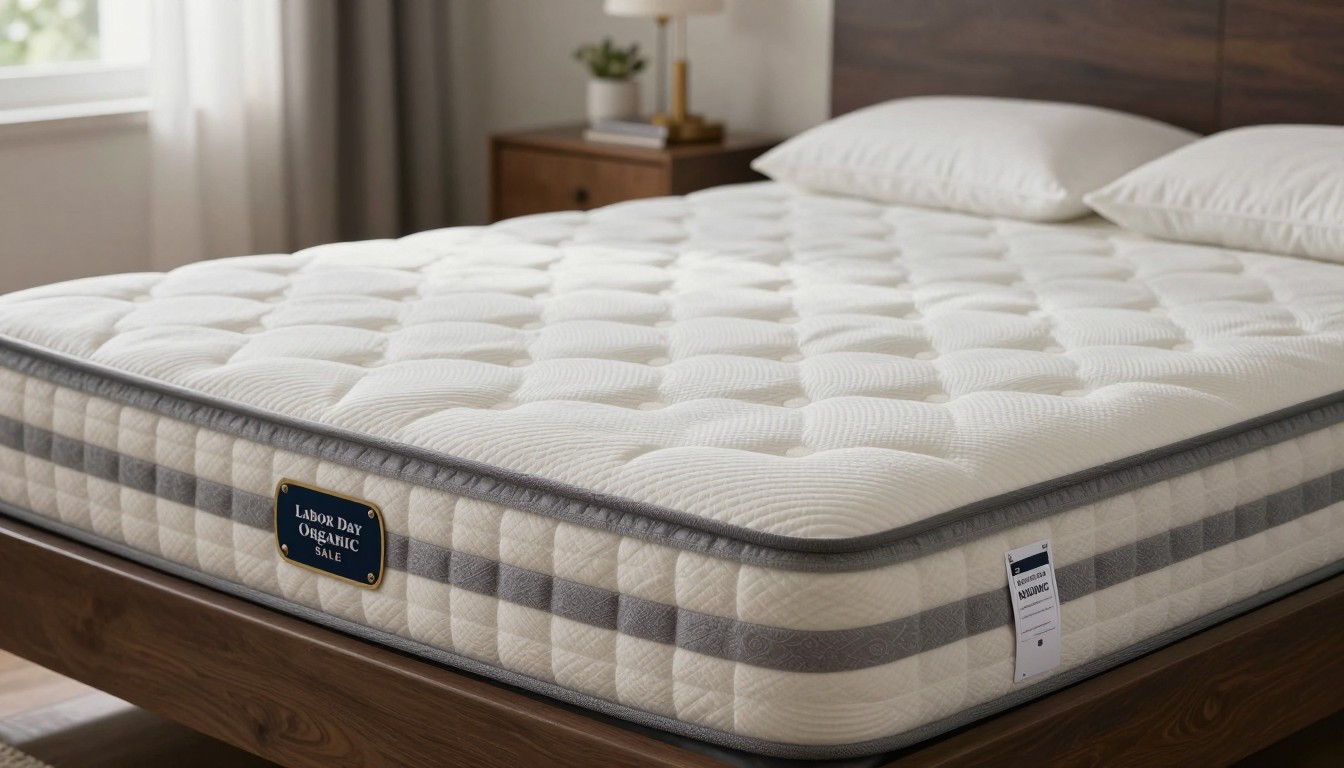
 by
by Quick answer: My pick is the Saatva Latex Hybrid for shoppers considering this construction, but only if the live listing shows documented organic credentials, meaningful savings, and acceptable terms.
- Sleep Sage publishes a dedicated tracker for Labor Day mattress promotions.
- Sleep Foundation publishes a separate holiday-sales guide with deal-comparison advice.
- No product-specific discount amount is confirmed, so the current checkout price and policy terms still need verification.
Updated July 2026 · Reviewed for accuracy
A Labor Day organic mattress sale is worth shopping only when the markdown and the organic claim both survive a close read. A holiday banner by itself tells me very little.
I’d focus on the final checkout price, the precise scope of any certification, the full construction sheet, and every cost attached to returns or delivery. If those details aren’t clear, I wouldn’t let a countdown or crossed-out price make the decision.
Sleep Sage and Sleep Foundation both publish Labor Day deal guides, which confirms that this is an active mattress-shopping period. Their guides don’t verify the current offer or materials of an individual mattress, so the product listing and policy pages still matter most.
Start with the live price, not the crossed-out price
No product-specific markdown is confirmed for the featured mattress. That makes the live checkout price the starting point, not the promotional headline.
I compare the exact configuration I plan to order. That means matching the mattress size, foundation choice, delivery selections, and any extras before judging the discount. A cheaper headline can become a weaker offer if necessary services or return costs appear later.
I also separate genuine savings from bundled clutter. An included accessory has little value if I wouldn’t otherwise buy it, and it shouldn’t compensate for a mattress price that exceeds my budget. The number that matters is what leaves my account for the setup I actually need.
My deal-math checklist
- Record the final mattress price for the exact configuration.
- Add any delivery, setup, removal, or return-related charges shown in the terms.
- Give bundled extras only the value they have to you personally.
- Check whether sale purchases follow different return or exchange rules.
- Reject the offer if the final cost is above your firm spending limit.
According to Sleep Sage, its Labor Day page tracks mattress promotions and shopping strategies. That’s useful for market context, but I wouldn’t use another brand’s dramatic markdown as proof that this offer is competitive. Percentage language can distract from a higher starting price.
The broader Labor Day mattress-sales guide provides category-wide context. For this purchase, I’d still save the current product price and compare it with the live holiday checkout on an equal basis.
Organic claims need scope, not green language
The word “organic” in a sale headline doesn’t tell me which component, certificate, or production stage it describes. I treat it as a question that requires documentation, not as proof of the entire mattress build.
The useful evidence is specific. I want the certification name, the certifying organization, the material or finished item covered, the exact model scope, and a way to confirm that the document is current. If a page shows only leaves, earth-tone graphics, or broad environmental wording, I assign those elements no added value.
Component-level language needs an equally narrow interpretation. If documentation applies to a cover fiber, I don’t automatically extend that claim to latex, adhesives, the fire barrier, coils, or any other layer. Each material claim has to stand on its own wording and evidence.
The Nut’s organic-claim rule: If I can’t identify the certified component, certifier, exact model scope, and current status, I don’t pay extra for the word “organic.”
| Wording on the page | Evidence I’d seek | How I value it |
|---|---|---|
| Organic mattress | A named certificate showing exactly what product or material is covered | Potentially meaningful only when the scope matches the mattress being sold |
| Organic cover | The covered fiber, model relationship, certifier, and current documentation | Evidence for the named cover component, not every internal layer |
| Natural latex | A material description plus separate organic documentation if organic status is claimed | I treat “natural” and “organic” as separate purchasing claims |
| Eco-conscious or green | A specific material statement, standard, or independently checkable document | No price premium from me without concrete support |
I’d also check whether the certificate identifies the mattress itself, a particular component, a manufacturing facility, or a supplier. Those scopes aren’t interchangeable for buying purposes. The seller should make the relationship understandable without requiring the customer to guess.
This discipline protects the budget as much as it checks the claim. A modest discount on a clearly documented product can be a stronger value than a louder sale attached to vague environmental language.
Construction determines whether the deal has lasting value
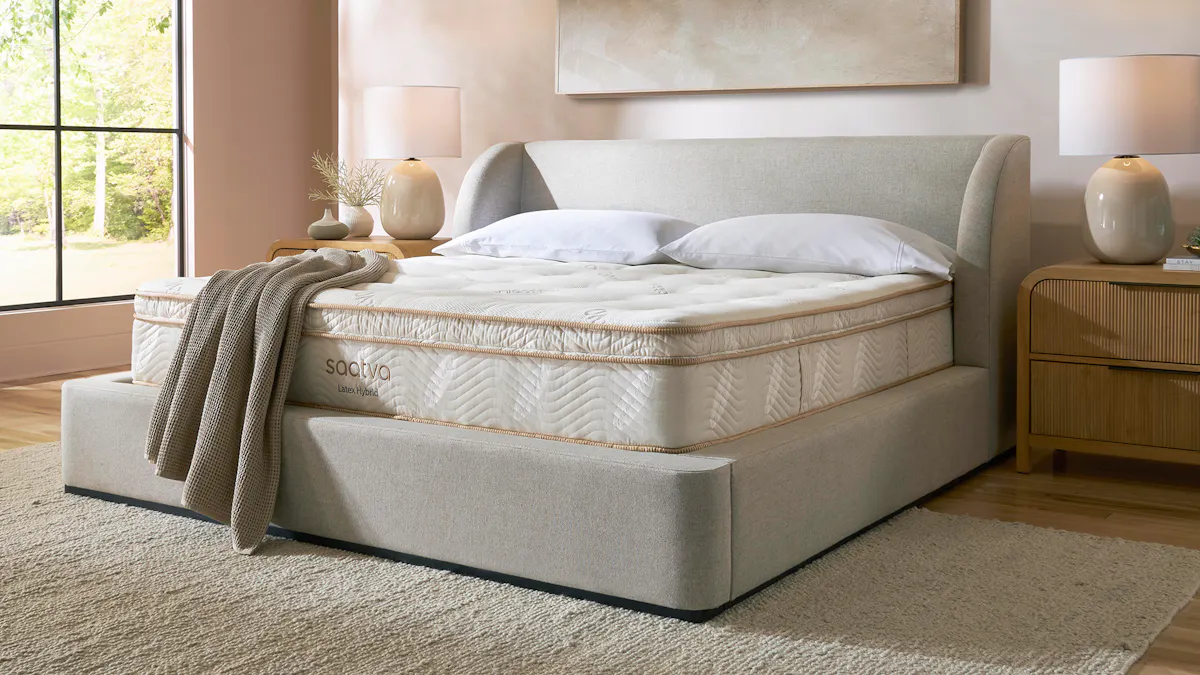
Per the manufacturer’s product naming, the featured bed is positioned as a latex hybrid. That label identifies the intended construction category, but it doesn’t disclose the complete layer arrangement, material specifications, firmness, or expected feel.
I’d want a layer-by-layer build before paying for the category name. Useful details include the cover material, quilting or padding, latex type and placement, any additional foam, the fire-barrier material, coil design, perimeter construction, and the base layer. If a foam layer is present, its density is relevant to my durability analysis. For the spring unit, I look for meaningful information about the wire, layout, and edge structure.
Without that build sheet, I can’t make a responsible durability call. I also can’t tell whether most of the price is buying substantial comfort materials or simply a premium label. A holiday markdown doesn’t repair an opaque specification page.
Construction evidence worth saving
- The complete order of layers from the cover to the support base
- The type and placement of the latex used in the comfort system
- The identity and density of any additional foam layers
- Details about the coil unit, perimeter, and zoning if zoning is claimed
- The material used for the fire barrier and the scope of related claims
- Documents that connect organic wording to the exact materials listed
Comfort language deserves the same restraint. Terms such as plush, responsive, supportive, or cooling are difficult to evaluate without a disclosed design and attributed owner feedback. No verified feel data or owner-review findings are available here, so I wouldn’t recommend the mattress for a particular sleep position, body type, or sensitivity.
Motion control and edge support also remain open questions. A hybrid category alone doesn’t tell me how much the surface moves, how the perimeter behaves, or whether two sleepers will experience the same comfort. Those are reasons to study the live policy terms before purchase, especially if the listing doesn’t answer the construction questions.
Comparing options? The Saatva Latex Hybrid is the pick we keep coming back to — see the final verdict ↓
Compare the holiday offer on equal terms
Sleep Sage describes its page as a tracker for Labor Day mattress deals, while Sleep Foundation publishes a separate holiday sale guide with shopping advice. These sources establish the broader deal environment, but they don’t replace the featured mattress’s live checkout and policy pages.
I use a like-for-like comparison. Every candidate price should represent the same mattress size, equivalent setup needs, and comparable policy conditions. Otherwise, a lower headline can win on paper while costing more for the household’s actual order.
| What to compare | Strong evidence | Weak evidence |
|---|---|---|
| Final price | The checkout total for the exact intended configuration | A headline discount detached from the final cart |
| Reference price | A saved baseline for the same configuration | A crossed-out figure with no useful context |
| Organic credentials | Current documents matched to the model or named component | Green imagery and undefined environmental wording |
| Purchase policies | Clear trial, return, exchange, delivery, and warranty terms | A broad promise without accessible conditions |
| Included extras | Items the shopper already needs and would otherwise purchase | Accessories used mainly to inflate the apparent savings |
Policy wording can change the practical value of a sale. Before ordering, I’d read the sections covering eligibility, return transportation, exchanges, damage reporting, delivery access, foundation requirements, and warranty exclusions. I wouldn’t assume the normal policy and holiday policy are identical unless the official terms say so.
Useful habit: Save the checkout summary, product specification page, certification documents, and purchase policies together. That creates a clean record of the exact information behind the decision.
A broader promotion can help with timing, but it shouldn’t set the budget. I decide my maximum spend before reading the sale page. If the live total exceeds that cap, the mattress isn’t the value choice, regardless of how large the displayed markdown appears.
Who should consider the offer, and who should skip it?
A latex-hybrid label narrows the construction category, but it doesn’t settle firmness, pressure relief, motion control, cooling, edge support, or durability. The best fit is therefore a shopper willing to verify those points rather than infer them from the product name.
I’d consider the offer if the final price fits an established budget, the organic evidence matches the materials that matter to you, and the complete policies are acceptable. I’d pause if any of those conditions remain vague.
A possible fit if you:
- Are specifically considering a latex-hybrid construction
- Prefer documented material claims over broad green language
- Can verify the exact checkout total before committing
- Find the live return and warranty conditions acceptable
- Have enough construction detail to judge the purchase
I’d pause if you:
- Need the lowest possible purchase price
- Require whole-product organic documentation that isn’t shown
- Need verified firmness or performance information before ordering
- Can’t determine the complete layer construction
- Feel pressured mainly by the holiday deadline
Budget discipline matters more than sale timing. A discounted mattress that remains above your limit is still unaffordable, and financing doesn’t reduce the purchase price. I wouldn’t stretch the budget merely to avoid missing a promotional window.
If the lowest initial outlay is the main goal, the used-mattress buying guide covers a different route. That option requires its own checks for condition, history, cleanliness, support, and remaining useful life, so I wouldn’t treat it as equivalent to buying a documented new organic model.
I’d also skip any offer that makes its materials difficult to verify. Organic positioning should make the evidence clearer, not force the shopper to interpret vague badges or disconnected certificates.
My verdict: wait for proof, not a holiday banner
The Nut’s bottom line: My verdict on the Saatva Latex Hybrid is conditional. Confirm the live checkout price, exact organic scope, full construction sheet, and complete policy costs before treating the holiday offer as good value.
The latex-hybrid direction may suit the category you’re shopping, but no verified product-specific discount or detailed build facts are available here. I won’t call it a bargain based on the event name alone.
If the documentation is clear and the final cost stays within your preset budget, the offer deserves consideration. If the organic claim is vague, the construction remains opaque, or the checkout exceeds your cap, skip it without regret.
ONE OPTION WORTH COMPARING
Shopping as well as reading? Here is one current option worth comparing: the Saatva Latex Hybrid. Check today’s price, sizing and return terms on the official product page before you order.
Saatva Latex Hybrid
- My verdict: wait for proof, not a holiday banner The Nut’s bottom line: My verdict on the Saatva Latex Hybrid is conditional
FAQ
Are Labor Day organic mattress discounts always genuine?
I wouldn’t assume that every displayed markdown equals meaningful savings. Sleep Sage and Sleep Foundation both publish holiday deal guides, but an individual offer still has to be checked against its live checkout price, comparable configuration, and purchase terms.
Does “organic mattress” mean every layer is organic?
I don’t treat the phrase as proof that every component has the same status. Check whether the documentation applies to the finished mattress, a named layer, a particular fiber, a supplier, or a production facility.
Is a latex hybrid automatically organic?
No construction label is automatic organic proof in my evaluation. I look for separate, current documentation that identifies the certified material or product and connects it clearly to the model being sold.
Should I wait until Labor Day before buying?
Wait only if the current price or terms don’t meet your needs and you’re comfortable comparing the later offer. Save a baseline for the exact configuration so the holiday headline can’t substitute for a real price comparison.
What if the sale price is still over my budget?
Skip it. A markdown doesn’t make an over-budget mattress affordable, and a holiday deadline isn’t a sound reason to accept a payment you didn’t plan for.