
 by
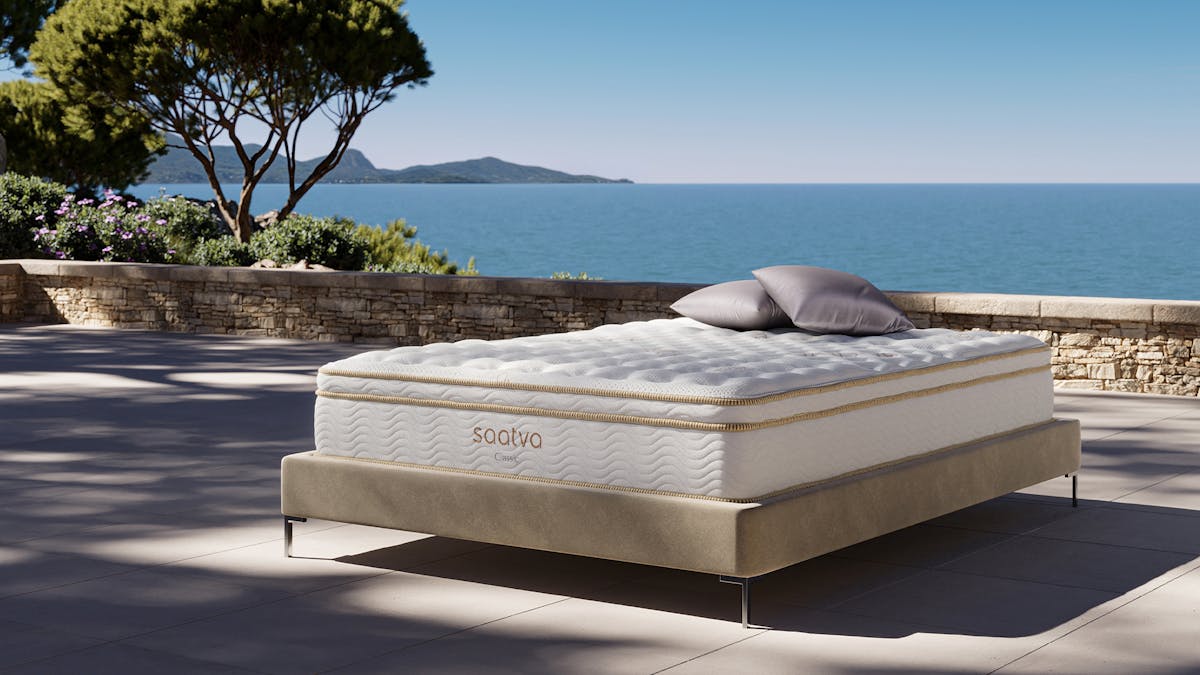
by Latex sleeps cooler, lasts longer, and responds faster. Memory foam contours deeper and isolates motion better. For most buyers who want the best of latex, the Saatva Latex Hybrid is the clear top pick: natural latex over pocketed coils, 365-night trial, free white-glove delivery. If you prefer the slow-contouring memory foam feel at a premium level, the Saatva Loom & Leaf delivers that with lifetime warranty and no-box-spring-needed construction.
Saatva Latex Hybrid
9.2/10
- Natural Talalay latex comfort layer: genuinely cooler and more responsive than foam
- Pocketed coil core adds edge support and airflow that all-foam latex can't match
- GOLS-certified organic latex, GOTS-certified organic cover
- Free white-glove delivery, setup and old mattress removal
- 365-night trial and lifetime warranty
- Heavier than a compressed foam-in-a-box, requires assistance to set up
- Only two firmness options (Medium, Firm), no Plush Soft
If you're drawn to latex for its cooling, responsiveness, and longevity, the Saatva Latex Hybrid is the most complete execution of those strengths. The hybrid coil base adds the edge support and airflow that all-foam latex designs sacrifice.
Saatva Loom & Leaf
8.7/10
- Dense high-quality memory foam with better cooling than typical boxed foams
- Deep contouring pressure relief for side sleepers and those with joint pain
- Exceptional motion isolation, barely any partner disturbance
- Free white-glove delivery and lifetime warranty
- Heavier and not compressed in a box
- No soft firmness option for very light-weight side sleepers
For buyers who genuinely want the memory foam feel rather than latex, the Loom & Leaf is where to go. It performs like a premium in-store mattress, not a boxed foam, and the 365-night trial removes all the guesswork.
What is a latex mattress?
Latex foam is derived from the sap of rubber trees. That raw sap is processed into foam using one of two methods: Talalay (poured, vacuum-sealed, then flash-frozen for a lighter, more consistent cell structure) or Dunlop (poured and baked straight through, producing a denser, firmer core). Natural latex contains a high percentage of actual rubber; synthetic latex uses styrene-butadiene rubber instead and is more affordable, though it lacks the durability and breathability of the natural version.
Because natural latex has an inherently open-cell structure, and because manufacturers add small pinholes during molding, air circulates through the material continuously. When you shift positions at night, that movement pushes warm air out and draws cooler air in. The result is a material that stays close to room temperature even during hot summer nights.
On feel, latex is responsive. Press a hand into it and it springs back the moment you lift away, no slow rebound, no sinking sensation. That makes it easier to change positions than memory foam.
What is a memory foam mattress?
Memory foam, also called viscoelastic polyurethane foam, was originally developed by NASA in the 1970s. It works differently from latex: the foam is temperature-sensitive and reacts to body heat by softening and deforming slowly around your shape. That slow conforming creates the signature hug feeling, your body is cradled from all sides, pressure points melt away.
Traditional memory foam has a closed-cell structure that traps heat. Manufacturers work around this with gel infusions, copper particles, phase-change covers, and open-cell reformulations. For a deeper look, see our guide on gel memory foam vs regular memory foam.
Memory foam excels at motion isolation. Its viscoelastic properties absorb vibration so completely that a partner rolling over at 3 a.m. registers as almost nothing on the other side of the bed.
Latex vs memory foam: full comparison
| Category | Latex | Memory Foam |
|---|---|---|
| Feel | Buoyant, springy, responsive rebound | Slow-contouring, deep sink, body hug |
| Cooling | Excellent, open-cell structure + airflow | Fair to good, depends on infusions/cover |
| Durability | 10–15+ years (natural latex) | 7–10 years (high-density foam) |
| Eco-Friendliness | High (natural latex: renewable, biodegradable) | Low-moderate (petroleum-based) |
| Motion Isolation | Moderate, transfers some movement | Excellent, absorbs nearly all motion |
| Pressure Relief | Good, distributes weight | Excellent, conforms to every curve |
| Price | $1,200–$3,500+ (queen, natural latex) | $600–$2,000 (queen, high-density) |
| Best For | Hot sleepers, combination sleepers, eco buyers | Side sleepers, light sleepers, budget buyers |
How the feel difference plays out in practice
With latex, you sleep on top of the mattress. The foam compresses but immediately resists, keeping you lifted and making it easy to roll over. For people who get up frequently at night, that responsiveness is genuinely useful.
Memory foam lets you sink into the mattress. That deep cradle is extraordinarily comfortable for side sleepers whose hips and shoulders need pressure relief. The trade-off is that repositioning takes more effort, and some sleepers describe feeling stuck. Heavier sleepers often find latex provides more consistent support over time. For a broader perspective, our memory foam vs hybrid vs latex comparison covers all three categories.
Cooling: where latex has a structural advantage
Natural latex's open-cell architecture means there are actual channels for air to move through. Every time you shift position, you're pumping warm air out and drawing cooler air in. Memory foam's default structure is the opposite: closed cells that trap heat. Modern memory foam with gel or open-cell reformulations performs better, but independent testing consistently shows latex sleeping cooler. Our best cooling mattress guide ranks both types.
Durability and long-term value
High-quality natural latex is one of the most durable mattress materials available, routinely reaching 12–15 years without significant compression. Memory foam durability is tied to foam density: high-density (5 lb/ft³ or higher) can last 8–10 years; low-density (under 3 lb/ft³) often sags within 3–5 years. Given the price gap, the long-term cost difference is smaller than the sticker price suggests.
Eco-footprint
Natural latex comes from a renewable source. Rubber tree farming is carbon-sequestering, and natural latex is biodegradable. Certifications like GOLS verify organic sourcing. Memory foam is a petroleum derivative; CertiPUR-US certification confirms it's free of ozone-depleting chemicals and heavy metals, but the base material remains synthetic and non-biodegradable.
Who should buy latex?
- Hot sleepers: the open-cell structure provides consistent temperature neutrality.
- Combination sleepers: responsive rebound makes changing positions effortless.
- Eco-conscious buyers: natural latex is the most environmentally defensible foam material.
- Sleepers who want long-term value: the higher upfront cost is offset by a 12–15 year lifespan.
- Back and stomach sleepers: latex's resistance keeps the spine better aligned.
Who should buy memory foam?
- Side sleepers: deep contouring relieves shoulder and hip pressure. See our best mattress for side sleepers roundup.
- Light sleepers who share a bed: motion isolation is unmatched.
- Budget-conscious buyers: quality memory foam starts several hundred dollars lower than natural latex.
- Sleepers with chronic pain: full-body conforming reduces pressure points across the entire surface.
If you run hot, move around at night, or care about eco credentials, choose latex. The Saatva Latex Hybrid is our strongest recommendation. If you're a side sleeper who wants deep pressure relief and maximum motion isolation, quality memory foam is the better tool, and the Saatva Loom & Leaf delivers that without the typical all-foam compromises.
Frequently asked questions
Is latex or memory foam better for back pain?
It depends on the cause. Memory foam's deep contouring relieves pressure-point pain and suits side sleepers. Latex provides more pushback and keeps the spine better aligned for back and stomach sleepers. A medium-firm latex hybrid is a versatile starting point. See our best memory foam mattress guide.
Does latex sleep cooler than memory foam?
Yes, consistently. Natural latex's open-cell structure circulates air passively, while memory foam absorbs and holds heat as it softens and contours.
How long does a latex mattress last compared to memory foam?
High-quality natural latex typically lasts 10–15 years. High-density memory foam runs 8–10 years; low-density can degrade in 3–5 years.
Is natural latex worth the extra cost?
For hot sleepers, eco-conscious buyers, and people who want a decade-plus lifespan, yes. For budget-focused shoppers or strict side sleepers who need deep pressure relief, quality memory foam delivers strong value at a lower price.
What's the difference between Talalay and Dunlop latex?
Both come from natural rubber sap. Dunlop is poured and baked in one continuous process, producing denser foam firmer at the core. Talalay is vacuum-sealed and flash-frozen, creating a lighter, softer, more uniform structure. Most all-latex mattresses use Talalay in the comfort layer and Dunlop in the support core.
Can you get motion isolation with latex?
Latex isolates some motion but noticeably less than memory foam. Couples where one partner is restless will generally find memory foam, or a latex hybrid with a pocketed coil core, more effective.
Which is better for side sleepers, latex or memory foam?
Memory foam is usually stronger for pure side sleepers due to deeper contouring. Softer Talalay latex can also work for lighter side sleepers who want more responsiveness. See best mattress for side sleepers.