
 by
by A 12+ hour flight isn't just a long nap opportunity. Used correctly, it's the most powerful jet lag prevention tool you have.
Why Long-Haul Sleep Is Different
On a 2-hour domestic flight, sleep is optional. On a 14-hour flight from New York to Singapore, how and when you sleep on the plane determines whether you land adapted or devastated. Long-haul flights cross enough time zones that the plane itself becomes a transitional circadian environment — and you can either use that transition strategically or fight it.
The key principle: sleep on the plane on destination time, not home time. This sounds obvious, but most travelers sleep whenever they're tired — which is home time, exactly when they should be staying awake to synchronize with the destination.
Pre-Flight: The Setup
Sleep Position Before You Board
Your sleep position on the night before a long-haul determines how aggressively you can use the flight to adapt. For an eastward flight departing in the morning: sleep normally the night before (do not extend sleep). For a westward departure: consider sleeping 1–2 hours later than usual to begin the clock delay.
Equipment That Actually Matters
Three items make a meaningful difference on long-haul flights:
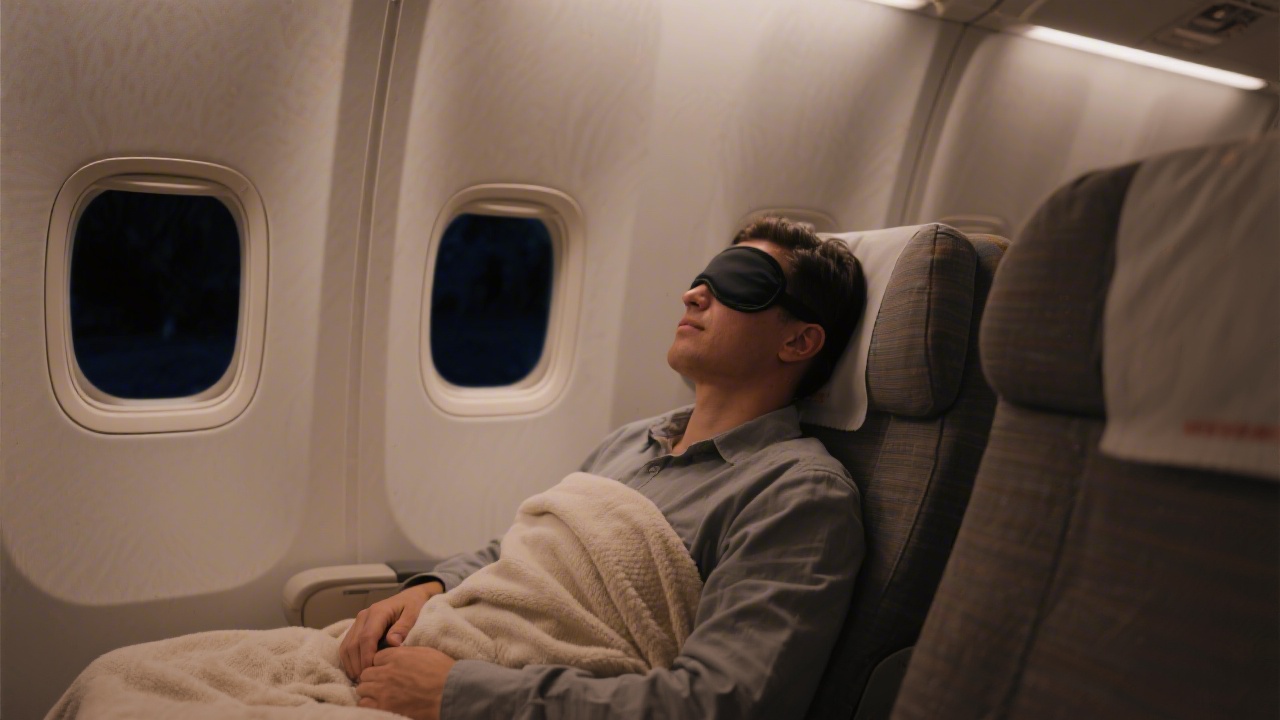
- Eye mask: Cabin lighting follows the airline's schedule, not yours. A full blackout mask gives you control over light exposure, the primary circadian zeitgeber.
- Noise-cancelling headphones or earplugs: Cabin noise (75–85 dB) suppresses sleep depth. Active noise cancellation reduces this to near-silence. Even foam earplugs reduce noise by 25–33 dB.
- Neck pillow: Sleep in an upright seat is structurally different from lying flat. A properly fitted neck pillow (memory foam, not U-shaped inflatable) prevents cervical extension that fragments sleep every 20–30 minutes.
The On-Flight Sleep Protocol
Step 1: Set Your Watch to Destination Time at Boarding
This is psychological anchoring. Every decision you make on the flight — when to eat, when to sleep, when to stay awake — should reference destination time, not home time.
Step 2: Map Your Sleep Window
Identify when it is "nighttime" at the destination during your flight. That is your sleep window. Use the in-flight map or a world clock app. If the destination is 10pm–6am while you're flying, that 8-hour window is when you want to sleep. Even if you only capture 4–5 hours within it, you've shifted your adaptation forward significantly.
Step 3: Stay Awake Outside Your Window
During destination daytime hours on the flight: move around, eat, drink water, engage with entertainment. Avoid the temptation to nap. Cabin air is dry and pressurized — fatigue is normal — but sleeping outside your destination window extends jet lag by 1–2 days.
Step 4: Use the Environment to Trigger Sleep
When your destination window arrives: put on the eye mask, insert earplugs or headphones with white noise, recline fully, take 0.5mg melatonin if eastward-traveling (20–30 minutes before you want to sleep), and avoid the call button or interaction for 90 minutes minimum.
Medication Options
For long-haul flights, some travelers use sleep aids to help initiate sleep during the target window. Options in order of preference:
- 0.5mg melatonin: Chronobiotic, no residual sedation, appropriate for most adults
- Diphenhydramine (Benadryl): OTC antihistamine with sedative effect; causes residual grogginess and suppresses REM — use only if nothing else works
- Prescribed sleep aids (zolpidem, etc.): Effective for sleep onset, but sedation effects persist past the sleep window on long flights; use only under medical guidance and never in premium cabin seats where you need to move to exit
Avoid alcohol for sleep initiation. Alcohol reduces REM and N3 (deep) sleep, fragments the second half of sleep, and dehydrates in an already dehydrating environment.
Economy vs. Business Class
The sleep quality gap between economy and business is real but not insurmountable. Economy strategies: window seat (wall support, control of window shade), bulkhead or exit row for leg room, arrive early to gate for overhead bin storage directly above your seat. The goal is minimizing position changes, which are the primary sleep fragmentors in upright seating.
After Landing: The First 4 Hours
If you arrive in daylight: get outside immediately. If you arrive at night: eat a light meal on destination time, avoid screens, and attempt to sleep within 1 hour of local bedtime. See our eastward or westward guides for the full post-landing protocol based on your direction. For pre-flight preparation see our prevention protocol.
Frequently Asked Questions
Should I sleep the whole long-haul flight or just part of it?
Only the portion that falls within destination nighttime. Sleeping the entire flight regardless of destination time is the most common mistake travelers make — it feels like good sleep banking but actually deepens the jet lag misalignment.
Is it better to take a red-eye or daytime long-haul flight?
For eastward travel, daytime departures arriving the next morning local time are generally better — they allow sleep on-flight during destination night, and you arrive into morning light for immediate clock advancing. For westward travel, overnight flights are often preferable. See our business travel guide for scheduling strategies.
What seat should I book for the best sleep on long-haul flights?
Window seat in a 3-3 configuration (avoid middle seats at all costs), away from galley and lavatories (noise and light), and in the forward section of the cabin (smoother turbulence, earlier deplaning). Seats with fixed armrests at window positions allow leaning against the fuselage.
Can I use a sleep mask with glasses?
Most contoured sleep masks accommodate light prescription glasses frames. Deeper contoured masks (designed for eye makeup) have more interior clearance. Remove glasses after the lights are off and use them to navigate before sleep rather than wearing them under the mask.
How do I stay awake on the flight when I should be awake?
Walk the aisle every 60–90 minutes, eat a small meal or snack on destination schedule, use cold water on your face in the lavatory, engage with entertainment with the window shade open if it's daylight at destination. Caffeine (coffee or tea) is effective but cut off at destination 2pm equivalent to avoid sleep window interference.