
 by
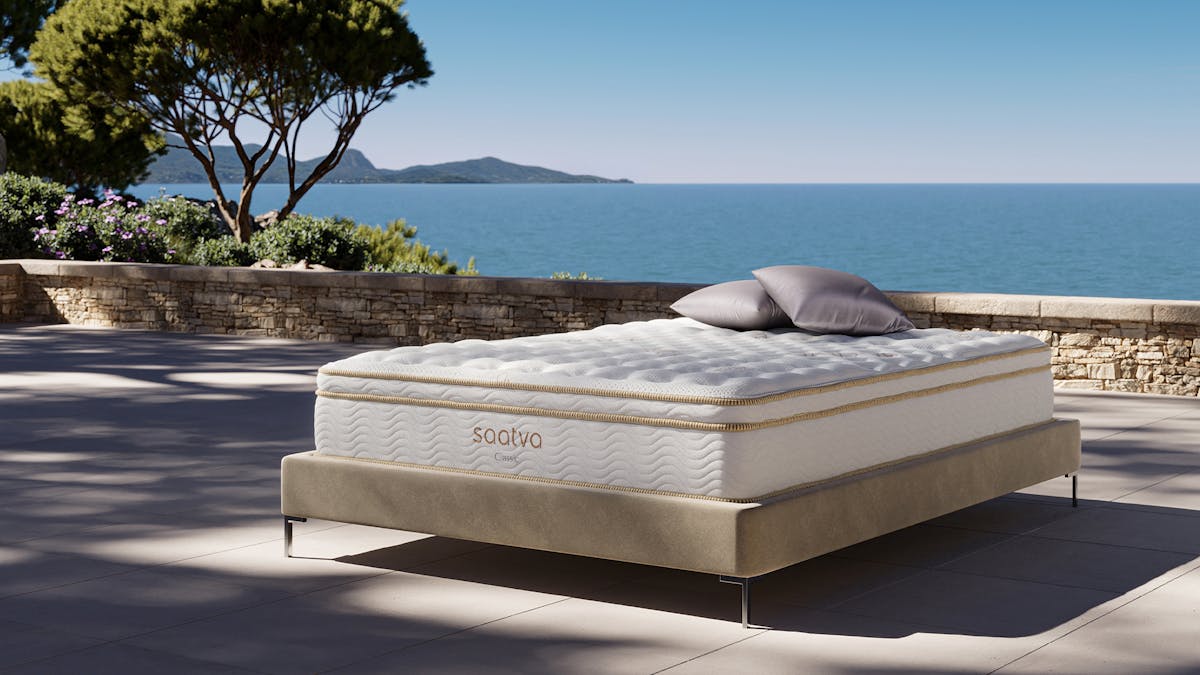
by The best mattress for a treehouse is the Saatva Classic: its dual-coil construction ventilates better than foam in humid forest environments, and Saatva's white-glove delivery crew handles setup for accessible treehouse locations. For treehouses with tight ladder or hatch access, the Amerisleep AS3 ships compressed in a box and fits through narrow stairwells.
Saatva Classic
9.2/10
- Dual-coil construction with open airflow throughout the core, one of the best-ventilated mattresses for humid forest environments
- Free white-glove delivery, setup, and old-mattress removal included
- 365-night trial and lifetime warranty back a hospitality-grade investment
- Three firmness options (Plush Soft, Luxury Firm, Firm) to match guest preference
- Ships full-size and flat, requires vehicle access to within a reasonable carry distance
- Heavy at around 100 to 120 lb for a queen, two people needed for any stairs
- $99 return fee applies if you decide to swap during the trial
For treehouse rentals and cabins with road access, the Saatva Classic brings hotel-caliber coil ventilation, white-glove delivery, and a 365-night trial. The dual-coil core allows airflow through the entire mattress thickness, which limits moisture concentration in high-humidity forest settings far better than all-foam alternatives.
Why treehouse mattress selection is different from a standard bedroom
A treehouse creates three problems that a living room or guest room does not: access, humidity, and temperature swing. Each one rules out a different class of mattress.
Access is the most immediate constraint. A standard queen innerspring or a rigid hybrid weighs 80 to 130 pounds and ships in a rectangular box that cannot bend. Anything with that geometry becomes very difficult at the top of an exterior ladder or through a tight rooftop hatch. Bed-in-a-box foam and latex mattresses compress down to a cylinder roughly 45 to 50 inches long, manageable for two people in an awkward stairwell.
Humidity is a chronic issue in a forest canopy environment. The tree itself introduces moisture through its bark and surrounding organic material. Even a well-sealed treehouse experiences higher ambient humidity than a ground-level structure, particularly in spring and summer. Traditional memory foam traps moisture and creates conditions for mold growth if a waterproof encasement is not used. Open-cell foam and natural latex are more forgiving. Coil-based mattresses like the Saatva Classic benefit from natural airflow through the coil layers, which actively limits moisture buildup.
Temperature swing matters for seasonal structures. A treehouse sealed in winter and reopened in spring can see 40 to 50 degree Fahrenheit swings inside. Gel foams and standard memory foam change feel noticeably with temperature. The dual-coil construction of the Saatva Classic stays more temperature-consistent than dense foam beds, and the Euro pillow-top adds cushioning without trapping heat.
Best mattresses for treehouse use (comparison)
| Mattress | Ships compressed | Humidity resistance | Firmness | Trial | Queen price |
|---|---|---|---|---|---|
| Saatva Classic | No (white-glove) | Excellent (dual-coil airflow) | Lux Firm 6/10 | 365 nights | ~$1,395 |
| Amerisleep AS3 | Yes | Good (open-cell Bio-Pur) | Medium 5/10 | 100 nights | From $1,049 |
| Helix Midnight | Yes | Good (hybrid coil) | Medium 6/10 | 120 nights | ~$1,099 |
Amerisleep AS3
8.8/10
- Rolls down to a manageable box, fits through hatches, up ladders, and around tight spiral staircases
- Bio-Pur open-cell foam breathes better than traditional memory foam, reducing moisture buildup in humid forest environments
- HIVE 5-zone support layer keeps spinal alignment correct on any flat platform surface
- CertiPUR-US certified, minimal off-gassing in small enclosed spaces
- Softer perimeter than a coil hybrid, pair with a slatted platform for best edge support
- Sleepers over 230 lb may prefer the AS5 Hybrid for a firmer, more supported feel
For any treehouse with tight access, the AS3 is the practical answer: a queen rolls to roughly 45 x 18 inches, manageable for two people on a narrow staircase or exterior ladder. Once unrolled on a slatted platform, it sleeps like a proper bed, not a camping pad.
Helix Midnight
8.4/10
- Ships compressed in a box, practical for limited-access treehouse installs
- Pocketed coil core allows airflow and resists humidity better than all-foam options
- Outstanding edge support for platform beds with no perimeter rail
- Lower price point than the AS3 at an equivalent comfort level
- Shorter trial (120 nights) and warranty (10 years) than Saatva and Amerisleep
- Motion isolation adequate but not exceptional for couples sharing a treehouse bed
The Helix Midnight gives you coil airflow in a compressed-box format, a rare combination for treehouse installs where you want hybrid support but cannot take delivery of a full-size box. Good edge support on a platform with no footboard is a meaningful advantage here.
Platform surface and foundation requirements
Most treehouses use a fixed structural platform rather than a traditional bed frame with box spring. The mattress sits directly on this surface, which changes what you need from the mattress and the platform itself.
A solid platform with no airflow accelerates moisture buildup under the mattress. Drill a grid of 1-inch ventilation holes spaced about 6 inches apart across the surface, or install a slatted insert over the solid deck. For new treehouse builds, a slatted platform with slats 3 inches wide and 2 to 3 inches apart matches the ventilation standard of a commercial bed frame and is adequate for both foam and hybrid mattresses without a box spring.
For a treehouse built on a living tree with natural lean, the platform is rarely perfectly level. A mattress with good edge support prevents roll-off on a surface with any tilt. Hybrid options with perimeter coil reinforcement (Saatva Classic, Helix Midnight) handle this better than all-foam options without perimeter support foam.
A waterproof mattress encasement under the fitted sheet is non-optional in a treehouse. It does two things: protects the mattress core from ambient humidity when the structure is unoccupied, and provides a washable barrier against the condensation that forms inside any structure experiencing rapid temperature change.
Delivery logistics for remote and limited-access locations
Treehouse delivery logistics depend entirely on what a delivery driver can physically reach with a truck, and what you can carry from there. Most bed-in-a-box brands (Amerisleep, Helix, DreamCloud, Nectar) deliver to the curb or door. From there, the compressed cylinder needs to reach the sleeping platform.
A compressed queen mattress from Amerisleep, Helix, or similar brands ships in a box roughly 45 inches long by 16 to 18 inches in diameter, and weighs around 65 to 75 pounds. Two people can carry this up an outdoor staircase, through a roof hatch, or around a tight hallway turn. Once positioned on the platform and unrolled, the mattress needs 24 to 72 hours to reach full expansion before it sleeps properly.
Measure the entire path before ordering: exterior stair width, hatch or door clearance (height and width at the tightest point), and the space needed to unroll on the platform without the mattress overhanging an edge during setup. A queen is 60 by 80 inches; a full is 54 by 75 inches and easier to maneuver in compact treehouse bedrooms.
For premium treehouse rentals where the property has vehicle access, Saatva's white-glove delivery service sends a two-person crew to deliver, set up, and remove any old mattress. Schedule this after any construction that affects vehicle access to the site.
Moisture, humidity, and mold prevention
Mold and mildew on a treehouse mattress comes from two sources: ambient humidity that permeates the structure, and condensation from occupant body heat against a cold sleeping surface. Both are manageable with the right combination of mattress material, encasement, and ventilation.
Natural latex handles moisture better than any foam. It is inherently antimicrobial and does not support mold growth at the humidity levels found in a forest canopy environment. If budget allows and the treehouse will see heavy year-round use, natural latex is the longest-lasting option.
Quality open-cell foam like Amerisleep's Bio-Pur performs nearly as well as latex when paired with a waterproof encasement. The open-cell structure allows moisture vapor to move through the foam rather than concentrating at the cover surface. Traditional slow-response memory foam with a closed-cell structure is more vulnerable in humid conditions.
Innerspring designs like the Saatva Classic have a structural advantage here: the dual-coil core allows airflow through the entire mattress thickness, which limits moisture concentration in the comfort layers above. This is one reason hotel-style innerspring mattresses last longer in high-occupancy environments than all-foam alternatives.
For treehouse rentals and cabins with vehicle access, the Saatva Classic brings hotel-grade coil ventilation, white-glove delivery, and a 365-night trial. For tight-access treehouses where the mattress must fit through a hatch or up a ladder, the Amerisleep AS3 ships compressed and handles humidity well. Both pair with a waterproof encasement and a slatted platform surface.
Frequently asked questions
Can I get a mattress delivered to a treehouse?
Yes. For accessible locations, Saatva's white-glove delivery service handles setup and removal of any old mattress. For tight-access builds, compressed bed-in-a-box formats (Amerisleep AS3, Helix Midnight) ship as a 65 to 75 pound cylinder that two people can carry up an outdoor staircase or through a roof hatch.
Does humidity damage a treehouse mattress?
It can if the mattress is exposed directly. A waterproof encasement under the fitted sheet is the single most effective protection. Coil-based mattresses like the Saatva Classic benefit from natural airflow through the dual-coil layers. Natural latex and open-cell foam like Bio-Pur are more moisture-tolerant than traditional dense memory foam.
What size mattress fits best in a treehouse?
A full (54 x 75 inches) is easier to maneuver through tight access points and works for single occupants or couples who sleep close. A queen (60 x 80 inches) is the practical maximum for most treehouse bedrooms and is what most guests expect in a rental. Measure the platform and the entire delivery path before ordering.
How long does a mattress last in a treehouse?
A quality coil or latex mattress in a maintained treehouse with a waterproof encasement and slatted platform can last 8 to 12 years. The Saatva Classic comes with a lifetime warranty, which covers long-term treehouse use well. For rental properties with high occupancy, budget for replacement every 5 to 7 years for foam, and 7 to 10 years for coil or latex. Mattresses in seasonally closed structures should be stored on the platform with the encasement sealed, not left uncovered through winter.