
 by
by How to Test Mattress Motion Isolation Before Buying
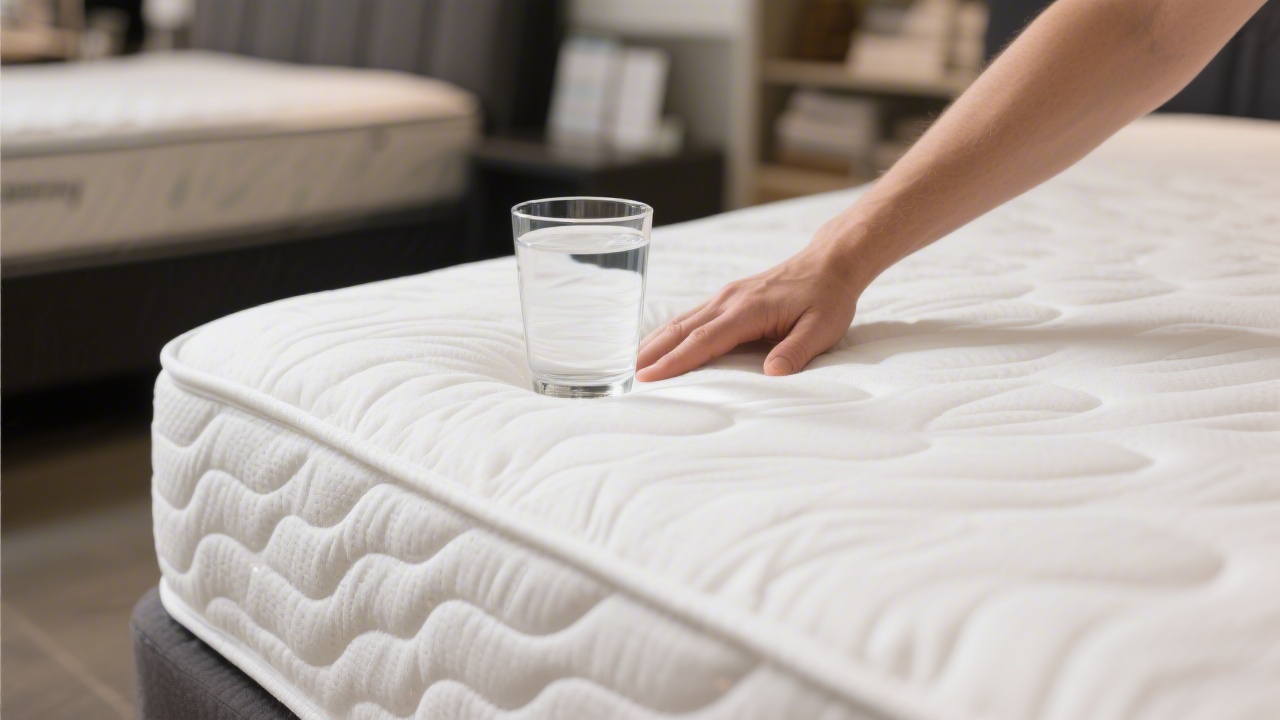
Motion isolation — the mattress’s ability to absorb movement from one sleeper and prevent it from disturbing the other — is one of the most testable physical properties of a mattress. Unlike firmness or breathability, you can objectively measure motion transfer in-store in under five minutes using nothing but a glass of water.
Our Pick
Saatva Classic
Top-rated by our testing team. White-glove delivery included.
What You Are Actually Measuring
Motion transfer is the transmission of kinetic energy through a mattress. When one partner turns over, gets up, or shifts position, they impart an impulse into the mattress. How much of that energy reaches the other side is determined by the mattress’s damping coefficient — essentially how quickly the material absorbs the wave.
High-damping materials (dense memory foam, latex) absorb kinetic energy quickly. Low-damping materials (coil systems, particularly interconnected Bonnell springs) allow energy to propagate across the mattress surface before being absorbed.
For a deeper understanding of the physics and what construction types score best, see our companion guide on what is motion transfer in mattresses.
The Water Glass Test
This is the most reliable in-store motion isolation test and requires zero equipment beyond what any mattress store has available:
- Place a full glass of water at the center of the mattress, approximately where one partner’s torso would rest.
- Stand at the opposite end of the mattress and press your knee firmly into the sleep surface, then release.
- Observe the water surface. Scale: minimal ripple = excellent isolation; significant wave = poor isolation.
- Move the glass to a quarter-point of the mattress width (near the edge on the partner’s side) and repeat from the opposite edge.
The glass-to-impulse distance matters: test at 12–18 inches (simulating a turn from sleeping position) and at 36+ inches (simulating getting out of bed).
In-Store Testing Protocol
The Roll Test
One partner lies on the mattress in their typical sleeping position while the other rolls from their back to their side. Grade the movement on a 1–5 scale: 1 = “I feel it clearly,” 5 = “I cannot detect movement.” Repeat with the rolling partner moving from back to side vs. side to back vs. getting up completely.
The Percussion Test
Press three fingers firmly into the mattress in a short “tap” motion from 18 inches away from the glass. This simulates the sharp impulse of a phone alarm grab or a repositioning movement rather than the slow pressure of a roll. Sharp impulses propagate differently from slow pressure changes — interconnected coil systems often handle slow pressure well but transmit taps more readily.
The Exit Test
Getting out of bed is the highest-energy motion in a typical night. One partner sits up from lying down, swings their legs off, and stands while the other’s head remains on the pillow. Grade how much head-bounce occurs. This is the motion that most consistently disrupts light-sleeping partners.
What Test Results Mean by Mattress Type
| Mattress Type | Typical Test Result | Why |
|---|---|---|
| Memory Foam (dense) | Excellent (4–5/5) | High damping coefficient; energy absorbed near impulse point |
| Latex | Good (3–4/5) | Good damping but slightly bouncier than foam |
| Pocket Coil Hybrid | Good (3–4/5) | Individual coils limit lateral energy propagation |
| Bonnell/Offset Coil | Poor (1–2/5) | Connected coils transmit energy across entire surface |
| Pillow-Top Memory Foam Hybrid | Good-Excellent (3.5–5/5) | Foam comfort layer dampens before energy reaches coils |
At-Home Testing During Trial Period
If you purchase with a sleep trial, set up your own at-home test in the first week:
- Place a phone face-up on the partner’s side and record the accelerometer readout (many free apps do this) while the other partner performs the roll and exit tests. Compare readings across different mattresses.
- Ask your partner to rate sleep quality on nights when you had a restless sleep vs. calm nights — mattresses with poor isolation show correlation between your activity and their quality rating.
The Saatva Classic uses individually wrapped coils in both layers, which perform substantially better on motion transfer tests than open Bonnell systems — a common point of confusion since “innerspring” covers both designs.
Our Pick
Saatva Classic
Top-rated by our testing team. White-glove delivery included.
Frequently Asked Questions
Does a firmer mattress have better motion isolation?
Not necessarily. Firmness and motion isolation are different properties. A firm latex mattress has excellent isolation; a soft memory foam mattress has excellent isolation. A firm Bonnell innerspring has poor isolation despite being firm. Isolation depends on damping coefficient and coil independence, not firmness.
Is the water glass test accurate?
The water glass test is a reliable qualitative test that correlates well with accelerometer-based laboratory measurements. It effectively distinguishes between interconnected coil mattresses (poor isolation) and pocket coil or foam mattresses (good isolation). It is less effective at distinguishing between models in the good-to-excellent range.
Can you improve motion isolation on an existing mattress?
A thick memory foam or latex topper (3–4 inches) adds a damping layer that meaningfully reduces motion transfer on an interconnected coil mattress. This is a $100–$300 solution versus a full mattress replacement. It does not fully replicate a purpose-built foam or pocket coil mattress but is detectable in testing.
Does motion isolation matter for single sleepers?
For single sleepers, motion isolation matters only if pets sleep on the mattress or if self-motion (turning over) tends to wake you. High-damping mattresses also absorb your own movements better, which can improve sleep continuity even without a partner.
How do I test motion isolation if I cannot bring my partner to the store?
Use the water glass test alone by conducting both the impulse (at one side) and the measurement (glass at the other side) yourself. Alternatively, use the percussion test with your smartphone accelerometer app in hands-free mode — place the phone flat on the mattress surface and step back to perform the motion test, then review the recorded data.