
 by
by The best mattress for floor sleeping is the Amerisleep AS3, a Medium-feel all-foam bed built to balance support and softness for every sleep position, with Bio-Pur foam, a 100-night trial, a 20-year warranty, and free shipping and returns. For a luxury innerspring alternative, the Saatva Classic in Luxury Firm: its dual-coil construction provides rigid, supportive feel without relying on a foundation, white-glove delivery eliminates setup hassle, and a 365-night trial gives real time to evaluate floor placement.
What is the best mattress for a floor mattress?
The best mattress for floor sleeping is a Medium-feel all-foam bed with a dense support base, since the floor already adds firmness and you need something that stays comfortable without a foundation while balancing support and softness for your sleep position. Our #1 pick is the Amerisleep AS3, a Medium-feel all-foam mattress built to balance support and softness for every sleep position, made with Bio-Pur foam and backed by a 100-night trial, a 20-year warranty, and free shipping and returns. Its dense base holds up on a rigid floor surface while the Medium feel keeps the sleeping surface comfortable rather than punishing. For a luxury innerspring alternative, the Saatva Classic offers a self-supporting dual-coil design that works without a foundation. A mattress does not treat back pain or any other condition, so consult a doctor for persistent symptoms.
Amerisleep AS3
8.8/10
- Medium-firm profile stays supportive without a box spring underneath
- HIVE 5-zone layer keeps the lumbar supported even on hard surfaces
- Plant-based Bio-Pur foam sleeps cooler than conventional memory foam
- CertiPUR-US certified, made in the USA, 20-year warranty
- Softer edges than a coil hybrid, not ideal for sitting on the perimeter
- Sleepers over 230 lb may prefer the firmer AS2 or AS5 Hybrid
The AS3 handles floor use well because its dense Bio-Core base resists the hard, flat surface, while the HIVE zoning still adapts to pressure points. It is lighter and easier to move than the Saatva, making it the better pick for anyone who needs to reposition or store the mattress frequently.
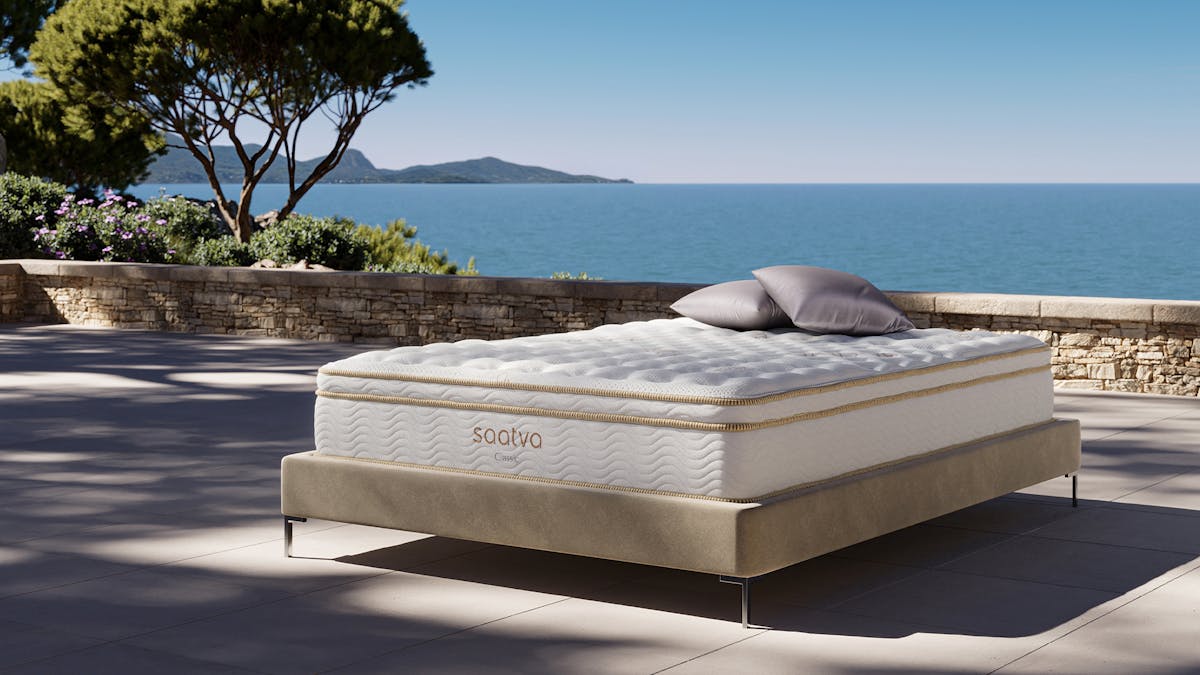
Saatva Classic
9.2/10
- Dual-coil construction provides firm, stable support on any hard surface including the floor
- Zoned lumbar foam pad keeps the lower back supported without a box spring or foundation
- Free white-glove delivery, setup, and old-mattress removal
- 365-night trial and lifetime warranty, the longest policies in the category
- Three firmness options, Luxury Firm is best suited to floor placement
- Heavy and ships flat, not roll-packed, so moving it alone is difficult
- $99 return fee if you choose to return during the trial
The Saatva Classic's coil-on-coil system is inherently self-supporting. On a hard floor surface, the rigid base coils do exactly what a foundation would do: distribute weight evenly and prevent the lumbar zone from sinking. The free white-glove setup means no wrestling a compressed roll into position.
Floor sleeping: what it means for your mattress
Putting a mattress on the floor is a deliberate choice for many sleepers. Japanese culture built an entire sleep tradition around it. Minimalists favor the low-profile aesthetic. Parents use rollable options for guest kids. Travelers or dorm users need something portable that compresses and stores without a frame.
The challenge is that floor placement changes how a mattress performs. Without a box spring or slatted base, airflow under the mattress disappears. Moisture from the floor traps against the underside, and mold becomes a real risk over weeks. A mattress designed with dense, moisture-resistant construction handles this better than budget builds with thin fabric bottoms.
The second issue is support. On the floor, a mattress cannot flex the way it does on slats. Memory foam and medium-density all-foam mattresses benefit slightly from the rigid surface, maintaining their profile more consistently. Very soft mattresses collapse on hard floors; very firm mattresses become punishing without any give from a foundation.
What makes a mattress work on the floor
- Medium firmness (5 to 7/10): the floor adds firmness, so starting medium rather than firm avoids an overly hard sleeping surface.
- Dense or coil base: a high-density support core or dual-coil system does not bottom out against a rigid surface the way thin-base budget foams do.
- Moisture-resistant cover: a tight knit or treated cover slows the moisture absorption that accelerates mold under the mattress.
- Portable options (futon or tri-fold): for truly portable use, a Japanese shikibuton or tri-fold foam pad is the right tool: light, rollable, and purpose-built for floor placement.
Best floor mattress options compared
| Mattress | Type | Firmness | Floor suitability | Trial | Queen price |
|---|---|---|---|---|---|
| Amerisleep AS3 | All-foam (Bio-Pur) | Medium 5/10 | Very good, dense base | 100 nights | From $1,049 |
| Saatva Classic | Dual-coil innerspring | Luxury Firm 6/10 | Excellent, self-supporting coils | 365 nights | From $1,395 |
| Japanese shikibuton | Rollable cotton/wool | Firm 7 to 8/10 | Purpose-built, air daily | Varies | $80 to $300 |
| Tri-fold foam pad | Folding foam | Medium-firm 6/10 | Excellent for occasional use | Varies | $100 to $250 |
Japanese shikibuton and futon-style options
If the intent is truly traditional floor sleeping, a shikibuton, the Japanese rollable cotton-fill mattress, is the purpose-built choice. These run 3 to 4 inches thick, weigh 10 to 20 pounds, roll or fold for daytime storage, and come in at $80 to $300. They are firm by design, reflecting the Japanese philosophy that a firmer sleeping surface supports the spine more consistently.
The practical rule for shikibuton use: do not leave them flat on the floor permanently. Roll them up each morning and stand them to let moisture from body heat dissipate. On hardwood or tile, a thin tatami mat beneath adds insulation and airflow and is traditional practice for exactly this reason.
Tri-fold foam pads (4 to 6 inches, typically CertiPUR-US memory foam) are the American equivalent: portable, foldable, machine-washable cover in most cases, and genuinely functional for guest use at $100 to $250.
Mold prevention: the most overlooked floor mattress problem
Airflow under a mattress is not a luxury feature. It is a moisture-management mechanism. Without it, the underside of the mattress stays damp from condensation, particularly in air-conditioned rooms or on concrete floors. In three to six weeks, that moisture produces visible mold on the fabric bottom and inside the foam layers.
Three practical countermeasures work:
- Stand the mattress up once a week for an hour to let both surfaces air. This applies to any mattress but matters most in humid climates.
- Place a moisture barrier between mattress and floor. A tatami mat, a bamboo mat, or a commercial mattress ventilation pad all work. Even a few strips of pine slatting create enough airflow to extend mattress life significantly.
- Use a mattress protector with a waterproof underside, which slows the condensation transfer from the mattress bottom upward through the foam layers.
Floor sleeping and back pain
Whether floor sleeping helps or hurts back pain depends entirely on the mattress and the sleeper's body weight. For lighter sleepers (under 150 lb) on medium-firm foam, the added firmness from the floor often reduces lumbar sinkage and improves morning pain scores. For heavier sleepers or those with hip and shoulder pressure points, the floor's rigidity removes the cushioning that side sleepers need for neutral spinal alignment.
The clinical guidance on floor sleeping is limited, but the general principle from sleep posture research holds: medium-firm support, not maximum firmness, produces the best outcomes for non-specific lower back pain. A mattress that reads 5 to 6 on firmness on a frame reads closer to 6 to 7 on the floor, which remains within the therapeutic range for most body types.
If floor sleeping worsens back pain consistently after four weeks, the floor is adding too much firmness for your pressure points. The solution is either a mattress topper to soften the surface or switching from floor placement to a low-profile platform bed frame.
Frequently asked questions
Is it bad to sleep on a mattress on the floor?
Not inherently, but mold is the main risk. Without airflow under the mattress, moisture accumulates, and foam and fabric can develop mold within weeks on humid floors. Stand the mattress to air weekly and use a moisture barrier to manage this.
Which type of mattress is best for the floor?
A dense all-foam with medium firmness (like the Amerisleep AS3) or a coil hybrid with a rigid base (like the Saatva Classic) both perform well on the floor. The all-foam option stays comfortable on a rigid surface without a foundation, and the coil option is self-supporting and does not need a foundation to maintain its structure. For portable or traditional use, a shikibuton or tri-fold pad is the right category entirely.
Does floor sleeping help back pain?
For lighter sleepers, the added firmness sometimes reduces lower back sinkage and improves alignment. For side sleepers or heavier bodies, the extra firmness creates pressure points at the hips and shoulders. Results vary, and the four-week mark is the right threshold to evaluate whether floor placement is helping or hurting.
Can you put a Saatva or Amerisleep mattress on the floor?
Both companies technically permit floor use. Saatva notes the 14.5-inch version is not compatible with adjustable bases but does not prohibit floor placement. Amerisleep's warranty covers manufacturing defects and sagging regardless of base type. Neither voids the warranty for floor placement, though a platform frame is always the better long-term choice for moisture control and mattress longevity.
For floor sleeping on a full-size mattress, the Amerisleep AS3 delivers a Medium-feel all-foam build with Bio-Pur foam that handles the rigid surface well on a 100-night trial, with a 20-year warranty and free shipping and returns. For a luxury innerspring alternative, the Saatva Classic in Luxury Firm delivers a self-supporting coil structure that works without a foundation, backed by a 365-night trial and lifetime warranty. Whatever you choose, air it weekly: mold prevention is the single biggest maintenance task for floor mattresses.
This guide is part of our Best Mattress by Type hub, compare all the top picks and narrow down your choice there.