
 by
by Best Mattress by Type — Find the right construction for how you sleep
The right mattress type depends on your sleep position, body weight, and what you want from a bed. Hybrids work for most people, memory foam excels at pressure relief, latex stays cooler and lasts longer, and innerspring gives the most responsive, traditional feel. If you need organic materials or a specific format, scroll to the sub-cluster that fits. Every category below links to a full tested guide.
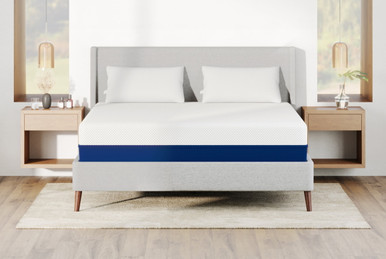
Amerisleep AS3
9.1/10
- HIVE 5-zone support layer firms under the lumbar and softens at the shoulders
- Partially plant-based Bio-Pur foam is open-cell for better airflow
- CertiPUR-US certified; made in the USA
- One design covers back, side, and combination sleepers
- Softer edges than a coil hybrid
- Sleepers over 230 lb may prefer the AS5 Hybrid for more rebound
No matter which mattress type you end up choosing, the AS3 sets the baseline for pressure relief, zoned support, and trial-period confidence that every other pick should be measured against.
How to choose a mattress type
Mattress type describes construction, not quality. A well-made innerspring and a well-made memory-foam bed can both earn a top score; the question is which construction matches your body, your partner, and your habits. The major types differ on four axes:
- Motion isolation: all-foam and latex absorb movement; innerspring transfers it.
- Temperature: innerspring and hybrid run coolest; dense memory foam runs warmest.
- Feel: memory foam hugs and contours; latex bounces back fast; coil beds have the most responsive "on top of" feel.
- Durability: latex and high-quality innerspring last the longest; low-density foam degrades fastest.
The clusters below match you to the type that fits your situation, then link to every tested guide in that category.
Hybrid mattresses
Hybrid beds combine pocketed coils with foam or latex comfort layers. They are the most versatile type: good cooling, decent motion isolation, strong edge support, and a responsive feel that does not lock you in position. Most weight categories and sleep positions are well served by a hybrid.
- Best hybrid mattress — our main tested roundup across all budgets and body types.
- Best hybrid mattresses 2026 — updated picks with current pricing and new lab data.
- Best affordable hybrid mattress — quality coil-foam beds under $900 queen, no sacrifice on support.
Memory foam mattresses
Memory foam contours closely to the body, absorbs motion exceptionally well, and leads on pressure relief for side sleepers and people with joint pain. The trade-off is heat retention in dense foams and a slow-to-rebound feel that some people find restricting. CertiPUR-US certification removes the main off-gassing concern. Plant-based and non-toxic variants extend the category further.
- Best memory foam mattress — the core guide, tested across positions and weights.
- Best memory foam mattresses 2026 — current-year updated rankings.
- Best CertiPUR-US memory foam mattress — certified foams with third-party emission and content testing.
- Best memory foam mattress for couples — motion isolation and edge support prioritized for two sleepers.
- Best non-toxic memory foam mattress — low-emission, additive-minimal options for chemically sensitive sleepers.
- Best plant-based memory foam mattress — partially bio-sourced foams that run cooler than petroleum-based alternatives.
- Best mattress without memory foam — latex, innerspring, and hybrid picks for sleepers who dislike the hug-and-sink feel.
- Best foam mattress — broader foam category covering poly foam and specialty foam constructions.
Latex mattresses
Latex is the most durable mainstream mattress material. It responds faster than memory foam (less "stuck" feeling), sleeps cooler due to an open-cell or pinholestructure, and natural latex is one of the few mattress materials that is genuinely biodegradable. Natural latex commands a premium; synthetic blends bring the price down.
- Best latex mattress — all-latex and latex-hybrid picks, covering Dunlop vs Talalay construction.
- Best natural latex mattress — GOLS-certified natural latex options with full supply-chain transparency.
Innerspring mattresses
Traditional innerspring beds have the highest airflow of any type, a familiar bouncy feel, and strong edge support. Pocketed-coil upgrades deliver better motion isolation than older Bonnell designs. If you want a responsive mattress that does not retain body heat and does not cost as much as a full hybrid, innerspring remains a solid choice.
- Best innerspring mattress — tested coil beds from budget to premium with real lab measurements.
Organic, natural and certified mattresses
Organic certifications (GOTS, GOLS, OEKO-TEX) verify that materials were grown and processed to defined environmental and health standards. This cluster covers organic cotton, organic latex, bamboo covers, and baby and kids options where low off-gassing is not optional.
- Best organic mattress — GOTS/GOLS verified picks across price points.
- Best organic mattresses 2026 — updated with current availability and certification status.
- Best organic mattresses — deeper roundup covering more brands and construction variants.
- Best bamboo mattress — beds with bamboo-derived covers or foam for sleepers prioritizing natural fibers.
- Best organic cotton mattress — GOTS-certified cotton ticking with verified supply chains.
- Best organic mattress for babies — firm, low-VOC beds meeting infant sleep safety guidelines.
- Organic mattress for kids 2026 — updated picks for toddlers and school-age children with growth-stage sizing guidance.
Bed-in-a-box and mail-order mattresses
Bed-in-a-box delivery has made it practical to buy a mattress without visiting a store. The mattress is compressed, rolled, and shipped in a standard box; it expands fully within a few hours. Trial periods (typically 100 to 365 nights) replace the showroom test. Virtually every foam and hybrid bed now ships this way.
- Best bed in a box mattress — the core guide to compressed-delivery beds by type and price.
- Best mattress in a box — alternate roundup with different brand coverage and budget segmentation.
- Best mail order mattress — white-glove and standard delivery options ranked on trial length, return ease, and setup service.
Specialty formats
Some situations call for a non-standard form factor: a floor mattress for a low-profile aesthetic, a folding mattress for a guest room or camping, a low-profile option for high-profile bed frames, or a flippable double-sided bed for even wear.
- Best floor mattress — firm, breathable options designed for direct floor use without a frame.
- Best folding mattress — tri-fold and bi-fold options for guest rooms, camping, and tight storage.
- Best low profile mattress — beds under 8 inches tall for high-platform frames and bunk beds.
- Best flippable mattress — double-sided beds that extend lifespan by distributing wear evenly between surfaces.
Orthopedic mattresses
Orthopedic is not a regulated term, but beds in this category share construction traits aimed at spinal support: firmer cores, zoned firmness layers, and minimal sinkage at the lumbar. They are the go-to for chronic back pain, arthritis, and anyone who wakes with joint stiffness.
- Best orthopedic mattress — support-first picks tested for spinal alignment across back and side positions.
- Orthopedic mattress for elders — firmer, high-edge-support options suited to reduced mobility and easier bed entry and exit.
Technology-forward mattresses
Smart mattresses add active components: dual-zone temperature control, sleep-stage tracking, automatic firmness adjustment, or snore detection. Graphene-infused foams take a passive approach, drawing heat away from the sleep surface through thermal conductivity rather than active cooling.
- Best smart mattress 2026 — active temperature, biometric tracking, and auto-firmness picks for 2026.
- Best graphene mattress 2026 — graphene-infused foam beds evaluated for measurable cooling improvement over standard foam.
Start with the type that matches your sleep position and heat preference, then use the trial period to confirm. The Amerisleep AS3 covers the widest range of sleepers with its 5-zone HIVE layer and 100-night risk-free return. If you already know your type, use the cluster links above to go straight to the tested guide for that category.