
 by
by Our Top Pick
Saatva Classic
Affiliate link — we earn a commission at no extra cost to you.
Mattress size decisions involve more variables than most buyers consider: room dimensions, the height of the people sleeping in the bed, whether there are sleeping partners (human or otherwise), your budget, and whether this is a primary bedroom or a guest room. This guide provides a decision framework for every common situation so you arrive at the right size before you start comparing specific mattresses.
For exact dimensions by size, see our complete mattress sizes guide. This page focuses on the decision logic, not the measurements.
Standard Mattress Sizes at a Glance
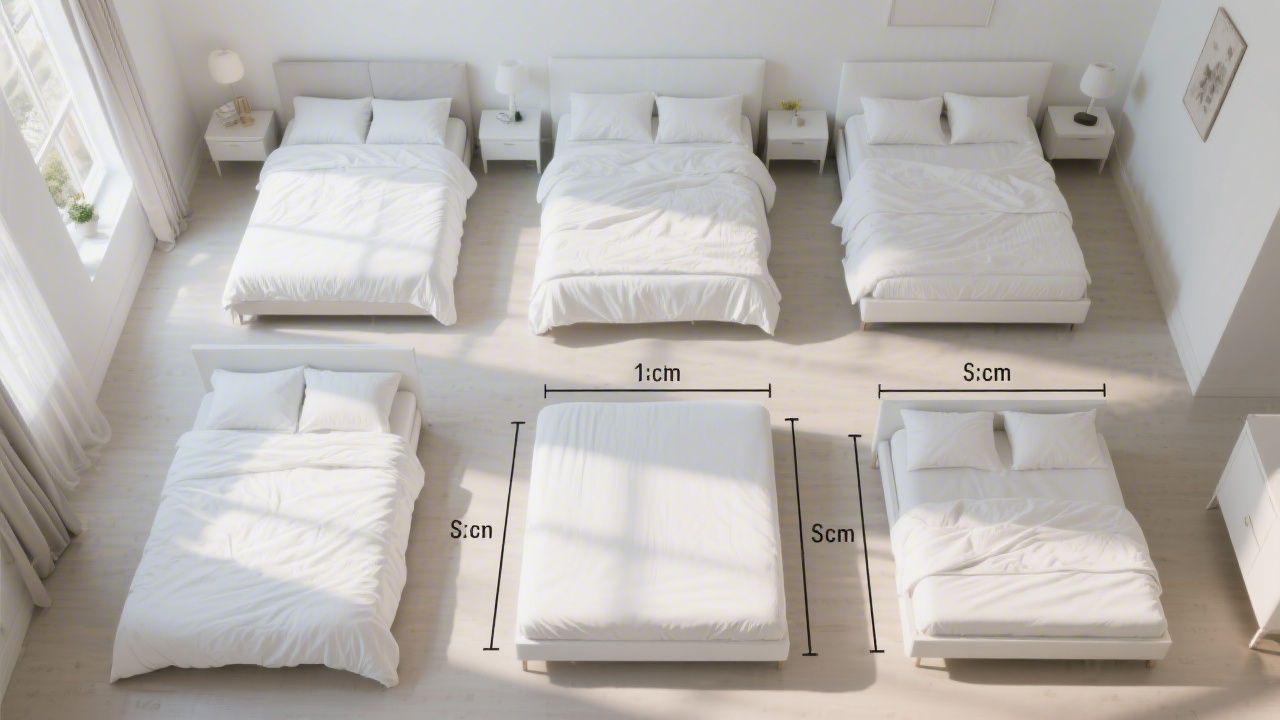
The five standard sizes in increasing order: Twin (38 x 75"), Twin XL (38 x 80"), Full (54 x 75"), Queen (60 x 80"), King (76 x 80"), California King (72 x 84").
Split versions (Split King, Split California King) are two separate mattresses used together — typically for adjustable bed setups where each partner needs different positioning.
Decision Framework: Solo Sleeper
For a single adult sleeping alone:
- Under 6 feet tall, room under 10 x 10 ft: Twin or Twin XL. A Twin XL adds 5 inches of length over a standard Twin, which matters if you are close to or over 6 feet.
- Under 6 feet tall, room 10 x 10 ft or larger: Full or Queen. A full gives more room to spread out without requiring a large bedroom. A Queen is the better long-term investment if the room allows it.
- Over 6 feet tall: Twin XL minimum. A standard Twin (75 inches long) will not accommodate a 6'3" sleeper. Consider a Full or Queen if the room allows — the extra length in non-XL versions (75") may still be tight for tall sleepers.
- Primary adult bedroom: Queen is the standard recommendation for a single adult who wants room to spread out and wants to accommodate an occasional guest without a separate guest room setup.
Decision Framework: Couple
For two adults sharing a mattress:
- Both under 6 feet, room under 12 x 12 ft: Queen. A queen (60 inches wide) gives each person 30 inches of width — adequate for most couples. The minimum room size for a comfortable queen setup is 10 x 12 feet.
- Both under 6 feet, room 12 x 14 ft or larger: King. A king adds 16 inches of total width over a queen (76 inches vs 60 inches), which is a meaningful difference for couples who value space or move frequently at night. Minimum room size for a comfortable king setup is 12 x 14 feet.
- At least one partner over 6'3": California King. The California King is 84 inches long (4 inches longer than a standard King) but 4 inches narrower. Only choose a California King if the length matters — the trade-off in width is real.
- Different sleep needs (one partner needs adjustability): Split King. Two Twin XL mattresses on a dual adjustable base allows each partner to customize their sleeping position and firmness independently.
Decision Framework: Guest Room
Guest rooms present a tension between hospitality and practicality:
- Guest room under 10 x 10 ft: Twin XL. A Twin XL maximizes floor space while providing adequate length for adult guests. The XL version is worth the marginal cost difference over a standard Twin.
- Guest room 10 x 12 ft: Full or Queen. A full is a reasonable middle ground — more comfortable than a Twin for solo guests and workable for two guests who know each other well. A queen is better if the room allows it and occasional couples will use the room.
- Guest room 12 x 14 ft or larger: Queen. The queen is the standard guest room recommendation at this room size. Guests generally expect a queen in a dedicated guest room in a full-size home.
- Budget-constrained guest room: A Full is the most cost-effective option that still provides reasonable hospitality for solo guests.
Decision Framework: Kids and Teens
- Toddler to age 8: Twin. A Twin is standard for children's rooms. It maximizes floor space for play, accommodates sleepovers on the floor, and is easy to outfit with affordable bedding.
- Ages 8–12: Twin or Twin XL depending on child's height. At this age some children are approaching heights where a standard Twin (75") will be limiting within a few years.
- Teens: Twin XL minimum. Teenagers grow, and a Twin XL will accommodate adult height. If the room allows, a Full gives a teen more space and the mattress will remain usable if they take it to college or an apartment.
Room Size Minimums: Quick Reference
These are functional minimums — enough space to walk around three sides of the bed and open nightstand drawers:
- Twin: 8 x 10 ft
- Twin XL: 8 x 10 ft
- Full: 10 x 10 ft
- Queen: 10 x 12 ft
- King: 12 x 14 ft
- California King: 12 x 14 ft
For rooms under these minimums, go down one size. The discomfort of a slightly smaller mattress is less than the discomfort of a room where you cannot walk around the bed without turning sideways.
Budget Considerations
Moving from queen to king typically costs $300–$600 extra on the mattress alone. Then add king-size sheets, duvet covers, and potentially a new bed frame. The total upgrade cost is often $500–$1,000 more than the equivalent queen setup. If you are choosing between a mid-range king and a premium queen, the premium queen is usually the better investment in sleep quality.
See our best mattress rankings for size-specific pricing across all major brands. Our Saatva Classic review includes pricing for all sizes from Twin to Split King.
Frequently Asked Questions
What is the minimum room size for a queen mattress?
The minimum recommended room size for a queen bed is 10 x 10 feet, though 10 x 12 is more comfortable. A queen mattress (60 x 80 inches) in a 10 x 10 room leaves very limited floor space around the bed, which can make the room feel cramped and creates accessibility issues if you need to make the bed from all sides.
Is a queen big enough for two people?
A queen mattress gives each person about 30 inches of width — roughly the width of a crib. Most couples find this adequate for sleep, though it does require some accommodation. Couples with significant height difference or one partner who moves frequently may find a king more comfortable. There is no definitive answer: if you have slept well in a queen together, it is working.
How much taller is a California king than a king?
A California king (72 x 84 inches) is 4 inches longer and 4 inches narrower than a standard king (76 x 80 inches). A California king is not simply a 'tall king' — it is narrower, which matters if you are a couple who values width over length. The California king is only the right choice if at least one sleeper is 6'3" or taller.
Does mattress size affect price significantly?
Yes. Moving from a queen to a king typically adds $300–$600 to the mattress cost, and proportionally more for premium brands. You also need to budget for king-size bedding, which costs more than queen-size. If you are on a budget, the queen is almost always the better value unless the king is genuinely necessary.
Can a full mattress work for two adults?
Technically yes, but a full mattress (54 x 75 inches) gives each person only 27 inches of width — less than a twin. Most couples find this uncomfortable for regular use. A full is better suited to a single adult in a small room or a guest room that occasionally hosts two guests.
Our Top Pick
Saatva Classic
Affiliate link — we earn a commission at no extra cost to you.