
 by
by Top Pick
Saatva Classic
Dual-coil innerspring with Euro pillow top — handcrafted in the USA.
Starting at $1,174 • Free white-glove delivery • 365-night trial
The Support Core's Role
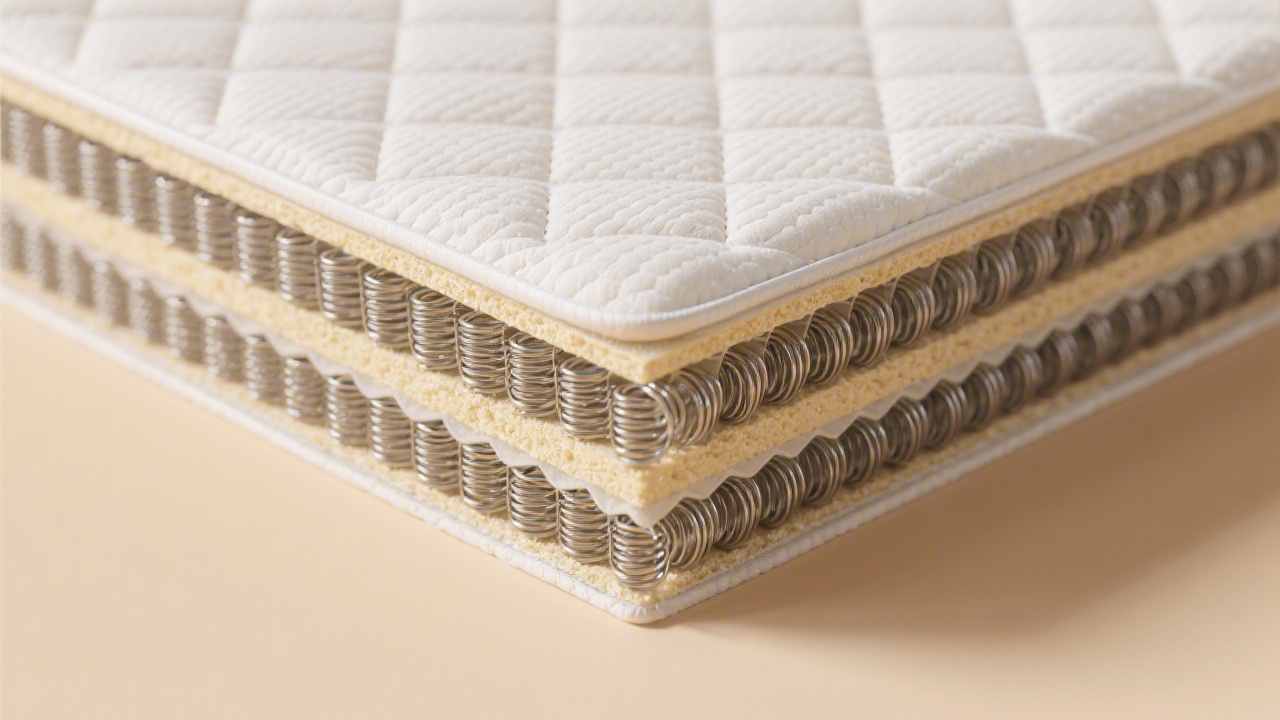
The support core is the load-bearing foundation of a mattress. While comfort layers determine how the mattress feels, the support core determines whether the mattress holds its structure over 5, 10, or 15 years of use. A mattress with an excellent comfort layer on a failing support core will sag, lose spinal support, and cause pain — often within a few years.
Mattress marketing focuses heavily on comfort layers because they are easier to describe and demonstrate. Support core quality is harder to communicate but arguably more important for long-term satisfaction with a mattress purchase.
Coil Support Cores
Pocketed Coil Systems
Individually pocketed coils are the standard in premium hybrid mattresses. Each coil is encased in a fabric pocket, allowing it to compress independently. The advantages: superior motion isolation compared to other coil systems (coils that don't interconnect don't transfer motion as efficiently), precise point-by-point support, and the ability to use different coil gauges in different zones (firmer under the lumbar, more flexible under the shoulders).
Pocketed coil quality is determined by coil count, gauge, coil height, and tempering. A queen mattress with 900-1000 individually pocketed support coils, 13-gauge wire, and tempered steel represents a high-quality support core. Fewer than 800 coils per queen or unspecified gauge is a quality concern.
Offset Coil Systems
Offset coils are hourglass-shaped coils connected by a hinge mechanism that gives them a hinge-like action — firmer when fully compressed, more flexible in the initial compression phase. This design is associated with traditional premium innerspring mattresses and is used in the base layer of the Saatva Classic. Offset coils interlock at their ends, which provides excellent edge support and durability.
Continuous Coil Systems
Continuous wire coil systems form each row of coils from a single piece of wire. They are less expensive to manufacture and less capable of independent compression. Motion transfer is higher than pocketed coil systems. Continuous coil mattresses are generally found in the budget to mid-range segment and are adequate for dorm rooms and guest rooms but not recommended for primary use by adults over 200 lbs.
Foam Support Cores
High-Density Polyfoam
All-foam mattresses use a high-density polyfoam (HDPF) support core. Density is the critical specification: the minimum acceptable density for a support core is 1.8 PCF; 2.0-2.5 PCF is better; anything below 1.5 PCF will develop permanent body impressions within 2-4 years under normal use.
Foam support cores are silent (no coil sounds), perform well for motion isolation, and are compatible with adjustable bases (coil cores can sometimes be damaged by extreme articulation). They retain more heat than coil cores, which is the primary performance trade-off.
Natural Latex Cores
All-latex mattresses use a latex support core — either natural latex, synthetic latex, or a blend. Natural latex (Talalay or Dunlop processed) has exceptional durability: a high-quality latex core can maintain its support properties for 15-20 years, outlasting any foam or coil alternative. The cost is significantly higher, and the weight makes all-latex mattresses among the heaviest available (a queen can exceed 100 lbs).
What to Verify in Support Core Specifications
When comparing mattresses, the following support core specifications are worth confirming:
- Coil gauge — 13-14 gauge for standard use; 12-13 for heavier sleepers
- Coil count — 800-1000 per queen minimum for premium hybrids
- Foam density (PCF) — 1.8 minimum, 2.0+ recommended for foam cores
- Edge support construction — reinforced perimeter coils or foam encasement; weak edge support reduces the usable surface area and accelerates edge wear
- Tempered steel — heat-treated steel coils resist fatigue cracking better than non-tempered wire
Support Core and Warranty Coverage
Support core failure — specifically, permanent body impressions — is what most mattress warranties actually cover. The threshold is typically a 1-1.5 inch impression when the mattress is unoccupied. Saatva's 15-year warranty includes this coverage. Evaluating warranty terms reveals how confident a manufacturer is in their support core construction: shorter warranties or higher impression thresholds for coverage indicate less confidence in core durability.
Related Guides
See our best innerspring mattress guide for a detailed coil system comparison, our Saatva Classic review as an example of premium offset coil construction, our mattress durability guide for lifespan data by construction type, and our mattress foundation guide for how base support interacts with the mattress support core.
Frequently Asked Questions
What is the support core of a mattress?
The support core is the bottom structural layer of a mattress. It provides the foundational firmness and prevents sagging. Everything above it — comfort layers, transition layers, pillow tops — rests on the support core. Its material, thickness, and construction quality are the primary determinants of a mattress's structural durability over time.
What types of support cores are available?
The main support core types are: pocketed coil (individually wrapped springs, best motion isolation among coil types), offset coil (hourglass-shaped, firmer, traditional innerspring quality), continuous coil (single wire, least expensive, adequate but more motion transfer), high-density foam (common in all-foam mattresses, quality depends heavily on density), and natural latex (most durable, expensive, found in premium foam alternatives).
How do I know if my mattress support core is failing?
Signs of support core failure: visible sagging in the sleeping area when the mattress is unoccupied, a 'hammock' feeling where your body sinks into a dip, waking with back or hip pain that was not present when the mattress was new, and a noticeable asymmetry in firmness across the mattress surface. Coil failure may also produce squeaking sounds when moving.
What is a high-density foam support core?
High-density foam support cores use polyurethane foam with a density of 1.8 PCF or higher (some premium versions reach 2.5-3 PCF). The foam provides a solid, firm base without the motion transfer of coils. Memory foam mattresses use high-density foam cores to prevent the softer memory foam comfort layers from sinking through to the floor. Durability varies significantly by density — 1.8 PCF is adequate; below 1.5 PCF is a warning sign.
Is a coil support core better than foam?
For most sleepers, coil support cores outperform foam on durability and airflow, while foam cores outperform on motion isolation. Coils maintain their structural integrity longer under heavy loads. Foam cores can develop permanent compression (body impressions) over time. Coil cores also allow air to flow through the mattress base, while foam cores trap heat. The choice depends on priorities: couples prioritizing motion isolation favor foam; sleepers prioritizing durability and airflow favor coil.
Our Recommendation
Saatva Classic
Dual-coil innerspring with Euro pillow top — handcrafted in the USA.
Starting at $1,174 • Free white-glove delivery • 365-night trial