
 by
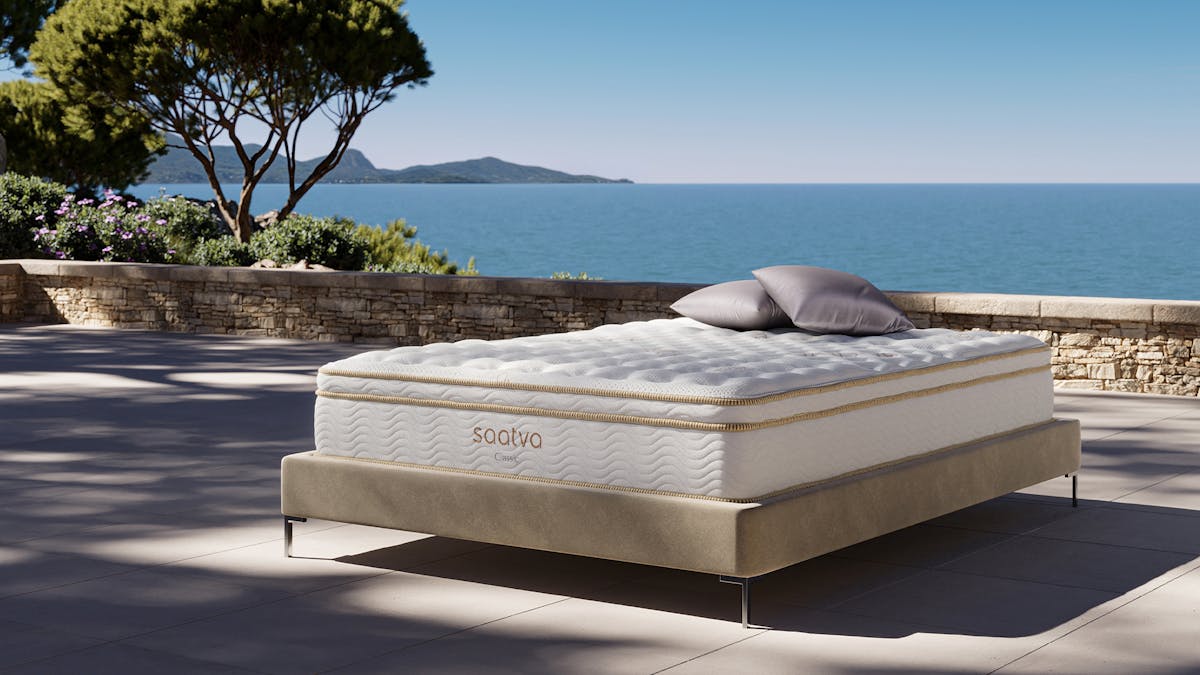
by A standalone mattress delivers 80% of your sleep quality improvement at a fraction of the cost. Unless you have acid reflux, snoring, or severe back pain, skip the bundled sleep system and put that budget into a better mattress. Our top pick for most sleepers is the Saatva Classic: dual-coil construction, zoned lumbar support, 365-night trial, and white-glove delivery, the mattress that a premium sleep system is built around anyway.
Saatva Classic
9.4/10
- Dual-coil system with a zoned lumbar foam pad, supports the spine without sacrificing comfort layer softness
- Outstanding cooling (max surface 89.5°F) thanks to open-coil airflow
- Strong edge support (only 2.25" sitting sinkage), full usable surface area
- Free white-glove delivery: in-room setup and old-mattress removal
- 365-night home trial; lifetime warranty
- Ships flat, not compressed, needs white-glove appointment
- Moderate motion isolation compared to all-foam beds
- $99 return transport fee during trial period
The Saatva Classic is the mattress you would find at the center of any well-designed sleep system. Buying it standalone at $1,595 queen gives you the same spine support and luxury feel without the $2,000-$4,000 bundle premium. If you later decide you need an adjustable base, Saatva's Lineal base pairs with it perfectly.
What is a sleep system, exactly?
A sleep system is a bundled package sold by mattress retailers that typically includes a mattress, an adjustable base or foundation, and one or more accessories such as pillows, sheets, a mattress protector, or a smart-cover. Retailers market them as a holistic sleep upgrade, often at a package price that appears discounted against buying each component separately.
Common sleep system bundles include:
- Entry-level system ($1,500-$2,500): mattress + basic foundation or platform base
- Mid-tier system ($3,000-$5,000): mattress + adjustable base with head/foot articulation + pillow set
- Premium system ($5,000-$10,000+): mattress + split-king adjustable base + smart cover (Eight Sleep, OOLER) + premium bedding
The core question is whether the premium you pay for a bundled system delivers proportional sleep quality improvement over a good standalone mattress.
Component value: what actually moves the needle
Every component in a sleep system has a different marginal impact on actual sleep quality. Here is an honest breakdown:
Mattress, highest ROI, non-negotiable
The mattress is the only component with a high, unconditional impact on sleep quality. Spinal alignment, pressure relief, temperature regulation, and motion isolation are all primarily determined by the mattress, not by what sits under or around it. A poor mattress cannot be rescued by premium accessories. A great mattress functions well on a simple platform or box spring.
Allocation rule: put 60-70% of your total sleep budget here. For most queen sleepers, $1,400-$2,000 lands in the sweet spot where construction quality is genuinely excellent and cost is not yet driven by branding.
Adjustable base, high value for specific conditions, comfort feature otherwise
An adjustable base earns its cost if you have acid reflux, sleep apnea, snoring, or chronic lower back pain. Elevating the head 15-45 degrees has clinical support for all four conditions. For everyone else, adjustable bases are a convenience feature, reading in bed, zero-gravity preset, not a sleep quality driver.
Cost reality: a quality single adjustable base runs $400-$800. Split king bases (dual-zone, each side independent) run $1,200-$1,800. The premium sleep system bundles often include a mid-tier base marked up significantly from standalone pricing.
Pillows, high value for neck pain, moderate otherwise
Pillow loft must match shoulder width and sleep position to prevent cervical strain. Side sleepers typically need 4-6 inches of loft; back sleepers 3-4 inches; stomach sleepers prefer flat. An incorrect pillow partially offsets a good mattress. Budget $80-$150 for a quality pillow matched to your position.
Sheets, high value for hot sleepers only
Percale cotton and bamboo-derived fabrics provide measurably better moisture wicking than polyester blends. For hot sleepers, this matters. For neutral or cold sleepers, the upgrade from mid-range to premium sheets produces minimal functional change in sleep architecture, it affects feel, not sleep staging.
Mattress protector, low cost, high protection, always worth it
A waterproof mattress protector ($40-$80) preserves the mattress warranty, guards against spills and sweat, and reduces allergen accumulation. The cost-to-protection ratio is the best in the entire system. This one is a straightforward yes regardless of budget.
Mattress topper, situational, not a substitute
Toppers add surface softness, not structural support. They compress within 1-2 years of regular use. A topper is appropriate when a structurally sound mattress is slightly firmer than preferred, not as a primary comfort upgrade. Never use a topper to compensate for a worn or fundamentally inadequate mattress.
Mattress vs complete sleep system, at a glance
| Factor | Standalone mattress | Complete sleep system |
|---|---|---|
| Sleep quality impact | High, determined primarily by mattress construction | Marginal uplift beyond mattress (for most sleepers) |
| Cost range (queen) | $1,400-$2,200 for a quality mattress | $3,000-$10,000+ bundled |
| Adjustable base | Not included; can add later for $400-$800 | Included; often marked up in bundle |
| Trial flexibility | Full trial on the mattress (100-365 nights) | Trial terms vary by component; base often non-returnable |
| Best for | Most sleepers; those without acid reflux or snoring | Sleepers with acid reflux, snoring, sleep apnea, severe back pain |
| Value | Excellent, budget focused on highest-ROI component | Variable, depends heavily on bundle composition |
When a complete sleep system is worth it
There are four scenarios where investing in a full sleep system is genuinely justified:
- Acid reflux or GERD: Elevating the head 6-8 inches reduces nighttime reflux symptoms. This requires an adjustable base, a wedge pillow is a poor substitute for head elevation distributed across the torso, not just the neck.
- Obstructive sleep apnea or chronic snoring: Head elevation reduces airway collapse. If you use a CPAP, adjustable positioning also helps with hose management and mask seal.
- Chronic lower back pain: Zero-gravity positioning (simultaneous head and foot elevation) reduces lumbar disc pressure, which can meaningfully improve sleep quality and morning stiffness for back pain sufferers.
- Couples with different firmness preferences: A split-king adjustable system (two twin XL mattresses on independent bases) is the only way to give both sleepers full customization without compromise.
If none of these apply, a standalone mattress on a quality box spring or platform frame delivers equivalent or better sleep quality per dollar.
Recommended budget allocation
| Component | Recommended spend | Priority |
|---|---|---|
| Mattress | $1,595 (Saatva Classic) or $1,049+ (Amerisleep AS3) | 1, Non-negotiable |
| Pillow(s) | $80-$150 each | 2, Always |
| Mattress protector | $40-$80 | 2, Always |
| Sheets | $100-$200 percale or bamboo | 3, Hot sleepers only |
| Adjustable base | $400-$800 standalone | Conditional, buy only if you have qualifying condition |
| Smart cover (active cooling) | $1,500-$2,000+ | Optional, only if hot sleeping is severe and sheets don't solve it |
Amerisleep AS3
8.9/10
- HIVE 5-zone support firms specifically under the lumbar, strongest zoned all-foam on the market
- Plant-based Bio-Pur foam sleeps cooler than standard memory foam
- CertiPUR-US certified, made in the USA
- 20-year warranty, 100-night trial
- Softer edges than a coil hybrid
- 100-night trial is shorter than Saatva's 365-night
At $1,049 queen, the AS3 is the best standalone mattress value for side and combination sleepers who want all-foam pressure relief without the coil noise. Pairs with any adjustable base if you decide to add one later.
The Saatva approach: standalone that scales to a system
Saatva sells both the Classic mattress and their Lineal adjustable base separately and as a combination. This is worth noting because it inverts the standard sales model: instead of bundling components you may not need, you can buy the mattress now on its 365-night trial and decide on the base later. The dual-coil construction of the Classic is flexible enough for full articulation on an adjustable base without the coil-damage risk that affects other innerspring designs.
If you later add the Saatva Lineal base, you get the full adjustable system without paying for it upfront. It is the most rational purchase sequence if you are unsure whether you need an adjustable base.
Frequently asked questions
Does a sleep system actually improve sleep quality over a good standalone mattress?
For most sleepers, no, not meaningfully. Sleep quality is primarily determined by the mattress, not by the accessories around it. The exception is sleepers with acid reflux, snoring, sleep apnea, or severe back pain, who do see measurable improvement from an adjustable base.
Is an adjustable base worth the cost?
For specific medical conditions (acid reflux, sleep apnea, snoring, lower back pain), yes, head elevation has clinical support. For everyone else, it is a comfort feature, not a sleep quality driver. Buy it if you have a qualifying condition; skip it if you don't and put the budget toward a better mattress.
What order should I upgrade my sleep setup?
Mattress first, always. Then pillow matched to your sleep position. Then a mattress protector. Then sheets if you sleep hot. Then an adjustable base if you have a medical reason. Toppers and smart covers last, and only if the earlier layers have not solved the problem.
Are premium sheets worth the extra cost?
For hot sleepers, yes, percale cotton and bamboo-derived sheets wick moisture measurably better than polyester blends. For neutral or cold sleepers, the upgrade has minimal impact on sleep architecture. Invest here only after the mattress and pillow are right.
Can I add an adjustable base to the Saatva Classic later?
Yes. The Saatva Classic is compatible with the Saatva Lineal adjustable base, and the dual-coil construction handles articulation without coil damage. You can buy the mattress now on the 365-night trial and add the base separately once you determine whether you need it.
For most sleepers, a quality standalone mattress like the Saatva Classic delivers superior value over a bundled sleep system. Save the system premium for an adjustable base only if you have acid reflux, snoring, sleep apnea, or chronic back pain, conditions with documented clinical benefit from head elevation.