
 by
by Our pick: Saatva Loom & Leaf
Consistently top-rated for construction quality and independently verified coil/foam specs.
What Memory Foam Density Actually Measures
Density in the context of memory foam is simply mass per unit volume — specifically, how much one cubic foot of foam weighs in pounds. A 4 lb/ft³ foam means a 12"×12"×12" cube of that foam weighs 4 pounds. Higher density means more raw material (polyol and diisocyanate polymer) per unit of space — more material equals higher quality and longer lifespan.
This is critically different from firmness, which is measured separately by ILD (Indentation Load Deflection). A high-density memory foam can be soft (low ILD), and a low-density foam can be firm (high ILD). Density and firmness are independent variables. Most shoppers conflate them — which is exactly why many brands don't publish density specs prominently.
The Density Scale: What the Numbers Mean
| Density | Quality Tier | Expected Lifespan | Best For |
|---|---|---|---|
| Below 3 lb/ft³ | Budget | 2–4 years | Guest room, temporary use |
| 3–3.9 lb/ft³ | Entry-level | 4–6 years | Light sleepers under 130 lbs |
| 4–4.9 lb/ft³ | Standard | 7–10 years | Most adult sleepers |
| 5+ lb/ft³ | High Density | 10–15+ years | Heavier sleepers, long-term investment |
Why Low-Density Foam Fails Faster
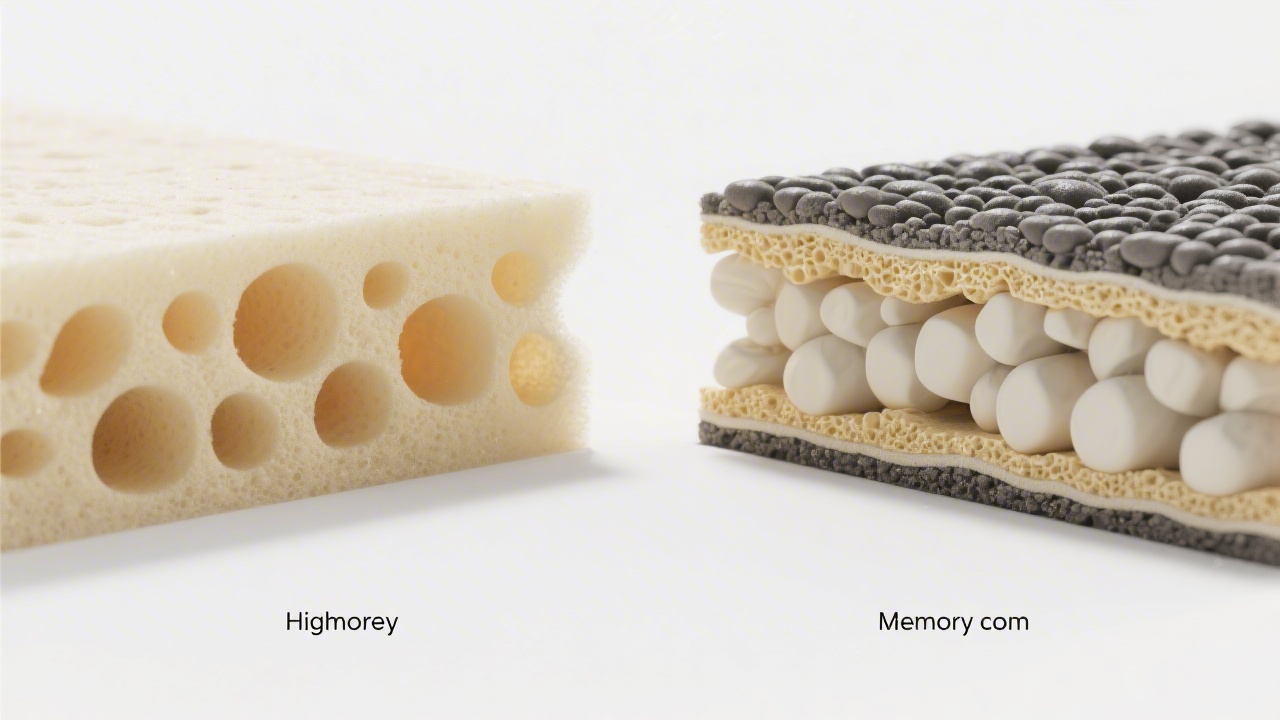
Low-density memory foam has a sparse polymer matrix — fewer polymer strands per cubic inch means each strand bears more stress during compression. Over months and years of regular use, these strands fatigue and break down. The result is the permanent body impression (sagging) that renders a mattress unsupportive.
A 2.5 lb/ft³ foam mattress that feels fine in the store may develop visible body impressions within 18–24 months of regular use. The foam doesn't disappear — it just loses its ability to recover. This is also why lightweight sleepers can extend the life of low-density foam further than heavier sleepers: less force per session means slower polymer fatigue.
High-Density Foam: Trade-offs to Know
5+ lb/ft³ memory foam is genuinely better in durability and support maintenance. But there are trade-offs:
- Heat retention: Denser foam has less air space, which means less airflow and more heat retention. High-density foam is inherently warmer than lower-density foam. Gel infusion and copper infusion are specifically developed to address this in high-density applications.
- Heavier mattress: More material equals more weight. A high-density foam mattress can be significantly heavier than a budget foam mattress, which matters during setup and rotation.
- Slower response: Higher-density viscoelastic foam is typically slower to recover shape — more "stuck" feeling. For those who change positions frequently, this can be a factor.
- Higher price: More raw material = higher manufacturing cost = higher retail price. 5+ lb foam mattresses rarely cost less than $1,200 for a queen.
How to Find Density Specs When Brands Don't List Them
Many brands either don't publish density or bury it in FAQ sections. Strategies for getting the real number:
- Check the brand's spec sheet PDF if available (often linked in the footer or help center).
- Contact customer service directly — ask specifically for "memory foam density in lbs per cubic foot."
- Look for third-party reviews that include foam core sampling (some mattress review sites have done physical testing).
- Use mattress weight as a proxy: a queen mattress under 60 lbs that claims premium memory foam is almost certainly using lower density foam.
The Saatva Loom & Leaf uses 5 lb/ft³ memory foam as its core — one of the few mainstream brands that explicitly publishes this spec and uses genuinely high-density foam at its price point.
Density by Layer: Support Core vs Comfort Layer
Density requirements differ by layer function. For a comfort layer (the top 2–4 inches you directly compress), 4–5 lb is ideal — high enough for durability, low enough to allow adequate contouring without excessive heat. For a transition layer or support base, 1.8–2.0 lb/ft³ high-resilience polyfoam is appropriate and cost-effective — this layer needs firmness and durability, not contouring.
Be wary of brands that advertise "5 lb memory foam" without specifying which layer. A 1-inch 5 lb foam topper on top of 7 inches of 2 lb base foam is not the same as a 3-inch 5 lb comfort layer.
Related reading: our foam types comparison, mattress price guide, and how often to replace your mattress.
Our pick: Saatva Loom & Leaf
Consistently top-rated for construction quality and independently verified coil/foam specs.
Frequently Asked Questions
Voted best luxury innerspring mattress with exceptional lumbar support and white-glove delivery.
Check Price & Availability FAQPage", "mainEntity": [ {"@type":"Question","name":"What is considered high density memory foam?","acceptedAnswer":{"@type":"Answer","text":"5 lbs per cubic foot or above is considered high density memory foam. This tier is significantly more durable than 3-4 lb foam and is appropriate for long-term use by most adult sleepers, particularly those over 180 lbs."}}, {"@type":"Question","name":"Is higher density memory foam firmer?","acceptedAnswer":{"@type":"Answer","text":"Not necessarily. Density and firmness are different properties. Density measures how much material is in a given volume; firmness is measured by ILD (how much force is needed to compress the foam). High-density foam can be soft, medium, or firm."}}, {"@type":"Question","name":"Does high density memory foam sleep hot?","acceptedAnswer":{"@type":"Answer","text":"High-density foam tends to sleep warmer because it has less air space. Manufacturers address this with gel infusion, copper infusion, or open-cell foam processing. If you sleep hot, look for high-density foam with one of these thermal management features."}}, {"@type":"Question","name":"What density memory foam is best for heavy people?","acceptedAnswer":{"@type":"Answer","text":"Sleepers over 230 lbs should look for 5+ lb/ft³ memory foam. At this weight, lower density foams compress more aggressively and develop body impressions significantly faster. High density foam also maintains support structure longer under higher loads."}}, {"@type":"Question","name":"How do I find the density of my mattress foam?","acceptedAnswer":{"@type":"Answer","text":"Check the brand's spec sheet PDF, or contact customer service and ask specifically for 'memory foam density in lbs per cubic foot.' If a brand can't or won't provide this number, that's telling. Mattress weight is a rough proxy — heavier mattresses at the same thickness generally use higher density foam."}} ] }What is considered high density memory foam?
5 lb/ft³ or above. This tier is significantly more durable and appropriate for long-term use, particularly for sleepers over 180 lbs.
Is higher density memory foam firmer?
Not necessarily. Density and firmness are independent properties. High-density foam can be soft, medium, or firm — density measures material content, not compression resistance.
Does high density memory foam sleep hot?
Tends to, yes. Denser foam has less air space. Manufacturers address this with gel infusion, copper infusion, or open-cell processing — look for these features if you sleep hot.
What density memory foam is best for heavy people?
Sleepers over 230 lbs should look for 5+ lb/ft³. Lower-density foams compress more aggressively under higher loads and develop body impressions faster.
How do I find the density of my mattress foam?
Check the brand's spec PDF or contact customer service directly. Ask for "memory foam density in lbs per cubic foot." If they can't or won't provide it, that's a flag.