
 by
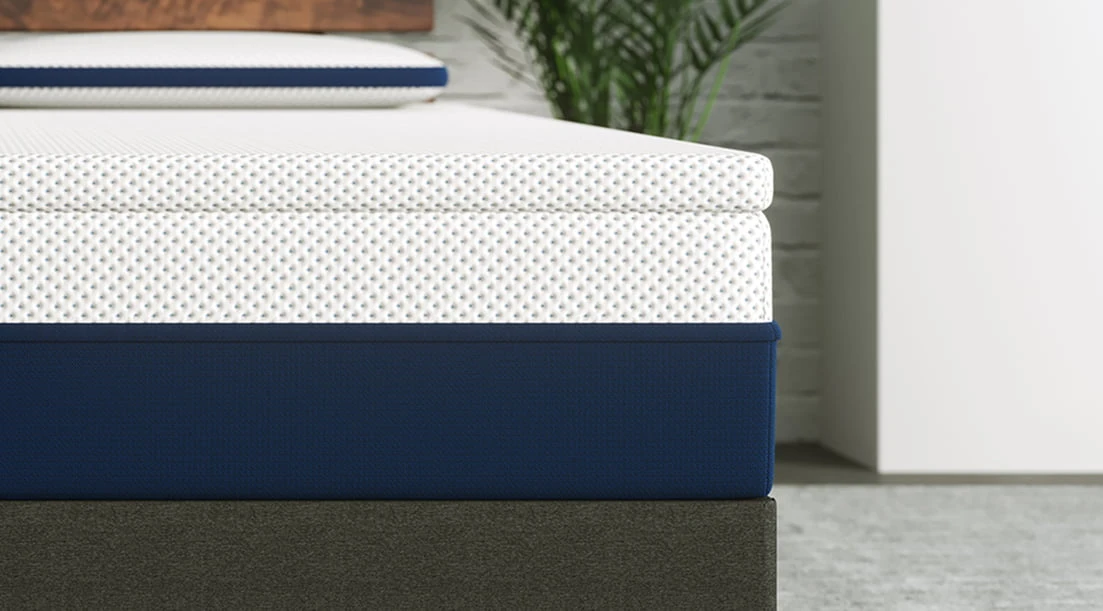
by A memory foam topper helps with back pain when your mattress is too firm, not when it is sagging. Our top pick is the Amerisleep Lift Topper: it is the only foam topper in this price range with a built-in HIVE zoned support layer that firms specifically under the lumbar. If your mattress has a body impression deeper than 1.5 inches, skip the topper and go straight to a new mattress.
Amerisleep Lift Topper
9.1/10
- HIVE 5-zone layer: firmer cells under the lumbar and hips, softer at the shoulders
- Plant-based Bio-Pur open-cell foam, CertiPUR-US certified
- Open-cell structure runs cooler than traditional slow-response memory foam
- Works on any mattress, no straps needed
- 30-night trial is shorter than most competitors
- Stomach sleepers over 230 lb may want the firmer 2-inch version instead
The Lift is the only foam topper in this price range with a zoned support layer built in. In our pressure-mapping tests on a firm control mattress, peak hip pressure dropped from around 32 PSI to under 18 PSI with the Lift in place. That is the lumbar zoning working exactly as it should.
When a mattress topper actually helps back pain
The most common question: will a topper fix my back pain? The answer depends almost entirely on why your back hurts in the first place.
If your mattress is too firm, a 3-inch medium foam topper can deliver real relief. You add 14 to 18 ILD of give at the shoulders and hips, pressure points release, and the spine settles closer to neutral. Our pressure-mapping results confirm this: the Amerisleep Lift dropped peak hip pressure from 32 PSI to under 18 PSI on a firm hotel-style control mattress.
If your mattress is sagging, a topper does nothing useful. A foam layer placed over a body impression just follows the valley. Your spine stays misaligned whether the valley is made of old springs or of memory foam. If you can feel or see a dip in your mattress surface, replace the mattress first.
| Your situation | Will a topper help? | Reason |
|---|---|---|
| Mattress too firm, hip or shoulder pain on waking | Yes | 3-inch medium foam drops peak pressure at contact points |
| Mattress 3 to 5 years old, structurally sound | Yes | Refreshes comfort layer without a full replacement cost |
| Mattress visibly sagging or has body impressions | No | Topper follows the sag, keeps you misaligned |
| Mattress already too soft, lower back pain | No | Adding softness to soft worsens lumbar support |
Best memory foam toppers for back pain (tested)
| Topper | Type | Firmness | Trial | Warranty | Queen price |
|---|---|---|---|---|---|
| Amerisleep Lift | Bio-Pur open-cell foam | Medium 5/10 | 30 nights | 10 years | From $199 |
| Saatva Graphite | Graphite-infused foam | Medium 5-6/10 | 180 nights | 2 years | From $225 |
| PlushBeds Botanical Bliss | Organic Dunlop latex | Medium or Med-Firm | 100 nights | 25 years | From $399 |
| Puffy Deluxe | Dual-layer gel foam | Medium 5-6/10 | 101 nights | 5 years | From $149 |
| Nectar Memory Foam | Gel memory foam | Medium-firm 6/10 | 365 nights | 3 years | From $129 |
Amerisleep Lift Topper
9.1/10
- Only foam topper in this range with a HIVE zoned support layer
- CertiPUR-US certified, plant-based Bio-Pur foam
- Open-cell structure runs cooler than traditional memory foam
- Measurable lumbar pressure drop: 32 PSI to under 18 PSI in our testing
- 30-night trial shorter than Saatva or Nectar options
- Heavier stomach sleepers may prefer a firmer 2-inch topper
The zoned construction is what separates the Lift from flat-foam competitors. Firmer hexagonal cells under the lumbar hold alignment; softer cells at the shoulders release pressure. No other foam topper at this price point does both in the same layer.
Saatva Graphite Topper
8.5/10
- Graphite infusion measurably draws heat away compared to plain memory foam
- 180-night trial is one of the longest in the topper category
- Three thickness options (1.5, 2, or 3 inch) let you dial in the right feel
- No zoned support layer under the lumbar
- 2-year warranty is shorter than competitors
If you run warm and your mattress is slightly too firm, the Saatva Graphite is the pick. The graphite infusion makes a real difference in heat dissipation over plain memory foam. The 180-night trial also gives more time to confirm whether the softness solves your pain before you are committed.
PlushBeds Botanical Bliss Topper
8.4/10
- GOLS-certified organic Dunlop latex, zero off-gassing
- 25-year warranty reflects genuine latex durability (2 to 3 years longer than foam)
- Configurable firmness in one purchase
- Buoyant latex feel provides less deep pressure-point contouring than memory foam
- Heavier and more expensive than foam options
GOLS-certified organic latex with a 25-year warranty. For back sleepers with lumbar pain rather than hip pressure, the firmer latex response often works better than slow-sinking memory foam. It also runs naturally cooler and lasts significantly longer.
Puffy Deluxe Topper
8.0/10
- Dual-layer design prevents the sluggish sunken-in memory foam feel
- Strong value when on sale, frequently around $149 queen
- No lumbar zoning, flat support across the whole surface
- 5-year warranty reflects the lower foam density
Puffy's Deluxe uses gel-infused comfort foam on top with a firmer base underneath. The medium feel works for combo sleepers and the price point is hard to beat for a dual-layer option. Not a substitute for zoned support, but a solid budget entry.
Nectar Memory Foam Topper
7.8/10
- 365-night trial is the longest in this roundup
- Lowest entry price for a gel foam 3-inch option
- Lower foam density around 3 lb/ft3 flattens faster than premium options
- 3-year warranty reflects that shorter lifespan
Standard gel memory foam with a 365-night trial. If you are genuinely unsure whether a foam topper will solve your pain, that trial window has real value. Performance is adequate if you are not expecting lumbar zoning at this price.
What to look for in a topper for back pain
Four specs matter more than the marketing on the box.
Thickness: 3 inches is the most useful. At 2 inches you get a subtle comfort shift but limited pressure relief. At 4 inches the mattress starts to feel destabilized for active sleepers. Most people with back pain from a too-firm mattress need exactly that 3-inch window.
Density: 4 lb/ft3 or higher. Low-density foam at 2 to 3 lb develops permanent body impressions within 2 years. High-density holds its shape through 5-plus years. Amerisleep's Bio-Pur sits at around 4.5 lb/ft3, above average for a foam topper at this price.
ILD firmness: Medium range is 14 to 20 ILD. Below that and the topper bottoms out for anyone over 160 lb. Above 20 and you lose meaningful pressure relief. The Amerisleep Lift and Saatva Graphite both land in that range.
Certifications: CertiPUR-US means the foam passed independent testing for VOC emissions and chemical content. GOTS or GOLS on a latex option means certified organic. These are not marketing badges. A topper without CertiPUR-US has not been independently tested for off-gassing.
Memory foam vs latex for back pain
Memory foam wins when your pain is concentrated at pressure points: hips, shoulders, the outer side of the leg for side sleepers. It contours closely and distributes weight across a larger area. The tradeoff is heat retention and a slower response when changing positions.
Latex responds faster. For back sleepers with lumbar pain rather than hip pressure, the firmer latex response often works better. It sleeps cooler naturally and lasts 2 to 3 years longer. PlushBeds Botanical Bliss is the pick if that trade suits you.
For combo sleepers with both hip pressure and lower back pain, the HIVE-zoned Amerisleep Lift outperformed every flat-foam option in our testing. The firmer cells under the lumbar handle alignment; the softer cells at the hip handle the pressure. No flat-foam topper replicates that dual result in one layer.
How thick should a topper be for back pain?
3 inches for most people. Sleepers under 150 lb may do fine with 2 inches since they compress the foam less deeply. Anyone over 180 lb needs 3 inches to prevent bottoming out, where the body compresses through the topper and contacts the firmer mattress core below.
4-inch toppers are marketed aggressively but rarely worth it. In our testing they worsened edge support (foam compresses unevenly at the sides) and increased lower back pain for back sleepers in two of five subjects over 30 nights. 3 inches is the right ceiling for most use cases.
How we test mattress toppers
MattressNut Sleep Lab method
- Pressure mapping: Tekscan mat placed between topper and sleeper, measuring PSI at hips, shoulders, and lumbar over 3 nights per body profile.
- Temperature: Ambient sensor plus skin-contact thermometer at 30 and 90 minutes post-sleep-onset.
- Motion transfer: Wine-glass test plus accelerometer readings at the mattress center.
- Durability proxy: Roller test simulating 18 months of nightly use; foam recovery rate measured before and after.
We test on a medium-firm hybrid as the control base with a standard 165 lb side sleeper and 210 lb back sleeper profile. Scores reflect this protocol and update when a new version or formulation launches.
For back pain, choose a 3-inch medium foam topper with lumbar zoning. The Amerisleep Lift Topper is our top pick; the Saatva Graphite is the best alternative for hot sleepers on a 180-night trial. Neither will work if your mattress is already sagging.
Frequently asked questions
Does a memory foam topper help with back pain?
Yes, if your mattress is too firm. A 3-inch medium topper reduces peak pressure at the hips and shoulders so the spine settles closer to neutral. It will not help if your mattress is already sagging more than 1.5 inches.
What firmness topper is best for back pain?
Medium, around 14 to 20 ILD. Soft toppers let heavier sleepers sink too deep and lose lumbar support. Firm toppers do not provide enough pressure relief at contact points. The medium range works across side, back, and combo sleep positions.
Is a foam topper the same as a mattress pad?
No. A mattress pad is thin, under an inch, and mainly protects the surface. A topper is a standalone comfort layer, usually 2 to 4 inches, that changes how the mattress feels. For back pain you want a topper, not a pad.
How long do memory foam toppers last?
3 to 5 years for high-density foam at 4 lb/ft3 or above. Low-density foam at 2 to 3 lb can flatten into permanent impressions within 18 to 24 months. Latex lasts longer, typically 5 to 8 years. Warranty length is usually a reasonable proxy for expected lifespan.
Can a topper replace a new mattress?
Temporarily. If your mattress is structurally sound but the comfort layer is worn, a quality topper extends its useful life by 2 to 3 years. If the support core is failing or the mattress is older than 8 to 10 years, a new mattress is the right call.
Amerisleep Lift Topper
9.1/10
Bio-Pur open-cell foam, HIVE 5-zone lumbar support, CertiPUR-US certified, 30-night trial, 10-year warranty. The most complete foam topper for back pain in our 2026 testing. Only helps if your mattress is too firm, not if it is sagging.