
 by
by For most sleepers, a hybrid mattress wins: better cooling, stronger edge support, longer lifespan, and more responsive feel. Memory foam is the better choice for light sleepers sharing a bed who need maximum motion isolation, or for side sleepers with sensitive pressure points who want deep contouring. Our top pick for the hybrid side is the Saatva Classic (coil-on-coil construction, three firmness levels, 365-night trial). For premium memory foam, the Saatva Loom & Leaf delivers contouring depth without the heat retention typical of budget foam beds.
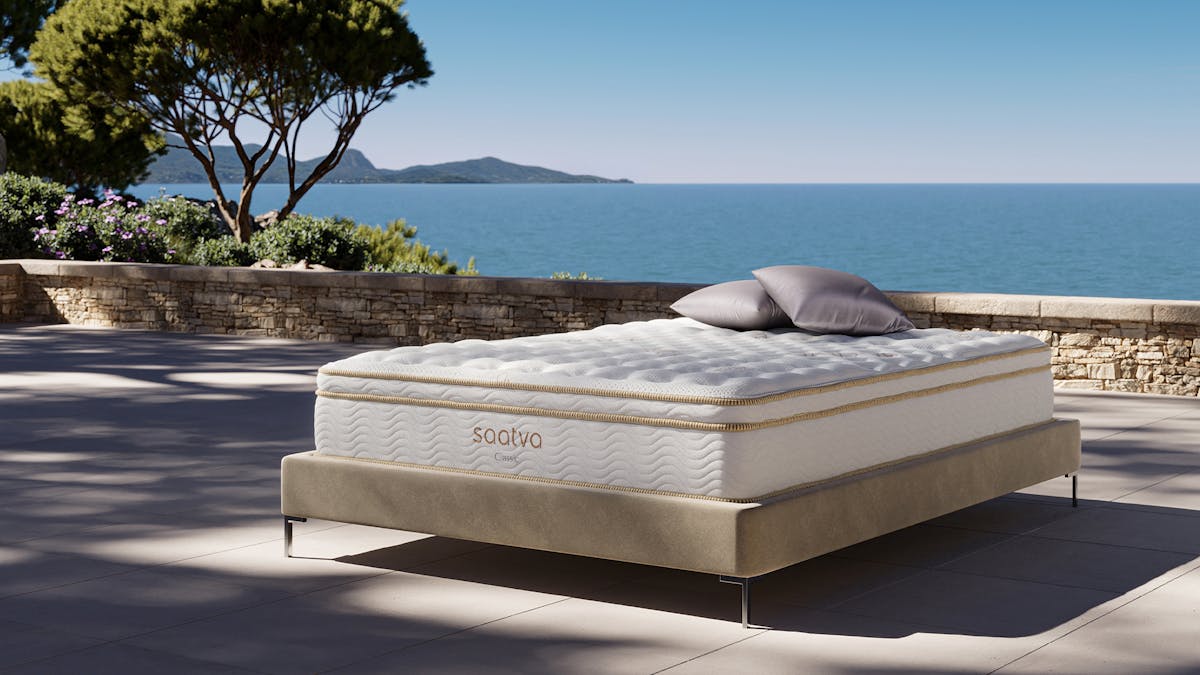
Saatva Classic
9.2/10
- Dual offset coil system with reinforced lumbar pad and organic cotton Euro pillow-top
- Exceptional airflow through the coil core, runs measurably cooler than all-foam
- Strong perimeter edge support, usable to the corner of the mattress
- Free white-glove delivery, in-room setup, and old mattress removal
- 365-night home trial, lifetime warranty
- Delivered flat, not roll-packed in a box
- $99 return fee if you decide to send it back within the trial
- Heavier than a foam bed if you move often
The Saatva Classic is the clearest answer to the hybrid side of this comparison. A dual-coil structure that breathes through the core, three firmness options covering back, side, and stomach sleepers, and a 365-night trial long enough to actually confirm it works. It's the mattress we return to most often for couples, hot sleepers, and anyone who has been let down by edge sag on cheaper foam beds.
The core difference: construction
Memory foam and hybrid mattresses solve the same problem, sleeping comfort, using very different architecture. A memory foam mattress replaces the coil layer with a dense high-resilience support foam, placing the slow-response viscoelastic layer on top. A hybrid uses a pocketed coil core topped with 2 to 4 inches of foam or latex. That structural difference drives nearly every performance gap between them.
Both constructions can be comfortable. The question is which trade-offs actually matter for your sleep style, body weight, room temperature, and bedroom situation.
Memory foam vs hybrid at a glance
| Category | Memory Foam | Hybrid | Edge |
|---|---|---|---|
| Cooling | Moderate (gel/copper help) | Excellent, coil airflow | Hybrid |
| Motion isolation | Excellent | Good (pocketed coils) | Memory foam |
| Edge support | Soft, compresses at edge | Strong coil perimeter | Hybrid |
| Responsiveness | Low, slow bounce-back | High, easy repositioning | Hybrid |
| Pressure relief | Excellent, deep contouring | Good (comfort layer) | Memory foam |
| Durability | 6 to 9 years typical | 8 to 12 years typical | Hybrid |
| Entry price | Lower ($400 to $1,800) | Higher ($900 to $2,500) | Memory foam |
| Noise | Silent | Minor coil creak possible | Memory foam |
Four criteria that actually separate them
1. Cooling
This is the clearest performance gap. Pocketed coils leave open space through the core, and that airflow keeps the sleep surface measurably cooler through the night. Memory foam is a dense, closed-cell material by design, which is part of why it contours so well and also why it traps body heat. Gel infusions, copper infusions, and open-cell foams all reduce the gap, but none of them fully replicate what an open coil core does for airflow. Hot sleepers who move from a foam bed to a hybrid routinely notice a difference within the first week.
2. Motion isolation
Memory foam has a genuine edge here. The slow-response viscoelastic material absorbs movement at the source, so a partner rolling over at 3 a.m. is barely perceptible on the other side. Quality pocketed coils in a hybrid reduce cross-mattress motion transfer significantly compared to older interconnected coil systems, but they cannot match the deadened feel of a dedicated memory foam surface. If you share a bed with a restless sleeper and this is your main complaint, all-foam remains the cleaner solution.
3. Edge support
Hybrids win here without contest. A reinforced coil perimeter gives a firm, stable surface at the edge for sitting, reading, or using the full sleeping width. All-foam mattresses compress at the edges under body weight, which effectively narrows the usable sleeping surface for couples and creates an unstable perch for anyone sitting on the side to put on shoes. This is a real quality-of-life difference, not a theoretical one.
4. Durability and lifespan
Tempered steel coils are resilient. A quality hybrid typically lasts 8 to 12 years before showing meaningful body impressions. All-foam mattresses, particularly in the lower and mid-price segments, begin to show sagging in the 6 to 9 year range, and the sagging tends to occur exactly where body weight concentrates most. High-density support foam, like what Saatva uses in the Loom & Leaf, resists compression better than cheap polyfoam, but the hybrid construction holds a durability advantage that compounds over time.
Who should choose a hybrid
Hybrids are the better default for most adult sleepers. Back sleepers who want responsive support with genuine lumbar push-back find that a zoned coil system outperforms all-foam in alignment quality. Hot sleepers get the airflow advantage without relying on gel additives alone. Couples benefit from stronger edge support and a usable surface across the full width. Anyone over 230 lb benefits from coil resilience that resists sagging long-term. Combination sleepers who change positions multiple times per night find the higher responsiveness easier to sleep on than the body-hugging resistance of memory foam.
If you're deciding between the two types and don't have a strong reason to prioritize motion isolation, a hybrid is the more versatile investment.
Who should choose memory foam
Memory foam makes sense in three clear situations. First, light sleepers sharing a bed who are genuinely disturbed by partner movement. Second, side sleepers with sensitive pressure points at the shoulder or hip, where deep contouring of slow-response foam provides relief that a firmer hybrid comfort layer may not match. Third, budget-conscious shoppers: the all-foam segment offers more solid options at lower price points than the hybrid category does at the same spend.
If motion isolation is the priority and you sleep cool naturally or live in a cooler climate, a quality all-foam mattress is a reasonable choice.
Saatva Loom & Leaf
8.7/10
- High-density memory foam with superior cooling versus budget in-a-box foam
- Premium organic cotton cover, gel-infused layer reduces heat retention
- Excellent motion isolation and deep pressure relief for side sleepers
- Same 365-night trial and lifetime warranty as the Saatva Classic
- White-glove delivery included at no extra charge
- All-foam, so edges are softer than the Saatva Classic's coil perimeter
- More expensive than comparable online foam beds once discounts apply
- Two firmness options versus three for the Classic
If you've decided memory foam is the right choice, the Loom & Leaf is where to land. It solves the typical foam pitfalls: the high-density construction runs noticeably cooler than standard in-a-box foam, and white-glove delivery means you're not wrestling a 75 lb roll into a bedroom yourself. You still get the 365-night trial, so you have real time to confirm it works.
A note on mid-range all-foam
At the mid-range price point, the Amerisleep AS3 is the strongest all-foam option we've tested. Its Bio-Pur plant-based foam runs cooler than standard petroleum-based memory foam, and the HIVE 5-zone system firms specifically under the lumbar where most support failures happen. It costs less than the Loom & Leaf with a 100-night trial, which makes it a practical starting point if you're new to all-foam and not ready to commit to a premium price. The trade-off versus the Loom & Leaf is build quality and delivery: the AS3 ships compressed in a box rather than being hand-delivered and set up.
Verdict
For most sleepers, a hybrid is the better long-term investment. The cooling, edge support, durability, and responsiveness advantages are tangible and compound over the life of the mattress. Memory foam remains the right call for motion isolation and deep pressure contouring. The Saatva Classic covers the hybrid case; the Saatva Loom & Leaf covers the premium all-foam case. Both come with a 365-night trial and lifetime warranty, so there's no reason to guess.
Frequently asked questions
Do hybrid mattresses sleep cooler than memory foam?
Yes, consistently. The open coil core allows air to circulate through the mattress during sleep. Gel infusions and open-cell foam constructions reduce the heat gap in all-foam beds, but they don't fully close it. Hot sleepers who switch from foam to a hybrid typically notice the difference within the first week.
Is a hybrid mattress worth the higher price?
For most buyers, yes. The additional lifespan alone, roughly 2 to 4 years longer than a comparable all-foam mattress, often justifies the price difference on a cost-per-year basis. Add the edge support, cooling, and responsiveness advantages, and hybrids are the better value at the mid-to-premium price point.
Which is better for combination sleepers?
Hybrid is the clearer choice. The responsive coil layer makes repositioning easy, so switching from back to side to stomach doesn't require effort. Memory foam's slow bounce-back resists movement, which can feel like the mattress is holding you in place.
Can memory foam be as supportive as a hybrid?
High-density memory foam provides solid support, but the push-back feel is different from coils. Heavier sleepers, generally over 230 lb, tend to fare better long-term on a hybrid because the coil core resists compression more reliably than support foam does under sustained weight.
What is the difference between a hybrid and an innerspring?
A traditional innerspring adds a thin soft layer over a basic coil unit. A true hybrid places 2 to 4 inches of foam or latex between the coil unit and the sleep surface, providing substantially more pressure relief and contouring than a simple pillow-top innerspring. The Saatva Classic is a coil-on-coil hybrid with a Euro pillow-top: the lower coil layer handles support; the upper micro-coil layer handles comfort and response.
How long does a hybrid mattress last?
A well-built hybrid typically lasts 8 to 12 years. The Saatva Classic, which uses tempered steel offset coils, holds up at the higher end of that range. All-foam mattresses in the same price bracket typically show meaningful body impressions after 6 to 9 years, particularly in the spots where weight concentrates most.