
 by
by Ready to complete your sleep bedroom? The Saatva Classic is our top-rated luxury innerspring hybrid — individually wrapped coils, organic cotton cover, three firmness options, and white-glove delivery. See current pricing and configurations at Saatva.
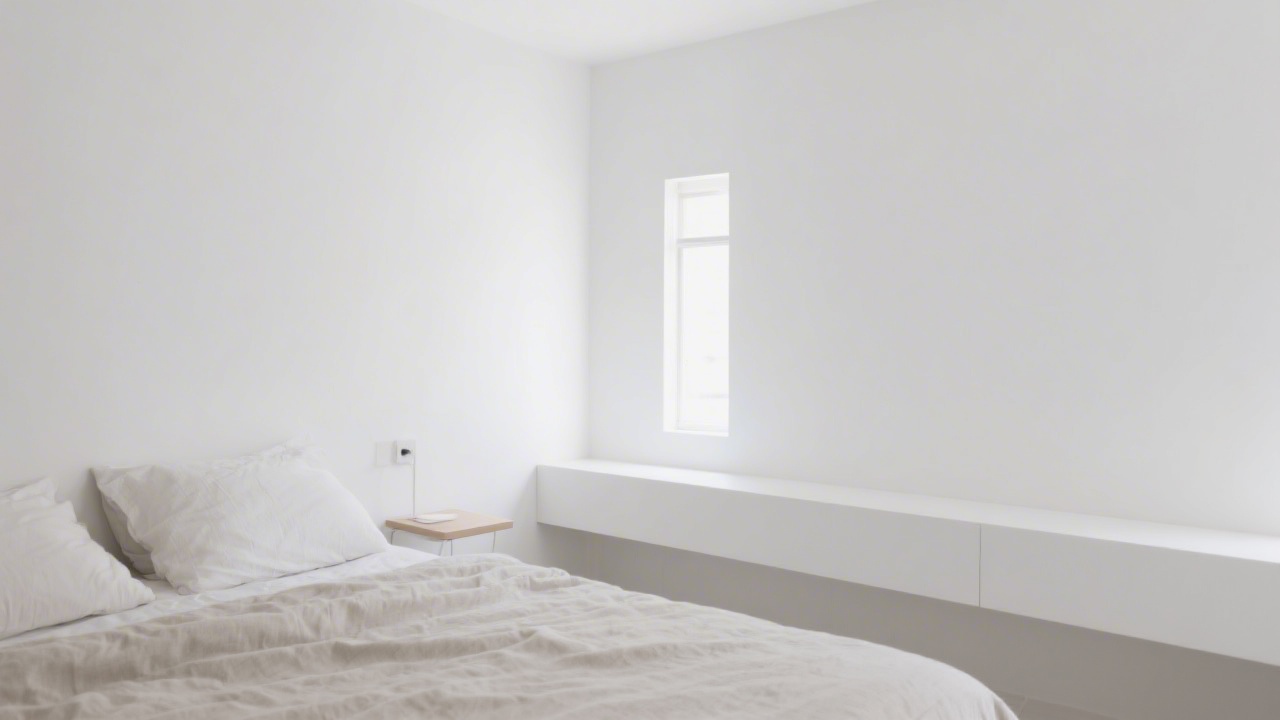
Visual clutter is a measurable enemy of sleep. Neuroscience research from Princeton University found that visual inputs compete for neural resources, and environments with multiple competing visual elements require ongoing low-level cortical activity — a state incompatible with sleep onset. A minimalist bedroom — defined as fewer than seven visible surfaces from the sleeping position — reduced self-reported sleep onset time by an average of 18 minutes in a UK residential design study. This is not aesthetic preference. It is cognitive load management.
The Cognitive Load Argument for Minimalism
When you lie in bed looking at a cluttered room, your brain does not "ignore" the clutter. It scans it. Every object on a dresser, every item on a chair, every pile on the floor is a potential incomplete task — something to be dealt with, categorized, or resolved. The default mode network (the brain region associated with self-referential thinking and rumination) activates in response to environments associated with unfinished tasks. This is the neurological mechanism behind the well-documented finding that messy bedrooms correlate with higher rates of insomnia.
Minimalist design removes the inputs. It is not about aesthetics — it is about reducing the number of signals the brain receives during the window when it needs to quiet down.
The Seven-Surface Rule
The practical implementation principle from sleep-focused interior design: count the visible horizontal surfaces from your sleeping position. This typically includes the nightstand top, dresser top, desk surface, any chairs or benches with items on them, and visible floor areas used for storage. The research benchmark is seven or fewer. This is not an arbitrary number — it maps roughly to the working memory limit (George Miller's "7 ± 2" rule) beyond which the brain must expend active effort to manage visual inputs.
Most bedrooms fail this test easily — a dresser with 12 items, a nightstand with 8, a chair used as a clothing storage system. The minimalist renovation is not about throwing things away but about relocating them: to drawers, behind closed doors, to other rooms.
Minimalist Bedroom Design Principles
1. Furniture Reduction
The minimum viable bedroom is a bed, one nightstand per sleeper, and one closed-door storage unit (wardrobe or closet). Every additional piece should earn its presence. A desk in the bedroom activates work associations and is associated with higher sleep onset times in telework studies. A bench at the foot of the bed is typically a horizontal surface waiting to accumulate items. If it cannot justify itself functionally with surfaces clear, it should not be in the room.
2. Concealed Storage
Built-in wardrobes with floor-to-ceiling doors are the single highest-impact investment in a minimalist bedroom. They eliminate the most common source of visual clutter (clothing) behind closed surfaces. Under-bed storage with a solid bed skirt or a platform base with drawers handles secondary storage without adding visible surface area.
3. Nightstand Discipline
The nightstand has a defined purpose: lamp, one book, phone (face down or in a drawer), water glass. That is four items. Every additional item represents a decision not to put something away. A floating wall-mounted nightstand with a small drawer enforces this discipline structurally — the surface is simply not large enough to accumulate.
4. Visual Horizon Management
The zone from the door to the bed — the line of sight as you enter the room — should be clear. This means the floor is clear, the bed is made, and the first visible surfaces are intentional (the bed as a composed object, not a pile). This visual horizon is what determines the felt quality of the room in the first two seconds of entering it.
For related principles on how space affects sleep, see our guide to bedroom floor plans for sleep and bedroom furniture spacing. For a behavioral framework for managing bedroom environment, see bedroom boundaries for sleep.
The Minimalist Mattress Choice
In a minimalist bedroom, the bed becomes the dominant visual object. The mattress and bedding determine whether that dominant object reads as intentional or as an afterthought. The Saatva Classic has a clean, hotel-quality aesthetic and an organic cotton cover that pairs with any minimal bedding scheme. Its profile (10.5" or 14.5" depending on configuration) provides a proportionally substantial bed presence — appropriate for a room where the bed is the visual anchor.
Frequently Asked Questions
Does a minimalist bedroom actually improve sleep?
Research supports it. Visual clutter activates the brain's task-management systems and prevents the cognitive quieting required for sleep onset. Removing visible clutter — particularly incomplete tasks — reduces default mode network activity, which is associated with the rumination that delays sleep.
What is the minimum furniture needed in a bedroom?
The functional minimum is a bed, one nightstand per sleeper, and one closed-storage unit. Everything beyond that should earn its presence by serving a function that cannot be handled by the minimum set.
Should I remove the TV from my bedroom for better sleep?
The research is fairly consistent: yes. A TV is both a visual object (the largest non-bed item in most bedrooms, dominating the visual field from the sleeping position) and a behavioral cue (associated with stimulating content). Sleep medicine guidelines recommend the bedroom be used only for sleep and sex — and TVs are incompatible with that conditioning.
How do I make a minimalist bedroom feel warm, not cold?
Minimalist does not mean austere. The warmth comes from material quality, not quantity: high-count linen bedding, a single warm-toned rug, wood furniture with visible grain. The principle is: fewer items, higher quality per item. The warmth is in the texture of each piece rather than the accumulation of many pieces.
How many items should be on a nightstand?
Four is the practical maximum for minimalist sleep design: a lamp, one book, a phone (face down or in drawer), and a water glass. A floating wall-mounted nightstand with a small drawer is the structural solution that enforces this discipline naturally.
Ready to complete your sleep bedroom? The Saatva Classic is our top-rated luxury innerspring hybrid — individually wrapped coils, organic cotton cover, three firmness options, and white-glove delivery. See current pricing and configurations at Saatva.