
 by
by Neck pain upon waking is one of the most common musculoskeletal complaints, and it is almost always attributed to "sleeping wrong." That diagnosis is correct but incomplete. Neck alignment during sleep depends on two variables that interact with each other: pillow loft and mattress firmness. A pillow that works perfectly on one mattress may be completely wrong on another — and this interaction is the reason so many people find that a new "supportive" pillow fails to solve their neck pain after a mattress change.
The Cervical Spine During Sleep
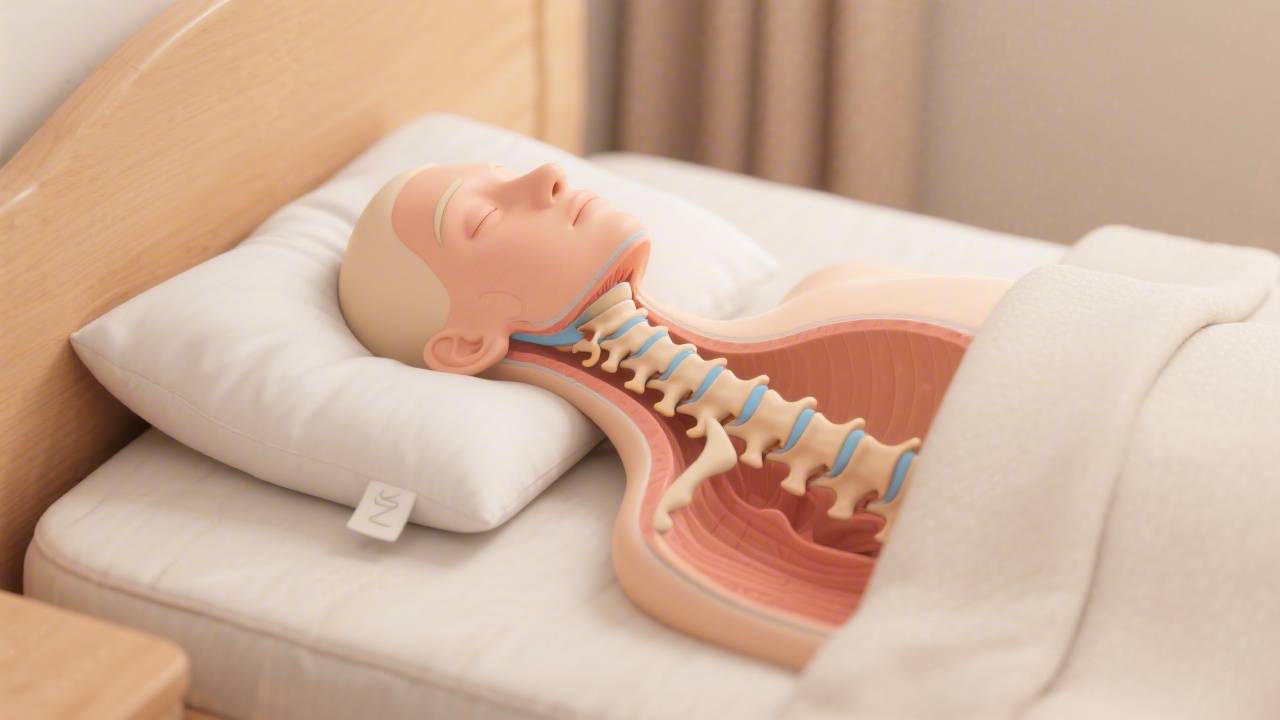
The cervical spine has a natural lordotic curve of approximately 20–40 degrees in most adults. During sleep, this curve must be maintained in whatever position is being used. Deviation from the neutral lordosis — either flattening into kyphosis (flexion) or exaggeration into hyperlordosis (extension) — loads the facet joints, the intervertebral discs, and the posterior cervical musculature (particularly the suboccipital group) in ways that produce morning stiffness, pain, and in chronic cases, contribute to cervical disc degeneration.
How Mattress Firmness Changes Pillow Requirements
For Back Sleepers
In back sleeping, the head rests at approximately mattress level (since the back of the skull contacts the sleep surface with minimal gap). The pillow fills the occipital-to-mattress gap, which on most adults is 2–4 inches. The mattress firmness affects pillow requirements primarily through thoracic spine position: on a soft mattress, the thoracic spine sinks, reducing its kyphosis and slightly extending the cervicothoracic junction. This changes the optimal pillow height by approximately 0.5–1 inch.
In practice: back sleepers on soft mattresses generally need a slightly thicker pillow (4–5 inches) compared to back sleepers on firm mattresses (3–4 inches). The difference is small but meaningful for those with existing cervical sensitivity.
For Side Sleepers
The mattress-pillow interaction is most dramatic for side sleepers. The pillow's job is to bridge the gap between the ear (which rides at the top of the skull) and the mattress surface. This gap equals the shoulder width minus the degree to which the shoulder sinks into the mattress.
Consider a side sleeper with a 19-inch shoulder width. On a firm mattress with 0.5 inches of shoulder sinkage, the gap to fill is 18.5 inches. On a medium mattress with 1.5 inches of shoulder sinkage, the gap is 17.5 inches. On a medium-soft mattress with 2.5 inches of shoulder sinkage, the gap is 16.5 inches. A pillow providing 6 inches of effective height would achieve neutral on the firm mattress, put the cervical spine in mild kyphosis on the medium mattress, and put it in moderate kyphosis on the medium-soft mattress.
This arithmetic explains why people who switch from a firm to a medium mattress often develop neck pain despite keeping the same pillow — the effective gap has decreased by 1–2 inches, making the previously correct pillow too thick.
Pillow Properties That Affect Neck Alignment
Loft (Height)
The stated loft on a pillow is measured uncompressed. Under the weight of the head (approximately 10–12 lbs), most pillows compress to 60–80% of their stated height. Down and down-alternative pillows compress most (to 50–60%). Memory foam pillows compress least (to 85–95% due to material resilience). Latex pillows fall between. When selecting pillow height, the relevant measurement is compressed loft under head weight, not stated loft.
Fill Type and Neck Support
Cervical contour pillows — with a raised perimeter and lower center — are designed for back sleepers and position the cervical spine in mild extension (which is the natural lordotic direction). They work well for dedicated back sleepers but are poorly suited for side sleepers, who need consistent height across the pillow width. Adjustable fill pillows (shredded foam or latex) allow loft customization, which is valuable when you are uncertain of the correct height for a new mattress.
Testing Your Cervical Alignment
For back sleepers: after lying in your sleep position for 2 minutes, reach behind your neck — if you can slide your hand fully under with room to spare, your pillow is too thin. If your chin is touching or approaching your chest, it is too thick. A slight, gentle curve under your palm is the target.
For side sleepers: have a partner check whether your nose is parallel to the bed edge. If your nose tips toward the mattress, the pillow is too thin; if it points toward the ceiling, too thick. The nose should point straight toward the wall in front of you.
When You Change Your Mattress, Reassess Your Pillow
The interaction between mattress and pillow means that any significant mattress change — from firm to medium, or from medium to soft — requires re-evaluation of pillow loft. As a practical guideline, if you move to a mattress that is more than one firmness category softer, reduce pillow loft by approximately 0.5–1 inch for back sleeping and 1–1.5 inches for side sleeping. If you move to a firmer mattress, increase loft by the same increments.
The Saatva Classic is available in three firmness profiles; Saatva also offers a pillow with adjustable insert that allows precise loft calibration — which is particularly useful during the break-in period of a new mattress before you know exactly how much the surface will sink under your shoulder weight.
Internal Resources
- Shoulder Alignment During Sleep: The Side Sleeper's Challenge
- Spinal Alignment During Sleep: What It Means and Why It Matters
- Best Sleeping Position for Your Spine — Biomechanics Guide
Frequently Asked Questions
Key Takeaways
- The Cervical Spine During Sleep: a key factor in making the right sleeping decision.
- How Mattress Firmness Changes Pillow Requirements: a key factor in making the right sleeping decision.
- Neck alignment during sleep depends on two variables that interact with each other: pillow loft and mattress firmness.
- The Cervical Spine During Sleep The cervical spine has a natural lordotic curve of approximately 20–40 degrees in most adults.
- During sleep, this curve must be maintained in whatever position is being used.
Our Top Pick: Saatva Classic
Voted best luxury innerspring mattress with exceptional lumbar support and white-glove delivery.
Check Price & AvailabilityWhy does my neck hurt after getting a new mattress?
The most common reason is that your existing pillow is now the wrong loft for the new mattress. If the new mattress is softer than your previous one, your shoulder sinks deeper, reducing the gap that the pillow needs to fill — meaning your pillow is now too thick and is pushing your head into cervical kyphosis. Try reducing pillow loft by 1–2 inches, or switch to a lower-profile pillow to see if the neck pain resolves within a week.
Can one pillow work for both back and side sleeping?
It is difficult because the loft requirements differ significantly — typically 3–4 inches for back sleeping versus 5–7 inches for side sleeping. A mid-range pillow (4–5 inches) can function reasonably in both positions if the mattress firmness is appropriate and the difference in your shoulder-to-ear measurement is not extreme. Adjustable fill pillows that allow you to add or remove material are the most practical solution for combination sleepers.
Should a pillow be firm or soft for neck pain?
The relevant variable for neck pain is loft (height), not firmness per se. However, a pillow that is too soft compresses too easily, effectively reducing its loft under head weight and allowing the head to drop into the mattress. For people with existing cervical pain, a pillow with moderate resistance — medium-density memory foam or solid latex — provides more predictable and consistent support than down or down-alternative, which shifts and compresses variably during the night.
Is it better to sleep without a pillow for neck pain?
For back sleepers, sleeping without a pillow on a firm mattress leaves the cervical spine in extension, which can compress the posterior cervical elements and worsen facet-type neck pain. A low-loft pillow (2–3 inches) that maintains the natural lordosis is almost always better than no pillow for back sleepers. For stomach sleepers, no pillow is genuinely the least harmful option — any pillow height adds to the cervical rotation load that makes prone sleeping problematic.
How long does it take to find the right pillow loft for a new mattress?
Allow 2–4 weeks for the mattress to settle (most mattresses compress by 10–20% in the first month) and for your body to adapt to the new surface. Do not make a final pillow decision in the first week. Evaluate neck and shoulder comfort at weeks two and four and adjust pillow loft incrementally — half-inch changes are often sufficient. Keep a simple sleep journal noting pain levels and pillow height to identify the optimal configuration.