
 by
by Upgrade Your Sleep Foundation
Whatever you put in your body before bed, your mattress determines the baseline. The Saatva Classic combines individually wrapped coils with luxury foam for pressure relief and spinal support — without trapping heat.
Nicotine Is a Stimulant — Full Stop
This point gets lost in conversations about smoking, which are often dominated by cancer and cardiovascular risks. But for sleep specifically, nicotine's identity as a stimulant is the central fact. Nicotine activates nicotinic acetylcholine receptors (nAChRs) throughout the brain and peripheral nervous system, triggering a cascade of stimulatory neurotransmitters: dopamine, norepinephrine, and serotonin all spike. Cortisol — the stress and alertness hormone — also rises.
The result is increased heart rate, elevated blood pressure, heightened alertness, and faster cognitive processing. All of these are the opposite of what sleep requires.
How Smoking Disrupts Sleep Architecture
Polysomnography studies consistently show that smokers experience:
- Increased sleep latency — smokers take longer to fall asleep, particularly with evening cigarettes
- Reduced total sleep time — averaging 30–40 fewer minutes per night versus non-smokers in large population studies
- Suppressed REM sleep — similar mechanism to cannabis, reducing dream-stage sleep
- Increased light sleep (stage N1/N2) — more fragmented sleep structure
- More overnight awakenings — driven by nicotine withdrawal during the overnight fast
The Overnight Withdrawal Problem
This is the mechanism most people do not consider: smokers are addicted. During the 6–8 hours of sleep, plasma nicotine levels drop continuously. By the early morning hours, many habitual smokers are already experiencing mild withdrawal — tremor, anxiety, elevated cortisol — which causes micro-arousals and premature awakening.
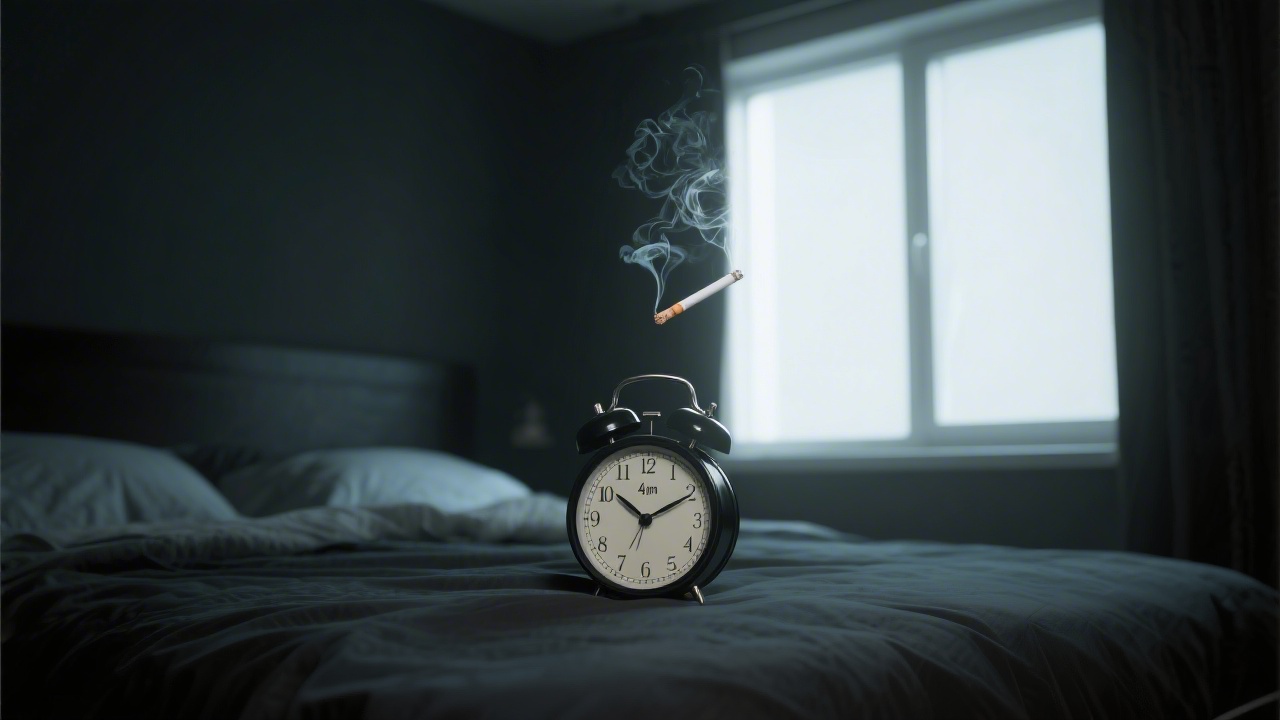
This is why many smokers wake at 4–5 AM "for no reason" and find they cannot return to sleep. The reason is nicotine withdrawal. Reaching for a cigarette resolves the withdrawal and allows them to feel normal — but also confirms that the substance is now necessary for baseline function, including sleep.
Vaping: Same Problem, Different Delivery
Electronic cigarettes and nicotine vapes deliver nicotine through aerosolized propylene glycol or vegetable glycerin rather than combustion — eliminating most carcinogens. But for sleep, the mechanism is identical: nicotine is nicotine.
Some research suggests that nicotine salt formulations (common in pod systems like JUUL) have faster, sharper absorption kinetics than cigarettes — potentially causing more acute stimulation. Evening vaping is equally disruptive to sleep as evening smoking from a pharmacological standpoint.
What Happens to Sleep When You Quit
The first week of nicotine cessation is often sleep's worst period. Withdrawal symptoms include severe insomnia, early morning awakening, increased anxiety, vivid dreams, and REM rebound. This is the brain recalibrating to operate without nicotine — a necessary but painful process.
The timeline for improvement:
- Days 1–7: Worst sleep. Insomnia, anxiety, vivid dreams as REM rebounds. Stay the course.
- Weeks 2–4: Sleep begins stabilizing. Some users see improvement faster than baseline by week 3.
- Months 1–3: Significant improvement in sleep quality, especially deep sleep and REM structure.
- Months 3–6+: Total sleep time and sleep architecture typically normalize and exceed pre-cessation baselines for most ex-smokers.
Nicotine Replacement Therapy and Sleep
NRT (patches, gum, lozenges, spray) prevents the more severe withdrawal symptoms but does not eliminate all sleep disruption — nicotine in any form is still stimulating. Specific considerations:
- Patches worn overnight: Maintain plasma nicotine, preventing withdrawal arousals, but nicotine itself causes vivid dreaming and delayed sleep onset in some users. Many cessation programs recommend removing patches before bed.
- Gum and lozenges: Short-acting; avoid use within 2–3 hours of bedtime.
- Varenicline (Chantix): Partial nAChR agonist; has its own sleep side effect profile including vivid and disturbing dreams in some users.
If you are working on sleep quality alongside cessation, optimizing other factors — caffeine cutoff timing, evening sugar intake, and sleep environment temperature — can help offset the disruption during the withdrawal period.
Upgrade Your Sleep Foundation
Whatever you put in your body before bed, your mattress determines the baseline. The Saatva Classic combines individually wrapped coils with luxury foam for pressure relief and spinal support — without trapping heat.
Frequently Asked Questions
- How does nicotine affect sleep?
- Nicotine is a stimulant that activates nicotinic acetylcholine receptors in the brain, increasing dopamine, norepinephrine, and cortisol. This delays sleep onset, reduces total sleep time, and suppresses REM sleep. Smokers also experience withdrawal symptoms during overnight fasting that cause micro-arousals.
- Do nicotine patches affect sleep?
- Yes. Wearing a nicotine patch overnight maintains plasma nicotine levels and prevents withdrawal arousals — but the nicotine itself can cause vivid dreams, insomnia, and difficulty maintaining sleep. Removing the patch before bed avoids stimulant effects but leaves withdrawal arousals unaddressed.
- Does vaping disrupt sleep as much as smoking?
- Vaping delivers nicotine more efficiently than cigarettes in many cases, with faster peak absorption. The sleep-disrupting mechanism is identical — stimulant-mediated arousal and overnight withdrawal. Vaping without nicotine has no documented sleep effect.
- How long after quitting smoking does sleep improve?
- Initial sleep worsens in the first 1–2 weeks of cessation due to nicotine withdrawal and rebound REM. By weeks 3–4, most ex-smokers report improved sleep quality. By months 3–6, total sleep time and sleep architecture normalize and typically exceed pre-cessation baselines.
- Can nicotine gum or lozenges help you sleep?
- No — nicotine in any form (gum, lozenge, patch, spray) is stimulating. Using nicotine gum in the evening to manage cravings will delay sleep onset. Short-acting forms (gum, lozenge) should be used earlier in the day during cessation attempts.