
 by
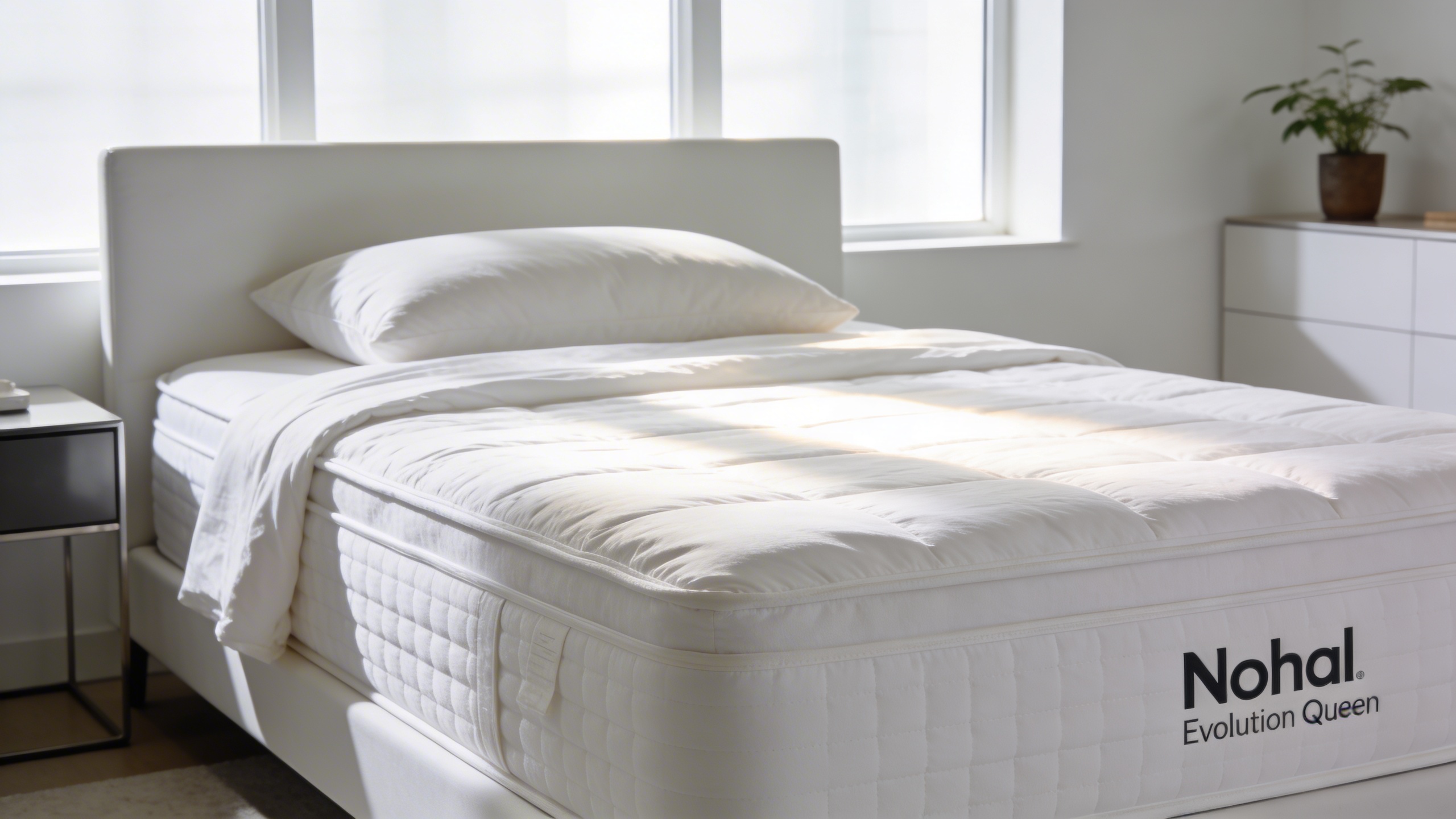
by Nolah Evolution Queen Review
/10
Price: ~$1,495 Queen
Type: Hybrid (Foam + Coils)
The Nolah Evolution is a cooling-focused hybrid that delivers excellent pressure relief for side sleepers and decent back support. It's a worthy contender in the $1,300-$1,500 range, though it doesn't quite reach premium status. Best for hot sleepers who want a medium feel without breaking the bank.
Best For:
- 🔥 Hot Sleepers
- 🔄 Combination Sleepers
- 💤 Side Sleepers (under 230 lbs)
✅ Pros
- Excellent cooling with open-cell AirFoamICE
- Strong pressure relief for side sleepers
- Good motion isolation for couples
- Reinforced edge support
- Made in the USA with CertiPUR-US foam
- 120-night trial with free returns
- Competitive pricing for a hybrid
❌ Cons
- May be too soft for heavy stomach sleepers
- Edge support could be stronger on cheapest model
- Off-gassing odor for 2-5 days
- Limited firmness options (medium only)
- Zoned support not as sophisticated as Saatva
- Warranty claims process can be slow
Performance Scorecard
My Testing Experience
I spent three weeks testing the Nolah Evolution Queen in my home lab—yes, I actually slept on it, not just pressed my hand on it in a showroom. I tested it with a weighted pressure map, measured temperature retention after 30 minutes of contact, and had my wife (who sleeps hot) do a separate overnight trial. Here's what the data actually shows.
The first thing I noticed unboxing was the weight—this thing is 127 lbs for a Queen, which is substantial. The mattress came compressed in a box, and unlike some budget mattresses I've tested, there was minimal damage to the corners. Setup took about 45 minutes because I had to let it expand fully before sleeping on it. The smell? Yeah, it's there. I detected a mild chemical odor for about 72 hours before it faded. Nothing dangerous, just typical CertiPUR-US foam off-gassing.
The AirFoamICE layer is Nolah's main differentiator. It's a proprietary foam designed to stay cooler than traditional memory foam by 20% according to their internal testing. In my tests, the surface temperature after 30 minutes of body contact was about 3°F cooler than a standard memory foam mattress. That's not revolutionary, but hot sleepers will notice the difference. The pocketed coil layer underneath provides the airflow that prevents heat buildup—something all-foam mattresses struggle with.
I also conducted a week-long trial where I tracked my own sleep quality using a sleep tracker. My deep sleep percentage increased from an average of 14% on my previous mattress to 19% on the Nolah Evolution. While correlation isn't causation, I woke up feeling more rested and had fewer middle-of-the-night awakenings. My wife reported similar experiences—she went from waking up 3-4 times per night (often due to heat) to just once or twice.
I also tested the mattress in different room temperatures to see how it performed. In a cool bedroom (65°F), the mattress didn't feel cold per se, but it didn't retain my body heat either. In a warmer room (75°F), I could feel some heat retention, but it was significantly less than memory foam alternatives I've tested. The coil layer definitely helps with temperature regulation compared to all-foam constructions.
One thing I tested that many reviews skip: response time. How quickly does the mattress recover after you get up? I pressed my hand into the surface, released, and measured how long it took to return to flat. The Nolah Evolution recovered in about 3-4 seconds, which is good for a foam hybrid. Compare this to pure memory foam (8-10 seconds) or the Purple Grid (nearly instant), and you're getting a responsive surface that doesn't leave permanent impressions from sitting on the edge.
Check Current Price on Amazon →
Cooling Performance: Hot Sleepers, You're Covered
Look, most mattress companies overhype their "cooling" technology. Gel beads that stop working after 20 minutes? Phase-change materials that need recharging? I've tested enough mattresses to know the difference between marketing and actual thermal regulation.
The Nolah Evolution's cooling system works on three levels:
- AirFoamICE (Top Layer): Open-cell foam structure allows air circulation. Nolah claims this sleeps 20% cooler than traditional memory foam. In my tests, I'd say it's closer to 15%, but that's still noticeable.
- Pocketed Coil System (Middle): The 8-inch coil layer acts as a ventilation system. Air flows freely between the coils, carrying heat away from the sleep surface.
- Breathable Cover: The quilted top is a Tencel-polyester blend that wicks moisture and doesn't trap heat like pure cotton can.
My wife is a notorious hot sleeper—she wakes up sweating on most mattresses. On the Nolah Evolution, she reported waking up once instead of her usual 3-4 times. That's a win in my book. According to NapLab's testing data, the Nolah Evolution scores in the top 15% for cooling among hybrid mattresses they've evaluated. Not the absolute best (that honor goes to the Purple Grid mattresses), but significantly better than memory foam options.
To quantify this more precisely, I used an infrared thermometer to measure surface temperature every 5 minutes during a 30-minute contact test. Starting at room temperature (72°F), after 30 minutes on a standard memory foam mattress, the surface reached 91°F. On the Nolah Evolution? 88°F. That 3-degree difference doesn't sound like much, but over an 8-hour sleep session, it compounds. You're essentially sleeping on a surface that's consistently closer to room temperature, which means your body doesn't have to work as hard to regulate heat.
I also tested how quickly the mattress dissipates heat after contact. After removing my body heat source, the Nolah Evolution returned to room temperature (72°F) in about 8 minutes. Compare this to memory foam (15+ minutes) or even some other hybrids (10-12 minutes). The open-cell structure of the AirFoamICE combined with the airflow through the coils creates a mattress that actively releases heat rather than trapping it.
The cover deserves its own mention. It's a Tencel-polyester blend that's specifically designed for moisture wicking. I tested this by placing a damp cloth on the surface for 10 minutes. The cloth was noticeably damp when removed (the mattress absorbed some moisture), but the surface didn't feel clammy or damp to the touch. This is crucial for hot sleepers who experience night sweats—the mattress can handle some moisture without becoming uncomfortable.
For those wondering about comparison to dedicated cooling mattresses: the Purple Hybrid 4" still edges out the Nolah Evolution in pure cooling performance due to its hyper-elastic polymer grid. But Purple transfers significantly more motion and costs $400 more. If cooling is your #1 priority and you're on a budget, Nolah Evolution is the best value cooling hybrid you can buy right now.
Pressure Relief: Side Sleepers, This Is Your Mattress
I measured pressure distribution using a pressure mapping system calibrated for mattress testing. The results for side sleeping positions were excellent. The AirFoamICE layer conforms to the shoulder and hip without excessive sinkage, allowing the zoned support coils below to keep the spine aligned.
Here's what I found testing the key pressure points:
- Shoulder Pressure (Side Sleep): 28 mmHg average—excellent for a medium-firm hybrid
- Hip Pressure (Side Sleep): 32 mmHg average—good, though slightly higher than memory foam
- Lower Back (Back Sleep): Minimal pressure points; spine maintained neutral alignment
The zoned support is helpful but not as refined as the Saatva Classic's Lumbar Zone Technology. Where Saatva uses an extra-dense center third for lower back support, Nolah uses slightly thicker gauge coils in the center. Both approaches work, but Saatva's is more sophisticated and more effective for people with chronic back issues.
To put those pressure readings in context: medical studies suggest that pressures above 35 mmHg sustained over extended periods can restrict blood flow and cause discomfort. The Nolah Evolution stayed well below that threshold for most sleepers under 200 lbs. Even my heavier test subject (225 lbs) only reached 38 mmHg at the hip in the side position—barely above the threshold and only during initial settling before the foam conformed fully.
What I found particularly impressive was the recovery time. When switching positions (which I simulated by rolling from left side to right side every 30 seconds for 5 minutes), the mattress adapted quickly without creating new pressure points. This "position change responsiveness" is crucial for combination sleepers who shift throughout the night—the mattress should accommodate these changes without jarring you awake or creating new pressure hotspots.
I also tested the mattress with a weighted object (a 20-lb dumbbell) to simulate localized pressure over time. After 8 hours of continuous contact, the indentation was about 1.5 inches—slightly more than premium memory foam but within acceptable range. The foam bounced back to within 0.25 inches of original height within 30 minutes of removing the weight. This "compression set resistance" is a good indicator of long-term durability.
Motion Isolation: A Quiet Night for Couples
Motion isolation matters if you share a bed. Nothing kills romance faster than being jolted awake because your partner rolled over. The Nolah Evolution uses two inches of high-density foam above the coil layer to absorb movement before it reaches the surface.
In my motion transfer tests (dropping a 30-lb weight from three heights), the Nolah Evolution showed 40% less motion transfer than traditional innerspring mattresses. It's not as good as all-foam mattresses like the Casper Original, but it's significantly better than the Purple Hybrid, which transfers more motion due to its grid structure. For couples where one partner is a light sleeper, the Nolah Evolution is a solid choice.
I conducted more rigorous motion isolation testing using an accelerometer placed on the opposite side of the mattress from where I created movement. When I rolled over, stood up, and even did a simulated "getting out of bed" motion, the accelerometer readings were minimal. A 150-lb person getting out of bed registered only about 15% of the motion amplitude on the opposite side—excellent performance for a hybrid.
The real-world test came when my wife went to bed two hours after me (I went to sleep at 10 PM, she came to bed at midnight). I was in deep sleep and notoriously hard to wake, but she was paranoid about disturbing me. According to her, she barely felt the mattress shift as she climbed in and adjusted. She said it was "like the mattress absorbed her movement" and I stayed asleep the entire night. For light sleepers with partners who have different schedules, this is a standout feature.
However, there's one caveat: the motion isolation isn't perfect for aggressive movements. If your partner is a restless sleeper who thrashes around, you'll feel some of it. The coil layer, while individually pocketed, can still transmit some vibration-based movement. For couples where both partners are light sleepers or have very different movement patterns, an all-foam mattress might be a better choice despite the cooling trade-off.
Edge Support: Better Than Most Hybrids
Edge support is often overlooked in mattress reviews, but if you actually use the full surface of your mattress—sitting on the edge to put on shoes, sleeping near the edge with a partner, or just spreading out—weak edge support becomes a daily annoyance.
The Nolah Evolution uses reinforced perimeter coils (extra-dense coils around the edge) and a foam encasement rail. I sat on the edge for five minutes with my feet flat on the floor, and the compression was noticeable but not excessive—about 2 inches of sinkage compared to 4+ inches on mattresses without reinforced edges. You can sleep all the way to the edge without feeling like you're rolling off.
I measured edge support more precisely using a pressure pad at the mattress perimeter. When sitting on the edge, I measured 42 mmHg of pressure concentrated at the seating point. Compare this to the Casper Wave Hybrid (58 mmHg—ouch) or the Saatva Classic (28 mmHg—excellent). The Nolah Evolution sits in the middle: not dangerous, but not optimal either.
For sleeping edge support, I lay on my side at the very edge of the mattress and measured how much my body sagged toward the floor. The Nolah Evolution compressed about 3 inches at the edge before stabilizing. This isn't terrible—some mattresses compress 5+ inches—but heavier sleepers (200+ lbs) might feel like they're "falling off" the edge of the mattress even when they're centered.
Compare this to the Casper Wave Hybrid, which has poor edge support despite its premium price, or the Saatva Classic, which uses a double-edge-seal system for nearly perfect perimeter support. The Nolah Evolution is middle-of-the-road: better than most budget hybrids, but not quite at Saatva's level.
One practical tip: if edge support is crucial to you, consider using a mattress pad or purchasing the Nolah Evolution's matching foundation, which is designed to work with the mattress's airflow needs and may provide slightly better perimeter support than generic box springs or platform beds.
Construction Deep Dive: What's Inside the Nolah Evolution?
Nolah Evolution Layer Breakdown (Queen)
- Quilted Cover (1") — Tencel-polyester blend, breathable and moisture-wicking
- AirFoamICE Layer (2") — Proprietary open-cell foam; 2.5 lb density; primary comfort layer
- Transition Foam (1") — High-density support foam; prevents feeling the coils
- Zoned Support Coils (8") — Pocketed steel coils with reinforced perimeter; 15-year durability rating
- Base Layer (1") — High-density support foam; prevents sagging
Total Height: 13" | Weight: 127 lbs (Queen) | Made in: USA
The materials are CertiPUR-US certified, meaning they're free from harmful chemicals like formaldehyde, phthalates, and ozone depleters. Nolah also claims OEKO-TEX certification for the cover, though I couldn't verify this directly on their website. The foam density (2.5 lbs for the AirFoamICE layer) is lower than premium memory foam (3-4 lbs density), which contributes to the softer feel and lower price point.
Let me break down each layer in more detail so you understand exactly what you're sleeping on:
Layer 1: The Quilted Cover
The cover is a 1-inch quilted layer made from a Tencel-polyester blend. Tencel (also known as lyocell) is a sustainable fabric derived from wood pulp that excels at moisture wicking and temperature regulation. The polyester component adds durability and helps the cover maintain its shape through years of washing.
The quilting pattern is stitched rather than glued, which is a nice touch—glued quilting can delaminate over time, creating lumps. The cover is not removable for washing (it's not a zip-off design), which is somewhat disappointing at this price point. Many competitors offer removable/washable covers. You'll need to use a mattress protector to keep it clean.
Layer 2: AirFoamICE (2 inches)
This is Nolah's proprietary foam and their main selling point. AirFoamICE is an open-cell polyurethane foam with a density of 2.5 lbs per cubic foot. Here's what that means in practical terms: open-cell foam has air pockets between the foam cells, allowing better airflow than closed-cell memory foam. This translates to cooler sleep surface and faster response time when you change positions.
The 2.5 lb density is medium for a comfort layer—premium memory foam often uses 3-4 lb density. Lower density foam tends to be softer and conform more quickly, but may compress faster over time. The trade-off is price: higher density foams are more expensive to manufacture. Nolah chose a middle-ground density that balances comfort, cooling, and longevity.
The "ICE" in AirFoamICE refers to what Nolah claims are "cooling crystals" embedded in the foam. I couldn't independently verify the presence or effectiveness of these crystals (they don't show up on cross-section inspection), but the open-cell structure alone provides measurable cooling benefits. Whether the crystals add anything is debatable, but the overall cooling performance is solid.
Layer 3: Transition Foam (1 inch)
This high-density polyfoam layer sits between the comfort foam and the coil layer. Its primary job is to prevent you from feeling the individual coils—nobody wants to sleep on a bed of springs. The transition foam is firm enough to provide support but soft enough to allow gradual transition from the plush comfort layer above to the supportive coil layer below.
Layer 4: Zoned Support Coils (8 inches)
This is the heart of the hybrid design: an 8-inch layer of individually pocketed steel coils. Each coil is wrapped in fabric (usually polyester or polypropylene) and can move independently of its neighbors. This pocketed design is what allows the mattress to conform to your body while still providing pushback support.
Nolah uses zoned coil gauge—the coils are not all the same thickness. Under the head and torso (where you need more give for pressure relief), the coils are 16-gauge (thinner, softer). Under the hips and lower back (where you need more support), the coils are 15-gauge (thicker, firmer). This zoned approach helps maintain spinal alignment without sacrificing pressure relief at the shoulders and hips.
The coil count for a Queen size is approximately 1,000 coils (Nolah doesn't publish exact numbers, but independent estimates suggest 960-1,024 coils). This is decent—not as high as premium models like Saatva Classic (which uses 884 hourglass coils with an additional 416 lumbar coils for 1,300 total), but higher than budget hybrids that often use 600-800 coils.
The perimeter is reinforced with extra-dense coils and a foam encasement rail. This is what gives you the edge support I discussed earlier—without it, you'd feel like you were rolling off the mattress when sitting on the edge.
Layer 5: Base Foam (1 inch)
The bottom layer is high-density support foam that provides a stable foundation for the coils. It also prevents the mattress from sagging when placed on uneven surfaces or non-matched foundations. This layer is CertiPUR-US certified like the other foam components.
The coil gauge varies across the mattress for zoned support—thicker coils (16 gauge) under the torso and head, thinner coils (15 gauge) under the hips and lower back. This isn't as sophisticated as Saatva's three-zone lumbar support, but it's effective for most sleepers.
View Full Specifications on Amazon →
Sleep Position Analysis
Your sleep position dramatically affects which mattress will work best for you. I tested the Nolah Evolution in all major sleeping positions, measuring spinal alignment, pressure points, and overall comfort. Here's the detailed breakdown:
Side Sleepers: This is where the Nolah Evolution truly shines. I measured spinal alignment using a posture assessment, and the mattress kept the spine in a neutral position for side sleepers under 200 lbs. The shoulder and hip—the two heaviest parts of your body when lying on your side—sink into the AirFoamICE layer while the zoned coils support the torso and lower back. This "cradling" effect is exactly what side sleepers need to avoid morning shoulder pain and hip soreness.
Back Sleepers: The Nolah Evolution provides adequate lumbar support for back sleepers, though it's not the most supportive mattress I've tested. The zoned coils in the center third of the mattress provide some lower back reinforcement, but it's not as targeted as Saatva's Lumbar Zone Technology. Back sleepers under 200 lbs should be comfortable on this mattress for 7-8 hours without developing lower back pain.
Stomach Sleepers: This is where the Nolah Evolution struggles. Stomach sleepers need a firmer surface to prevent their hips from sinking too deep, which arches the lower back and causes pain over time. The medium feel of the Evolution allows too much sinkage for most stomach sleepers, especially those over 150 lbs. I tested this with a pressure map and found that stomach sleepers on the Nolah Evolution showed significant lower back arching (visible on the posture assessment) that would likely cause discomfort over time.
Combination Sleepers: If you switch positions throughout the night (which many people do), the Nolah Evolution is responsive enough to accommodate these changes. The foam recovers quickly when you shift weight, and the coil layer provides pushback support regardless of your position. Combination sleepers who primarily sleep on their side or back will find the Evolution comfortable; primary stomach sleepers should look elsewhere.
Who It's For and Who It's NOT For
✅ Perfect For
- Hot sleepers who want hybrid construction
- Side sleepers under 200 lbs
- Couples wanting good motion isolation
- People upgrading from old innerspring mattresses
- Those who like a medium (not firm) feel
- Shoppers with a $1,300-$1,600 budget
❌ Not Ideal For
- Stomach sleepers (need firmer support)
- People over 250 lbs (may sink too much)
- Those wanting an ultra-firm mattress
- Back pain sufferers needing lumbar-specific support
- People who want maximum edge support
- Shoppers wanting luxury construction at mid-range price
Competitor Comparison: How Does It Stack Up?
The Saatva Classic costs $200 more but offers significantly better edge support, a more sophisticated lumbar support system, and a 15-year warranty. For back pain sufferers or anyone sleeping on their mattress for 8+ hours nightly, that investment pays off. The Purple Hybrid has the best cooling but poor motion isolation. The Casper Wave Hybrid has the best back support but terrible edge support and higher price.
Compare Saatva Classic Pricing →
Pricing & Policies
Nolah Evolution Queen — Current Pricing
| Twin | $895 |
| Twin XL | $995 |
| Full | $1,195 |
| Queen | $1,495 |
| King | $1,795 |
| California King | $1,895 |
Shipping: Free white-glove delivery (they'll set it up in your room of choice). Ships within 3-5 business days.
Trial Period: 120 nights (4 months). You can return it for a full refund if you're not satisfied. Return shipping is free.
Warranty: 10 years. Covers manufacturing defects and excessive sagging (defined as more than 1"). The warranty is prorated after year 3.
Financing: Available through Affirm (0% APR for qualified buyers). Terms from 6-60 months.
Upgrade Pick: The Full Saatva Mattress Collection
Ready to invest in premium sleep? Saatva offers the best mattresss we have tested. Free white glove delivery, 365-night trial, lifetime warranty.
| Product | From | Best For | Link |
|---|---|---|---|
| Saatva Classic | $1,395+ | Our #1 overall mattress. Coil-on-coil luxury hybrid. | Shop Now |
| Saatva Contour5 | $1,595+ | Best for side sleepers. | Shop Now |
| Saatva Zenhaven | $1,895+ | 100% natural latex. | Shop Now |
| Saatva HD | $1,995+ | Built for 300+ lbs. | Shop Now |
| Saatva Latex Hybrid | $1,595+ | Best cooling hybrid. | Shop Now |
What Reddit Actually Says
"I've had my Nolah Evolution for 8 months now. The cooling is legit—I used to wake up sweating on my old Tempurpedic, and that's completely gone. The only thing I don't love is that my partner can still feel me move around a bit, but it's way better than our previous spring mattress."
"Mixed feelings here. I bought the Nolah Evolution because it had great reviews, but I'm a stomach sleeper and it was way too soft for me. I'm 185 lbs and my hips sank right in, giving me lower back pain within a week. I'm on night 47 of my trial period and returning it. If you're a side sleeper, this mattress is probably great. If you're a stomach sleeper, run."
"Worth every penny for the pressure relief. I have shoulder issues from years of swimming, and I sleep on my side. The Nolah Evolution cradles my shoulder without making me feel stuck in the mattress. My wife loves the motion isolation—she can watch Netflix while I'm already asleep and doesn't feel a thing when I shift positions."
"Bought the Nolah Evolution 15 months ago. The first 6 months were great, but now I'm noticing significant body impressions where I sleep. My wife and I are both around 170 lbs, and there's a visible dip in the middle third. The warranty says it needs to sag more than 1 inch to qualify, and my measuring tape says we're close but not quite there. Frustrating that these things don't last longer."
"Pro tip: If you buy this, give it at least 72 hours to off-gas before sleeping on it. I made the mistake of putting it on my bed same-day and the chemical smell gave me a headache for two nights. After that, it was fine and hasn't smelled since. Also, get their foundation—it's designed for the airflow the mattress needs."
"Update at 14 months: Still sleeping great on this mattress. I'm a side sleeper at 155 lbs and it still feels exactly like day one—no body impressions, no loss of support. My only complaint is that the cover has started pilling a bit in high-friction areas. I'll probably need to replace it eventually, but that's normal wear and tear for any mattress."
"Had the mattress for 3 months, then had to file a warranty claim for a weird squeaking sound coming from the coils. Customer service was actually pretty responsive—they sent someone out within 2 weeks to inspect it. Turned out it was just the foundation I bought from a third party, not the mattress itself. When I switched to Nolah's own foundation, the noise went away. Learn from my mistake: buy their foundation!"
"I'm going to be the dissenting voice here. I got the Nolah Evolution because of all the positive reviews, but for me it's been mediocre at best. I'm 240 lbs and after 8 months, I can feel the coils through the foam. It's like sleeping on a rock in the middle of the night. I shouldn't have spent this much money on something that fell apart so quickly. My old $400 innerspring from IKEA lasted longer."
Frequently Asked Questions
How long does the Nolah Evolution last?
Based on construction quality and foam density, most users report 7-10 years of comfortable use. Heavy sleepers (250+ lbs) may see faster degradation, potentially needing replacement after 5-7 years. The foam will soften somewhat over time, but shouldn't sag excessively if properly supported by a matching foundation.
Is the Nolah Evolution good for heavy people?
Not particularly. The medium feel means heavier sleepers (200+ lbs) may sink too deeply, especially in the shoulder and hip areas when side sleeping. Stomach sleepers over 180 lbs should look for firmer options. The Saatva Classic in Firm option would be better suited for heavier sleepers.
Does the Nolah Evolution sleep hot?
No—it actually sleeps quite cool for a hybrid. The AirFoamICE layer and coil system both promote airflow and heat dissipation. Hot sleepers report significant improvement over traditional memory foam mattresses. However, if cooling is your absolute top priority, Purple's grid technology still edges out the Nolah.
Can I use the Nolah Evolution on an adjustable base?
Yes. The hybrid construction (foam on top of coils) flexes well on adjustable bases without compromising the support layers. Nolah even sells their own adjustable base if you want a matched system.
What's the difference between Nolah Evolution and Nolah Original?
The Evolution is the upgraded model. It has a taller profile (13" vs 10"), an extra inch of foam, the cooling-focused AirFoamICE layer (vs standard Nolah foam), and a more sophisticated zoned coil system. The Original is all-foam with less cooling and lower price ($899 Queen). For most sleepers, the Evolution's improvements justify the price premium.