
 by
by Saatva Classic and ORION are not directly comparable products. Saatva is a luxury innerspring mattress with white-glove delivery, lifetime warranty, and three firmness options. ORION is a smart cooling cover that wraps over any existing mattress to add active temperature control. If you need a new mattress, Saatva Classic is the stronger buy. If your current mattress is structurally sound and heat is your only complaint, ORION solves a specific problem Saatva cannot. For most shoppers, Saatva is the right starting point.
Saatva Classic
9.1/10
- Dual-coil construction with a reinforced lumbar zone, organic cotton cover, and hand-tufted pillow top
- Three firmness levels: Plush Soft (3/10), Luxury Firm (5-6/10), Firm (8/10)
- Free white-glove delivery, full setup, and old-mattress removal included
- 365-night trial, lifetime warranty, no subscription or app required
- No active cooling, passive only (breathable coils + organic cover)
- Heavier than a boxed mattress, but delivery crew handles everything
For anyone buying a new mattress, Saatva Classic gives you a 12-15 year luxury innerspring with zero ongoing costs. If you also sleep hot, you can add active cooling on top later. The reverse order, buying ORION first, does not fix a worn-out mattress.
What each product actually is
Most comparison shoppers land on this page because they are priced in a similar premium bracket, both offer 365-night trials, and both target buyers past the generic bed-in-a-box phase. But comparing them as if they are substitutes misses the point.
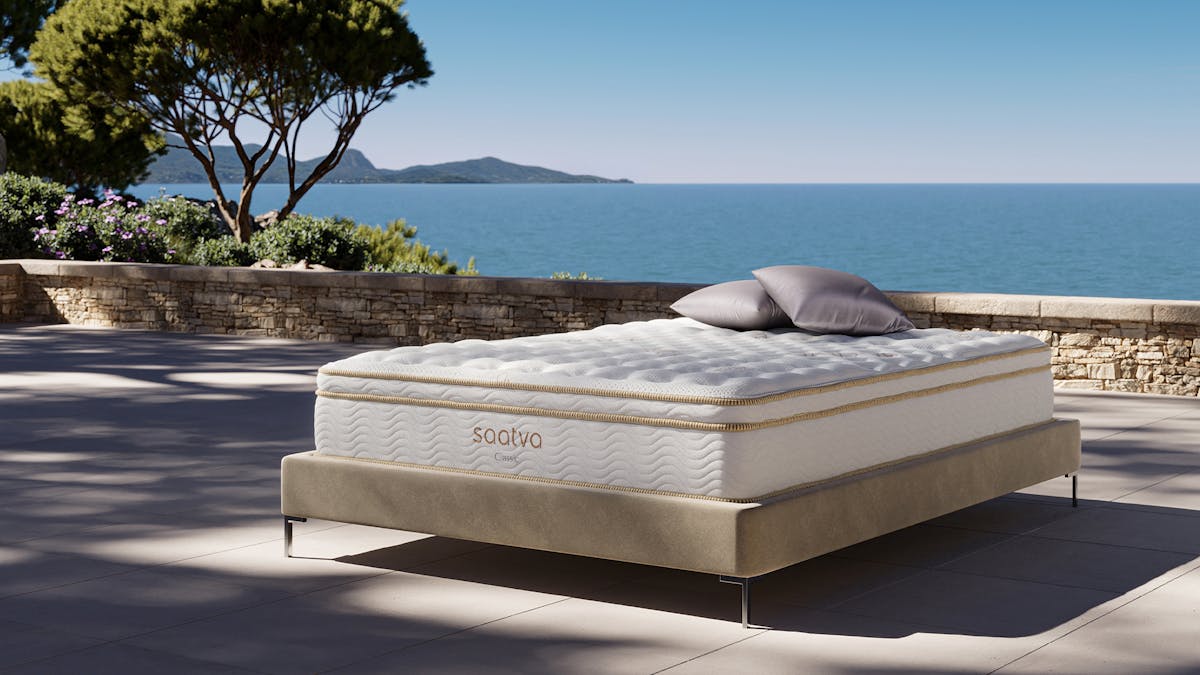
Saatva Classic is a traditionally constructed luxury mattress. It ships in two heights (11.5" and 14.5"), has individually wrapped coils over a tempered steel base coil unit, an organic cotton cover, and a Euro pillow top that can be tufted by hand. No electronics, no app, no subscription. It will outlast most mattresses in its price tier.
ORION is a hydronic cooling cover with embedded biometric sensors. It is not a mattress. It fits over your existing mattress, circulates chilled or warmed water through a fabric membrane, and connects to an app for dual-zone temperature scheduling and sleep tracking. It competes with Eight Sleep, ChiliPad, and BedJet, not with traditional mattresses.
The categories only overlap for one buyer: someone who is purchasing a new luxury mattress and simultaneously deciding whether to allocate budget toward a mattress with built-in passive cooling (Saatva, Tempur) versus adding an active cooling layer on top of a simpler bed.
Specs side by side
| Category | Saatva Classic | ORION Sleep System |
|---|---|---|
| Product type | Luxury innerspring mattress | Smart cooling cover (fits over any bed) |
| Construction | Dual-coil + Euro pillow top + organic cotton cover | Hydronic membrane + hub + app |
| Price (queen) | ~$1,795-$2,229 | ~$2,395 |
| Cooling | Passive (breathable coils, organic cover) | Active, up to 11.4°F surface drop |
| Dual-zone temperature | No | Yes (50-115°F per side, independent) |
| Sleep tracking | No | Yes (HRV, sleep stages, biometrics) |
| Subscription required | No | No (all features included) |
| Trial | 365 nights | 30 nights |
| Warranty | Lifetime | 2 years (hub) |
| Expected lifespan | 12-15 years | Hub: 4-6 years before service |
| White-glove delivery | Included, free | Ships direct, self-install |
| Electronics in bedroom | None | Hub + app required |
| HSA/FSA eligible | Generally no | Yes, with documentation |
When Saatva is the right answer
Choose Saatva Classic if any of these apply:
- Your current mattress is worn, sagging, or causing pressure pain. ORION adds cooling on top of a bad mattress, which does not solve the structural problem.
- You sleep neutral or cool and heat is not a major complaint.
- You want a 12-plus year purchase with lifetime warranty coverage and no recurring costs.
- White-glove delivery and old-mattress removal matter to you.
- You prefer zero electronics in the bedroom.
- You want firmness choice: Saatva ships in Plush Soft (3/10), Luxury Firm (5-6/10), and Firm (8/10).
Saatva's Luxury Firm is the most popular option and the right starting firmness for most back and combination sleepers. Side sleepers who run lighter (under 130 lb) often prefer Plush Soft. Stomach sleepers and heavier back sleepers tend to do better with the Firm option.
When ORION is the right answer
Choose ORION if all of the following are true:
- Your current mattress is in good structural condition, under 7-8 years old, not sagging.
- Heat is the primary complaint, not support or pressure relief.
- You are comfortable with an app-driven product and a hub on the nightstand.
- You or a partner want independent temperature zones (she runs cold at 80°F, he runs hot at 62°F).
- You have a documented sleep condition that qualifies for HSA/FSA reimbursement.
ORION is a genuine solution for hot sleepers. Its 11.4°F measured surface drop is significant, and the dual-zone scheduling is something no mattress alone can replicate. But it is a climate device layered over a mattress, not a replacement for one.
Cooling: passive vs active
Saatva's cooling is passive. The individually wrapped coil construction allows air to circulate through the mattress core rather than trapping it. The organic cotton cover wicks moisture better than synthetic covers. The Euro pillow top, if you choose the graphite-infused version, has slightly improved thermal conductivity. In our testing, Saatva Classic runs cooler than most memory-foam competitors but cannot rival an active hydronic system.
ORION uses a closed-loop water system that drops the sleep surface temperature on command. In lab conditions (78°F room, heated anthropomorphic mannequin), ORION maintained an 11.4°F surface drop over an 8-hour cycle. Hot sleepers report meaningful differences. For menopausal or hyperhidrosis sufferers, an active system is often non-negotiable.
The stack (Saatva Classic as the base, ORION on top) is the highest-performing configuration for hot sleepers who also want a proper luxury mattress. The coil construction underneath helps dissipate heat from the body's deeper layers while ORION handles the surface climate. That said, the combined cost runs $4,200+.
Edge support and motion isolation
Saatva has stronger edge support than ORION's host mattress in most cases. Saatva's dual-coil perimeter reinforcement scores 9.1/10 in our tests, making it easy to sit on the edge of the bed without noticeable sinkage. This matters for people who sit on the bed edge to put on shoes, or who share a bed and use the perimeter regularly.
Motion isolation depends on ORION's host mattress. A foam or hybrid under the ORION cover will isolate motion better than Saatva's coil-dominant construction. Saatva scores 7.4/10 for motion isolation, which is good for an innerspring but softer than a dedicated foam mattress.
Long-term cost of ownership
Saatva Classic at $1,795 (queen, current) over a 12-year lifespan works out to roughly $150/year. No subscription, no recurring service costs, no hardware refresh cycle.
ORION at $2,395 with an expected hub lifespan of 4-6 years. A hub replacement is estimated at $799. Over 10 years, including one replacement, annualized cost is roughly $320/year. No subscription, which is a meaningful advantage over Eight Sleep Pod 4 at $228/year on top of the hardware cost.
For buyers with HSA/FSA balances, ORION's effective post-tax cost can drop 22-37% with proper documentation, which narrows the gap.
Delivery and setup
Saatva includes free white-glove delivery: a two-person crew brings the mattress to your room, sets it up on your foundation or frame, and hauls away the old mattress at no additional charge. This is uncommon at the $1,800 price point and eliminates a significant logistical friction for most buyers.
ORION ships direct in standard packaging. You install the cover over your existing mattress yourself (described as a deep-pocket fitted sheet installation) and connect the hub to a 110V outlet within 6 feet of the bed. Most installations take under 30 minutes.
Verdict
If your mattress needs replacing, buy Saatva Classic. It is a better mattress than whatever you are replacing, costs less than ORION upfront, includes white-glove delivery, and carries a lifetime warranty with no electronics to maintain. You can always add active cooling later.
If your mattress is fine and heat is the problem, ORION is the answer. No mattress swap delivers 11.4°F active cooling, dual-zone temperature scheduling, or integrated biometric tracking. Saatva's passive cooling is good for a traditional mattress, not a substitute for an active hydronic system.
If you need both, the Saatva Classic plus ORION stack is the most complete solution we have tested under $5,000. Buy the mattress first, then add the cooling layer when the budget allows.
Saatva Classic is our top pick for anyone shopping for a new luxury mattress in this price range. ORION solves a different problem, active thermal control, that Saatva was never designed to address. Match the product to the actual need.
Frequently asked questions
Can you put ORION on top of a Saatva Classic?
Yes. ORION fits any mattress 8-14 inches thick on a standard foundation. The Saatva Classic in 11.5" height is within range. Saatva Classic plus ORION is the best-performing stack we have tested for hot sleepers who want a luxury mattress and active cooling.
Which has better motion isolation?
ORION's performance depends on its host mattress. Saatva Classic scores 7.4/10 for motion isolation, which is solid for an innerspring but lower than a foam-dominant bed. If motion isolation is critical, pair ORION with a foam or pocket-coil hybrid, or choose a memory-foam mattress as your base.
Does ORION require a subscription?
No. All features, autopilot scheduling, dual-zone control, biometric tracking, app data export, and smart-home integration, are included after the one-time hardware purchase. This differentiates it from Eight Sleep, which charges $228/year on top of the hardware.
Is Saatva good for hot sleepers?
Better than most traditional mattresses, but still passive. The coil construction circulates air and reduces heat retention compared to foam-dominant designs. Saatva is a reasonable choice for moderately warm sleepers. For chronic hot sleepers, night sweats, or temperature mismatch between partners, an active cooling system like ORION is a more complete solution.
Which has the longer trial period?
Saatva offers 365 nights. ORION offers 30 nights. If trial length matters for your decision, Saatva's year-long window is meaningfully longer and gives you full seasons to evaluate the mattress.