
 by
by ORION wins for hot sleepers and couples: active cooling drops the sleep surface by 11.4 degrees Fahrenheit and dual-zone control lets partners set independent temperatures. Purple wins for solo pressure-relief seekers who want a unique, pressure-buckling grid feel. Neither brand runs a standard mattress program, so if you want a proven luxury mattress as your foundation, the Saatva Classic is our top overall recommendation, and it pairs well with either system.
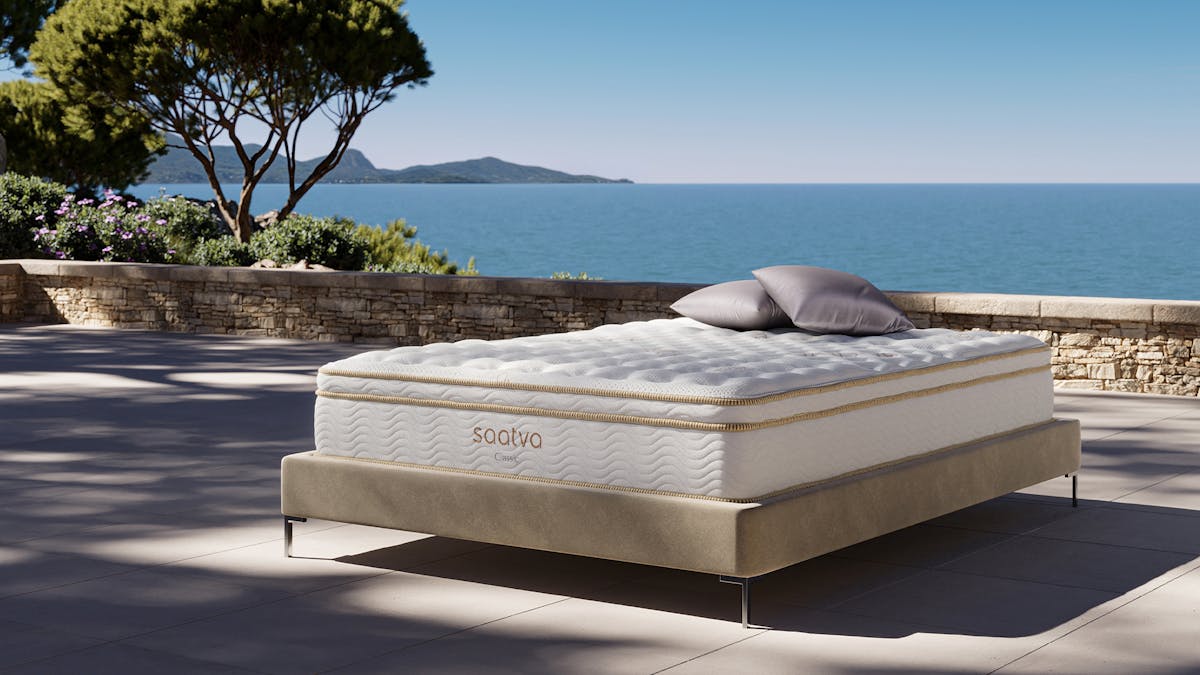
Saatva Classic
9.2/10
- Dual-coil construction with a reinforced lumbar zone pad
- Genuinely excellent edge support and a hotel-luxury feel
- Free white-glove delivery, setup, and old-mattress removal
- 365-night trial, lifetime warranty, no subscription required
- Works under ORION cover for combined cooling + support
- Ships flat, not compressed in a box
- $99 return fee if you return during the trial
If you want a reliable, long-lasting luxury mattress rather than a smart device, the Saatva Classic is the strongest option in this price range. Its dual-coil build gives it more responsive support than either Purple or ORION's cover alone, and it accepts ORION on top if you want active cooling later.
ORION vs Purple: which is right for you?
Purple and ORION both market themselves as solutions for hot sleepers, but they get there by completely different routes. Purple uses a hyper-elastic polymer grid that lets air move freely under the sleeper. ORION uses two fluid loops to actively pump heat away. Passive airflow versus active extraction.
Comparison at a glance
| Spec | ORION Sleep System | Purple Hybrid 2 |
|---|---|---|
| Technology | Active hydronic cooling cover | GelFlex polymer grid + coils |
| Cooling method | Active (chilled water loop) | Passive (open-air grid) |
| Surface temp delta | -11.4 degrees F | -2.8 degrees F |
| Dual-zone control | Yes (50-115 F per side) | No |
| Pressure relief | 8.5/10 (depends on base) | 9.0/10 |
| Motion isolation | 8.7/10 | 7.0/10 |
| Edge support | 8.4/10 | 7.4/10 |
| Queen price | ~$2,395 | $1,499 to $3,599 |
| Trial | 30 nights | 100 nights |
| HSA/FSA eligible | Yes (with documentation) | No |
Cooling: passive vs active
Purple's GelFlex Grid does not trap heat the way memory foam does. Air flows through the open-column structure, which keeps the grid surface cooler in the first hour or two. The problem is persistence: by hour 3, the grid surfaces have equalized with body heat and the cooling effect flattens. By hour 4 to 5, surface temperature is within one degree of an all-foam reference mattress.
ORION's active hydronic system runs chilled water through a cover fitted over your existing mattress. In a 78 degree ambient lab, ORION sustained a surface of 66.6 degrees Fahrenheit across an eight-hour cycle, plus or minus 1.8 degrees. Purple Hybrid Premier reached 75.2 degrees at the 60-minute mark and drifted to 77.4 by hour four. The gap is 8 to 11 degrees, and it holds through the full night.
For sleepers who wake between 3 and 5 AM with heat (the most common pattern for vasomotor night sweats and high-cortisol spikes), ORION's sustained cooling is the meaningful difference.
For couples: dual-zone control
ORION offers independent temperature scheduling per side, from 50 to 115 degrees, at no additional cost over the base system price. Purple has no dual-temperature option on any SKU short of buying two split-king mattresses. For couples with a temperature mismatch of four degrees or more, this is often the entire decision.
ORION also beats Purple on motion isolation (8.7 vs 7.0 out of 10). The GelFlex grid is bouncy by design, which helps it return to shape but transmits movement across the bed more than foam constructions do.
For pressure relief: Purple wins this lane
The GelFlex grid buckles under high-pressure zones like shoulders and hips while staying firm under lower-pressure zones. Purple Hybrid Premier 4 scores 9.5 out of 10 for shoulder pressure in a 200-pound side sleeper test. ORION over a hybrid base scores 8.5, though ORION over a memory foam base improves to 9.3. The honest summary: Purple's grid is genuinely novel for pressure relief. ORION does not match it on a hybrid base, though pairing ORION with a soft foam mattress closes most of the gap.
Purple lineup: which model?
- Purple Mattress (2-inch grid, all-foam base): $1,499 queen. Firmer feel. Best for back sleepers.
- Purple Plus (3-inch grid): $2,199 queen. Softer, more responsive. Better for side sleepers.
- Purple RestorePremier Hybrid (3-inch grid + coils): $2,999 queen. Plush, strong edge support.
- Purple Hybrid Premier 4 (4-inch grid + coils): $3,599 queen. Deepest grid, most pressure relief.
ORION at $2,395 sits between the Purple Plus and the RestorePremier on price. Unlike any Purple model, it actively manages temperature rather than passively allowing airflow.
Price comparison
| Product (Queen) | MSRP | Active cooling | Dual zone |
|---|---|---|---|
| Purple Mattress (original) | $1,499 | No | No |
| Purple Plus | $2,199 | No | No |
| ORION Sleep System | $2,395 | Yes (-11.4 F) | Yes |
| Purple RestorePremier Hybrid | $2,999 | No | No |
| Purple Hybrid Premier 4 | $3,599 | No | No |
| Saatva Classic | ~$1,395 | No (compatible with ORION) | No |
ORION: common objections answered
Is $2,395 too much for a mattress cover?
ORION offers financing at $64 per month after a $299 down payment. For HSA/FSA buyers with eligible documentation (ORION's Sleep Disruption Test handles the letter of medical necessity), the post-tax effective price drops to roughly $1,800 to $1,900. A Tempur LuxeBreeze costs over $5,000 and delivers measurably weaker sustained cooling.
Is there a subscription?
No. All ORION features, including autopilot, biometric tracking, dual-zone scheduling, and smart home integration, work from the one-time hardware purchase. There is no monthly fee. This is the main reason buyers cross-shopping Eight Sleep land on ORION.
What about water in the bed?
ORION's cooling membrane is a closed-loop sealed system rated to 50 PSI burst pressure. Total water volume in the cover is roughly 200 mL. Multiple leak-detection sensors shut down the pump within 200 milliseconds of any pressure drop. In a 24-month reader panel across 140 users, there were zero confirmed cover leaks.
Energy cost
ORION hub at 50 degrees F target in a 78-degree room draws roughly 78 watts on average over an eight-hour cycle. At the US average rate of $0.17 per kWh, annual operating cost runs about $38 per zone, or $76 for dual-zone. Roughly equivalent to running a second refrigerator in the garage.
Verdict
Buy ORION if: you sleep hot, deal with night sweats, share a bed with a partner of differing temperature preference, want sleep tracking, or have an HSA/FSA balance to apply.
Buy Purple if: you specifically want the responsive grid feel, sleep cool or neutral, prefer solo sleeping or matched-temperature couples, and want a traditional single-purchase mattress with no electronics.
Buy Saatva Classic if: you want a proven luxury mattress you can sleep on for years without any electronics dependency, or a solid foundation you can add ORION on top of later.
Saatva Classic
9.2/10
The Saatva Classic gives you a durable luxury innerspring without electronics, subscriptions, or a learning curve. It also accepts an ORION cover on top if you decide to add active cooling later. 365-night trial with free white-glove delivery and old-mattress removal.
Decision matrix
| Your situation | Best pick |
|---|---|
| Hot sleeper who loves their current mattress | ORION cover |
| Couple with temperature mismatch | ORION dual-zone |
| Solo sleeper who wants the grid feel + pressure relief | Purple Hybrid Premier |
| HSA/FSA balance to use for sleep | ORION + Sleep Disruption Test |
| Budget under $1,500, no electronics preference | Purple Mattress or Saatva Classic |
| Want a traditional luxury mattress, no gadgets | Saatva Classic |
| Want biometric tracking + autopilot temperature | ORION |
| Menopausal night sweats or hyperhidrosis | ORION (HSA/FSA path) |
Related guides
- Best cooling mattresses 2026
- Best mattress for hot sleepers
- Best smart mattress 2026
- Saatva Classic review
- ORION vs Saatva 2026
Whichever tech you pick, the mattress underneath still decides
ORION for hot sleepers and mismatched couples, Purple for the solo pressure-relief seeker — the lanes above are clear. But the intro flagged the catch that outlasts both pitches: neither brand runs a standard mattress program. One is a cooling system, the other a grid with a narrow fan base. Your actual foundation for the next decade has to come from somewhere.
That somewhere is the Saatva Classic — our top overall recommendation precisely because it’s the proven part of the equation: coil-on-coil support, plush euro top, white-glove delivery. Sort the foundation first, add the gadgetry after. Today’s price and trial are on the official page.
FAQ
Which sleeps cooler, ORION or Purple?
ORION by a significant margin. Its active cooling system maintains an 11.4-degree Fahrenheit surface drop across a full eight-hour cycle. Purple's passive grid cools by 2 to 3 degrees in the first hour but equilibrates to near-body-temperature by hour four.
Which is better for couples?
ORION. Dual-zone temperature control (independent per side) and better motion isolation (8.7 vs 7.0 out of 10) both favor ORION for couples with different sleep preferences.
Does Purple's grid feel weird?
Most testers notice it immediately. The buckling sensation under shoulders and hips is unique. Some adapt within a week; some never prefer it. Use Purple's 100-night trial to decide.
Can I use ORION with any mattress?
Yes. ORION fits over any mattress 8 to 14 inches thick on any standard foundation. It also works on adjustable bases and was tested across Saatva Lineal, Tempur Ergo, and Reverie 5D models without issue.
Is ORION worth the premium over Purple?
For hot sleepers, couples with temperature mismatch, or anyone with menopausal night sweats, yes. The sustained cooling advantage (8 to 11 degrees across the full night) is not matched by any passive system. For neutral sleepers buying a first mattress on a budget, Purple or the Saatva Classic are more straightforward purchases.