
 by
by Editor's Pick
Saatva Classic — Best Overall Mattress
Luxury innerspring quality at direct-to-consumer pricing. 365-night trial, white-glove delivery, lifetime warranty.
Pain and Sleep: The Bidirectional Relationship
Pain disrupts sleep, and poor sleep amplifies pain. Research consistently shows that inadequate sleep lowers pain threshold, increases pain intensity perception, and reduces pain tolerance. This bidirectional relationship means that addressing either factor helps the other: improving sleep quality reduces pain perception, and reducing pain improves sleep quality.
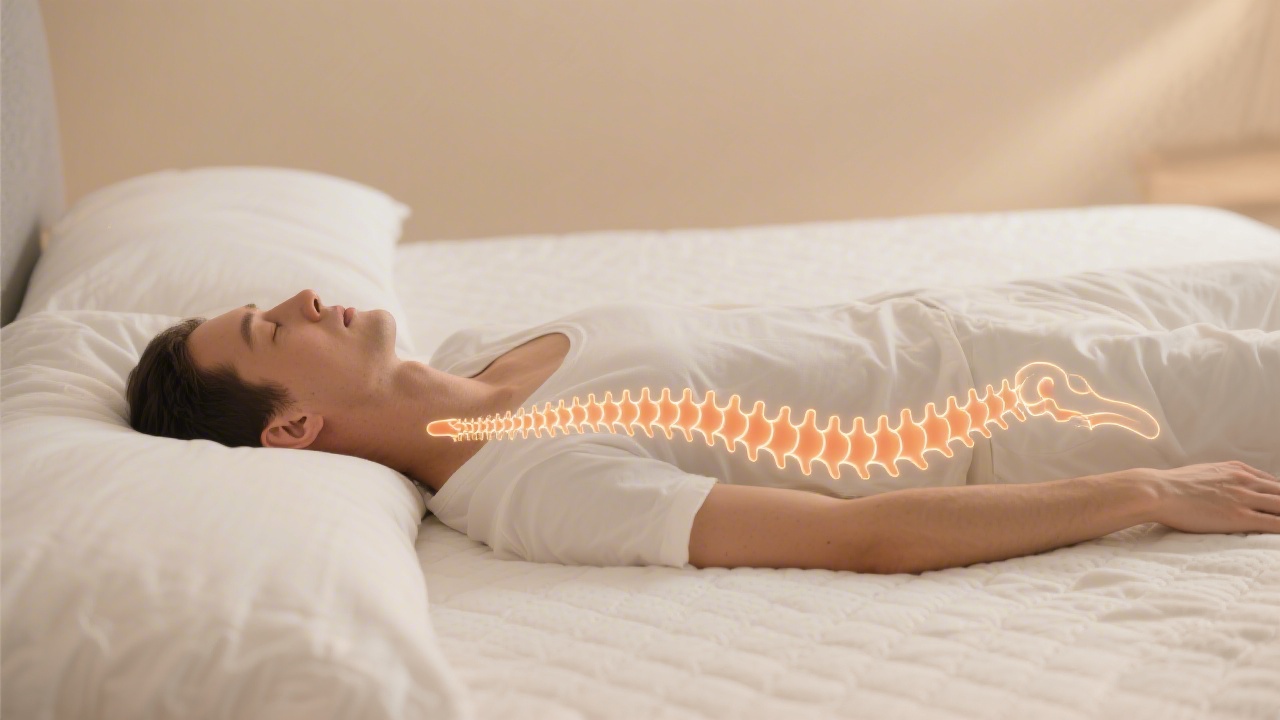
The mattress is the most structurally significant sleep environment variable for pain. The wrong mattress creates or worsens pressure points and spinal misalignment on every sleep cycle, night after night. This guide addresses every common pain condition with specific mattress and sleep position guidance.
Related: Complete Sleep Guide 2026 | Mattress Buying Guide
Lower Back Pain
Lower back pain affects approximately 80% of adults at some point in their lives and is among the most common reasons for mattress replacement.
Mattress requirements: Sufficient firmness to prevent the hips from sinking below the shoulders (causing lumbar splay), combined with enough comfort layer depth to relieve pressure at the iliac crest and greater trochanter.
Evidence: A 2003 RCT in The Lancet (Kovacs et al., n=313) found that medium-firm mattresses reduced chronic non-specific low back pain significantly compared to firm mattresses (OS 5.28 vs 2.10, p<0.001). A 2009 study in the Journal of Chiropractic Medicine found new medium-firm mattresses significantly reduced back pain and improved sleep quality.
Position guidance: Back sleeping with a pillow under knees keeps the lumbar spine in neutral. Side sleeping with a pillow between the knees prevents hip adduction that twists the lumbar spine. Stomach sleeping flattens the lumbar lordosis — generally the worst position for low back pain sufferers.
Recommendation: Medium-firm hybrid (6/10 firmness). Saatva Classic Luxury Firm or Firm for back and heavier sleepers.
Hip Pain
Hip pain during sleep is most commonly reported by side sleepers and is typically caused by greater trochanteric bursitis, iliotibial band tightness, hip osteoarthritis, or labral pathology.
Mattress requirements: Sufficient comfort layer depth (3+ inches) to cushion the greater trochanter contact point. Too-firm a mattress concentrates pressure at the hip, worsening bursitis symptoms.
Position guidance: Side sleep on the non-painful hip with a pillow between the knees. Back sleeping eliminates hip point loading entirely.
Recommendation: Plush soft hybrid or medium hybrid. Saatva Plush Soft or Saatva Classic in Luxury Firm with pillow-top for side sleepers.
Shoulder Pain
Shoulder pain from sleep is most common in side sleepers and is associated with rotator cuff pathology, shoulder impingement, or AC joint osteoarthritis.
Mattress requirements: Deep pressure relief at the shoulder contact point. Memory foam or thick latex comfort layers distribute shoulder pressure over a wider area. Too-firm surfaces create point loading at the acromion and greater tubercle.
Position guidance: Side sleepers should ensure the shoulder can sink into the comfort layer rather than being laterally compressed. A softer pillow that allows the head to sit slightly lower than the shoulder may reduce impingement. Back sleeping eliminates shoulder pressure entirely.
Recommendation: Soft to medium hybrid (3-5/10 firmness). High-quality memory foam or latex comfort layer at least 3 inches deep.
Arthritis
Arthritis encompasses osteoarthritis (degenerative joint disease) and rheumatoid arthritis (autoimmune). Both cause joint pain, stiffness, and reduced range of motion that significantly affects sleep quality.
Mattress requirements: Low motion transfer (to avoid waking from partner movement), ease of repositioning (arthritis sufferers often need to shift position frequently — responsive latex or coil-based surfaces are easier to reposition on than deep memory foam), appropriate height for getting in/out of bed (24-28 inches total height is typically easiest).
Position guidance: Avoid prolonged pressure on affected joints. Arthritis in the knee benefits from a pillow under the knees (back sleeping) or between the knees (side sleeping). Hand/wrist arthritis may benefit from sleeping with hands in a neutral rather than flexed position.
Recommendation: Medium hybrid with latex comfort layers. Adjustable base with head and foot elevation to find pressure-free positions.
Fibromyalgia
Fibromyalgia is characterized by widespread musculoskeletal pain, fatigue, sleep disturbances, and heightened pain sensitivity (central sensitization). Poor sleep significantly worsens fibromyalgia symptoms, creating a vicious cycle.
Mattress requirements: Because fibromyalgia patients have widespread tender points and heightened pressure sensitivity, they typically require more pressure relief than standard recommendations suggest. Softer comfort layers and high-quality memory foam or latex that distributes pressure across a larger surface area tend to perform best.
Additional considerations: Temperature regulation is important, as many fibromyalgia patients report temperature sensitivity. Motion isolation is valuable for reducing sleep disruption.
Recommendation: Medium-soft hybrid (4-5/10 firmness) with latex or copper-infused memory foam comfort layers. Saatva Classic Plush Soft.
Scoliosis and Spinal Conditions
Scoliosis (lateral spinal curvature) and other spinal conditions including spinal stenosis, degenerative disc disease, and herniated discs create highly individual mattress requirements depending on the specific curvature pattern, location, and symptom profile.
General principles: Zoned support mattresses that offer firmer support at the lumbar zone and softer at shoulder and hip zones can better accommodate non-standard spinal curvature. Medium-firm is a reasonable starting point, with trial period adjustment. Adjustable bases allow personalized positioning that may significantly reduce symptomatic pressure.
Related pages: Sleep Disorders Guide | Sleep Science Hub
Pregnancy
Sleep discomfort during pregnancy evolves by trimester. First trimester: fatigue and nausea. Second trimester: growing abdomen shifts center of gravity. Third trimester: back pain, hip pressure, frequent urination, and difficulty finding comfortable positions.
Mattress requirements: Left-side sleeping (recommended by OB-GYNs after 20 weeks to improve fetal blood flow) requires good hip and shoulder pressure relief. Full-length body pillows significantly improve comfort in the third trimester.
Recommendation: Medium hybrid with adequate comfort layer depth for side sleeping. Body pillow support. Avoid stomach sleeping after first trimester.
Sleep Position Reference
Back sleeping: Neutral spine position. Best for most conditions except snoring/apnea (worsens in supine). Pillow under knees reduces lumbar pressure.
Side sleeping (left): Recommended for acid reflux, snoring, late pregnancy. Requires mattress to accommodate hip/shoulder pressure points. Pillow between knees maintains pelvic alignment.
Side sleeping (right): Generally equivalent to left for most conditions. Not recommended for acid reflux (worsens symptoms).
Stomach sleeping: Generally the most problematic position: cervical hyperextension from head turning, lumbar lordosis reversal. Avoid for most pain conditions. If you cannot break the habit, use no pillow or a very flat pillow and place a thin pillow under the lower abdomen to reduce lumbar stress.
Frequently Asked Questions
What mattress firmness is best for back pain?
Medium-firm is the most consistently well-supported firmness for back pain across the research literature. A landmark 2003 RCT published in The Lancet (Kovacs et al.) found medium-firm mattresses significantly reduced chronic low back pain and disability compared to firm mattresses. However, optimal firmness depends on sleep position and body weight: side sleepers with back pain often need a softer surface (3-4/10) to relieve hip and shoulder pressure while maintaining lumbar support, while back sleepers with back pain typically do best at medium-firm (6/10).
Is memory foam or innerspring better for back pain?
Hybrid mattresses (pocketed coils plus comfort foam or latex layers) perform best for back pain in the available evidence. They combine the pressure relief of foam (relieving trigger points) with the targeted support of coil systems (preventing excessive sinkage of the hips). All-foam mattresses can be appropriate for side sleepers with back pain if high-density foam prevents excessive hip sinkage. Traditional innerspring alone provides insufficient pressure relief for most back pain sufferers. Latex hybrids specifically are highly rated for back pain due to latex’s natural responsiveness, which resists the “sinking in” feeling of memory foam.
How should I sleep to relieve hip pain?
For hip pain sufferers, back sleeping with a pillow under the knees is typically the most pressure-free position, as it keeps the hip joints in a neutral, unloaded position. If side sleeping is preferred, sleep on the non-painful hip and place a pillow between the knees to keep the pelvis level and prevent hip adduction pressure. A softer mattress comfort layer helps side sleepers by cushioning the hip contact point. Saatva Plush Soft or a medium hybrid with significant comfort layer depth performs well for hip pain side sleepers.
What mattress is best for arthritis?
Arthritis sufferers benefit most from a mattress that minimizes pressure at affected joints while providing sufficient support to maintain spinal alignment. For most arthritis patients, a medium to medium-soft hybrid with memory foam or latex comfort layers provides the best balance. Key features: low motion transfer (to avoid waking from partner movement), ease of repositioning (latex or coil systems are more responsive than deep memory foam, making it easier to shift position during the night), and a height that makes getting in and out of bed comfortable (ideally 24-28 inches floor-to-top of mattress).
Does sleeping position matter as much as mattress for pain?
Both matter significantly, and they interact. The optimal mattress for a back sleeper is different from the optimal mattress for a side sleeper with the same pain condition. Sleep position modifications are often immediately actionable (adding a knee pillow, trying a different position) while mattress changes require investment. For acute pain, position adjustment is the faster intervention. For chronic pain, the mattress is the structural foundation — no sleep position adjustment can fully compensate for a mattress that creates pressure points or allows spinal misalignment.
Editor's Pick
Saatva Classic — Best Overall Mattress
Luxury innerspring quality at direct-to-consumer pricing. 365-night trial, white-glove delivery, lifetime warranty.