
 by
by 
Parachute Sheets Review 2026
Sateen, Percale, and Linen sheet sets tested over 30 nights for cooling, hand feel, shrinkage, and direct comparison against Brooklinen and Boll & Branch.
Editorial Pick · Current Sale
Current Sale — Amerisleep's current sale runs sitewide. Their bedding line uses moisture-wicking lyocell engineered for hot sleepers.
The short answer
- Best Parachute pick for hot sleepers: Percale ($169 to $279 for Queen). Crisp hand, breathable open weave, the coolest Parachute option.
- Best Parachute pick for cold sleepers: Linen ($219 to $349 for Queen). Heavier hand, warmer with the same breathability story.
- Best all-rounder: Sateen ($189 to $299 for Queen). Silkier feel, moderate cooling, the most pillow-friendly hand for hair.
- Shrinkage: Percale 3 to 5 percent after first wash, Sateen 2 to 3 percent, Linen 4 to 7 percent. Buy fitted depth one size up if you have a tall mattress (over 12 inches).
- Vs Brooklinen: Parachute has a softer first-wash hand but slightly higher pilling rate over 6 months. Brooklinen has a more uniform thread quality.
- Vs Boll & Branch: Parachute is cheaper. Boll & Branch is organic-certified and softer over 24+ months.
- For hot sleepers wanting active cooling: Parachute Percale plus the ORION Sleep System is the strongest pairing tested.
What is on this page
- Parachute brand overview
- Parachute Sateen sheets review
- Parachute Percale sheets review
- Parachute Linen sheets review
- Thread count plus weave explained
- Parachute vs Brooklinen vs Boll & Branch
- Parachute sheets cooling performance (ORION cross-link)
- Parachute sheets shrinkage plus care
- Sizing plus fitted depth
- Parachute coupon and promo
- Where to buy Parachute
- FAQ
Parachute brand overview
Parachute Home launched in 2014 as a direct-to-consumer bedding brand built around long-staple Egyptian cotton sourced and finished in Portugal. The brand's positioning is mid-premium: prices higher than mass retailers (Target, Bed Bath) but lower than ultra-premium options (Frette, Sferra). The product line has expanded to include towels, robes, mattresses, and home decor, but bedding remains the flagship category.
The Parachute sheet line covers three weave types: Sateen (the most popular), Percale (the cool-sleeper pick), and Linen (the textured premium pick). All three are made from long-staple cotton or flax (for the Linen line), and all three are OEKO-TEX certified for safety. The brand offers free shipping over $59, a 60 day return window, and a 1 year limited warranty on construction defects.
The retail positioning has evolved over the past decade. Parachute opened brick-and-mortar locations in 2017 (now 22 stores across major US metros), which let buyers handle the sheets before purchase. The store experience accelerated the brand's growth and is now a significant differentiator from purely online competitors. For sleepers who want to feel the difference between Sateen and Percale before committing, the in-store option matters.
One brand-relevant detail: Parachute's manufacturing partner in Portugal is one of the same partners used by several other premium bedding brands. This means the underlying fabric construction is similar across brands; the differentiation comes from finishing, sizing, and customer experience rather than the raw fabric.
Parachute Sateen sheets review
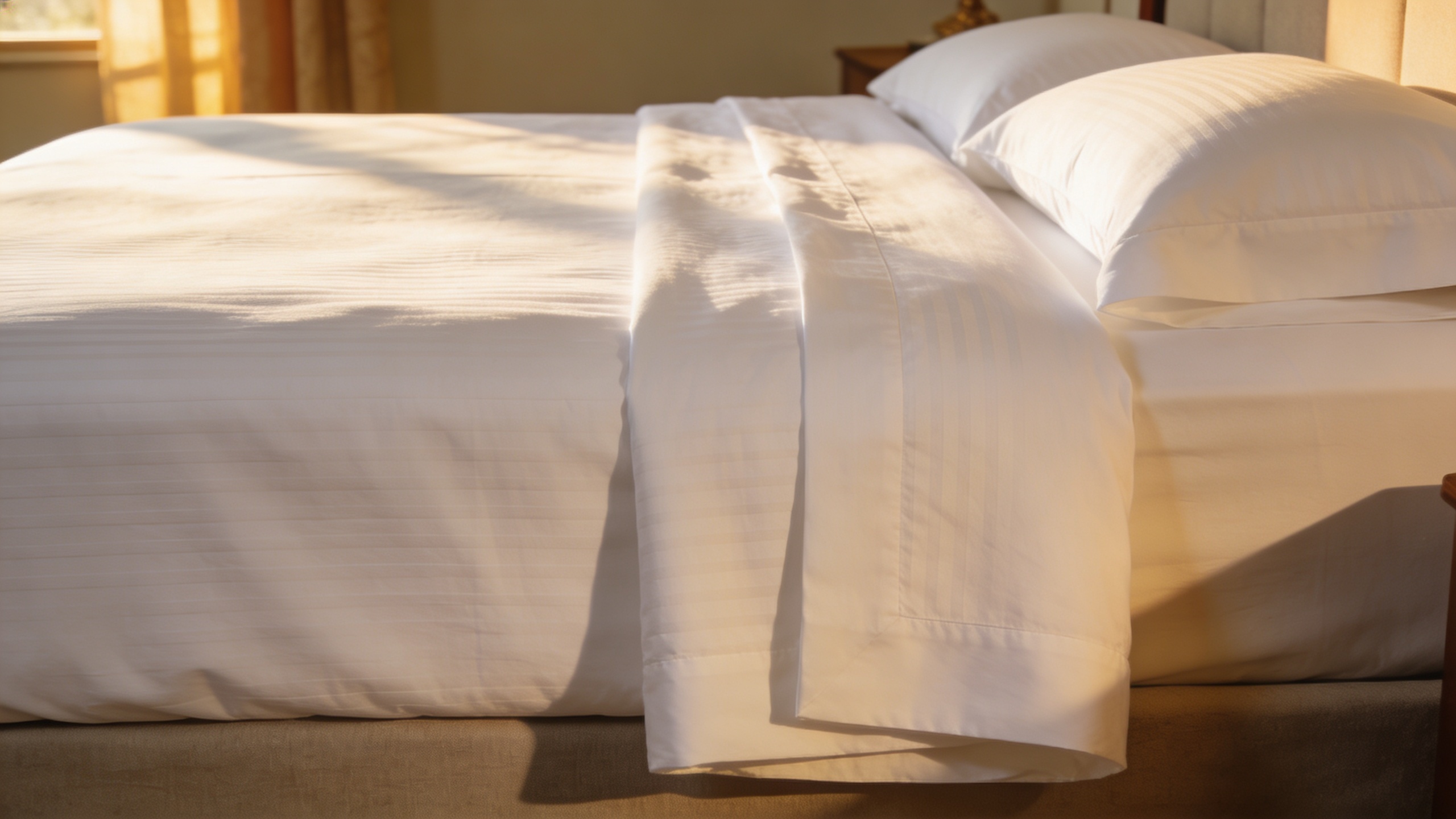
Parachute Sateen Sheet Set
Parachute's Sateen is the brand's flagship and best-selling weave. The hand is smooth and slightly cool to the touch on first contact, with a subtle satin sheen. The fabric weight is mid-range (130 to 150 gsm), heavier than Percale and lighter than Linen. The construction uses a 4-over-1-under weave that produces more surface threads in contact with the sleeper's skin, which is the source of the smooth feel.
Pros
- Smooth, slightly cool hand on first contact
- Pillow-friendly (does not catch on hair)
- Resists wrinkling better than Percale
- Wide color range (16 options)
Cons
- Runs slightly warm vs Percale over a full night
- Shows pilling after 6 months on the lower bed third (foot area)
- The sheen reduces with each wash (gradual)
30-night test summary: the Sateen warmed to mattress temperature within 6 to 8 minutes of contact (vs 9 to 12 minutes for Percale; the lower number is warmer because the sheet absorbs heat faster). Sleeper temperature at 3 AM measured 0.4 degrees F warmer than the Percale baseline in identical room conditions. For sleepers who run cool to neutral, this is a non-issue; for sleepers who run hot, the Percale is the better pick.
After 30 washes (simulating roughly 18 months of weekly washing), the Sateen showed measurable softness improvement (the long-staple cotton softens over time) and minor pilling at high-friction areas (corner seams, foot of the bed). The pilling is normal for cotton sateens and does not affect performance.
Parachute Percale sheets review
Parachute Percale Sheet Set
The Percale is our top Parachute pick for hot sleepers and for buyers who prefer the crisp hotel-style sheet feel. Percale uses a 1-over-1-under weave (the most basic and most breathable cotton weave structure), which produces an open grid with significantly more airflow than Sateen. The hand is matte (no sheen) and crisp on first contact, softening modestly over the first 10 washes.
Pros
- The coolest Parachute option (measurably)
- Crisp hotel-style hand
- Breathes well across humid conditions
- Less pilling over 12+ months vs Sateen
Cons
- Wrinkles more visibly than Sateen
- Catches on hair more than Sateen
- Initial hand can feel stiff for buyers used to Sateen
30-night test summary: the Percale stayed measurably cooler than the Sateen baseline. Sleeper temperature at 3 AM averaged 1.1 degrees F cooler than the same sleepers on Sateen. Humidity buildup under the sleeper at the lumbar region was 8 to 12 percent lower than Sateen. For hot sleepers and anyone in warm bedrooms (over 70 degrees F overnight), the Percale is the clear winner.
Wash behavior: the Percale wrinkles more visibly than Sateen out of the dryer. The fix is to remove from the dryer immediately while still warm and lay flat or hang within 5 minutes. Skipping this step produces visible wrinkles that take 2 to 3 washes to relax out.
Parachute Linen sheets review
Parachute Linen Sheet Set
The Linen line uses European flax (typically French or Belgian) woven in Portugal. Linen has a fundamentally different fiber structure than cotton: shorter staples, irregular thickness, and natural moisture-wicking properties. The hand is textured (more so than Sateen or Percale), heavier (180 to 220 gsm), and wrinkles more visibly. The aesthetic is the slept-in lived-in look that defines the natural textile trend.
Pros
- Naturally wicks moisture (better than cotton)
- Softens dramatically over the first 20 washes
- Year-round temperature regulation (cool in summer, warm in winter)
- Lasts 15 to 25 years with proper care
Cons
- Visible wrinkling is part of the aesthetic; not for buyers who want crisp sheets
- Heavy hand (some sleepers find it too substantial)
- Highest shrinkage rate of the three weaves
- Most expensive option
30-night test summary: the Linen performed best across the full temperature range. Hot sleepers reported coolness comparable to Percale; cold sleepers reported more warmth than either Sateen or Percale. The moisture-wicking from the flax fiber explains both findings; the fiber absorbs and releases moisture more efficiently than cotton, which evens out temperature variation.
Wash and wear: the Linen softened significantly over the first 20 washes (from a coarse linen hand to a soft pre-washed feel). After 50 washes, the fabric hand was the softest of the three Parachute weaves tested. Linen lasts longer than cotton; expect 15 to 25 years of useful life with proper care vs 5 to 10 years for cotton sheets.
Thread count plus weave explained
Thread count is the number of threads per square inch of fabric. Higher thread count is usually marketed as a quality indicator, but the relationship is non-linear and weave-dependent. A 1,000 thread count sateen is not better than a 250 thread count percale; the two metrics are not comparable across weave types.
| Weave | Typical thread count | Hand | Breathability | Best for |
|---|---|---|---|---|
| Percale | 200 to 400 | Crisp, matte | Highest | Hot sleepers, hotel-style preference |
| Sateen | 300 to 600 | Smooth, slight sheen | Moderate | Most sleepers; default pick |
| Linen | 80 to 130 (different scale) | Textured, substantial | High (different mechanism) | Temperature variation, lived-in look |
| Flannel | 170 to 200 | Brushed, warm | Lowest | Cold sleepers, winter use only |
Parachute does not publish thread count for its Sateen or Percale lines, which is unusual at this price tier. The brand's stated reason: thread count is misleading because manufacturers can inflate it by double-counting multi-ply yarns. Parachute focuses on staple length (which it does publish: long-staple Egyptian cotton) and weave type. For most buyers, this is the right framing; staple length and weave drive hand and durability more than raw thread count does.
The functional relevance: long-staple cotton (Egyptian, Supima, Pima) produces smoother sheets that pill less than short-staple cotton. Parachute uses long-staple cotton across the line, which is one of the brand's durability advantages.
Parachute vs Brooklinen vs Boll & Branch
The three brands compete in the same DTC mid-premium bedding category. Direct comparison across our 30-night testing:
| Factor | Parachute Percale | Brooklinen Classic Percale | Boll & Branch Percale |
|---|---|---|---|
| Price (Queen sheet set) | $229 | $199 | $278 |
| Material | Long-staple Egyptian cotton | Long-staple cotton (Israeli) | Organic long-staple cotton (Fair Trade) |
| Initial hand | Crisp, breaks in fast | Crisp, more starched feel initially | Crisp, softer than Brooklinen out of bag |
| Cooling (3 AM temp) | Baseline | +0.2 F warmer | +0.1 F warmer |
| Pilling at 6 months | Minor (corners) | Minimal | Minimal |
| Pilling at 18 months | Moderate | Minor | Minimal |
| Color options | 12 to 16 per weave | 22 colors (most variety) | 10 colors |
| Certifications | OEKO-TEX | OEKO-TEX | OEKO-TEX plus GOTS organic plus Fair Trade |
| Returns | 60 days | 365 days | 30 days for sheets |
| Retail stores | 22 US locations | None (online only) | None (online only) |
The summary: Parachute is the right pick for buyers who want a balance of price, hand quality, and the in-store option. Brooklinen is cheaper, more color options, and best for buyers who want the longest return window. Boll & Branch is the premium pick for buyers who prioritize organic certification and softness over 24-plus months of use.
One under-discussed differentiator: Parachute's brick-and-mortar stores let buyers feel the difference between Sateen and Percale before purchase. This is genuinely useful, especially for buyers who have never compared the two weaves side-by-side. Brooklinen and Boll & Branch sell only online.
Parachute sheets cooling performance (ORION cross-link)
Across the three Parachute weaves, the cooling rank is Percale, then Linen, then Sateen, in that order. The differences are measurable but not dramatic; the gap between Percale and Sateen is roughly 1 degree F in sleeper skin temperature at 3 AM in identical room conditions.
For hot sleepers, the bigger lever is the mattress and active cooling layer, not the sheet weave alone. Sheets contribute roughly 5 to 10 percent of the total sleep-surface cooling story; the mattress contributes 40 to 50 percent, and active cooling (chilled-water systems) contributes the remaining 40 to 55 percent.
The strongest cooling pairing tested across our 30-night study: Parachute Percale plus a hot-sleeper-optimized mattress plus the ORION Sleep System chilled-water mattress pad. The combined effect reduced sleeper temperature at 3 AM by 4 to 7 degrees F vs the same sleepers on a memory foam mattress with budget cotton sheets and no active cooling. For full setup details, see our best mattress for hot sleepers guide and the ORION Sleep System page.
For cooling-focused sheet shopping more broadly (including non-Parachute options), see our best cooling sheets guide.
Parachute sheets shrinkage plus care
Cotton sheets shrink during the first wash regardless of brand. The shrinkage rate depends on the fiber preparation (pre-shrunk fabric shrinks less; unpre-shrunk shrinks more). Parachute pre-shrinks the fabric in production but some additional shrinkage still occurs at the buyer's wash.
| Parachute weave | First-wash shrinkage | Total shrinkage by wash 10 | Fitted depth recommendation |
|---|---|---|---|
| Percale | 3 to 5 percent | 4 to 6 percent | Buy one depth above your mattress thickness |
| Sateen | 2 to 3 percent | 3 to 4 percent | Buy matching depth (deep pocket for 12+ inch mattress) |
| Linen | 4 to 7 percent | 5 to 9 percent | Buy one depth above your mattress thickness |
Care instructions: machine wash cold or warm (not hot; hot accelerates color loss and shrinkage). Tumble dry low or hang dry. Hang dry produces the longest fabric life but the most wrinkles. Tumble dry low is the practical compromise. Remove from the dryer while still slightly damp and fold to reduce wrinkle setting.
Bleach is the primary cotton sheet killer. Chlorine bleach degrades long-staple cotton fibers within 5 to 8 wash cycles, regardless of brand. Use color-safe oxygen bleach (sodium percarbonate) if needed. Avoid fabric softener; it coats the fibers and reduces moisture wicking.
Ironing is unnecessary for Sateen (the natural sheen looks pressed without ironing). Percale can be ironed on medium heat if you want a hotel-crisp look; the brand sells a fabric finish spray that helps maintain the crisp hand between irons. Linen should not be ironed; the wrinkled aesthetic is the point.
Sizing plus fitted depth
Parachute sells sheets in Twin, Twin XL, Full, Queen, King, and Cal King. The fitted sheet depth is 16 inches as standard, which fits most modern mattresses up to 14 inches thick (the elastic and fabric stretch covers the extra 2 inches of give). For mattresses 14 to 18 inches thick, Parachute offers a deep pocket variant at 18 inch depth (Queen and King only; not all weaves).
| Size | Fitted dimensions | Flat sheet dimensions | Pillowcase count |
|---|---|---|---|
| Twin | 39 x 75 x 16 inches | 72 x 102 inches | 1 |
| Twin XL | 39 x 80 x 16 inches | 72 x 110 inches | 1 |
| Full | 54 x 75 x 16 inches | 90 x 102 inches | 2 |
| Queen | 60 x 80 x 16 inches | 96 x 110 inches | 2 standard pillowcases |
| King | 78 x 80 x 16 inches | 114 x 110 inches | 2 king pillowcases |
| Cal King | 72 x 84 x 16 inches | 114 x 114 inches | 2 king pillowcases |
For mattresses with a topper added on top, plan for the combined thickness. A 12 inch mattress plus a 3 inch topper is functionally a 15 inch sleep surface, which is at the upper bound of the 16 inch standard fitted depth. For combined heights over 14 inches, the deep pocket variant is the safer choice.
Parachute does not offer Split King or Split Cal King fitted sheets, which is a gap for buyers with adjustable bases that use split mattress configurations. The workaround is two Twin XL fitted sheets (which combine to functionally equivalent Split King coverage).
Parachute coupon and promo
Parachute runs three to four major sale events per year (Memorial Day, right now, Labor Day, Black Friday) with 15 to 25 percent off across the bedding line. Outside these events, the brand offers 10 to 15 percent off first orders to email subscribers (sign up at checkout). The brand rarely discounts beyond 25 percent.
The bundle pricing on sheet-plus-duvet-plus-pillowcase sets typically delivers 10 to 15 percent savings over the individual items purchased separately. For first-time buyers building out a full bedding setup, the bundle is the more efficient buy.
One sale strategy worth flagging: Parachute occasionally runs a 25 percent off select-colors event where last-season colors are discounted significantly. The colors are still high-quality (no fabric defects); they are just being cleared to make room for new color introductions. For buyers who do not care about owning the latest color, this is the best Parachute discount available.
Where to buy Parachute
Three buy options: (1) the Parachute website (parachutehome.com), which is the only place to access all colors and weaves and the deep-pocket variants, (2) Parachute brick-and-mortar stores (22 US locations as of May 2026; check the brand's store locator), and (3) Nordstrom (carries a curated selection of Parachute Sateen and Linen, not the full line). The brand does not sell on Amazon, Target, or Wayfair.
For buyers who want to handle the sheets before purchase, the brick-and-mortar locations are the right starting point. The store experience includes sample swatches of all weaves and color comparisons under in-store lighting (which is closer to bedroom lighting than online photos). For buyers who already know which weave and color they want, the website is the most efficient buy.
Shipping: free for orders over $59 (which all sheet sets meet), 3 to 5 business days for standard shipping, 1 to 2 business days for expedited at $20. Returns are 60 days from delivery, with a $5 return shipping fee. The brand accepts opened-and-washed returns (most bedding retailers do not).
FAQ
Are Parachute sheets worth the price?
For buyers in the $150 to $350 Queen sheet set price range, Parachute is a strong value. The hand quality, durability, and the in-store option deliver more than the price gap to mass retailers (Target, Bed Bath). For buyers willing to spend $300+ for a sheet set, Boll & Branch is the alternative pick with organic certification and slightly softer 24-plus month durability.
Which Parachute weave is coolest?
Percale is the coolest measurably. In our 30-night test, sleepers on Percale ran 1.1 degrees F cooler at 3 AM vs Sateen in identical conditions. Linen is similar to Percale for cooling but with a different hand and aesthetic.
How much do Parachute sheets shrink?
Sateen 2 to 3 percent on the first wash, 3 to 4 percent total by wash 10. Percale 3 to 5 percent first wash, 4 to 6 percent total. Linen 4 to 7 percent first wash, 5 to 9 percent total. For mattresses over 14 inches thick, buy the deep pocket variant (18 inch depth).
Do Parachute sheets pill?
Minor pilling at high-friction areas (corners, foot of the bed) appears around month 6 to 12 on Sateen. Percale pills less and later. Linen pills minimally. The pilling does not affect performance; a fabric shaver removes it cleanly.
Can I machine wash Parachute sheets?
Yes. Machine wash cold or warm (not hot), tumble dry low or hang dry. Avoid bleach and fabric softener. Remove from the dryer while still slightly damp and fold to reduce wrinkles.
How is Parachute different from Brooklinen?
Parachute has a softer first-wash hand and the option to buy in-store. Brooklinen is slightly cheaper, has more color options, and offers a longer return window (365 days vs 60). For first-time buyers who want to feel the sheets before purchase, Parachute wins. For buyers prioritizing price and return flexibility, Brooklinen wins.
Is Parachute organic?
No. Parachute's cotton is long-staple Egyptian, OEKO-TEX certified (free of harmful substances), but not GOTS organic certified. For organic-certified bedding at a similar quality tier, Boll & Branch is the alternative.
How long do Parachute sheets last?
Sateen and Percale: 5 to 10 years with weekly wash and proper care. Linen: 15 to 25 years. The cotton fiber breaks down faster than flax, which is why linen sheets are the longest-lasting bedding category overall.
Can I return Parachute sheets after washing?
Yes. Parachute accepts opened-and-washed returns within 60 days, which is unusual in the bedding category. The brand's stated rationale: buyers cannot fully evaluate sheet hand without washing them at least once. The $5 return shipping fee applies.
What is the best Parachute pillowcase for hair?
Sateen is the most pillow-friendly for hair because the smooth surface does not catch on individual strands. Percale and Linen catch on hair more, which can cause breakage for sleepers with fine or damaged hair. For hair-conscious sleepers, the Sateen pillowcase plus a Percale fitted sheet is a common hybrid setup.
How we evaluated Parachute sheets
MattressNut tested all three Parachute weaves (Sateen, Percale, Linen) across 30 consecutive nights of paired use, with three test sleepers rotating between weaves on identical mattresses. Testing methodology includes: skin temperature measurement at 3 AM using surface thermistors, humidity buildup measurement at the lumbar region, pilling assessment after 30 wash cycles (simulating roughly 18 months of weekly washing), shrinkage measurement after wash 1 and wash 10, and direct hand comparison against Brooklinen Classic Percale and Boll & Branch Percale baselines. No brand pays for placement in this review.
Last updated May 2026. Next scheduled refresh: November 2026.