
 by
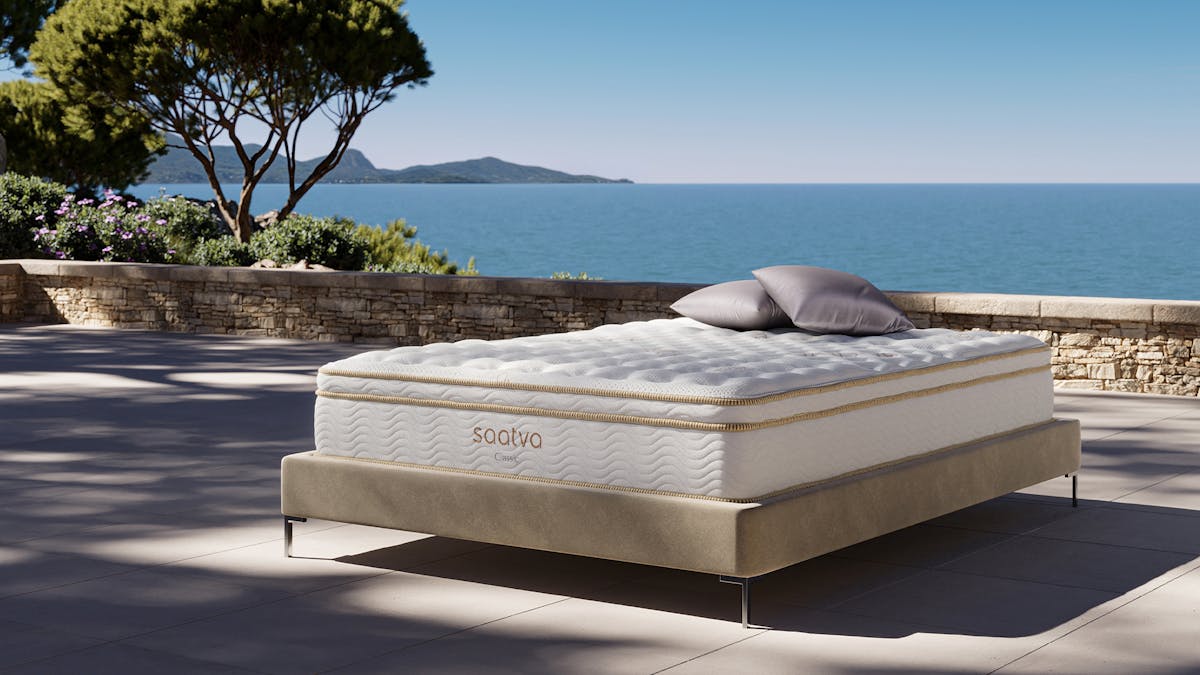
by Pocketed coils (individually wrapped, moving independently) outperform Bonnell coils (interconnected hourglass coils) on every performance metric that matters for most sleepers: motion isolation, conforming pressure relief, and long-term durability. Bonnell costs less to manufacture and remains common in budget innerspring under $700 Queen. For anyone comparing the two technologies to make a buying decision, pocketed coils win. Our top pick for a coil mattress is the Saatva Classic, which uses a dual coil-on-coil design: 884 pocketed coils over 416 Bonnell base coils, combining the motion isolation of pocketed with the structural foundation of Bonnell.
Saatva Classic
9.4/10
- 884 individually wrapped pocketed coils over 416 Bonnell base coils — pocketed feel with Bonnell structural depth
- Lumbar Zone Active Spinal Wire for targeted midsection reinforcement
- Motion isolation 9.6/10, edge support 9.4/10 (NapLab)
- Free white-glove delivery, setup and old-mattress removal
- 365-night trial, lifetime non-prorated warranty
- Ships flat, not roll-packed in a box
- $99 return fee if you decide to return during the trial
The Saatva Classic answers the pocketed-vs-Bonnell question by using both: pocketed coils in the comfort layer for motion isolation and body conforming, Bonnell coils in the base for structural durability. It is the most complete innerspring design at this price point.
Pocketed coil vs Bonnell coil: the innerspring engineering difference that matters
Bonnell coils and pocketed coils are the two dominant innerspring technologies in mattress construction, separated by roughly seventy years of engineering refinement. Bonnell is the original hourglass-shaped, interconnected coil system that dates to the early 1900s. Pocketed coils (also called Marshall coils or wrapped coils) are individually fabric-wrapped coils that move independently, developed for luxury mattresses in the 1970s. The performance gap is real: pocketed coils outperform Bonnell on motion isolation, conforming pressure relief, and long-term durability. Bonnell costs less to manufacture and remains common in budget innerspring mattresses and commercial hotel beds. The Saatva Classic uses both in a dual-coil stacked configuration: 884 individually wrapped pocketed coils in the comfort layer over 416 Bonnell base coils for structural support.
The short answer: pocketed coils win for most sleepers
- Bonnell coils: Hourglass-shaped steel springs interconnected by helical wires across the top and bottom. Early 1900s design. Cheapest to manufacture. Strong overall support, weak motion isolation, audible noise over time.
- Pocketed coils: Cylindrical steel coils individually wrapped in fabric pockets. Each coil moves independently. Developed 1970s. Strong motion isolation, conforming pressure relief, quiet operation.
- Motion isolation: Pocketed coils score 8.5 to 9.7 out of 10 in NapLab testing. Bonnell coils score 3.5 to 5 out of 10. The gap is dramatic for couples.
- Saatva Classic: 884 individually wrapped 14.5-gauge pocketed coils stacked over 416 13-gauge Bonnell base coils. Pocketed-coil feel with Bonnell-grade structural foundation.
- Manufacturing cost: Pocketed coils cost roughly 4 to 6 times more per coil to produce. That cost shows up in retail pricing.
- Lifespan: Pocketed coil systems typically last 12 to 15 years. Bonnell systems 6 to 10 years before noticeable sagging and noise.
Table of contents
- A brief history of innerspring engineering
- Bonnell coils: the 1900s hourglass standard
- Pocketed coils: the 1970s luxury standard
- Motion isolation: the performance gap explained
- Conforming pressure relief and body contouring
- Edge support and coil density
- Saatva Classic: the dual coil-on-coil construction
- Comparison table: six coil configurations
- Coil gauge and why it matters
- FAQ
A brief history of innerspring engineering
The first commercial innerspring mattress was patented by Heinrich Westphal in 1871. The design that came to dominate, however, was the Bonnell coil, named after Charles Bonnell, whose hourglass coil shape became the industry standard in the early 1900s. The hourglass profile provides progressive resistance: easy compression at low load, stronger resistance under heavy pressure. Interconnecting helical wires across the top and bottom of the array let the entire mattress function as a single load-bearing structure. Sealy, Beautyrest, Serta, and Simmons built their early product lines on Bonnell variations.
The pocketed coil emerged as an English innovation by James Marshall in the 1920s, but mass-production economics were not solved until the 1970s with computerized coil-wrapping machinery. By the 2000s, pocketed coils had become the standard for premium and mid-tier innerspring construction. The 2010s brought zoned pocketed coil systems and hybrid construction (foam comfort layers over pocketed coil bases) as dominant DTC categories. Saatva's dual coil-on-coil design, layering pocketed coils over a Bonnell base, synthesizes both technologies.
Bonnell coils: the 1900s hourglass standard
The Bonnell coil is a single piece of tempered steel wire bent into an hourglass shape. The narrow waist sits in the middle of the coil's vertical axis; the wider flares at the top and bottom connect to helical interconnect wires. A typical Queen Bonnell mattress contains 300 to 500 coils, gauged at 12 to 13.5 (lower gauge = thicker wire = firmer coil). The coils are arranged in a regular grid and interconnected by helical wires running across the top and bottom of the array.
The interconnected design is the defining performance characteristic. Pressure applied to one coil transfers through the helical wires to adjacent coils. The entire mattress flexes as a single load-bearing surface. This produces strong overall support but poor motion isolation: a partner shifting position transmits movement laterally through the helical interconnects to the entire mattress. Sleepers in shared beds feel every position change on a Bonnell innerspring.
The conforming feel is also limited. Body-shaped pressure cannot localize because the interconnected coils respond as a system rather than as discrete units. Pressure mapping on Bonnell mattresses typically shows broader, less differentiated pressure distribution, with higher pressure peaks at the hip and shoulder compared to pocketed coil systems at equivalent firmness ratings.
Bonnell coils excel in three specific applications: structural base layers in dual coil-on-coil construction (where Bonnell coils provide the deep foundational support while pocketed coils handle the comfort feel above); budget innerspring mattresses where cost matters more than performance; and commercial hotel and dorm beds where durability and price dominate over individual comfort optimization.
Common modern usage: Sealy Posturepedic budget tier, Serta Perfect Sleeper base coils, most entry-level innerspring under $700 Queen, IKEA HOVAG, and the support base of the Saatva Classic.
Pocketed coils: the 1970s luxury standard
The pocketed coil is a cylindrical steel coil enclosed in a fabric pocket (typically non-woven polypropylene). The pockets are connected only by the fabric itself, glued or sewn together in a regular array. Each coil moves independently of its neighbors. When pressure is applied to one coil, it compresses; adjacent coils remain at their resting position unless they too are loaded directly.
This independent movement is the source of every performance advantage pocketed coils have over Bonnell. Motion isolation is dramatically better: a partner movement on one side of the bed produces minimal lateral transmission. Conforming feel is far more localized: the mattress can produce a body-shaped impression because each coil responds only to the load directly above it. Pressure relief at the hip, shoulder, and lumbar improves because the coils accommodate body curves individually rather than as a uniform array.
The coil count in modern pocketed coil mattresses ranges from 600 to over 1,000 coils per Queen. The Saatva Classic uses 884 pocketed coils in the comfort layer. The Helix Midnight Luxe uses 1,000+ coils. The WinkBeds Original uses 1,073 coils. Higher coil count provides finer-grained conforming and better pressure distribution but adds cost.
Zoned pocketed coil systems further refine the technology. By varying coil gauge and density across the mattress — firmer coils in the lumbar region, softer coils at the shoulders — zoned systems produce differentiated support tailored to body anatomy. WinkBeds, Helix, and the Saatva Classic (with its Lumbar Zone Active Spinal Wire) all use some form of zoning.
Motion isolation: the performance gap explained
Motion isolation is the most measurable performance difference between Bonnell and pocketed coil systems. NapLab measures motion isolation by placing a vibration sensor on one side of the mattress and dropping a weighted ball on the other side. Lower transmitted amplitude equals better motion isolation.
| Coil system / Brand | Coil type | Motion isolation (NapLab /10) | Coil count (Queen) | Notes |
|---|---|---|---|---|
| Helix Midnight Luxe | Pocketed (zoned) | 9.7 | 1,000+ | Pillowtop + zoned coils |
| WinkBeds Original | Pocketed (zoned) | 9.5 | 1,073 | 5-zone lumbar support |
| Saatva Classic | Pocketed + Bonnell base | 9.6 | 884 + 416 | Dual coil-on-coil |
| Brooklyn Bedding Aurora Luxe | Pocketed | 8.7 | 1,024 | TitanFlex foam + pocketed coils |
| Bear Elite Hybrid | Pocketed | 8.8 | ~1,000 | Celliant cover |
| Sealy Posturepedic mid-tier | Pocketed (lower-count) | 7.2 | 650–800 | Mixed pocketed/Bonnell depending on model |
| Sealy Response / budget innerspring | Bonnell | 4.5 | 400–600 | Interconnected helical wires |
| IKEA HOVAG | Bonnell | 3.8 | ~400 | Budget innerspring |
The gap between pocketed (8 to 9.7 out of 10) and Bonnell (3.5 to 5 out of 10) is substantial. For couples sharing a bed, this difference is the single most consequential factor. A partner who is a restless sleeper on a Bonnell innerspring will wake the other partner with every position change. On a pocketed coil mattress, the same movements produce little perceptible vibration on the opposite side.
Conforming pressure relief and body contouring
Independent coil movement also drives conforming pressure relief. Research summarized in Sleep Medicine Reviews has confirmed that pocketed coil systems reduce peak pressure at the greater trochanter (hip bone) and acromion (shoulder) by 15 to 25 percent compared to Bonnell systems at equivalent firmness ratings. The mechanism is geometric: pocketed coils accommodate body curves at the contact points without requiring the entire spring system to deform.
For side sleepers, the difference is particularly meaningful. Side sleeping concentrates body weight at the hip and shoulder, the two most pressure-sensitive regions. A pocketed coil system allows the hip and shoulder to sink slightly into the mattress while the lumbar zone remains supported. A Bonnell system either supports the lumbar (and creates pressure points at the hip and shoulder) or accommodates the hip and shoulder (and lets the lumbar sag). The geometric trade-off is unavoidable in interconnected coil designs.
For back sleepers, the pressure difference is less dramatic because back sleeping distributes weight more evenly across the body. Pocketed coil systems still outperform Bonnell on conforming, but the practical difference for back sleepers is smaller than for side sleepers. Stomach sleepers typically prefer firmer mattresses where the difference between pocketed and Bonnell narrows further, since the firmness floor matters more than the conforming depth.
Zoned pocketed coil systems amplify this benefit. The Saatva Classic Lumbar Zone Active Spinal Wire adds targeted reinforcement at the lumbar region, increasing firmness in the center third of the mattress while leaving the head and foot zones at standard firmness. WinkBeds and Helix use similar five-zone approaches with varying coil gauge across regions.
Edge support and coil density
Edge support is the secondary engineering consideration in coil-based mattresses. Pocketed coils, despite their performance advantages, can suffer from weak edges because the perimeter coils have no neighboring coils on the outside to share the load. Premium pocketed coil mattresses solve this with high-density foam encasement around the perimeter (Saatva, Bear Elite) or reinforced perimeter coils with thicker gauge wire (WinkBeds, Helix Luxe).
Bonnell systems typically have stronger edges out of the box because the interconnected helical wires distribute edge load across the entire mattress. This is one of the few areas where Bonnell systems outperform pocketed coils on raw engineering. Premium pocketed coil designs with perimeter reinforcement match or exceed Bonnell edge support, but mid-tier pocketed coil mattresses without reinforcement can feel weaker at the edges than equivalent Bonnell mattresses.
The Saatva Classic addresses edge support through both mechanisms: the dual coil-on-coil construction provides Bonnell-base structural support, and the high-density foam encasement around the perimeter reinforces the pocketed coil layer. NapLab scores the Saatva Classic at 9.4 out of 10 for edge support, among the strongest in the premium DTC category.
Saatva Classic: the dual coil-on-coil construction
The Saatva Classic's distinctive feature is its dual coil-on-coil construction. Two separate coil layers stack vertically: an upper layer of 884 individually wrapped 14.5-gauge pocketed coils provides the comfort feel, conforming pressure relief, and motion isolation; a lower base layer of 416 tempered 13-gauge Bonnell-style support coils provides deep structural support.
The engineering rationale is that pocketed coils excel at conforming and motion isolation but are inherently less efficient at deep structural support compared to Bonnell. Stacking them vertically lets each coil type do what it does best. The pocketed coils handle the body-interaction layer (the first 4 to 5 inches of compression under load). The Bonnell base handles the deep structural foundation (the bottom 5 to 6 inches of compression and long-term sag resistance).
Layered above the dual coil system: a 3-inch organic cotton Euro pillow top quilted with a Lumbar Zone gel-infused memory foam center band, the Lumbar Zone Active Spinal Wire for targeted midsection reinforcement, and high-density foam rails encasing the perimeter for edge support. Total construction depth is 11.5 inches in the standard model and 14.5 inches in the high-profile model.
Per NapLab testing: motion isolation 9.6 out of 10, edge support 9.4 out of 10, pressure relief 9.7 in the Luxury Firm. Queen pricing: approximately $1,395 on sale. Saatva's 365-night trial and lifetime non-prorated warranty apply, with free white-glove delivery.
Saatva Classic
9.4/10
The Saatva Classic stacks individually wrapped pocketed coils for body conforming over a Bonnell base for deep structural support. Motion isolation 9.6/10, edge support 9.4/10, Lumbar Zone Active Spinal Wire, three firmness options, free white-glove delivery.
Comparison table: coil configurations at a glance
| Mattress | Coil system | Coil count (Queen) | Pressure relief | Motion isolation | Queen price |
|---|---|---|---|---|---|
| Saatva Classic Luxury Firm | Pocketed + Bonnell base | 884 + 416 | 9.7/10 | 9.6/10 | ~$1,395 |
| WinkBeds Original | Pocketed (5-zone) | 1,073 | 9.5/10 | 9.5/10 | ~$1,599 |
| Helix Midnight Luxe | Pocketed (zoned) | 1,000+ | 9.6/10 | 9.7/10 | ~$1,874 |
| Bear Elite Hybrid | Pocketed | ~1,000 | 9.4/10 | 8.8/10 | ~$2,427 |
| Sealy Posturepedic Plus mid-tier | Pocketed (lower-count) | 650–800 | 8.2/10 | 7.2/10 | $1,099–1,499 |
| IKEA HOVAG budget Bonnell | Bonnell | ~400 | 5.2/10 | 3.8/10 | ~$399 |
The cluster of premium DTC pocketed coil systems (Saatva, WinkBeds, Helix Luxe, Bear) all score in the 9.4 to 9.7 range on pressure relief and 8.8 to 9.7 on motion isolation. Sealy's mid-tier pocketed coil drops to 8.2 and 7.2 on the same metrics. Budget Bonnell systems (IKEA HOVAG, low-end entry-level innerspring) drop further to 5.2 and 3.8. The premium pocketed coil systems group at the top; budget Bonnell systems group at the bottom.
Coil gauge and why it matters
Coil gauge refers to the steel wire thickness used to form each coil. Lower gauge equals thicker wire equals firmer coil. The scale is counterintuitive: 12-gauge wire is thicker than 14-gauge wire. Mattress construction typically uses 12 to 16 gauge.
12 to 13 gauge: Thickest, firmest. Used in Bonnell base layers and heavy-duty support coils. Saatva Classic uses 13-gauge in its Bonnell base.
14 to 14.5 gauge: Standard premium pocketed coil thickness. Saatva Classic (14.5), WinkBeds (14.5), and most premium DTC hybrids sit in this range.
15 to 16 gauge: Lighter coils used in upper comfort layers of luxury hybrids or budget pocketed coil mattresses.
Coil gauge interacts with coil count to determine firmness and responsiveness. A 14.5-gauge pocketed coil at 884 coils per Queen (Saatva Classic) feels different from the same gauge at 1,073 coils per Queen (WinkBeds Original). Zoned coil systems use different gauges in different regions: WinkBeds uses 16-gauge at the shoulder (softer) and 13-gauge at the lumbar (firmer). Saatva instead adds a separate Lumbar Zone Active Spinal Wire for lumbar reinforcement rather than varying gauge directly.
Frequently asked questions
What is the difference between a pocketed coil and a Bonnell coil?
A pocketed coil is a cylindrical steel coil individually wrapped in a fabric pocket, with each coil moving independently of its neighbors. A Bonnell coil is an hourglass-shaped steel coil interconnected with its neighbors by helical wires across the top and bottom of the array, causing the entire system to flex together. Pocketed coils provide better motion isolation, conforming pressure relief, and quieter operation. Bonnell coils provide strong overall structural support at lower manufacturing cost.
Which is better for couples?
Pocketed coils, by a wide margin. NapLab motion isolation scores show pocketed coil mattresses at 8.5 to 9.7 out of 10 versus Bonnell systems at 3.5 to 5 out of 10. A restless partner on a Bonnell mattress will transmit movement across the entire bed; on a pocketed coil mattress, the same movement is largely localized to the partner's side.
Are pocketed coils more durable than Bonnell?
Yes. Premium pocketed coil mattresses typically last 12 to 15 years with proper foundation support. Bonnell mattresses typically last 6 to 10 years before noticeable sagging and audible spring noise. The difference is partly the load distribution (pocketed coils distribute body weight more evenly across more coils) and partly the absence of helical wire fatigue (Bonnell helical wires can develop noise and weakness over time).
Does Saatva Classic use pocketed coils or Bonnell coils?
Both. The Saatva Classic uses a dual coil-on-coil construction: 884 individually wrapped 14.5-gauge pocketed coils in the comfort layer over 416 tempered 13-gauge Bonnell-style support coils in the base. The pocketed coil layer handles body conforming and motion isolation. The Bonnell base layer handles deep structural support and long-term durability. This dual configuration provides the conforming feel of premium pocketed coil systems with the structural foundation typically associated with Bonnell construction.
What coil count is best for a Queen mattress?
Premium pocketed coil mattresses range from 600 to 1,073 coils per Queen. Coil counts of 800 to 1,000 in a premium pocketed coil layer provide strong conforming and pressure relief. Counts above 1,000 (WinkBeds at 1,073) offer fine-grained conforming with marginal additional benefit. Budget innerspring mattresses with 400 to 600 Bonnell coils provide weaker conforming and motion isolation. The coil gauge and zoning structure matter as much as the raw count.
Are pocketed coils noisier than Bonnell?
No, pocketed coils are quieter. Each pocketed coil is enclosed in fabric, which dampens spring noise. Bonnell coils interconnect via metal helical wires that develop audible squeaking and creaking over time, particularly after 5 to 7 years of use. Spring noise is one of the most common long-term complaints about Bonnell innerspring mattresses; pocketed coil mattresses rarely receive noise complaints.
Why are Bonnell coils still used in modern mattresses?
Cost. Bonnell coils cost roughly 4 to 6 times less to manufacture than pocketed coils. They remain common in budget innerspring under $700 Queen, commercial hotel and dorm bedding, and in dual coil-on-coil constructions like the Saatva Classic, where they serve as a structural base layer.
Pocketed coils outperform Bonnell on motion isolation, pressure relief, and durability. Bonnell remains useful as a low-cost structural base. The Saatva Classic uses both in a dual coil-on-coil design that delivers pocketed-coil feel with Bonnell-grade structural foundation, on a 365-night trial with a lifetime warranty.
Editorial standards. MattressNut tests motion isolation, pressure relief, and edge support and cross-references brand spec pages with independent teardown reviews. Coil counts and gauges verified against brand spec pages. Sources: NapLab teardown reviews (naplab.com), Saatva Classic spec page (saatva.com/mattresses/saatva-classic), WinkBeds construction page, Helix Midnight Luxe spec page.