
 by
by Purple and Sleep Number solve fundamentally different problems. Purple wins on pressure relief and cooling through its GelFlex Grid, with no ongoing subscription costs. Sleep Number wins on adjustability, letting each partner dial in a custom firmness number, but the full system cost runs $4,000 to $8,000+ once you add the base and smart features. For most buyers comparing these two, the Saatva Classic offers a better baseline: hotel-quality innerspring hybrid construction, zoned lumbar support, and a 365-night trial at a more predictable price.
Saatva Classic
9.2/10
- Dual-coil construction with Lumbar Zone reinforcement, better baseline support than either Purple or Sleep Number
- Three firmness options (Plush Soft, Luxury Firm, Firm), chosen at purchase, not via app
- Free white-glove delivery and old mattress removal
- 365-night trial and lifetime warranty with no hidden subscription costs
- No in-the-moment adjustability like Sleep Number
- Ships flat, not rolled in a box; heavy setup
- $99 return fee if you decide to send it back
If you are shopping Purple vs Sleep Number and value quality construction, predictable pricing, and long-term durability over gimmick-tech, the Saatva Classic is the stronger foundation. It beats Purple on edge support and coil responsiveness, and beats Sleep Number on total cost transparency.
The core technology difference
The Purple vs Sleep Number question comes up often because both brands market themselves around sleep technology and charge a premium for it. But they solve entirely different problems, and the "right" choice depends on what you actually need.
Purple GelFlex Grid
Purple's GelFlex Grid is a hyper-elastic polymer structure that collapses under pressure points (hips, shoulders) while staying firm under well-supported areas (lumbar, legs). This produces adaptive pressure relief without the heat retention that plagues dense memory foam. The grid does not adjust on command, it responds passively in real time based on your body weight distribution. The construction is consistent, durable, and requires no maintenance or subscription. The trade-off: the feel is genuinely different from foam or coils, and some sleepers never adapt to it.
Sleep Number air chambers
Sleep Number builds each side of the mattress around an inflatable air chamber. Your "Sleep Number" (0 to 100) is the firmness you prefer, set via remote or app by adding or releasing air. Split models let each partner control their side independently, which is the primary selling point for couples. Smart models add biometric tracking: heart rate, breathing rate, and HRV. The system works, but it introduces mechanical complexity, subscription dependency, and a total system cost that the entry-level mattress price obscures significantly.
Specs at a glance
| Spec | Purple 4 | Sleep Number i8 |
|---|---|---|
| Type | Specialty foam (GelFlex Grid) | Adjustable air (dual chambers) |
| Firmness | Medium (fixed, ~5/10) | Adjustable 0-100 per side |
| Cooling | Excellent (open grid airflow) | Good (air core, depends on comfort layer) |
| Motion isolation | Excellent | Good (split chambers help) |
| Edge support | Moderate | Good |
| Trial period | 100 nights | 100 nights |
| Warranty | 10 years | 15 years (mattress only) |
| Queen mattress price | ~$1,999 | ~$2,299 (i8, mattress only) |
| Full system cost | ~$2,000-2,500 with base | $4,000-$8,000+ with smart base and features |
| Subscription required | None | SleepIQ for full smart features |
| Mechanical failure risk | Low | Moderate (air pump, leaks) |
Total cost of ownership: the honest comparison
This is where most Purple vs Sleep Number comparisons mislead readers. The advertised mattress price is only the starting point for Sleep Number.
- Sleep Number i8 mattress, queen: ~$2,299
- Adjustable base (FlexFit 2 or 3): $1,000 to $2,500 additional, and Sleep Number strongly pushes its proprietary bases
- SleepIQ+ subscription: required for the biometric features in higher-end models
- Service calls: air pump failures and leaks require technician visits; common in older units
A fully equipped Sleep Number system for two partners can easily run $6,000 to $8,000, and that does not include bedding sized for the split-top configuration.
Purple's pricing is more straightforward. The Purple 4 (queen) runs about $1,999, works with most standard bases, and carries no ongoing subscription costs. You buy a mattress; you sleep on it.
Who should buy Purple
Purple makes sense if your priority is pressure relief and temperature neutrality. The GelFlex Grid is genuinely good at both, particularly for side sleepers who struggle with hot foam beds and combination sleepers who shift positions during the night. Motion isolation is excellent, so it works well for couples who have similar firmness preferences. The biggest question is whether the grid feel works for you, which is why the 100-night trial matters. Some sleepers love it immediately; others never adjust.
Who should buy Sleep Number
Sleep Number's real use case is couples with meaningfully different firmness preferences and no interest in shopping for two separate mattresses. If one partner needs firm support and the other needs soft pressure relief, the dual air chamber system handles this cleanly. The biometric tracking in smart models is a real feature, not marketing, though its sleep coaching value is debated. Accept that you are buying into an ecosystem with recurring costs and mechanical parts that will eventually need servicing.
Purple vs Sleep Number for back pain
Neither brand stands out as the clear winner here. Sleep Number's adjustability helps if you already know your preferred firmness number and need to fine-tune support precisely. Purple's zoned GelFlex Grid provides passive lumbar support that works well for back pain caused by pressure accumulation. Both offer 100-night trials, which gives you enough time to assess whether your specific pain pattern responds.
For back pain, the Saatva Classic remains the more consistently recommended option because its Lumbar Zone Technology, a dedicated reinforcement strip at the center third of the mattress, provides active zoned support rather than passive response.
Purple vs Sleep Number for couples
Sleep Number wins this category when partners have genuinely different firmness needs. The split air chamber lets each person dial in their side independently, which no foam or coil bed replicates. Purple handles couples well when both partners agree on a medium feel, with excellent motion isolation so one person's movement does not disturb the other.
The verdict
Choose Purple if you want proven pressure relief and cooling, no maintenance, no subscription, and a straightforward purchase. The GelFlex Grid is a real technology difference that performs as advertised for the right sleeper.
Choose Sleep Number if per-side adjustability is genuinely the feature you need and you are prepared for the total system cost and mechanical upkeep. It delivers on that specific promise.
If you are still deciding between both, consider that neither Purple nor Sleep Number offers the combination of traditional coil support, long trial, and transparent total pricing that the Saatva Classic does. It is worth testing as a baseline.
Purple wins on pressure relief and cooling, Sleep Number wins on adjustability. Both carry real trade-offs and neither is a universal upgrade over a well-built innerspring hybrid like the Saatva Classic, which delivers zoned lumbar support and a 365-night trial at a price that does not require a system purchase.
A grid, an air pump — or support that doesn’t need managing
The total-cost section above told the uncomfortable truth of this matchup: Purple keeps things simple but single-feel, while Sleep Number’s dial-a-number promise quietly grows into a four-to-eight-thousand-dollar system once the base and smart features join the invoice. One bed asks you to accept its feel; the other asks you to administer yours.
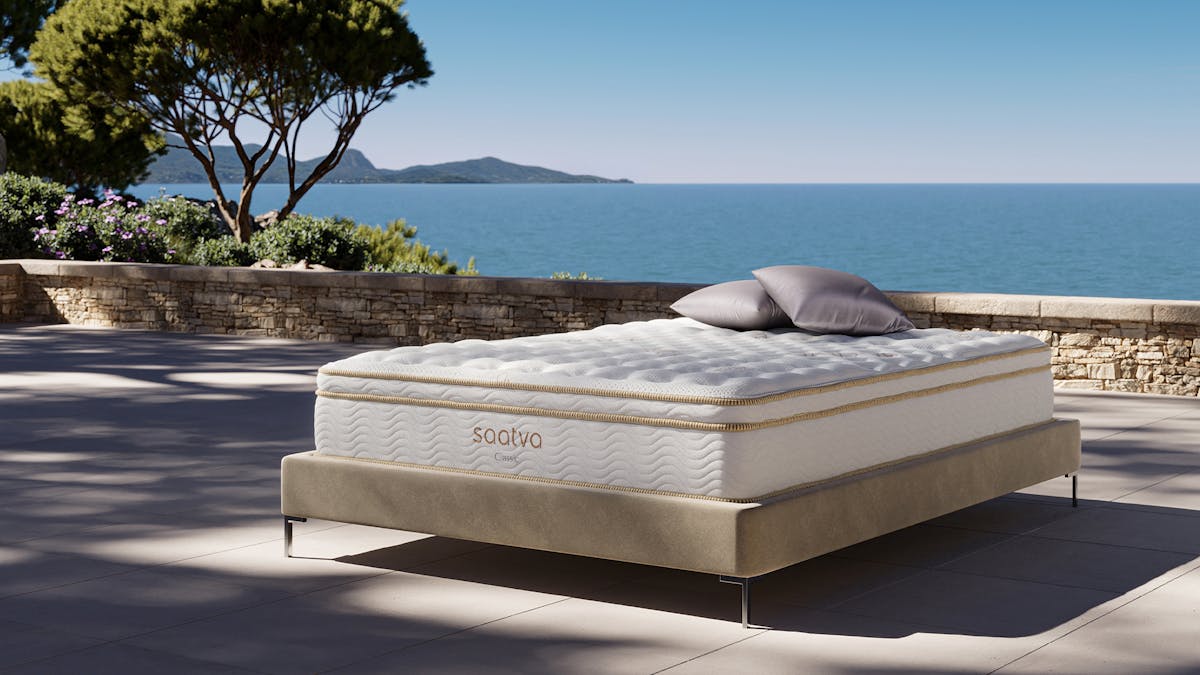
The back-pain section pointed at the third path: the Saatva Classic’s dedicated lumbar reinforcement supports actively without an app, a pump or a subscription — coil-on-coil under a plush euro top, white-glove delivered. If you were comparing these two on value, the Classic is the value; today’s price is on the official page.
Frequently asked questions
Is Purple better than Sleep Number for couples?
Sleep Number's split air chambers let each partner set their own firmness number, a genuine advantage for couples with very different comfort preferences. Purple does not offer adjustability. For couples who agree on a medium feel, Purple's motion isolation is better. For couples with meaningfully different firmness needs, Sleep Number is the more practical solution.
What is Sleep Number's real total cost?
The entry mattress price understates what you will actually spend. A mid-tier Sleep Number setup for two partners with an adjustable base typically runs $4,000 to $8,000. Factor in the SleepIQ subscription for smart features, proprietary accessories, and eventual service calls for air pump maintenance.
Does Purple require a special base?
Purple mattresses work on most standard frames, box springs, adjustable bases, and platform beds. The GelFlex Grid needs solid or slatted support with slats no more than 4 inches apart. No proprietary base is required, which keeps total system cost lower than Sleep Number.
How long does a Sleep Number mattress last?
Sleep Number air chambers typically last 8 to 15 years, but leaks are a documented failure mode. Foam comfort layers above the air chambers can compress sooner. Purple's GelFlex Grid is generally more durable than standard foam and has a simpler mechanical profile with fewer failure points.
Which is better for hot sleepers, Purple or Sleep Number?
Purple has the clear advantage for heat. The open GelFlex Grid allows airflow through the comfort layer that foam-covered air chambers cannot match. Sleep Number's upper comfort layers vary by model, and some trap heat. If sleeping hot is a primary concern, Purple is the stronger choice between the two.
Saatva Classic
9.2/10
If you are comparing Purple and Sleep Number and want to include a third option, the Saatva Classic is the one to test: dual-coil innerspring construction with a reinforced lumbar zone, three firmness options, white-glove delivery, a 365-night trial, and a lifetime warranty, all without a subscription or proprietary system lock-in.