
 by
by Purple wins on cooling and responsiveness thanks to its GelFlex Grid. Tempur-Pedic wins on motion isolation and deep pressure contouring thanks to its proprietary TEMPUR foam. Both start around $1,499 to $2,199 queen and are worth buying only if one of those specific strengths is your dealbreaker. For most sleepers, the Saatva Classic at $1,595 delivers comparable support and better overall value with a lifetime warranty and free white-glove delivery.
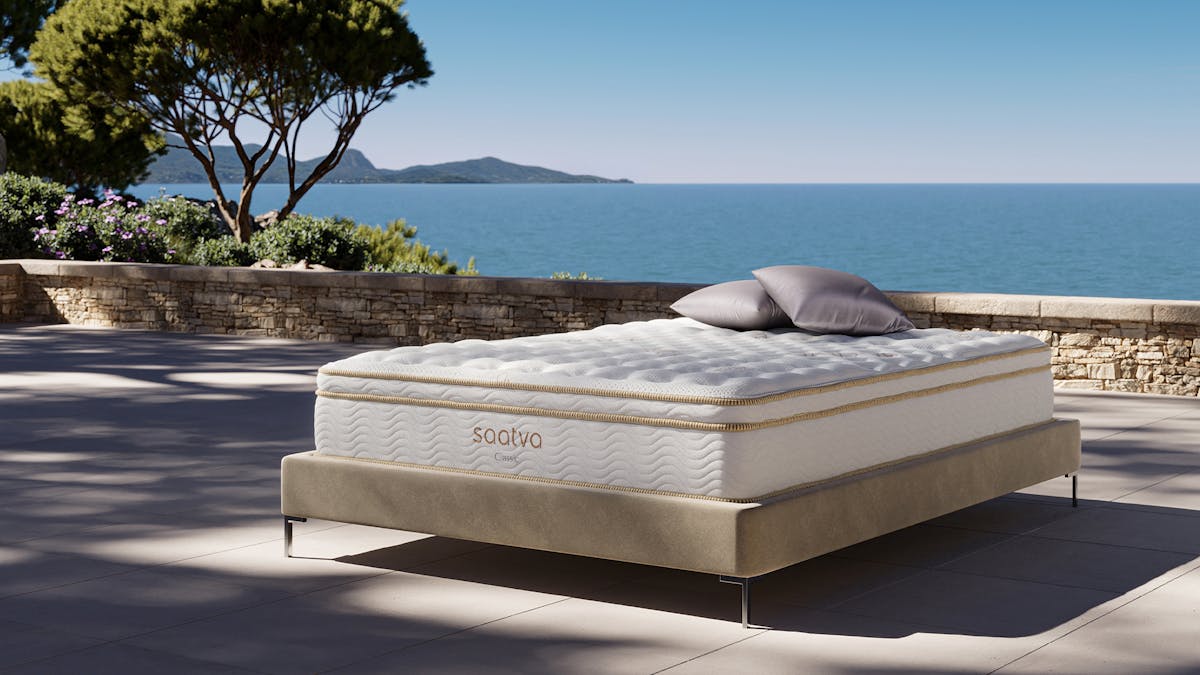
Saatva Classic
9.2/10
- Dual-coil construction with reinforced lumbar zone pad
- Better edge support and cooling than Tempur-Pedic's foam
- Free white-glove delivery, setup, and old mattress removal
- 365-night trial and lifetime warranty, the longest in the category
- Ships assembled, not compressed in a box
- $99 return fee applies during the trial window
If you are shopping between Purple and Tempur-Pedic primarily on price and value, the Saatva Classic undercuts both by $400 to $800 and adds a lifetime warranty and a 365-night trial that neither competitor matches. It does not replicate the GelFlex Grid feel or the dense TEMPUR hug, but it outperforms both on edge support, bounce, and long-term value per dollar.
Two very different technologies
Tempur-Pedic built its brand around TEMPUR material, a viscoelastic polymer originally developed by NASA. It is slow-responding, dense, and contours deeply around each body part. That density is what makes Tempur-Pedic the motion-isolation benchmark: movement energy is absorbed by the foam rather than transmitted across the surface. The entry-level Tempur-Adapt starts at roughly $2,199 queen; the Tempur-ProAdapt runs $3,199 and up.
Purple built its brand around the GelFlex Grid, a hyper-elastic polymer grid that collapses under pressure points such as the shoulders and hips while remaining firm under load-bearing zones like the lower back. Because the grid is open, air moves through it freely, giving Purple among the best thermal neutrality of any mattress. The Purple Original starts around $1,499 queen; the Purple Plus and Restore lines run $1,799 to $3,500.
Head-to-head: Purple vs Tempur-Pedic
| Category | Purple Original | Tempur-Adapt |
|---|---|---|
| Price (queen) | ~$1,499 | ~$2,199 |
| Type | GelFlex Grid + foam | All-foam TEMPUR |
| Thickness | ~9.25" | ~11" |
| Firmness | Medium (5/10) | Medium (5/10) |
| Cooling | Excellent. Open grid airflow | Fair. Foam retains heat |
| Motion isolation | Very good | Exceptional. Best in class |
| Pressure relief | Excellent. Grid collapses precisely | Exceptional. Deep contouring |
| Responsiveness | High. Immediate rebound | Low — slow return |
| Edge support | Good | Fair |
| Trial period | 100 nights | 90 nights |
| Warranty | 10 years limited | 10 years limited |
Cooling: Purple wins clearly
The GelFlex Grid's open structure allows airflow to pass directly through the comfort layer. Purple consistently ranks among the coolest-sleeping mattresses at any price, and that cooling property is structural, meaning it does not rely on gel infusions or phase-change material coatings that can wear off over two to three years.
Tempur-Pedic's TEMPUR material is dense by design, which is precisely how it achieves deep contouring. That density traps body heat. Tempur-Pedic has addressed this with their LuxeBreeze and ProBreeze lines, which add phase-change material and an open-cell foam layer, but those models cost $3,999 and up. The standard Tempur-Adapt and Tempur-Cloud remain warm-sleeping options.
Verdict: Hot sleepers should choose Purple without much hesitation here.
Motion isolation: Tempur-Pedic wins
No mattress at retail price absorbs movement as completely as Tempur-Pedic. The TEMPUR material does not transmit vibration across the sleep surface, which is why the brand's "wine glass" demonstration has worked for 30 years. If one partner wakes at 3 a.m. and gets up for water, a light sleeper next to them is unlikely to notice on a Tempur-Pedic.
Purple's GelFlex Grid is better than most coil hybrids on motion isolation, but it is not in the same tier as TEMPUR foam. The grid's responsiveness, which is an asset for combination sleepers, is part of what makes it slightly less effective at absorbing movement.
Verdict: Light sleepers sharing a bed with a restless partner should lean Tempur-Pedic.
Pressure relief: both excel, differently
Purple's grid collapses precisely under bony prominences. Because the grid responds immediately rather than slowly, shoulders and hips settle into it without delay, which is particularly helpful for side sleepers who move positions during the night.
Tempur-Pedic's contouring is slower and deeper. It molds around each contact point over the first few minutes of lying down. For people with chronic shoulder or hip pain who stay mostly in one position, that deep, enveloping contour is often the most effective pressure relief available in a consumer mattress.
Verdict: Combination sleepers prefer Purple's immediacy; stationary sleepers often prefer Tempur-Pedic's depth.
Is either worth the price?
At $1,499 to $2,199 queen, both brands represent a genuine investment. The justification depends on whether their specific strength is your actual dealbreaker:
- Pay for Tempur-Pedic if extreme motion isolation is non-negotiable. No other mattress matches it at this price.
- Pay for Purple if you sleep hot and need cooling that goes beyond standard phase-change treatments.
- Consider the Saatva Classic if neither of those specific strengths is critical: it offers comparable support to both at $1,595 queen, beats Tempur-Pedic on cooling, and adds a 365-night trial and lifetime warranty.
Who should choose which
Choose Purple if: you sleep hot, you move around a lot during the night, or you have tried memory foam before and found it too slow and suffocating. Purple's grid feel is genuinely unlike foam and suits combination sleepers well.
Choose Tempur-Pedic if: you share a bed with a very light sleeper, you sleep in one position all night and want the deepest possible contouring, or you have tried Purple and found it too firm or too unfamiliar in feel.
Choose Saatva Classic if: you want a luxury mattress at a lower price, prefer coil-based support with an innerspring feel, and value long trial and warranty terms over proprietary foam technology.
Worth buying only for a dealbreaker — most people don’t have one
This page’s own framing decides it: Purple and Tempur-Pedic each justify their price only if their signature strength (grid cooling on one side, deep stationary contour on the other) is your personal dealbreaker. The combination sleeper, the average couple, the buyer without a chronic pressure point: none of them gets full value from either specialty.
Which is why the general-case answer sat outside the duel all along: the Saatva Classic delivers comparable support with a lifetime warranty, a year-long trial and white-glove delivery, at money that undercuts both specialists. If no dealbreaker chose for you, the Classic is the default. Check what it costs today.
Frequently asked questions
Is Purple or Tempur-Pedic better for side sleepers?
Both work well for side sleeping. Purple's grid collapses precisely under shoulder and hip pressure, with immediate response for combination side sleepers. Tempur-Pedic provides slower, deeper contouring that suits people who sleep in one position all night. Hot side sleepers should choose Purple; those who share a bed with a light sleeper should lean Tempur-Pedic.
Why is Tempur-Pedic so expensive compared to Purple?
TEMPUR material is proprietary and expensive to produce. Tempur-Pedic also invests heavily in retail presence, R&D, and white-glove delivery. Purple's GelFlex Grid is also a proprietary material, but manufacturing costs land lower, which is reflected in the $700 price gap between the entry models.
Does Purple sleep cooler than Tempur-Pedic?
Yes, significantly. The open channels in the GelFlex Grid allow airflow through the comfort layer without any chemical treatment. Standard Tempur-Pedic models run warm; only the LuxeBreeze and ProBreeze lines ($3,999+) address this adequately, and those use phase-change material that wears down over time.
Can you feel your partner move on a Tempur-Pedic?
Minimally. Tempur-Pedic leads the industry in motion isolation. The TEMPUR material absorbs movement energy rather than transmitting it across the sleep surface, which is why it remains the benchmark for couples with mismatched sleep schedules.
How does the Saatva Classic compare to Purple and Tempur-Pedic?
The Saatva Classic uses a dual-coil hybrid construction rather than foam or grid technology. It does not replicate either brand's specific feel, but it matches both on support, outperforms Tempur-Pedic on cooling and edge support, and undercuts both on price by $400 to $800. It also comes with a lifetime warranty and 365-night trial, which exceeds both competitors' policies.