
 by
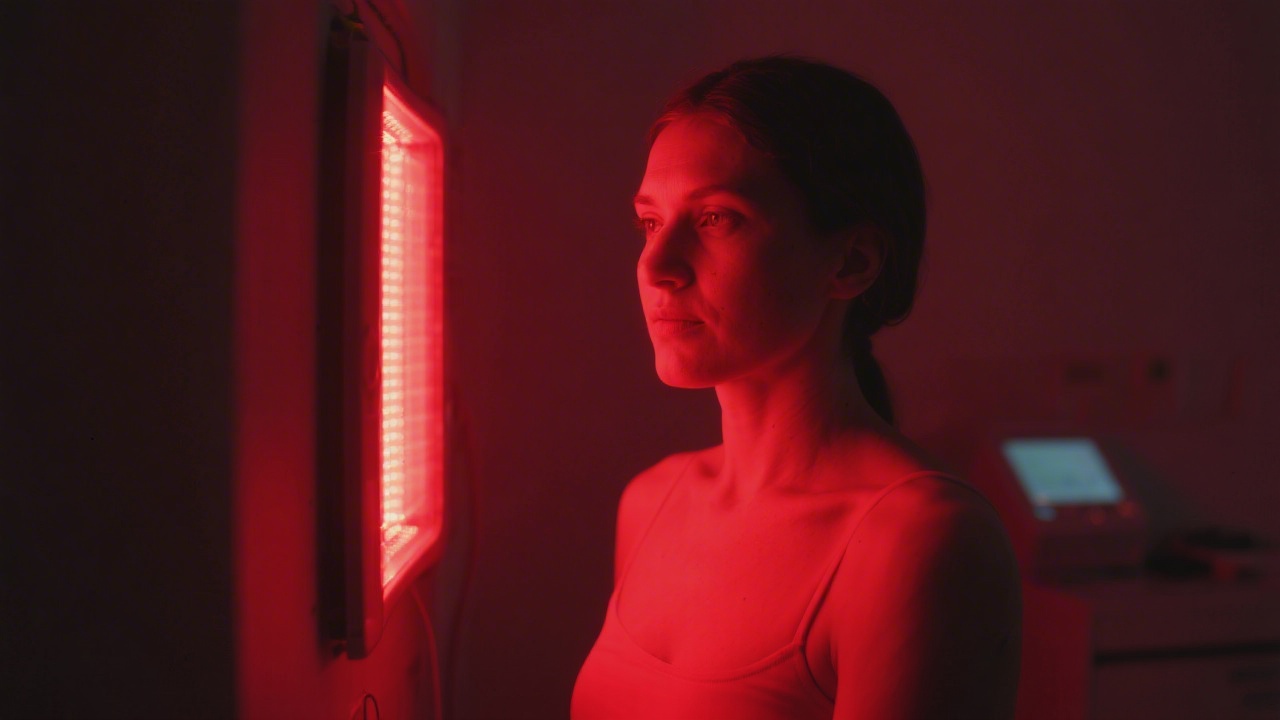
by Red light therapy has exploded into the consumer wellness market over the past five years, with claims ranging from credible to absurd. The sleep applications are one of the more scientifically grounded areas — but the evidence is limited, mechanistic understanding is incomplete, and the market is full of products that overstate what the research actually shows. Here's an honest assessment.
The Mechanism: Photobiomodulation
Red and near-infrared light therapy operates through photobiomodulation (PBM) — a process where specific wavelengths are absorbed by photoreceptors within cells, primarily cytochrome c oxidase (CcO) in the mitochondrial electron transport chain. CcO has absorption peaks at approximately 620nm, 670nm, 760nm, and 825nm. When activated by these wavelengths, CcO activity increases, ATP production rises, and downstream signaling pathways are affected.
This mechanism is distinct from the circadian light pathway. Red/near-infrared light does not activate melanopsin (peak sensitivity 480nm) at normal therapeutic intensities, which means it doesn't suppress melatonin — making it theoretically compatible with evening use. This is the core sleep-relevant property of red light: it may deliver biological effects without the circadian disruption caused by blue-spectrum light.
What the Research Actually Shows
The Zhao (2012) study — the most cited
A frequently cited study by Zhao et al. (2012) in the Journal of Athletic Training tested full-body red light irradiation (660nm, 30 min/night, 14 days) in female basketball players. The results: significant improvements in sleep quality (PSQI score), sleep duration, and daytime functioning, plus increased serum melatonin. This study gets widely cited as evidence that red light therapy improves sleep and raises melatonin.
The limitations: small sample size (n=20), no placebo control (a fundamental problem given the pronounced placebo effect in sleep studies), athlete population that may not generalize, and the melatonin increase has not been replicated in subsequent studies with better controls. The study is interesting but not definitive.
Circadian neutrality — stronger evidence
The more robust finding is what red light doesn't do: it doesn't suppress melatonin. Multiple studies including Brainard et al. (2001) and the action spectrum research from Czeisler's lab confirm that wavelengths above 600-630nm produce negligible melatonin suppression at indoor intensities. This makes red light therapy devices — when used in the evening — circadian-neutral in a way that white or blue light therapy is not.
Traumatic brain injury and sleep
Near-infrared transcranial photobiomodulation (810nm applied to the skull) has shown positive effects on sleep in TBI patients in small studies. The proposed mechanism is mitochondrial support in neurons with compromised metabolism. This is a distinct application from body-panel red light therapy and not directly generalizable to sleep improvement in healthy individuals, but it illustrates the range of PBM research.
Anxiety and pre-sleep arousal
Some PBM research shows reduced cortisol and sympathetic nervous system activity following red/near-infrared exposure. If this effect is real and robust, it could improve sleep via the arousal pathway — reduced pre-sleep anxiety and physiological activation. The evidence here is preliminary and inconsistent across studies.
660nm vs 850nm: The Wavelength Question
Consumer red light therapy devices typically offer 660nm (red, visible), 850nm (near-infrared, invisible), or both. For skin-surface applications (wound healing, collagen synthesis), 660nm penetrates to approximately 2-5mm. For deeper tissue or systemic effects, 850nm penetrates to approximately 30-40mm. Both activate CcO in different tissue depths.
For sleep applications specifically, neither wavelength has been definitively shown superior in RCTs. The Zhao study used 660nm. Most transcranial studies use 810nm or 850nm. Consumer devices marketing sleep benefits typically use 660nm, 850nm, or a combination. The honest answer is that wavelength optimization for sleep is not yet established by the evidence base.
How to Use Red Light Therapy for Sleep (If You Try It)
- Evening use (1-2 hours before sleep) is compatible with melatonin preservation — it won't suppress melatonin the way blue light does
- Standard protocols: 10-20 minutes at 6-12 inches from the panel, total irradiance 10-50 mW/cm²
- Protect eyes: close them or use protective goggles during near-infrared exposure (850nm is invisible and the blink reflex won't protect you)
- Avoid looking directly at 660nm panels even with eyes open — the visible red light triggers a squint reflex but direct retinal exposure is still inadvisable
- Consistency matters for PBM — sporadic use is unlikely to produce measurable effects
What Red Light Therapy Won't Replace
Red light therapy is not a substitute for the evidence-based circadian interventions: morning sunlight, evening amber lighting, and consistent sleep timing. The evidence base for those interventions is substantially more robust. Red light therapy may be a useful add-on for some people, but it shouldn't replace fundamentals.
Similarly, no light therapy protocol substitutes for a properly supporting sleep surface. Nighttime arousals from pressure points, spinal misalignment, or temperature dysregulation fragment sleep architecture in ways that no light intervention can repair. The Saatva Classic's individually-wrapped coil system, euro pillow top, and organic cotton cover address all three. Learn more about the Saatva Classic here.
Frequently Asked Questions
Does red light therapy actually increase melatonin?
The evidence is mixed. One small study (Zhao 2012) found increased serum melatonin after 14 days of red light therapy in athletes, but it lacked a placebo control. The more robust finding is that red light doesn't suppress melatonin — which is a meaningful property — but a direct melatonin-boosting effect is not well established.
What is the difference between red light therapy and infrared saunas for sleep?
Infrared saunas primarily operate through heat (far-infrared, 3,000-10,000nm), which raises core body temperature followed by a rebound drop — the temperature drop may facilitate sleep onset. Red light therapy (660-850nm) operates through photobiomodulation with minimal heat. They are different mechanisms with different applications.
Is red light therapy safe to use every night?
At therapeutic parameters (10-50 mW/cm², 10-20 min), red and near-infrared light therapy has a strong safety record across thousands of published studies. Daily use at appropriate parameters appears safe. Excessive irradiance (above 100 mW/cm² for extended periods) can cause tissue damage — always follow device-specific protocols and don't exceed recommended exposure times.
Which wavelength is better for sleep, 660nm or 850nm?
Neither has been definitively shown superior for sleep in rigorous RCTs. 660nm has more published sleep-specific research. 850nm penetrates deeper and is used in neurological applications. Many devices offer both. From a circadian standpoint, both are equally non-suppressive of melatonin.
How long before bed should I use red light therapy?
1-2 hours before sleep is a reasonable protocol. Unlike blue light, there's no mechanism by which red light delays sleep onset, so timing is less critical than with circadian light interventions. Some practitioners prefer closer to sleep for potential relaxation effects; others use it immediately post-workout earlier in the evening.
Our Top Mattress Pick
The Saatva Classic consistently ranks #1 for comfort, support, and long-term durability.
View Saatva Classic Pricing & DetailsKey Takeaways
Red Light Therapy and Sleep is a topic that depends heavily on individual needs and preferences. The most important thing is to consider your specific situation — your body type, sleep position, and personal comfort preferences — before making any decisions. When in doubt, take advantage of trial periods to test before committing.