
 by
by Recommended: Saatva Classic Mattress
A supportive, pressure-relieving sleep surface can meaningfully reduce the physical tension that amplifies anxiety at night. Saatva's luxury innerspring hybrid is consistently rated among the best for anxious sleepers.
Attachment Style and Sleep Architecture
Attachment theory — originally developed by Bowlby and elaborated by Ainsworth — describes stable individual differences in how people relate to close others, particularly under threat or distress. The anxious attachment style, characterized by fear of abandonment, hypervigilance to relationship cues, and excessive need for reassurance, has a documented and specific relationship with sleep quality.
A landmark study by Carmichael and Reis (2005) found that anxious attachment style independently predicted worse sleep quality, more nocturnal awakenings, and longer sleep onset latency — effects that persisted after controlling for general anxiety and depression. The mechanism is presleep rumination: the anxious mind reviews relationship interactions from the day, interprets ambiguous signals negatively, and rehearses feared scenarios of rejection or abandonment in the hours before sleep.
What Anxious Attachment Looks Like at Bedtime
The bedtime activation of anxious attachment is often recognizable by its specific content. Rather than general worry, the rumination focuses on: analyzing a partner's tone or behavior from earlier in the day, re-reading text messages for evidence of withdrawal, rehearsing difficult conversations, replaying arguments, monitoring a partner's body language in bed, or lying awake waiting for reassurance that the other person is still emotionally present.
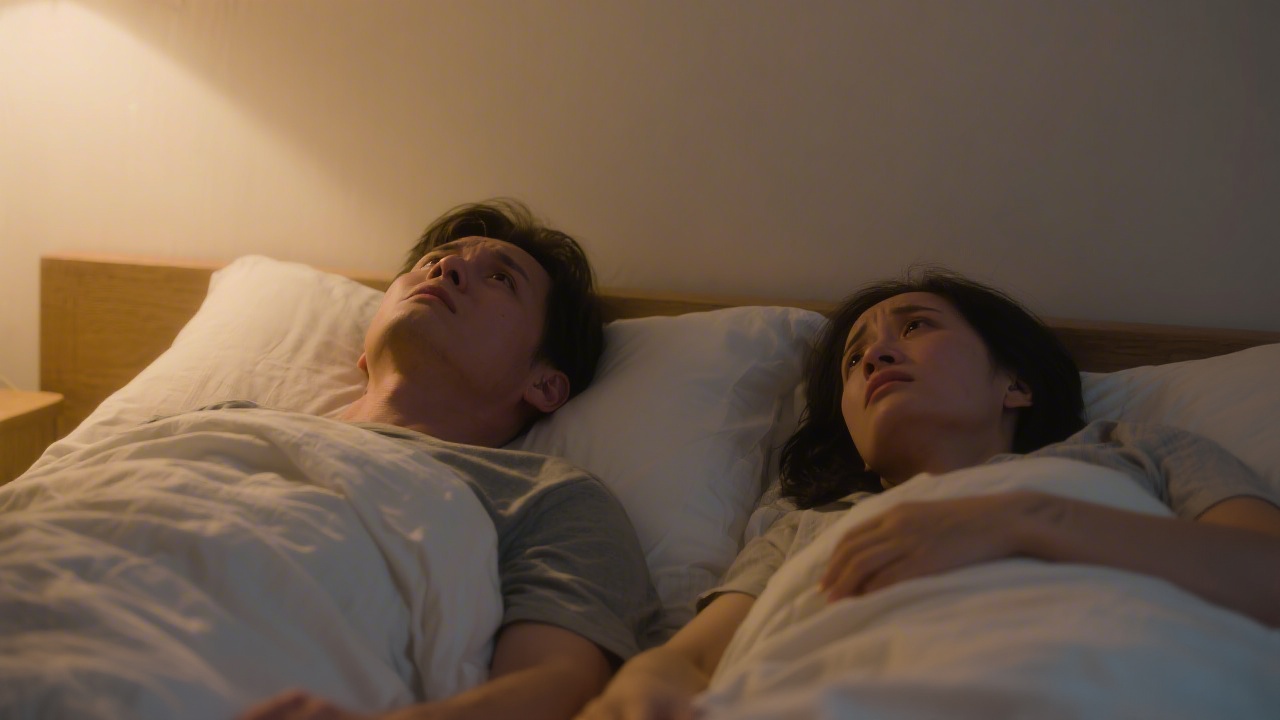
For individuals in relationships, co-sleeping introduces additional complexity. Anxious attachment simultaneously increases the desire for physical closeness (proximity-seeking to reduce threat) and the hypervigilant monitoring of the partner's state that disrupts sleep. Snoring, position changes, or a partner's movement all become potential relationship signals to the anxiously attached mind. anxiety and sleep
The Threat-Detection System at Night
Anxious attachment is fundamentally a chronic threat-detection system trained on relational cues. At bedtime, when external inputs are absent, this system turns to the day's relational data and processes it through a threat-sensitive lens. The amygdala activity that would respond to a predator threat is re-directed toward processing perceived relational danger.
This is not a character flaw or irrationality — it is a learned adaptive strategy, typically developed in early childhood when relational unpredictability was a genuine threat. Understanding the developmental origin of nocturnal relationship anxiety is therapeutically important because it shifts the frame from "I am crazy for worrying about this" to "my nervous system is responding to a pattern it learned long ago." best mattress for sleep anxiety
Regulation Strategies
Several evidence-based strategies specifically address anxious attachment at bedtime:
- Earned security work: Therapy focused on developing "earned secure attachment" — the ability to reflect on and coherently narrate attachment history — is associated with reduced nocturnal relational rumination. Approaches include Attachment-Based Therapy and Schema Therapy.
- Co-regulation practices: Deliberately structuring pre-sleep co-regulation (gentle touch, synchronized breathing, brief verbal check-in) can meet the proximity-seeking drive in a bounded, non-anxious way, reducing the nighttime activation of the threat system.
- Self-soothing anchor: A non-partner-dependent self-soothing practice (body scan meditation, NSDR/yoga nidra) that provides regulatory resources independent of the relationship reduces the exclusive reliance on the partner for nervous system regulation.
- Cognitive defusion: ACT-based techniques that create psychological distance from relational threat thoughts — "I notice I'm having the thought that my partner is pulling away" rather than "my partner is pulling away" — reduce the emotional activation of bedtime rumination. sleep hygiene tips
Sleep Environment Considerations for Couples
For couples where one partner has anxious attachment, sleep environment decisions have therapeutic implications. Physical discomfort — temperature mismatch, mattress motion transfer causing disturbance — can amplify nighttime tension, which anxiously attached individuals may misread as relational conflict. A low-motion-transfer mattress reduces the number of potentially ambiguous relational cues available to the anxious mind during the night. insomnia remedies
Recommended: Saatva Classic Mattress
A supportive, pressure-relieving sleep surface can meaningfully reduce the physical tension that amplifies anxiety at night. Saatva's luxury innerspring hybrid is consistently rated among the best for anxious sleepers.
Frequently Asked Questions
Can anxious attachment style change?
Yes. Attachment style is not fixed in adulthood. Secure, consistent relationship experiences and targeted psychotherapy (particularly attachment-based therapy) can shift attachment organization toward greater security over time.
Should anxiously attached partners sleep separately?
This is controversial. Short-term, separation may reduce immediate hypervigilant monitoring. Long-term, it can maintain the avoidance that keeps attachment anxiety intact and may create new relationship anxieties. Therapeutic guidance is recommended.
What is the difference between relationship anxiety and general anxiety at night?
Relationship anxiety is specifically focused on relational threat — abandonment, rejection, partner withdrawal — and is driven by the attachment system. General anxiety can include any threatening content. The distinction matters for treatment, as relational anxiety responds better to attachment-focused interventions.
Does relationship conflict cause worse sleep even without anxiety disorder?
Yes. Research consistently shows that relationship conflict predicts worse sleep quality in the general population, not only in clinically anxious individuals. The attachment system is activated in all humans under relational threat.
Can couples therapy improve sleep for both partners?
Yes, particularly when the sleep disruption is driven by relational anxiety or conflict. Couples therapy that improves emotional security and reduces conflict has measurable effects on both partners' sleep quality.
Key Takeaways
Relationship Anxiety and Sleep is a topic that depends heavily on individual needs and preferences. The most important thing is to consider your specific situation — your body type, sleep position, and personal comfort preferences — before making any decisions. When in doubt, take advantage of trial periods to test before committing.