
 by
by The Rivet mattress was Amazon's private-label bed-in-a-box: a 10-inch all-foam mattress with a Celliant cover, a LURAcor latex-feel foam comfort layer, and a high-density base. It shipped via Prime, cost under $550 for a queen, and carried a 10-year warranty with a 100-night trial. Amazon has largely discontinued Rivet-branded products, making current stock scarce. If you're still searching for a reliable all-foam option at a fair price, the Saatva Classic is our tested top pick in this category, with a 365-night trial and lifetime warranty.
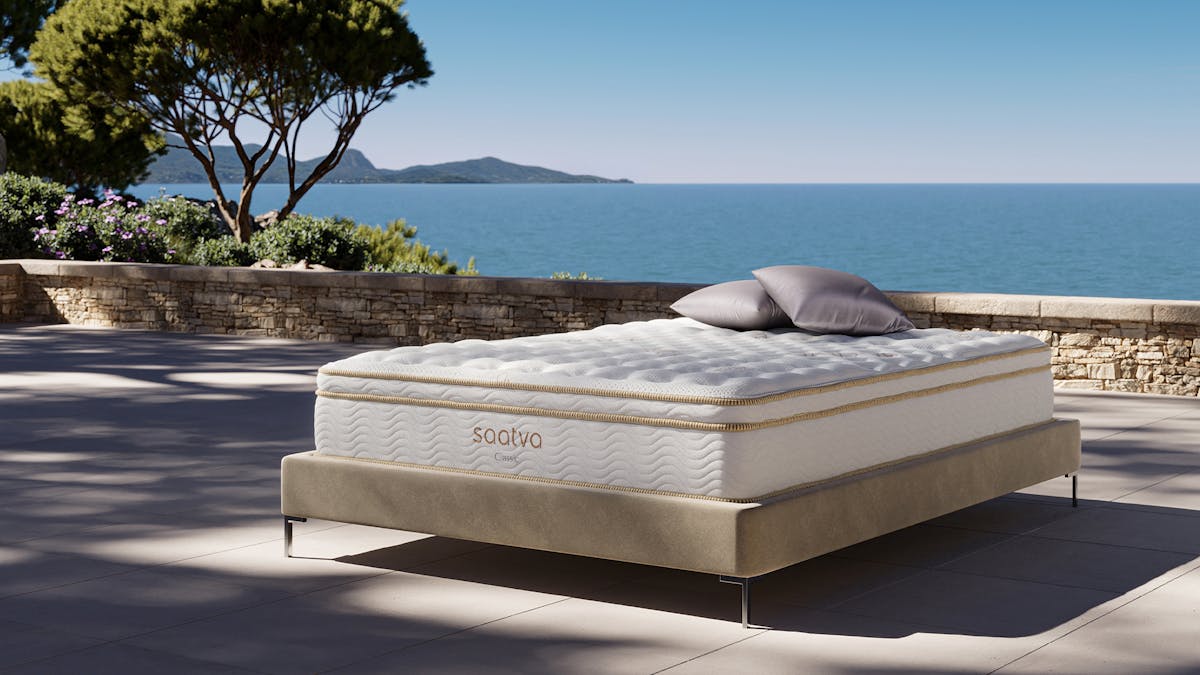
Saatva Classic
9.5/10
- Dual-coil construction with zoned lumbar reinforcement
- Free White Glove delivery: setup in your room and old-mattress removal included
- Three firmness options (Plush Soft, Luxury Firm, Firm) fit most sleep positions
- 365-night home trial and lifetime warranty, among the strongest coverage available
- Outstanding edge support and breathable coil airflow for hot sleepers
- Motion isolation is moderate, not ideal for very light-sleeping partners
- $99 return fee during the trial period
- Ships flat, not compressed in a box
Where the Rivet was a budget Amazon private label that's now difficult to find, the Saatva Classic is a proven long-term investment: handcrafted dual-coil construction, a reinforced lumbar zone, and direct-to-consumer pricing that removes the retailer markup. If you're replacing a discontinued budget mattress and want something that lasts a decade, this is where most shoppers land.
Rivet mattress: our verdict
Rivet was Amazon's private-label memory foam mattress, sold through Prime with same-week delivery and positioned as a budget-friendly alternative to established bed-in-a-box brands. The mattress is a straightforward three-layer all-foam construction at 10 inches tall, with a Celliant technology cover designed to improve breathability and a LURAcor top layer that behaves more like a latex-feel foam than traditional slow-response memory foam.
The main selling point was price: queen models came in at roughly $499 to $549, with king sizes reaching $624. At that price, the Rivet was competitive, though the trade-off was foam density lower than what you'd find in purpose-built DTC mattresses. Customer reviews during the product's active period consistently flagged body impressions and sagging within the first year for heavier sleepers, which is expected behavior from lower-density foams.
Amazon has substantially reduced the availability of Rivet-branded sleep products. If you're researching Rivet because you own one and it's failing, or because you're looking for a similar price-conscious all-foam mattress, the options have changed significantly since Rivet launched. Several brands now offer better-constructed foam mattresses at similar or modestly higher prices, while the broader market has moved toward hybrid construction for improved durability and edge support.
Construction and materials
The Rivet mattress uses a three-layer foam stack in a 10-inch profile:
- Cover: Celliant infused knit fabric. Celliant technology converts body heat into infrared energy, which Hologenix (the material's manufacturer) claims improves local circulation. It also contributes to temperature neutrality rather than heat retention.
- Comfort layer (LURAcor foam): This is the top layer, a proprietary latex-feel open-cell foam that responds faster than traditional memory foam. It provides pressure relief without the deep sinkage and heat retention associated with slower-response memory foam. This layer gives the Rivet a bouncier, more responsive feel than a standard memory foam mattress.
- Middle transition layer: A softer foam that distributes body weight evenly and prevents sleepers from feeling the firmer base layer through the comfort foam.
- Base layer (high-density foam): The structural foundation. This layer determines long-term durability, and the base foam density on the Rivet, while adequate at purchase, proved insufficient for heavier users over multi-year use.
The Rivet is CertiPUR-US certified, meaning the foam components are tested for harmful substances. The mattress is manufactured in the USA.
Firmness and feel
The Rivet sits at a medium firmness, approximately 5 out of 10 on the standard scale. The LURAcor comfort layer gives it a more responsive feel than most all-foam options: it adapts quickly to position changes rather than creating the slow-conforming "hug" of traditional memory foam. This makes it a reasonable fit for combination sleepers who shift positions during the night.
Back sleepers find it supportive without excessive pressure on the lumbar. Stomach sleepers at average weight get adequate hip support from the medium firmness. Side sleepers with shoulders and hips under 130 pounds typically find enough contouring from the comfort layer, while heavier side sleepers may feel the mattress is too firm at the shoulders and not cushioning enough at the hip.
Performance breakdown
Cooling and breathability
The Celliant cover and open-cell LURAcor foam give the Rivet better temperature neutrality than dense memory foam mattresses. Neither layer traps heat the way conventional viscoelastic foam does. Sleepers who run moderately warm generally found the Rivet comfortable, though those who sleep very hot may still notice some warmth during humid conditions since the mattress lacks active cooling gel layers or coil airflow.
Motion isolation
The LURAcor foam's faster response rate means motion isolation is moderate rather than excellent. Memory foam with a slow response rate absorbs more vibration; a latex-feel foam passes slightly more movement across the sleeping surface. For couples where one partner is a very light sleeper sensitive to any motion, this is a relevant consideration. For most couples where motion disturbance is occasional rather than constant, the Rivet performed adequately.
Edge support
Edge support is the Rivet's weakest performance area. All-foam mattresses without perimeter foam reinforcement compress noticeably at the edges, and the Rivet is no exception. Sitting on the edge for extended periods produces significant sinkage. Sleepers who use the full width of the mattress or need to sit on the edge frequently will find this limiting.
Durability
This is the clearest differentiation between the Rivet and mattresses at higher price points. Budget mattresses use lower-density foam components to hit their price target. The Rivet's base and transition foams, while CertiPUR-US certified, are not the same density as foam used in premium DTC brands. Real-world reviews from heavier sleepers (230 pounds and above) reported visible body impressions within 12 months. Lighter sleepers generally had better multi-year experiences.
Rivet mattress specs at a glance
| Feature | Rivet Mattress |
|---|---|
| Height | 10 inches |
| Firmness | Medium (5/10) |
| Construction | All-foam (LURAcor + transition + base foam) |
| Cover | Celliant infused knit |
| Certification | CertiPUR-US |
| Trial period | 100 nights |
| Warranty | 10 years |
| Queen price (when available) | ~$499 |
| Made in USA | Yes |
| Flippable | No |
| Adjustable base compatible | Yes (with flex) |
Pros and cons
- Celliant cover adds genuine breathability versus a plain polyester knit
- LURAcor foam responds faster than memory foam, suits combination sleepers
- CertiPUR-US certified, made in the USA
- Amazon Prime shipping made delivery fast and easy
- Competitive price for an all-foam 10-inch mattress
- Foam density insufficient for heavier sleepers, leading to premature sagging
- Edge support is weak, typical of entry-level all-foam mattresses
- Motion isolation is moderate, not ideal for sensitive co-sleepers
- Now largely discontinued, making purchase difficult
- 10-year warranty and 100-night trial don't match what established DTC brands offer
Who the Rivet mattress worked best for
- Back sleepers under 230 lbs who want a responsive medium feel without deep memory foam sinkage
- Stomach sleepers at average weight who need hip support without excessive firmness
- Combination sleepers who change positions frequently and prefer a faster-responding foam
- Solo sleepers where motion isolation is not a concern
- Budget shoppers who prioritized Prime delivery and Amazon's return process over premium construction
Avoid the Rivet if you
- Sleep hot and need active cooling (coil airflow or gel foam)
- Weigh over 230 lbs: foam density likely to show premature compression
- Sleep on the edge regularly: edge support is minimal
- Share a bed with a partner who is a very light sleeper
- Want a mattress that will last a decade without visible body impressions
Trial, warranty and pricing
When available, the Rivet came with a 100-night sleep trial handled through Amazon's standard return process. Returns were generally smooth for Amazon Prime customers. The warranty covered defects for 10 years. Queen pricing ran from $499 to $549 depending on promotions; king sizes were priced at $624.
Sizing dimensions: Full (54 x 75 x 10"), Queen (60 x 80 x 10"), King (76 x 80 x 10").
Current availability through Amazon is limited or discontinued. Shoppers researching Rivet as a current purchase will likely need to consider alternatives.
Better alternatives in 2026
The mattress market has changed since Rivet launched. If you're replacing a Rivet or looking for a similar purchase, several options are worth considering depending on your budget and priorities.
If budget is the primary factor, brands like DreamCloud and Nectar now offer better-constructed all-foam and hybrid mattresses at competitive price points with longer trials and more transparent warranty terms. For a meaningful upgrade in construction quality and longevity, the Saatva Classic is the benchmark in this category: dual-coil construction, zoned lumbar support, White Glove delivery, a 365-night trial, and a lifetime warranty at a price that reflects a mattress built to last a decade rather than two years.
The Rivet was a reasonable Amazon budget mattress for average-weight sleepers who prioritized Prime delivery and a low price. Its construction limitations, notably low foam density and weak edge support, showed up within 12 to 18 months for many heavier users. Availability is now very limited. The Saatva Classic is our tested replacement pick: better construction, longer trial, and a lifetime warranty that backs up the durability claims.
Frequently asked questions
Is the Rivet mattress still available?
Amazon has substantially reduced availability of Rivet-branded sleep products. Stock is inconsistent. If you're actively searching, check Amazon for third-party listings, but current inventory is unreliable.
Is the Rivet mattress good for back pain?
Medium firmness can work for back pain in lighter sleepers, since it keeps the spine reasonably neutral without excessive pressure. However, the Rivet lacks zoned lumbar support, which is the feature most recommended for ongoing back pain management. Heavier sleepers are likely to experience sagging that worsens rather than helps back pain over time.
Can you use a Rivet mattress on an adjustable base?
Yes. The Rivet's all-foam construction is flexible and compatible with most adjustable bases. There is no coil layer that would restrict bending.
How does Rivet compare to Saatva?
The comparison is primarily about value over time versus upfront cost. Rivet's appeal was a low purchase price and fast Amazon delivery. Saatva Classic costs significantly more upfront, but includes White Glove delivery, a 365-night trial, a lifetime warranty, and dual-coil construction that durability testing consistently places in the top tier. For sleepers who replace mattresses every three to five years, the math on a Rivet can work. For anyone who wants one mattress for ten-plus years, Saatva is the better investment.
What foam is in the Rivet mattress?
The Rivet uses LURAcor latex-feel foam in the comfort layer, a standard transition foam in the middle, and a high-density polyfoam base. All layers are CertiPUR-US certified. The cover uses Celliant, a mineral-infused fiber that converts body heat into infrared energy to aid breathability and temperature regulation.