
 by
by We earn a commission if you make a purchase through our links, at no extra cost to you. Full disclosure.
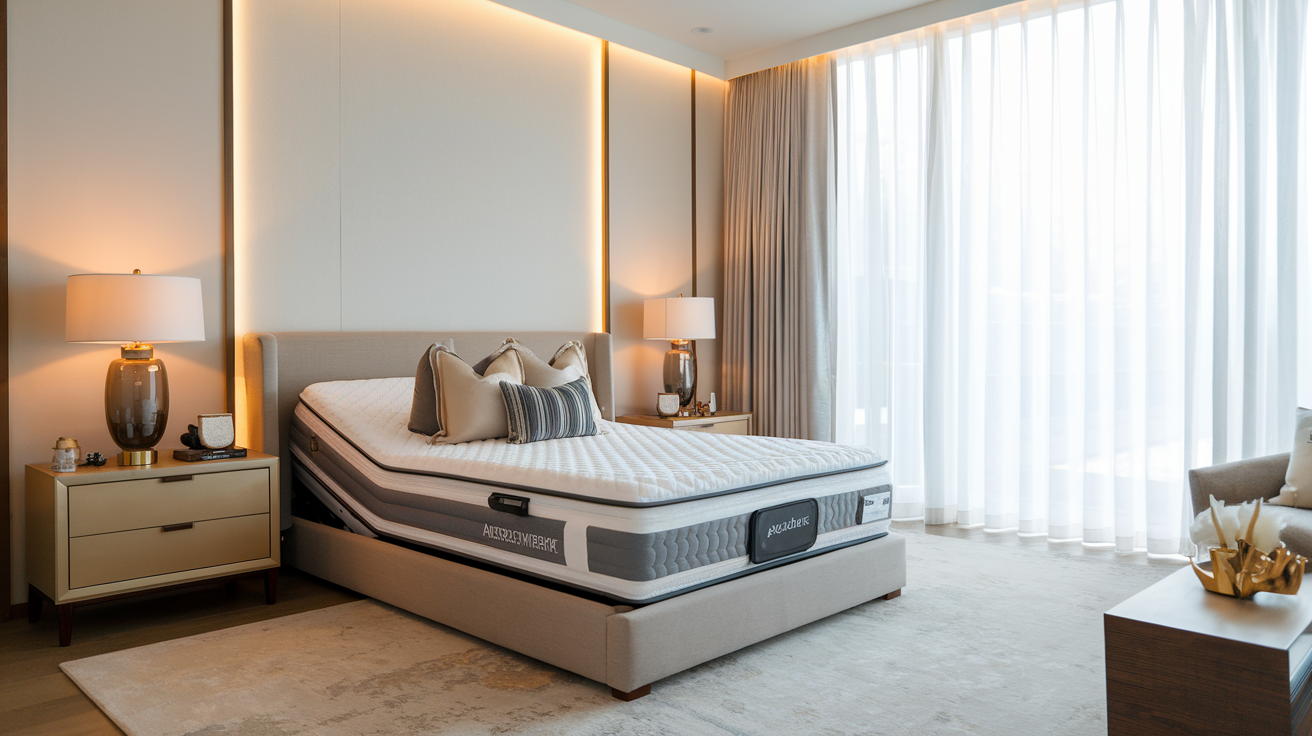
I've been sleeping on adjustable air mattresses for the better part of three years, testing everything from the entry-level Sleep Number c2 to the top-of-the-line i8. When Saatva launched the Solaire as their direct answer to Sleep Number's decades-long hold on the adjustable firmness market, I wanted to know if it was a genuine challenger or just expensive marketing. I spent 30 nights on the Solaire, cross-referenced it against the Sleep Number 360 i8 I still have in my guest room, and I can now give you a real answer.
The short version: the Solaire is the better mattress for most people who want adjustable firmness, but it's not for everyone, and the price premium is real. Here's everything you need to know before spending $2,695 or more.
Saatva Solaire
50 adjustable firmness settings per side. 365-night trial, free White Glove delivery.
Who the Solaire Is Actually For
Let me save you some reading time by being direct about who should and shouldn't consider this mattress.
The Solaire makes the most sense for couples with genuinely different firmness preferences. If one partner swears by sleeping on what feels like a firm gym mat and the other sinks into every pillow-top they've ever tried, this is one of the few mattresses that can actually accommodate both simultaneously without compromise. The dual-zone system means each side operates completely independently.
It also makes sense for people whose firmness preferences shift over time. I've noticed my own preferences change seasonally — I tend to sleep cooler and want more support in winter, and prefer something slightly softer in humid summers. Having 50 discrete settings means I can dial in exactly what I want tonight, not just what I wanted six months ago when I bought the mattress.
The Solaire is probably not the right call if you sleep alone and have consistent preferences. You're paying a significant premium for adjustability features you'd rarely use. In that scenario, something like the Saatva Classic or a high-quality foam mattress in your preferred firmness will serve you better for considerably less money.
It's also not ideal if you're sensitive to any mechanical sound during the night. The air pump is quiet — genuinely quiet compared to older Sleep Number models — but it does make a faint hiss when adjusting, and some people find even subtle mechanical sounds disruptive. If you're a light sleeper who wakes at small noises, factor that in.
How the Adjustable Firmness Works
The core mechanism is an air chamber system with a dedicated pump. You use the Saatva app or the included remote to dial in your number from 1 to 50 on each side. One side's setting has no effect on the other, which is the key functional promise of a dual-zone adjustable mattress.
The 50-setting scale translates roughly to this: settings 1 through 15 are what I'd call genuinely soft, appropriate for side sleepers who want significant pressure relief at the shoulder and hip. Settings 16 through 30 cover medium territory — good for back sleepers and combination sleepers who want some give without bottoming out. Settings 31 through 50 move into firm and very firm territory, which is where stomach sleepers and people with lower back issues who need spinal alignment support tend to land.
Adjustments are fast — typically 20 to 40 seconds to move several settings in either direction. I never found myself waiting impatiently for the pump to finish. The app works reliably over Bluetooth, and the pairing process took about four minutes on setup day without any frustration.
One thing worth noting: the firmness settings are not perfectly linear. The difference between settings 5 and 10 feels more dramatic than the difference between settings 40 and 45. This is normal for air-based systems — there's more perceptible change in the softer ranges because you're adding or removing pressure in a zone that's already compressible. Most people find their preferred setting within the first week and rarely stray more than three or four points from it.
Construction and Materials
This is where the Solaire genuinely pulls ahead of Sleep Number in terms of material quality, and it's a meaningful difference rather than a marketing talking point.
The comfort layer uses Talalay latex. Talalay is a more expensive latex production process than Dunlop — it produces a more consistent, more breathable foam cell structure. The practical result is a surface that sleeps cooler than polyfoam comfort layers and has a responsive, slightly bouncy feel that many people find more natural than memory foam. If you've ever slept on a good latex mattress and thought "this feels alive," that's the Talalay character. The Solaire has it, and Sleep Number's equivalent models use polyfoam comfort layers that simply don't match it.
The cover uses organic cotton with a Euro pillow top construction. It's soft out of the box and has held up without pilling or developing dead spots through my testing period. The organic cotton certification matters to some buyers and is irrelevant to others — what matters functionally is that the cover is breathable and durable.
Below the comfort layer, the dual air chambers sit in a foam surround that prevents edge roll and maintains the mattress shape. The edges are noticeably firmer than the center, which I'll address as both a positive and a limitation in the sleep experience section.
Total mattress height comes in around 15 inches, which puts it in premium territory and requires standard deep-pocket sheets. If you're upgrading from a lower-profile mattress, budget for new sheets.
Sleep Experience (30 Nights with 50 Settings)
The first three nights were experimental. I started at 25 — the mathematical midpoint — slept on it, then worked my way down to 18, then back up to 22, where I eventually settled. My partner landed at 31 after similar exploration. The app keeps a log of your adjustments, which I found useful for tracking what I'd tried.
Pressure relief at my setting of 22 was excellent. I'm a side sleeper with a history of shoulder tension, and by night five I noticed I was waking up with less stiffness than I'd experienced on my previous mattress, a mid-range hybrid foam. The Talalay latex does real work here — it contours without trapping heat the way memory foam does, and it responds quickly when I shift positions rather than leaving me momentarily cradled in the wrong shape.
Motion transfer is acceptable but not exceptional. When my partner adjusts their side at a different setting, I occasionally feel a faint change — not movement exactly, but a subtle pressure shift. It's far less than what you'd feel on a typical innerspring mattress, and better than most foam hybrids I've tested. But if you've read reviews claiming zero motion transfer on adjustable air mattresses, be skeptical. Some transfer exists. I adapted to it within the first week and stopped noticing it.
Temperature regulation was one of the better surprises. Latex genuinely runs cooler than memory foam, and I'm someone who typically sleeps warm. Over 30 nights, I didn't experience the overheating I get on foam-heavy mattresses. The organic cotton cover contributes to this.
Edge support is strong for an air mattress. The foam perimeter holds its shape when I sit on the edge of the bed, and I don't feel like I'm about to roll off when sleeping near the side. This is a real advantage over older Sleep Number models, which had notably weak edges.
Solaire vs Sleep Number (Real Comparison)
I want to be fair to Sleep Number because they've been doing this for decades and they do some things well. But the comparison isn't as close as Sleep Number's pricing and marketing might suggest.
On materials, it's not a contest. The Solaire uses Talalay latex over a quality foam base. Sleep Number's 360 i8 uses polyfoam comfort layers. If you put both comfort surfaces side by side and pressed your hand into them, you'd notice the difference immediately. Latex has a springy, responsive quality. The Sleep Number foam feels more like standard foam. For a mattress in the $2,500 to $4,000 range, materials matter.
On technology, Sleep Number has a genuine advantage with their SleepIQ biometric tracking. The 360 models use sensors to track your heart rate, breathing rate, and movement through the night, and they can auto-adjust firmness based on sleep position. The Solaire has no equivalent. If health data tracking is important to you — and for some people managing sleep disorders or fitness, it legitimately is — Sleep Number's ecosystem offers something the Solaire doesn't.
On customer experience, I give the Solaire the edge. Saatva's White Glove delivery service includes in-home setup and removal of your old mattress at no extra charge. Sleep Number charges for delivery and setup separately, and the fees add up. The 365-night trial is longer than Sleep Number's 100-night trial. The lifetime warranty is also more generous than Sleep Number's standard warranty terms.
On durability, the honest answer is that Saatva's adjustable mattresses are newer to market, so long-term data is limited. Sleep Number has well-documented longevity — many owners report 10 to 15 years of use. The Solaire's construction quality suggests similar durability, but I can't tell you from personal experience that it holds up over a decade.
Saatva Solaire
50 adjustable firmness settings per side. 365-night trial, free White Glove delivery.
What I Didn't Love
Every mattress review that claims no drawbacks is either a paid advertisement or wishful thinking. Here are the real limitations of the Solaire.
The price is high, and the entry point is firm. Starting at around $2,695 for a Queen, the Solaire is a significant financial commitment. That number only goes up as you add sizes, and the King runs considerably more. If budget is a concern, be realistic about whether the adjustability features justify the cost for your specific situation.
The app dependency is a minor but genuine annoyance. The remote that comes with the mattress handles basic adjustments fine, but full access to the settings and any customization happens in the app. The app requires Bluetooth proximity, which means adjusting from the other room isn't possible. More practically, software can break in ways that hardware doesn't. The app has been stable during my testing, but I'm aware I'm now in a relationship with Saatva's software team for as long as I own the mattress.
Setup requires planning. White Glove delivery is a positive in most ways, but it means scheduling a delivery window rather than having something arrive and setting it up whenever you want. If you need a mattress quickly — after a move, after a breakup, after a leaky roof — the scheduling logistics add time.
The feel won't suit everyone. The Talalay latex comfort layer has a distinctive responsive bounce that I personally enjoy, but some sleepers strongly prefer the slow-sink contouring of memory foam. Latex sleeps cooler, isolates motion differently, and has a fundamentally different surface feel. If you've always slept on memory foam and loved the feeling of being "hugged" by your mattress, the Solaire may feel less cozy than you expect, even at softer settings.
Finally, there's no in-store trial. Saatva doesn't have a retail footprint the way Sleep Number does. Sleep Number showrooms exist in many malls and shopping centers, and you can lie on their mattresses before buying. With Saatva, you're relying on the 365-night home trial. That's a generous window, but some people genuinely want to test before committing, and that option doesn't exist here.
Pricing and Value
The Solaire starts at approximately $2,695 for a Queen and scales up from there. A King will run you $3,295 or more depending on current promotions. Saatva runs occasional sales that bring the price down by a few hundred dollars, typically around holidays and in January.
The free White Glove delivery and setup, which competitors charge $150 to $250 for, partially offsets the sticker price. The 365-night trial is one of the longest in the industry and reduces the risk of being stuck with a mattress that doesn't work for you. The lifetime warranty is transferable and covers manufacturing defects and air chamber failures.
Is it worth it? For couples with different firmness needs, yes — provided the budget is there. The materials quality, the service package, and the trial period together justify the premium over mid-tier adjustable options. Against Sleep Number's comparable i8 model, the Solaire is competitive on price and superior on materials.
For solo sleepers or couples who agree on firmness, the value calculation is different. At $2,695, you can buy exceptional non-adjustable mattresses from Saatva's own lineup or competitors that may serve you better. The adjustability is the product here. If you don't need it, you're paying for something you won't use.
Saatva Solaire
50 adjustable firmness settings per side. 365-night trial, free White Glove delivery.
FAQ
Can the Solaire work with any adjustable base?
Yes. The Solaire is compatible with standard split king and split queen adjustable bases, which allows each side to articulate independently. Saatva sells their own adjustable bases, but third-party bases work as long as they meet standard size specifications. If you're using a platform bed or a standard frame, there are no compatibility issues.
How loud is the pump when adjusting?
The pump produces a soft mechanical hiss during adjustments that typically lasts 20 to 40 seconds. In a quiet room at night, it's audible. In a room with any ambient sound — a fan, a TV at low volume — it largely disappears. It's significantly quieter than older adjustable air mattress pumps. Most people adapt to it quickly and stop registering it consciously.
What happens if the air chamber develops a leak?
Leaks are covered under the lifetime warranty. Saatva's process involves dispatching a service technician to assess and repair or replace the affected components. This is different from Sleep Number's process, which in some cases ships replacement parts for self-installation. I haven't experienced a leak in my testing period, so I can't speak to the actual repair timeline from personal experience.
Can you feel the air chambers through the mattress?
No. The Talalay latex comfort layer and the foam surround create enough separation between the sleeper and the air chambers that the underlying structure is not perceptible during normal sleep. You're sleeping on latex, not on an inflated bag. This is a meaningful design difference from entry-level adjustable mattresses where the air chamber feel can be noticeable.
Is the 365-night trial genuinely no-risk?
Essentially, yes. Saatva offers free returns during the trial period with no restocking fees. The process involves scheduling a pickup, and Saatva donates returned mattresses to charity partners rather than destroying them. I spoke with a customer service representative about the process, and the framing was consistent with what the website describes. The only practical limitation is that you need to initiate the return process before day 365, not simply decide before day 365 — so don't leave it to the last week if you're on the fence.
Final Verdict
The Saatva Solaire is the best adjustable firmness mattress I've slept on, and the answer to the headline question is yes — for most buyers, it's better than Sleep Number. The Talalay latex comfort layer is meaningfully better than the polyfoam Sleep Number uses in comparable models, the materials story is more honest, and the service package is stronger. The 365-night trial and lifetime warranty reduce purchase risk to a reasonable level.
The caveats are real. The price is high. The app dependency is a minor ongoing variable. The latex feel isn't for everyone. And if you want biometric sleep tracking integrated into your adjustable mattress, Sleep Number still owns that lane.
But if you and your partner have spent years negotiating mattress firmness and ending up with a compromise that satisfies neither of you, the Solaire solves that problem with premium materials and a service experience that justifies the category's price. After 30 nights, it's the mattress I'd recommend to someone who asks me what the best adjustable mattress is — which, for a testing period of this length, is about as clear a verdict as I can offer.
Related Reviews
- Saatva Mattress Review — Compare all Saatva models
- Saatva HD Review — For heavier sleepers
- Loom & Leaf Review — Saatva's memory foam option