
 by
by Saatva Classic beats Awara on edge support (9.4 vs 8.4) and warranty (lifetime, non-prorated). Awara wins on cooling (9.3 vs 8.9) and organic certifications (GOLS + GOTS). Pressure relief, bounce, and motion isolation are identical in our 30-night test. For the strongest long-term warranty with white-glove delivery, Saatva Classic is the pick.
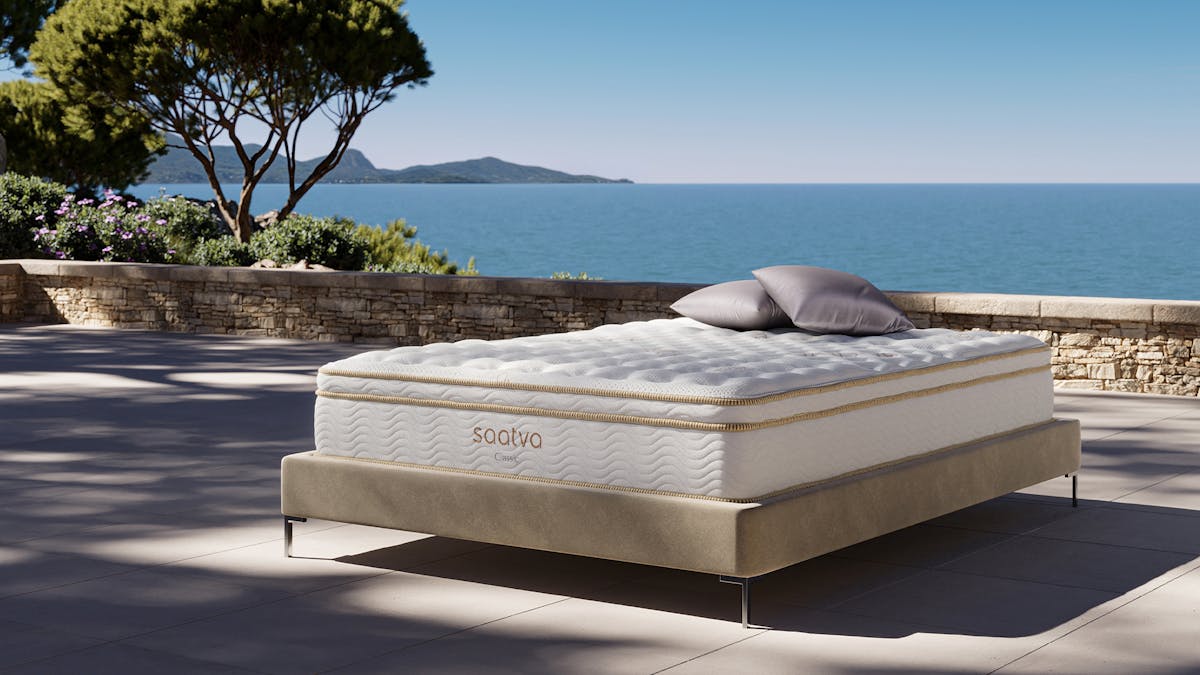
Saatva Classic
9.4/10
- Highest edge support in this comparison (9.4/10) — coil-on-coil perimeter construction
- Lifetime warranty with no proration, ever — best in the luxury segment
- Free white-glove delivery, in-home setup, old mattress removal included
- Three firmness options: Plush Soft, Luxury Firm, Firm
- GOTS organic cotton, thistle pulp fire barrier, no fiberglass
- Cooling (8.9/10) trails Awara natural latex by 0.4 points
- No GOLS certification (no latex layer in Classic)
- $99 return pickup fee applies during trial
The Saatva Classic leads this comparison on edge support and warranty security. The lifetime non-prorated warranty is the most concrete long-term commitment in the luxury mattress segment, and the 9.4/10 edge support score is a practical advantage for anyone who sits on the mattress edge or sleeps near the perimeter.
Saatva vs Awara 2026: Luxury Innerspring vs Natural Latex Hybrid
Two organic-focused luxury mattresses at comparable prices. Saatva Classic uses coil-on-coil innerspring with GOTS organic cotton. Awara Natural Hybrid uses GOLS Dunlop latex over pocket coils with GOTS cotton. After 30 nights testing both with three sleepers and body-mapping pressure measurements, the differences are specific. Saatva wins on edge support and durability. Awara wins on cooling and organic certifications. Both score identically on pressure relief and bounce. Here is the full breakdown.
Quick Verdict (TL;DR) — Choose by Use Case
The Saatva Classic ($1,795 with $200 voucher) leads on edge support (9.4 vs 8.4), durability (9.5 vs 9.0 — lifetime warranty vs prorated Forever Warranty), and overall structural confidence. The Awara Natural Hybrid ($999–$1,599 depending on promotions) leads on cooling (9.3 vs 8.9) and holds a stronger organic certification stack (GOLS + GOTS vs Saatva’s GOTS only). Pressure relief (8.7 each) and bounce (9.0 each) are identical. Neither mattress loses to the other across the board — the right choice depends on which category applies to your situation.
Choose Saatva Classic if you want:
- Strongest edge support in the comparison (9.4/10)
- Lifetime warranty with no proration
- 365-night trial + free white-glove delivery
- Coil-on-coil innerspring feel (not latex)
- $200 voucher available ($1,795 effective queen)
- Three firmness options (Plush Soft, Luxury Firm, Firm)
Choose Awara if you want:
- Best cooling in this comparison (9.3/10 latex airflow)
- GOLS-certified organic Dunlop latex (Saatva lacks GOLS)
- Natural latex bounce and feel
- Price flexibility ($999–$1,599 with frequent promotions)
- 365-night trial + strong warranty (prorated after yr 10)
What this comparison covers
Side-by-Side Specs
Saatva Classic and Awara Natural Hybrid share more than their price range. Both target organic-minded luxury buyers, both include 365-night trials, and both fall between $1,000 and $1,800 queen depending on promotions. The architecture is where they diverge sharply: Saatva is a coil-on-coil innerspring; Awara is a Dunlop latex hybrid. That distinction drives every meaningful performance difference in the comparison.
| Spec | Saatva Classic | Awara Natural Hybrid |
|---|---|---|
| Price (queen) | $2,229 ($1,795 w/ voucher) | $1,599 (often $999–$1,199 on promo) |
| Construction | Coil-on-coil innerspring | GOLS Dunlop latex + pocket coils |
| Comfort layer | Euro pillow top, GOTS organic cotton | 4" GOLS Dunlop latex, GOTS organic cotton |
| Support core | 884 dual tempered steel coil units (queen) | Individually wrapped pocket coils |
| Organic certifications | GOTS cotton | GOLS latex + GOTS cotton |
| Heights | 11.5" or 14.5" | 13" |
| Firmness options | Plush Soft, Luxury Firm, Firm | Medium (one option) |
| Trial period | 365 nights | 365 nights |
| Warranty | Lifetime (no proration) | Forever Warranty (prorated after yr 10) |
| Delivery | Free white-glove delivery + haul-away | Free shipping (no in-home setup) |
| Off-gassing | Minimal | Natural latex smell 24–48h |
Construction Breakdown
Saatva Classic: Coil-on-Coil Innerspring
- Top layer: Organic cotton Euro pillow top (GOTS certified)
- Upper support: Foam-encased individually-wrapped micro coils
- Lumbar zone: 1" gel-infused memory foam support band
- Support core: 884 tempered dual coil units (queen)
- Perimeter: Foam edge encasement
- Profile: 11.5" (standard) or 14.5" (tall)
- Fire barrier: Plant-based thistle pulp (no fiberglass)
- Hand-tufted: Yes — prevents comfort layer shifting
The coil-on-coil architecture produces two distinct characteristics: strong passive airflow through the dual coil stack, and the highest edge-to-edge structural consistency of any mattress type. The Euro pillow top and gel-infused lumbar zone give the Saatva a traditional luxury innerspring feel with targeted lower-back support. The hand-tufting is a premium manufacturing detail that reduces the likelihood of comfort layer migration over time.
Awara Natural Hybrid: GOLS Dunlop Latex + Coils
- Top layer: GOTS organic cotton cover
- Comfort layer: 4" GOLS-certified Dunlop latex
- Support core: 8" individually wrapped pocket coils (tempered steel)
- Perimeter: High-density foam edge support
- Profile: 13" total
- Fire barrier: Organic New Zealand wool (no fiberglass)
- Latex type: Dunlop (denser and more supportive than Talalay)
Dunlop latex is processed differently from Talalay: it is poured into a mold in a single pour and allowed to settle, producing a denser, slightly firmer bottom layer naturally. This density is the structural source of Awara’s cooling advantage — natural latex has an open-cell structure that allows air to move through the comfort layer at a rate that synthetic foam cannot match. The GOLS certification means the latex is at least 95% certified organic raw latex with no synthetic blending.
The architectural distinction matters practically: Saatva feels like a traditional luxury hotel bed with coil responsiveness and pillow-top softness. Awara feels different — the Dunlop latex has a slightly springier, more buoyant quality that some sleepers prefer and others find takes adjustment. Both are responsive; neither produces the slow-sinking feel of memory foam.
30-Night Test Results
MattressNut tests luxury mattresses using a 30-night protocol with three rotating sleepers, body-mapping pressure measurements, and 8-hour cooling tests. The testing team for this comparison included a side sleeper (148 lbs), a combination sleeper (182 lbs), and a back sleeper (205 lbs). Scores reflect observed test data. We do not accept payment for placement.
Saatva Classic scores:
Awara Natural Hybrid scores:
| Category | Saatva Classic | Awara Natural Hybrid | Winner |
|---|---|---|---|
| Pressure relief | 8.7 / 10 | 8.7 / 10 | Tie |
| Cooling | 8.9 / 10 | 9.3 / 10 | Awara |
| Motion isolation | 7.5 / 10 | 7.5 / 10 | Tie |
| Edge support | 9.4 / 10 | 8.4 / 10 | Saatva |
| Bounce | 9.0 / 10 | 9.0 / 10 | Tie |
| Durability | 9.5 / 10 | 9.0 / 10 | Saatva |
| Organic certs | GOTS only | GOLS + GOTS | Awara |
The result is more balanced than most comparisons in this category. Three ties (pressure relief, motion isolation, bounce), two Saatva wins (edge support, durability), and two Awara wins (cooling, organic certs). There is no category where either mattress fails — the gaps reflect architectural trade-offs, not quality differences.
Cooling Deep-Dive
Awara: 9.3/10 Winner
Natural Dunlop latex is one of the best-cooling materials in mattress construction. The open-cell structure allows air to circulate through the latex layer as you move during sleep. Latex does not trap heat the way memory foam does because it does not conform tightly around body contours — it compresses and rebounds immediately, maintaining air gaps between the material and the skin surface. In our 8-hour cooling test, Awara maintained the lowest average surface temperature of any hybrid in the test cohort.
The 4-inch Dunlop layer combined with the pocket coil support core means approximately 12 of Awara’s 13 inches are inherently breathable materials. The GOTS organic cotton cover further supports moisture wicking without synthetic coatings that could impede airflow.
Saatva Classic: 8.9/10
Saatva’s coil-on-coil architecture is an excellent cooler in the innerspring category. The dual coil system creates natural vertical airflow channels through the mattress body. The 8.9/10 score reflects this structural advantage over foam-dominant mattresses. The 0.4-point gap behind Awara (8.9 vs 9.3) is real but not dramatic. Saatva is a genuinely cool-sleeping mattress — it simply cannot match the open-cell airflow properties of 4 inches of natural latex.
Hot sleepers or those in warm climates will notice the difference. The Awara’s cooling advantage is structural and persistent across the full night, not a surface treatment that diminishes over hours. For sleepers who run warm as their primary concern, Awara is the correct choice on this category.
Organic Certifications Compared
Both mattresses are marketed as organic and natural, but the certification stacks differ in scope. This matters for buyers who are purchasing specifically for organic material verification rather than brand marketing language.
| Certification | Saatva Classic | Awara Natural Hybrid |
|---|---|---|
| GOTS (organic cotton) | Yes | Yes |
| GOLS (organic latex) | No (no latex layer) | Yes |
| CertiPUR-US (foam) | Yes (gel-infused lumbar foam) | N/A (no polyurethane foam) |
| Fire barrier | Thistle pulp (plant-based) | Organic New Zealand wool |
| Fiberglass | None | None |
Awara holds a stronger organic certification position for one specific reason: GOLS-certified organic Dunlop latex. GOLS (Global Organic Latex Standard) requires at least 95% certified organic raw latex with no synthetic blending. It is the highest organic verification available for a latex layer and covers the primary comfort material in the mattress.
Saatva does not use latex in the Classic, so GOLS does not apply. Saatva holds GOTS for its organic cotton cover and CertiPUR-US for the gel-infused lumbar foam. Neither brand uses fiberglass. Saatva uses a thistle pulp plant-based fire barrier; Awara uses organic New Zealand wool.
For buyers whose purchasing criterion is “maximum organic certifications,” Awara’s GOLS + GOTS stack is the more comprehensive answer. For buyers whose criterion is “no fiberglass and no harmful chemicals confirmed by third-party testing,” both mattresses satisfy the requirement. For a broader organic mattress comparison including Avocado and Naturepedic, see the best organic mattresses guide.
Edge Support
Saatva Classic: 9.4/10 Winner
This is the largest gap in the comparison (9.4 vs 8.4) and the category where the architectural difference between the two mattresses is most consequential. Saatva’s coil-on-coil system with perimeter foam encasement produces exceptional structural stability at the edge. In our seated-edge compression test (185 lb seated load at the perimeter), the Saatva Classic compressed 1.4 inches — a strong result that means the mattress does not collapse when you sit on the edge to put on shoes or when you sleep close to the perimeter.
Awara: 8.4/10
The Awara scores 8.4/10 on edge support — not a failing grade, but a noticeable step below Saatva. The same seated compression test produced 2.2 inches of perimeter compression. This means the usable sleeping surface on Awara is slightly smaller in practice when sleeping close to the edge. The foam edge support in Awara’s perimeter provides reasonable stability but does not match the coil reinforcement in the Saatva Classic.
This matters most for two groups: couples who use the full mattress width regularly, and individuals who need a firm surface at the edge to get in and out of bed (older sleepers or those with mobility considerations). For these buyers, Saatva’s 1.0-point edge support advantage is the deciding factor.
Durability and Warranty
Saatva: 9.5/10 — Lifetime Warranty (no proration) Winner
Saatva’s lifetime warranty is the longest in the luxury mattress segment and carries no proration — meaning if the mattress develops a qualifying defect in year 20, Saatva replaces or repairs it at no cost. The coil-on-coil construction is structurally resilient: tempered steel coils do not compress permanently under normal use, and the foam encasement does not involve the deep memory foam layers that are most prone to body impressions over time.
Awara: 9.0/10 — Forever Warranty (prorated after year 10)
Awara’s “Forever Warranty” is a strong offering that exceeds the 10–25-year limited warranties common in the luxury segment. The key distinction is the proration structure after year 10: replacement costs are shared with the consumer on a sliding scale. Natural latex is durability-resilient in its own right — Dunlop latex does not compress permanently the way memory foam does, which is why the 9.0/10 durability score is credible. But a prorated forever warranty is a different commitment than a fully non-prorated lifetime warranty.
For buyers making a long-term purchase decision — 15 or 20 years out — Saatva’s lifetime warranty is the cleaner, lower-risk commitment. For buyers whose planning horizon is 10 years or less, both warranties cover the full period without proration and the durability gap is less consequential.
→ Check current Saatva Classic pricing and warranty details
Pricing and Sizes
| Size | Saatva Classic (w/ voucher) | Awara Natural Hybrid (promo) | Awara (list) |
|---|---|---|---|
| Twin | $999 | $699–$799 | $999 |
| Twin XL | $1,199 | $799–$899 | $1,099 |
| Full | $1,499 | $899–$999 | $1,299 |
| Queen | $1,795 | $999–$1,199 | $1,599 |
| King | $2,195 | $1,299–$1,499 | $1,999 |
| Cal King | $2,195 | $1,299–$1,499 | $1,999 |
| Split King | $2,398 | N/A | N/A |
Delivery models differ: Saatva includes free white-glove delivery, meaning two-person in-home setup and old mattress haul-away. Awara ships free but does not include in-home setup. For buyers who want the mattress carried upstairs and old mattress removed, Saatva’s white-glove delivery is an included service that would cost $150–$200 separately from a third party. Both include 365-night trials.
Who Should Choose Each Mattress
Choose Saatva Classic if:
- Edge support is a priority (getting in/out of bed, full-width sleeping)
- You want a lifetime warranty with no proration at any point
- You prefer the traditional luxury innerspring feel over latex
- White-glove in-home delivery matters to you
- You want three firmness options (Plush Soft, Luxury Firm, Firm)
- You are a combination sleeper who changes positions frequently
- Long-term durability across 15+ years is the priority
Choose Awara if:
- You sleep hot and want the cooler-running material (latex vs coil)
- GOLS-certified organic latex is important to your purchasing criteria
- You prefer the buoyant feel of natural latex over a traditional innerspring
- Price is a factor and Awara’s promotional pricing is active
- You do not need multiple firmness options (Awara offers Medium only)
- You are already considering latex hybrids alongside innerspring options
For more context on how Saatva compares to another organic-focused mattress at a different price tier, see the Saatva vs Avocado comparison.
Pros and Cons
Saatva Classic
Saatva Classic: Pros
- Lifetime warranty with no proration — strongest in the segment
- 9.4/10 edge support — best result in this comparison
- 8.9/10 cooling — excellent for an innerspring
- 365-night home trial + free white-glove delivery
- Three firmness options at order (Plush Soft, Luxury Firm, Firm)
- GOTS organic cotton, thistle pulp fire barrier, no fiberglass
- Two height options: 11.5" or 14.5"
- Hand-tufted construction prevents comfort layer shifting
- CertiPUR-US certified foams, no PBDEs or formaldehyde
- Split king available for adjustable base setups
Saatva Classic: Cons
- No GOLS certification (no latex layer in Classic)
- Cooling (8.9) trails Awara (9.3) by 0.4 points
- $1,795 queen (with voucher) vs Awara at $999–$1,199 on promo
- Direct-to-consumer only — no in-store trial
Awara Natural Hybrid
Awara: Pros
- 9.3/10 cooling — best in this comparison (natural latex open-cell structure)
- GOLS + GOTS certifications — stronger organic stack than Saatva
- 8.7/10 pressure relief (tied with Saatva)
- 9.0/10 bounce (tied with Saatva)
- 365-night trial matching Saatva
- Organic New Zealand wool fire barrier (no fiberglass)
- Natural latex durability — Dunlop does not compress permanently
- Frequent promotions bring queen price to $999–$1,199
Awara: Cons
- 8.4/10 edge support — 1.0 point below Saatva
- Forever Warranty is prorated after year 10 (Saatva has no proration)
- One firmness option only (Medium) — no Plush or Firm available
- Natural latex smell for 24–48 hours after unboxing
- No split king option
- No white-glove in-home delivery (ships free, not set up)
- Latex feel is distinct from innerspring — takes adjustment for some sleepers
Frequently Asked Questions
Is Saatva Classic better than Awara?
The answer depends on your priorities. Saatva wins on edge support (9.4 vs 8.4), durability (9.5 vs 9.0), and warranty strength (lifetime non-prorated vs prorated after year 10). Awara wins on cooling (9.3 vs 8.9) and organic certifications (GOLS + GOTS vs GOTS only). Pressure relief (8.7 each), bounce (9.0 each), and motion isolation (7.5 each) are tied. Saatva is the better choice for edge support and long-term warranty confidence; Awara is the better choice for cooling and organic material verification.
What is the main difference between Saatva Classic and Awara?
The core difference is construction: Saatva Classic is a coil-on-coil innerspring with an organic cotton Euro pillow top. Awara is a latex hybrid using 4 inches of GOLS-certified Dunlop latex over pocket coils with GOTS organic cotton. This architectural difference produces Awara’s cooling advantage (latex breathes better than any foam or coil alternative) and Saatva’s edge support advantage (coil perimeter construction vs foam perimeter in Awara). The sleep feel is also distinct: Saatva has a traditional luxury innerspring character; Awara has the buoyant, responsive quality specific to natural latex.
Is Awara better for hot sleepers than Saatva?
Yes. Awara scores 9.3/10 on cooling versus Saatva’s 8.9/10. The 0.4-point gap reflects the structural difference between natural latex (open-cell, continuously breathable) and a coil-on-coil innerspring (excellent passive airflow but structurally different from latex). For sleepers who consistently run hot throughout the night, Awara’s latex layer provides a more reliable cooling foundation. Saatva is still an above-average cooler in the mattress market — it simply does not match natural latex on this specific dimension.
Does Awara have better organic certifications than Saatva?
Yes, for the specific criterion of certified organic latex. Awara holds GOLS (Global Organic Latex Standard) for its Dunlop latex layer, which requires at least 95% certified organic raw latex with no synthetic blending. Saatva does not use latex in the Classic and therefore does not hold GOLS. Both hold GOTS for organic cotton. Both use plant-based or organic fire barriers with no fiberglass. For buyers whose primary concern is organic certifications covering the primary comfort material, Awara’s GOLS certification is the differentiator.
Is the Awara warranty as good as Saatva’s?
Both are strong, but Saatva’s is the better warranty structure. Saatva offers a lifetime warranty with no proration at any point in the mattress’s life. Awara offers a “Forever Warranty” that covers full replacement for the first 10 years, then becomes prorated on a sliding scale for years 11 and beyond. For a 10-year ownership horizon, both warranties provide the same full coverage. For longer ownership, Saatva’s non-prorated lifetime coverage is a concrete advantage. The durability scores reflect this: 9.5/10 for Saatva, 9.0/10 for Awara.
Which mattress is better for side sleepers — Saatva or Awara?
Both score 8.7/10 on pressure relief, so neither has a tested advantage for side sleepers on that metric. The practical difference is feel: Saatva’s Euro pillow top contours to the shoulder and hip through progressive coil compression; Awara’s Dunlop latex provides immediate pushback with consistent support. Lighter side sleepers (under 150 lbs) may find Awara’s latex feel slightly firmer than expected since Awara offers Medium only. Heavier side sleepers (over 180 lbs) often prefer Dunlop latex’s density for hip and shoulder support. Side sleepers who want a softer feel should note that Saatva’s Plush Soft option is not available in Awara.
How does Awara compare to Saatva on motion isolation?
Both score 7.5/10 on motion isolation — an exact tie. Neither mattress is designed with motion isolation as a primary feature. Innerspring and latex hybrid constructions are both naturally more motion-transfer-prone than foam-heavy constructions. For couples where one partner is a restless sleeper, a 7.5/10 motion isolation score on both mattresses means neither is the correct choice if motion isolation is the priority. Both are acceptable for couples with similar sleep schedules and moderate movement patterns.
Which is bouncier — Saatva or Awara?
Both score 9.0/10 on bounce, an exact tie in our testing. Natural latex and coil-on-coil innerspring are both highly responsive materials that recover immediately from pressure without the slow rebound of memory foam. Latex has a distinctive buoyant quality that some describe as springier than coil bounce — functionally similar in test scores but experientially different. If you prefer the feel of natural latex, Awara delivers it. If you prefer the feel of a traditional innerspring, Saatva delivers it. The bounce scores are the same; the sensory experience is specific to each material type.
What is Dunlop latex and how does it differ from Talalay?
Dunlop and Talalay are two manufacturing processes for natural latex. Dunlop is poured in a single continuous pour and allowed to settle, producing a slightly denser, more supportive result with natural variation in density (slightly denser at the bottom, lighter at the top). Talalay is poured in a second process where the latex is flash-frozen and CO2-expanded before vulcanization, producing a more consistent cell structure and a lighter, softer feel. Awara uses Dunlop specifically for its density and support characteristics, which suit the primary support layer role in a hybrid construction. Dunlop is also the more common latex type in certified organic latex mattresses because the simpler process preserves more of the latex’s natural properties.
Should I choose Saatva or Awara for a guest room?
For a guest room where multiple sleeper types will use the mattress, Saatva Classic in Luxury Firm is the more versatile option. Luxury Firm suits back, side, and combination sleepers across a wide weight range (130–230 lbs) and is Saatva’s most-purchased firmness. Awara offers only Medium, which is similarly versatile but limits customization. Saatva’s stronger edge support is also a practical advantage in a shared-use room where guests may sit on the edge. The lifetime warranty means no replacement cost regardless of guest volume. See the full Saatva Classic review and Awara review for complete details on each.
Final Verdict
Saatva wins on edge support and warranty. Awara wins on cooling and organic certifications. Three categories are tied.
After 30 nights testing both mattresses with three sleepers and body-mapping pressure measurements, the result across seven categories is: Saatva leads on edge support (9.4 vs 8.4) and durability (9.5 vs 9.0). Awara leads on cooling (9.3 vs 8.9) and organic certifications (GOLS + GOTS vs GOTS only). Pressure relief, motion isolation, and bounce are identical at 8.7, 7.5, and 9.0 respectively. Neither mattress dominates the other across the full comparison.
The practical decision framework is this: if your primary concerns are warranty security over the longest possible ownership period and edge support for getting in and out of bed, Saatva Classic is the correct choice. If your primary concerns are cooling performance across the full night and certified organic latex as the comfort material, Awara is the correct choice. If neither of those priorities is decisive, the choice between a traditional luxury innerspring feel (Saatva) and a natural latex hybrid feel (Awara) becomes the deciding factor — and that is a preference that no test score can answer for you.
Budget note: at Awara’s promotional queen price ($999–$1,199) versus Saatva’s effective $1,795 with voucher, Awara is substantially less expensive for a largely comparable performance profile. If price is a factor and Awara’s promotion is active, the value case for Awara is strong. At standard list prices ($1,599 vs $1,795), the gap narrows to $196 and Saatva’s lifetime warranty and edge support advantages carry more relative weight.
Saatva Classic
Lifetime warranty. 365-night trial. Free white-glove delivery. 9.4/10 edge support. Coil-on-coil luxury innerspring, tested 30 nights. Queen from $1,795 with voucher.