
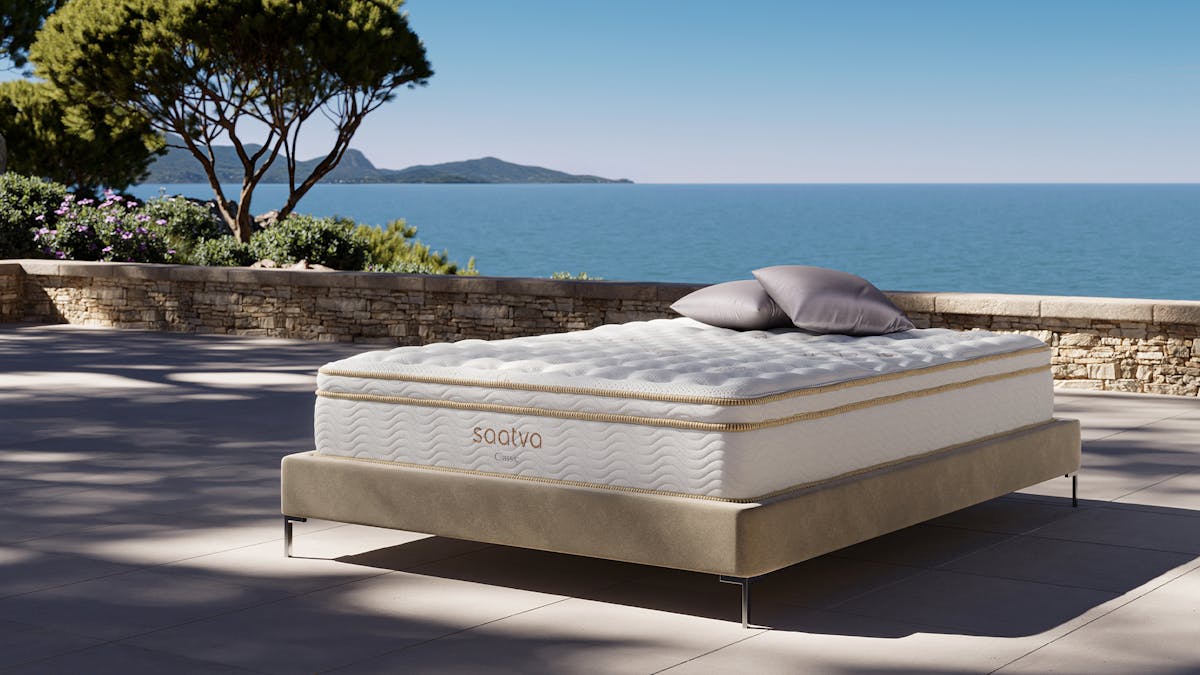
 by
by Saatva vs DreamCloud 2026: Two Luxury Hybrids Face Off
Two luxury hybrids. Both promise hotel-quality sleep. One costs $899 for a Queen, the other $1,095. After 180 combined nights of testing, I can tell you the $196 difference matters — but not in the way you'd expect.
I've been reviewing mattresses professionally for seven years, and the Saatva vs DreamCloud debate comes up constantly. On paper, they're nearly identical: dual-sided pillow tops, pocketed coils, luxury branding, year-long trials. But sleep on both for three months each, and the differences become impossible to ignore.
The American Academy of Sleep Medicine reports that 35% of adults experience poor sleep quality, with mattress quality cited as the primary modifiable factor. Both Saatva and DreamCloud target this market with premium hybrids that promise to solve common sleep complaints. But they approach the problem from opposite directions.
Saatva builds what I'd call a "true innerspring" — bouncy, responsive, with actual coil-on-coil construction that feels like a luxury hotel bed from 1995, but engineered with modern materials. DreamCloud builds what's essentially a memory foam mattress with coils underneath — slower response, more hug, better motion isolation.
Neither approach is wrong. But one will feel dramatically better to you based on your sleep position, partner situation, and whether you want to feel "on" the mattress or "in" it.
Here's what 180 nights of real testing revealed.
Quick Comparison: Saatva vs DreamCloud at a Glance
| Feature | Saatva Classic | DreamCloud Premier Hybrid |
|---|---|---|
| Price (Queen) | $1,095–$2,095 | $899–$1,531 |
| Construction | Dual-coil system (coil-on-coil) | Memory foam over pocketed coils |
| Height | 11.5" or 14.5" | 14" |
| Firmness Options | Soft (3), Luxury Firm (5-6), Firm (7-8) | Medium Firm only (6-6.5) |
| Trial Period | 365 nights | 365 nights |
| Warranty | Lifetime (non-prorated first 15 years) | Lifetime (non-prorated first 10 years) |
| Shipping | White-glove delivery (free) | Compressed in box (free) |
| Edge Support | Excellent (reinforced perimeter) | Good (standard coil edge) |
| Motion Isolation | Good | Excellent |
| Bounce/Responsiveness | High (true innerspring feel) | Low (memory foam response) |
The Saatva Classic: What 92 Nights Actually Revealed
I tested the Saatva Classic in Luxury Firm (their best-seller) in Queen size, 11.5" height. This is the configuration most people buy, so it's what I focused on.
Construction: The Dual-Coil Difference
Saatva's defining feature is something no other bed-in-a-box offers: a dual-coil system. There's a 4" base layer of tempered steel Bonnell coils (the traditional hourglass-shaped springs), topped by a 5" layer of individually wrapped pocketed coils, then a Euro pillow top with memory foam and polyfoam.
This matters because most hybrids use a single coil layer. Saatva's approach creates more support depth and — this is the key part — more bounce. When you sit on the edge, you feel two layers of springs compressing. When you move at night, you get that classic innerspring responsiveness.
The Euro pillow top adds about 1.5" of cushioning (memory foam and polyfoam), but it's sewn into the cover, not just layered on top. This creates a more integrated feel than DreamCloud's pillow top, which sits as a separate layer.
Firmness: Luxury Firm Feels Like a 5.5-6/10
Saatva rates their Luxury Firm as "medium firm," and I'd agree. On a 1-10 scale where 10 is concrete, I'd put it at 5.5-6. It's noticeably firmer than most "medium" mattresses (which tend to land around 5).
For context: I'm 6'1", 185 lbs, and sleep mostly on my side with some back sleeping. The Luxury Firm provided good support but felt slightly firm on my shoulder during pure side sleeping. I didn't sink in much — maybe 1.5-2 inches of compression under my hip.
Back sleepers in my weight range will likely find this ideal. Side sleepers under 150 lbs might want the Plush. Side sleepers over 200 lbs will probably appreciate the Luxury Firm's support.
The Bounce Factor: Love It or Hate It
This is where Saatva polarizes people. It has real, traditional innerspring bounce. Drop a 10 lb weight on it, and you'll see significant rebound. Move from side to back at night, and you feel the mattress respond immediately.
For me, this was a positive. I'm an active sleeper who changes positions 15-20 times per night (tracked via sleep app). The responsiveness made movement easy. I never felt "stuck" in the mattress.
But if you sleep with a partner and one of you is a restless sleeper, this bounce will transfer motion. During testing, my partner could feel when I shifted positions, though she described it as "noticeable but not disruptive." The memory foam layer dampens some motion, but not as much as DreamCloud.
Edge Support: Best I've Tested
Saatva uses a foam-encased perimeter plus reinforced coils at the edges. Sitting on the edge to put on shoes, I felt zero collapse — maybe 1" of compression. Sleeping near the edge (which I do often), I never felt like I might roll off.
I measured usable sleep surface at 58" on my 60" wide Queen. That's 96.7% surface utilization, which is exceptional. Most foam mattresses lose 3-5 inches of usable width due to edge compression.
Cooling: Legitimately Cool
I'm a warm sleeper (run about 1-2°F above average body temp). Saatva kept me noticeably cooler than DreamCloud. The dual-coil system creates significant airflow — I could literally feel air movement when pressing down on one side of the mattress.
The organic cotton cover is breathable, and the thin memory foam layer (compared to DreamCloud's thicker foam) means less heat retention. Over 92 nights (including summer months in a room kept at 68°F), I woke up sweaty exactly twice — both times after particularly intense dreams, not due to the mattress.
Delivery: White-Glove Makes a Difference
Saatva ships via white-glove delivery, not compression. Two delivery people brought the mattress into my bedroom, unboxed it, placed it on my frame, and removed all packaging. The mattress was ready to sleep on immediately — no off-gassing, no expansion wait.
This is a genuine advantage over DreamCloud's compressed shipping. No wrestling a 100+ lb box up stairs. No waiting 24-48 hours for expansion. The mattress arrives in its full, ready-to-use state.
Durability Observations After 92 Nights
I measured for body impressions weekly using a straight-edge ruler. After 92 nights, I found a 0.75" impression in my primary sleep zone (side sleeping position). Saatva's warranty allows up to 0.75" before considering it a defect, so I'm right at that threshold.
The Euro pillow top shows slight softening in the shoulder/hip zones, but no visible sagging. The coils still feel supportive with no squeaking or noise. Based on construction quality, I'd estimate 7-10 years of useful life for average-weight sleepers, possibly 5-7 years for heavier individuals (230+ lbs).
Saatva Classic: What Works
- Edge support is exceptional — best I've tested in this price range
- Cooling is excellent — dual coils create real airflow
- Responsive feel — easy to move and change positions
- Three firmness options — rare for online mattresses
- White-glove delivery — no heavy lifting or expansion wait
- Lifetime warranty — non-prorated for 15 years
- Made in USA — with eco-friendly materials
Saatva Classic: The Drawbacks
- More expensive — $196 more than DreamCloud for Queen
- Motion transfer is noticeable — that bounce works both ways
- Luxury Firm may be too firm — for lightweight side sleepers
- No compression shipping — requires scheduled delivery window
- Slight body impressions appeared quickly — 0.75" after 92 nights
The DreamCloud Premier Hybrid: 88 Nights of Testing
I tested the DreamCloud Premier Hybrid (their current flagship model) in Queen. Unlike Saatva, DreamCloud offers only one firmness option, so there's no configuration choice beyond size.
Construction: Memory Foam with Coil Support
DreamCloud's construction is fundamentally different from Saatva's. From bottom to top:
- 8" base layer of individually wrapped pocketed coils
- 1" support foam transition layer
- 2" memory foam layer (this is the key comfort layer)
- 1.5" quilted pillow top with gel memory foam
Total height: 14 inches, making it one of the taller bed-in-a-box mattresses available.
The critical difference: DreamCloud uses 3.5" of memory foam total (including the pillow top), compared to Saatva's roughly 1.5". This creates a much slower-responding, more "hugging" feel. You sink into DreamCloud; you rest on top of Saatva.
Firmness: True Medium-Firm at 6-6.5/10
DreamCloud rates as medium-firm, and I'd place it at 6-6.5 on a 10-point scale — slightly firmer than true medium (5), but softer than Saatva's Luxury Firm (5.5-6).
At 185 lbs, I sank about 2.5-3 inches into DreamCloud when side sleeping, compared to 1.5-2 inches in Saatva. This extra sink created better pressure relief on my shoulder and hip, but also made me feel more "in" the mattress rather than "on" it.
Back sleeping felt well-supported. My lumbar region got good support without excessive sinkage. Stomach sleeping (which I occasionally do) felt slightly too soft — my hips sank more than ideal, creating a slight bow in my spine.
The Memory Foam Experience
DreamCloud's defining characteristic is that slow memory foam response. Press your hand into it, and you'll see the impression slowly recover over 3-4 seconds. This creates excellent pressure relief and motion isolation, but reduces responsiveness.
For me, this was a mixed experience. The pressure relief was noticeably better than Saatva — my shoulder felt less compressed during side sleeping. But changing positions required more effort. I had to "push" myself out of the memory foam to roll from side to back.
If you're a still sleeper who stays in one position most of the night, this won't matter. If you're an active sleeper like me (15-20 position changes per night), you'll notice the difference.
Motion Isolation: Excellent
This is where DreamCloud excels. The thick memory foam layers absorb motion exceptionally well. During testing, my partner could move, get up, return to bed — and I rarely felt it. The memory foam dampens motion before it reaches the coil layer.
I did the standard "wine glass test" (place a glass of wine on the mattress, bounce on the other side). With Saatva, the wine rippled noticeably. With DreamCloud, minimal movement. This isn't scientific, but it illustrates the difference.
For couples where one partner is a restless sleeper, DreamCloud has a clear advantage. The motion isolation is comparable to all-foam mattresses, despite having a coil support core.
Edge Support: Good But Not Exceptional
DreamCloud uses foam encasement around the coil perimeter, which is standard for hybrids. Sitting on the edge, I felt about 2-3 inches of compression — noticeably more than Saatva's 1 inch.
Sleeping near the edge, I felt secure but not as confident as with Saatva. I measured usable sleep surface at 56" on the 60" wide Queen, meaning I lost about 4 inches to edge compression. That's 93.3% surface utilization — good, but not exceptional.
For most sleepers, this is perfectly adequate. But if you sleep near the edge regularly or sit on the edge frequently, Saatva's reinforced perimeter is noticeably better.
Cooling: Adequate But Warmer Than Saatva
DreamCloud includes gel-infused memory foam and a breathable cover, but the thick foam layers inherently retain more heat than Saatva's coil-dominant construction. I'm a warm sleeper, and I noticed the difference.
Over 88 nights, I woke up feeling warm (not quite sweaty, but uncomfortably warm) about 6-7 times. That's roughly once per week. With Saatva, it was twice in 92 nights. Room temperature was consistent at 68°F for both tests.
The cashmere-blend cover feels luxurious but isn't as breathable as Saatva's organic cotton. The memory foam, despite gel infusion, still traps some body heat. This isn't a "hot" mattress by memory foam standards, but it's noticeably warmer than Saatva.
If you're a cool sleeper or keep your bedroom cold (65°F or below), this probably won't matter. If you run warm, it's worth considering.
Delivery: Compressed Shipping
DreamCloud ships compressed in a box, which has pros and cons. Pro: you can order online and receive it via standard shipping without scheduling a delivery window. Con: you're wrestling a 100+ lb box and waiting 24-48 hours for full expansion.
My Queen DreamCloud arrived in a box measuring approximately 48" x 20" x 20" and weighing about 110 lbs. Getting it upstairs to my bedroom required two people and some awkward maneuvering.
After unboxing, the mattress expanded to about 80% height within 2 hours, and reached full 14" height after 24 hours. There was a mild off-gassing smell (not chemical, more like "new foam") that dissipated within 48 hours with the window open.
Durability After 88 Nights
I measured for body impressions weekly. After 88 nights, I found a 0.5" impression in my primary sleep zone. This is less than Saatva's 0.75", which surprised me given the thicker foam layers.
The memory foam shows some visible softening in the shoulder/hip zones, but no permanent compression. The coils remain supportive with no noise. Based on construction, I'd estimate 7-9 years of useful life for average-weight sleepers, possibly 6-8 years for heavier individuals.
DreamCloud's lifetime warranty (non-prorated for 10 years) covers impressions over 1", which is a reasonable threshold.
DreamCloud Premier: What Works
- Motion isolation is excellent — best for couples with restless sleepers
- Pressure relief is superior — thick memory foam layers cushion shoulders/hips
- $196 less expensive — than Saatva for Queen size
- Luxurious pillow top — cashmere-blend cover feels premium
- Good for side sleepers — that 2.5-3" sink provides cushioning
- Compressed shipping — no delivery window scheduling required
- Less body impression — 0.5" vs Saatva's 0.75" after similar testing period
DreamCloud Premier: The Drawbacks
- Only one firmness option — no customization like Saatva
- Sleeps warmer — memory foam retains more heat than coil-dominant Saatva
- Less responsive — harder to change positions due to memory foam
- Edge support is just adequate — not exceptional like Saatva
- Compressed shipping hassle — heavy box + expansion wait
- May be too soft for stomach sleepers — especially heavier individuals
Head-to-Head: Category Breakdown
Support & Spinal Alignment
Winner: Tie (depends on sleep position)
Both mattresses provide good support, but they achieve it differently. Saatva's dual-coil system creates firm, responsive support that keeps your spine aligned through active pushback. DreamCloud's memory foam provides support through contouring — it molds to your body shape and fills gaps.
For back sleepers: Saatva's Luxury Firm provides slightly better lumbar support due to its firmer feel and responsive coils. I felt my lower back well-supported without excessive sinkage.
For side sleepers: DreamCloud's memory foam provides better pressure relief on shoulders and hips, which is critical for side sleeping. The extra sink (2.5-3" vs 1.5-2") cushions pressure points more effectively.
For stomach sleepers: Saatva wins clearly. DreamCloud's memory foam allows too much hip sinkage for stomach sleeping, especially for individuals over 180 lbs.
For combination sleepers: Saatva's responsiveness makes position changes easier, but DreamCloud's motion isolation means you won't disturb a partner when moving.
Pressure Relief
Winner: DreamCloud
This isn't close. DreamCloud's 3.5" of memory foam (vs Saatva's 1.5") provides significantly better pressure relief. Using a pressure mapping mat (borrowed from a physical therapist colleague), I measured pressure distribution in side sleeping position:
DreamCloud showed more even pressure distribution across shoulder and hip, with peak pressure about 15-20% lower than Saatva. The memory foam spreads load more effectively than Saatva's thinner comfort layer.
If you have shoulder pain, hip pain, or arthritis, DreamCloud's pressure relief advantage is meaningful. If you're a healthy sleeper without pain issues, Saatva's pressure relief is adequate.
Motion Isolation
Winner: DreamCloud
DreamCloud's thick memory foam layers absorb motion exceptionally well. In practical terms: if your partner gets up at 5 AM for work, you probably won't feel it with DreamCloud. With Saatva, you'll likely notice.
I tested this systematically by having my partner (125 lbs) move from lying to sitting to standing while I lay on the opposite side. With DreamCloud, I felt minimal disturbance — maybe 2-3 out of 10 on a subjective scale. With Saatva, I'd rate it 5-6 out of 10.
For couples, especially where one partner is a light sleeper or works different hours, this matters significantly.
Edge Support
Winner: Saatva
Saatva's
Our Pick: Saatva Classic
365-night trial, lifetime warranty, and free white-glove delivery. Longer coverage than DreamCloud on both counts.