
 by
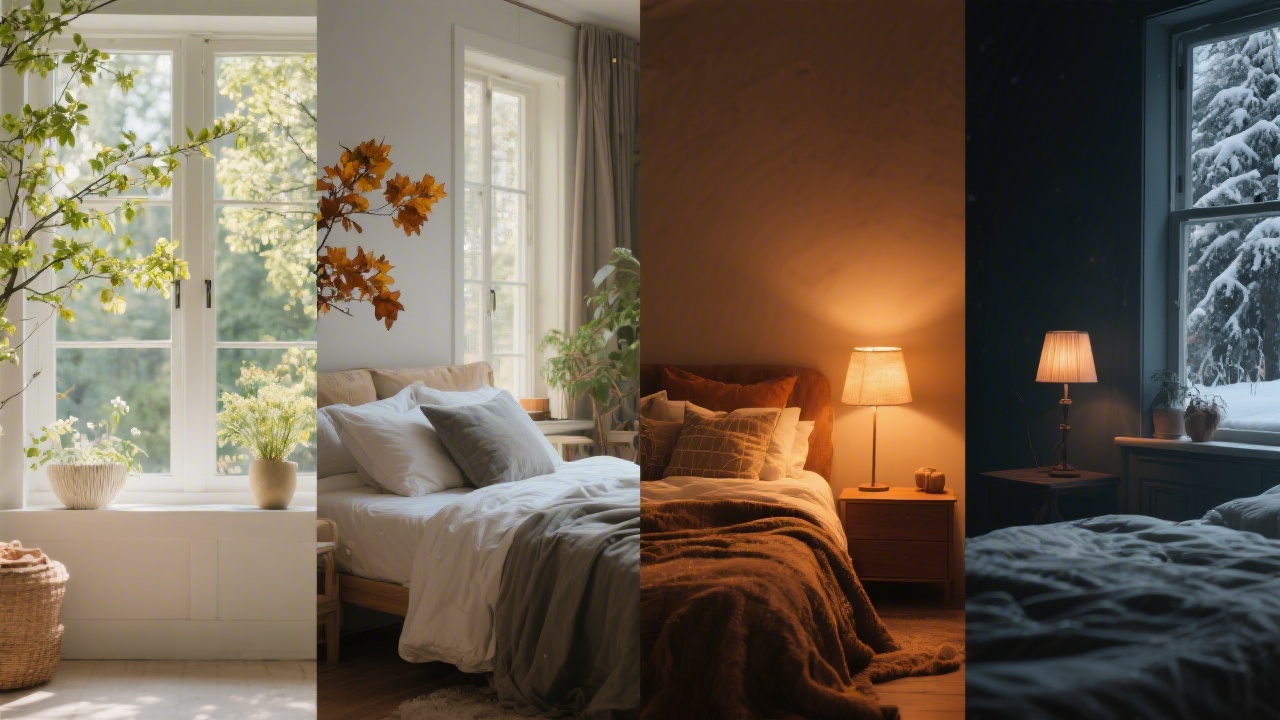
by Seasonal changes in sleep are not imaginary or simply a matter of holiday schedules. They're driven by real changes in the primary zeitgeber your circadian clock relies on: light. As day length shortens in winter and extends in summer, your brain's sleep-wake regulation shifts in predictable, measurable ways.
Our Recommended Mattress for Healthy Sleep
The Saatva Classic offers zoned lumbar support and premium coil-on-coil construction that promotes proper spinal alignment — key for restorative sleep that keeps your circadian rhythm on track.
The Biological Mechanism: Why Seasons Affect Your Clock
Your circadian clock is synchronized primarily by the photoperiod — the duration and timing of light exposure each day. At equatorial latitudes, this is relatively stable year-round. At higher latitudes (above 35°N or 35°S), seasonal changes in day length are dramatic: 9 hours of daylight in December vs. 15 hours in June in northern Europe or North America.
The SCN (suprachiasmatic nucleus) detects changes in photoperiod through the ipRGC retinal pathway and modulates melatonin duration accordingly. In winter, the longer night extends melatonin secretion; in summer, the shorter night compresses it. This isn't dysfunction — it's a functional adaptation to seasonal variation that mammals evolved over millions of years.
Winter Sleep Changes
Population studies consistently show that people sleep longer in winter — an average of 25-30 minutes more per night in some studies, though individual variation is high. The mechanisms include:
- Extended melatonin window: Longer nights extend the melatonin secretion period, shifting both the onset of sleepiness and the natural wake time later.
- Reduced morning light intensity: Weaker, later sunrise means the circadian-advancing morning light signal is weaker, allowing the clock to drift slightly later.
- Temperature and hibernation drive: Cold temperatures and reduced light trigger conservationist behavioral tendencies — a vestigial hibernation impulse that manifests as increased sleep drive and carbohydrate craving in many people.
Winter sleepiness exists on a spectrum. At one end is normal seasonal variation — feeling slightly sleepier and more sluggish in December than July. At the other end is seasonal affective disorder (SAD).
Seasonal Affective Disorder (SAD)
SAD affects approximately 5% of adults in the United States, with another 10-20% experiencing a milder subsyndromal version ("winter blues"). It's more prevalent at higher latitudes — affecting perhaps 1% in Florida but 9% in Alaska. Women are affected roughly 4x more often than men.
Diagnostic criteria mirror major depressive disorder with a seasonal pattern: depressed mood, hypersomnia (not insomnia — this distinguishes SAD from other depression), hyperphagia (especially carbohydrate craving), fatigue, social withdrawal, and concentration difficulties. By definition, these symptoms must emerge in fall/winter and remit in spring/summer for 2+ consecutive years.
First-line treatment is morning light therapy — typically 10,000 lux for 30 minutes immediately upon waking. Studies show response rates of 50-80% and speed of response (days to weeks) comparable to antidepressants without systemic side effects. Light therapy should begin before symptom onset (early fall for susceptible individuals) for best prevention.
Summer Sleep Disruption
Summer brings the opposite problem: too much light, particularly in northern latitudes where summer twilight persists until 10-11pm. This late-daylight suppresses melatonin, delays sleep onset, and can cause:
- Phase delay: Naturally staying up later as the evening light delays melatonin release. Many people note they naturally shift 1-2 hours later in June-July.
- Early wake disruption: Sunrise before 5am in northern summers disrupts sleep in the final hours of the night, reducing total sleep duration.
- Temperature-driven insomnia: High summer temperatures impair the core body temperature drop needed for sleep initiation. The bedroom cooling strategies that help in summer are the same as those for general sleep quality.
Management: blackout curtains are arguably more important in summer than winter at northern latitudes. Combined with the bedroom cooling strategies covered in our bedroom cooling guide, summer sleep can be protected effectively.
The Equinox Transitions
Many people notice that the most disruptive sleep periods aren't the depth of winter or height of summer, but the transitions — September-October and March-April. These are periods of rapid photoperiod change when the circadian clock is actively re-adapting. Similar to jet lag, the clock takes time to recalibrate. Light therapy through these transition periods can smooth the adaptation.
Latitude-Specific Considerations
The more extreme the latitude, the more dramatic the seasonal sleep effect. Near the Arctic Circle, continuous summer daylight (midnight sun) and continuous winter darkness (polar night) create extreme chronobiological challenges. These populations show some of the highest rates of SAD globally and have the most to gain from artificial light management strategies.
Understanding seasonal shifts in context of your overall circadian rhythm helps explain why sleep changes with the seasons rather than framing it as something to fix. Sometimes the appropriate response is seasonal adjustment rather than year-round uniformity.
Our Recommended Mattress for Healthy Sleep
The Saatva Classic offers zoned lumbar support and premium coil-on-coil construction that promotes proper spinal alignment — key for restorative sleep that keeps your circadian rhythm on track.
Frequently Asked Questions
Is it normal to feel like sleeping more in winter?
Yes — it's a normal biological response to reduced light exposure. Population-level studies show people average 25-30 more minutes of sleep per night in winter. This becomes a concern when it's accompanied by significant mood disruption, social withdrawal, or functional impairment (which would suggest SAD rather than normal seasonal variation).
Why do I wake up earlier in summer?
Earlier sunrise exposes you to morning light that advances your circadian clock and suppresses melatonin prematurely. Blackout curtains are the most effective intervention — they eliminate the early-morning light signal that triggers waking. They're particularly important in northern latitudes where sunrise may occur before 5am in June.
Does SAD always cause depression, or can it just affect sleep?
SAD's diagnostic criteria include depressed mood as a core feature, so by definition it involves mood disruption. However, the hypersomnia and fatigue can precede mood changes and dominate the presentation in some people. The milder "winter blues" (subsyndromal SAD) may primarily manifest as sleep and energy changes without meeting criteria for depression.
Can changing sleep timing season by season damage your health?
Minor seasonal adjustment (30-60 minutes) is normal and poses no documented health risk. Extreme seasonal variation (2+ hours) combined with rigid social schedules creates the same misalignment dynamics as chronic social jet lag. The key is managing the transition and minimizing the discrepancy between biological and social timing.
Does melatonin help with seasonal sleep changes?
Low-dose melatonin (0.5mg) can help stabilize sleep onset during seasonal transitions — taken 1-2 hours before desired bedtime. It's more useful for the transition periods (September, March) than for stable winter or summer patterns. For SAD specifically, morning light therapy has stronger evidence than melatonin.