
 by
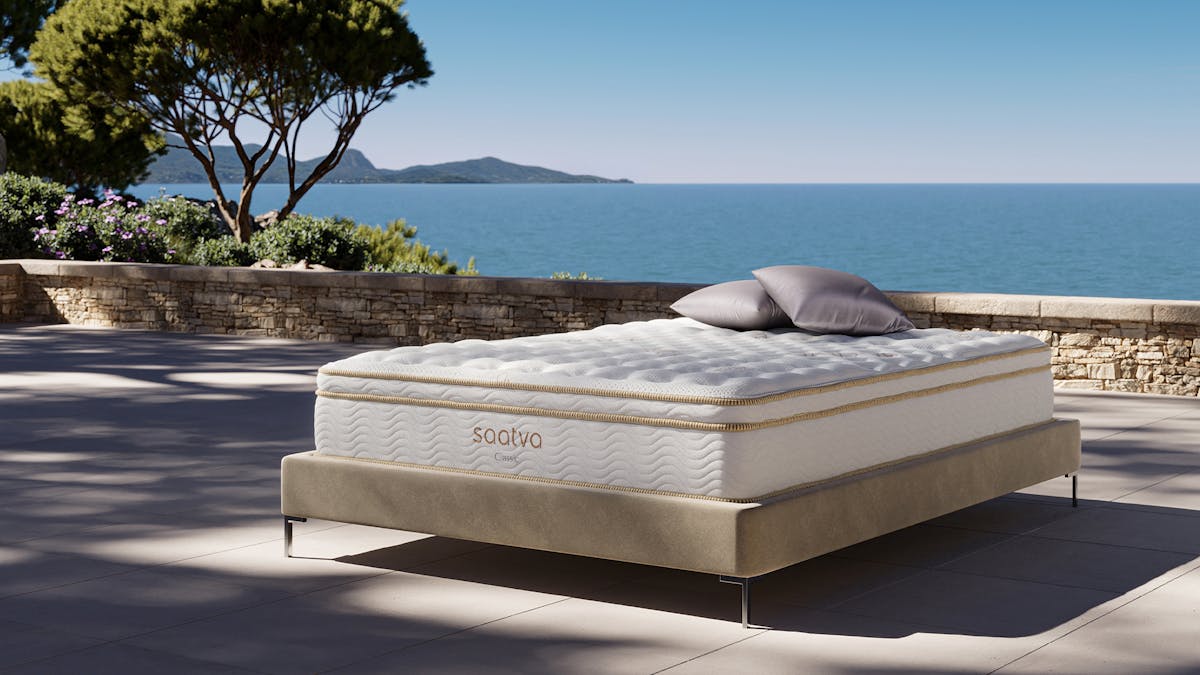
by Signature Sleep makes ultra-budget mattresses sold through Walmart and Amazon, priced between $100 and $420 for a queen. They work for guest rooms and kids' beds, but fall short as a primary adult mattress: thin foam layers, Bonnell coils in most models, and a 10-year warranty that trails every major online brand. If you are shopping in this price range as a stopgap, Signature Sleep delivers. If you need a mattress that holds up for 8 to 10 years, our top pick is the Saatva Classic, which ships on a 365-night trial with lifetime warranty and free white-glove delivery.
Saatva Classic
9.2/10
- Dual-coil innerspring with reinforced lumbar zone pad, 14.5 inches tall
- Organic cotton Euro pillow top, GREENGUARD Gold certified
- Free white-glove delivery, in-room setup, and old-mattress removal
- 365-night home trial and lifetime warranty, among the best in the industry
- Delivered flat, not compressed in a box
- $99 return fee applies if you use the trial
For anyone who discovered Signature Sleep on Amazon or Walmart and wants to understand what mid-luxury looks like by comparison, the Saatva Classic is the reference point: three firmness levels, a zoned lumbar coil system, and a build quality that lasts a decade or more.
What is Signature Sleep?
Signature Sleep is a budget mattress brand distributed primarily through Amazon and Walmart. Founded in 2003 in the United States, the company manufactures its mattresses in China and ships them to retail fulfillment centers. Prices range from roughly $100 to $420 for a queen, making Signature Sleep one of the most affordable mattress options available in the country.
The lineup covers three main categories: all-foam memory foam models (Memoir series), innerspring models using Bonnell coils (Gold series), and pocket coil hybrids (Contour series). The Vitality model, a charcoal-infused memory foam hybrid with encased coils, sits at the upper end of the range and is the most frequently reviewed option by primary sleepers.
Signature Sleep Vitality: construction and materials
The Vitality is built with three layers:
- Cover: breathable knit fabric with basic moisture management.
- Comfort layer: charcoal-infused memory foam, which is designed to reduce off-gassing and wick moisture. The charcoal infusion also contributes modestly to temperature regulation.
- Support core: individually encased pocketed coils that respond to weight independently. This limits motion transfer compared to Bonnell coil models and provides stable edge support for a mattress at this price.
The mattress is CertiPUR-US certified, which confirms the foam does not contain ozone depleters, heavy metals, formaldehyde, or phthalates, and meets low-VOC emission standards. The Vitality does not use a fiberglass fire barrier, though several entry-level Signature Sleep foam models do. Check the specific model label before purchase if this is a concern.
Comfort and firmness
The Vitality ships in a medium configuration, measuring roughly 13 inches tall. That places it around a 5 to 6 out of 10 on a standard firmness scale, making it workable for combination sleepers in the 130 to 230 lb range.
Back sleepers will find the coil support adequate for maintaining spinal alignment. Side sleepers get reasonable shoulder and hip relief from the memory foam layer, though the comfort layer is thinner than what you find on dedicated side-sleeper builds. Stomach sleepers over 160 lbs may sink slightly at the hips.
Motion isolation is decent for a hybrid at this price, thanks to the pocketed coils. Edge support is functional for getting in and out of bed but compresses noticeably under sitting weight.
Performance breakdown
Cooling
The charcoal-infused foam manages heat better than standard memory foam, and the coil layer promotes airflow through the core. For a budget hybrid, the Vitality sleeps reasonably temperature-neutral. Hot sleepers who need active cooling technology should look at a mattress with copper or gel infusion in the comfort layer.
Motion isolation
Pocketed coils absorb motion better than Bonnell coils. Couples with a restless sleeper will notice some cross-transfer but it is manageable, more so than on the Signature Sleep Gold or innerspring-only models.
Edge support
The perimeter holds reasonably well for sitting and rolling to the edge during sleep. Compression under heavy sustained pressure at the edge is noticeable after 12 to 18 months of use.
Durability
This is where Signature Sleep has the most significant limitation. Mattresses in the $250 to $400 range, regardless of brand, use lower-density foams that begin to show body impressions within two to three years of nightly use. Signature Sleep covers this with a 10-year warranty, but the warranty covers manufacturing defects rather than normal wear-related softening. Most adults using a Signature Sleep mattress as a primary bed should expect to replace it within four to six years.
Who Signature Sleep works for
- Guest rooms: low nightly usage means the mattress holds up far longer. The low price-to-quality ratio makes sense for occasional use.
- Children's beds: kids under 100 lbs produce less compression over time, and the Vitality's medium feel suits most children's sleep positions.
- Temporary housing or first apartment: an affordable functional mattress for a short-term stay, with the plan to upgrade within a year or two.
- Budget-constrained shoppers with no other option: if $300 is the ceiling, the Vitality is one of the better built options in that range.
Who should avoid Signature Sleep
- Primary sleepers over 230 lbs: the foam density is insufficient for sustained heavier-body use. The coils will hold shape longer than the foam layers, but the comfort system will degrade noticeably within one to two years.
- Chronic pain sufferers: active lumbar zoning, targeted pressure relief at the shoulder, and memory foam with high resilience are not features of the Vitality. A purpose-built sleep surface is worth the price difference for anyone managing back, hip, or shoulder pain.
- Couples wanting strong motion isolation: the pocketed coils help, but the thin comfort layer limits how much motion dampening is possible at this build quality.
Price and sizing
| Size | Dimensions | Approximate Price |
|---|---|---|
| Twin | 38 x 75 in | ~$140 |
| Twin XL | 38 x 80 in | ~$170 |
| Full | 54 x 74 in | ~$230 |
| Queen | 60 x 80 in | ~$355 |
| King | 76 x 80 in | ~$420 |
Prices vary by retailer and fluctuate frequently. Amazon and Walmart both run promotional pricing. The mattress does not come with a sleep trial in the traditional sense; returns are governed by the retailer's return policy, which differs by platform.
Trial, shipping, and warranty
Sleep trial
No direct brand trial. Return windows are set by Amazon (typically 30 days) or Walmart (typically 90 days for mattresses purchased online). After the return window closes, you own the mattress.
Shipping
Delivered compressed in a box via standard carrier, with no white-glove setup option. Delivery timelines depend on Amazon or Walmart logistics.
Warranty
10-year limited manufacturer warranty. Coverage applies to manufacturing defects. Body impressions deeper than 1.5 inches are typically required to file a claim, which in practice excludes most normal-wear softening.
Signature Sleep vs. mid-range alternatives
| Mattress | Price (Queen) | Type | Trial | Warranty |
|---|---|---|---|---|
| Signature Sleep Vitality | ~$355 | Foam hybrid | Retailer only | 10 years |
| Saatva Classic | From $1,095 | Innerspring hybrid | 365 nights | Lifetime |
| Sweetnight Twilight | ~$200 | Memory foam | 100 nights | 10 years |
| Amerisleep AS3 | From $1,049 | All-foam (Bio-Pur) | 100 nights | 20 years |
Frequently asked questions
Is Signature Sleep a good mattress?
For the price, yes, with qualifications. The Vitality model is a functional hybrid for guest use and lighter sleepers. As a primary mattress for adults who sleep on it every night, the foam density and build quality place a ceiling on how long it holds up, typically three to five years before noticeable softening.
Where is Signature Sleep made?
Signature Sleep mattresses are manufactured in China and distributed in the United States through Amazon, Walmart, and select furniture retailers.
Does Signature Sleep use fiberglass?
Some models in the entry-level foam range do use a fiberglass fire barrier under the cover. The Vitality hybrid uses a different fire barrier construction. Check the specific model's product listing or label. If fiberglass is a concern, look for CertiPUR-US certification plus an explicit "no fiberglass" callout on the product page.
Is the Signature Sleep Vitality flippable?
No. The Vitality has a single-sided construction with the comfort layer on top. Flipping it would mean sleeping on the coil support base, which is not usable as a sleep surface.
Can I use Signature Sleep with an adjustable base?
The Vitality's coil construction is compatible with most flat and slightly adjustable base positions. For full articulating adjustable bases with significant head and foot elevation, verify with the retailer, as the coil gauge affects flex tolerance.
How long does Signature Sleep last?
Expect three to five years of comfortable nightly use for primary adult sleepers. With lighter use in a guest room, the same mattress can remain serviceable for eight or more years. The 10-year warranty covers manufacturing defects, not wear-related softening.
Saatva Classic
9.2/10
If your budget extends to a mattress that will last a decade, the Saatva Classic is the strongest option in mid-luxury: 365-night trial, lifetime warranty, free white-glove setup, and a dual-coil innerspring system built with an organic Euro pillow top. Three firmness levels mean it works for most sleep positions and body weights.