
 by
by Struggling with sleep? Your mattress matters too.
A supportive, pressure-relieving mattress reduces the time it takes to fall — and stay — asleep. The Saatva Classic is our top-rated pick for deep, restorative sleep.
Technology and Sleep: The Full Picture
Most sleep advice about technology focuses on phones and implies a simple answer: use less, sleep better. Reality is more complex. Technology is woven into every part of modern life, including life that supports sleep. Smart speakers play sleep sounds. Apps track sleep quality. E-readers are better for sleep than physical books in dim lighting. Wearables inform sleep behavior.
A useful framework doesn't ask you to eliminate technology — it asks you to distinguish between technology that serves sleep and technology that disrupts it. This guide covers every major technology category and where it falls on that spectrum.
The Tiered Framework
Rather than one-size-fits-all advice, this framework offers three tiers based on how strictly you need to manage your sleep:
Tier 1: Strict (for people with significant sleep problems)
If you have chronic sleep onset problems (regularly taking 30+ minutes to fall asleep) or wake frequently and can't return to sleep, apply these rules:
- No screens in the bedroom except an alarm clock
- No social media after 8 PM, or after dinner if your schedule is earlier
- No work email after 8 PM
- No news consumption after 8 PM
- TV/streaming permitted in the living room only, ending 60 minutes before sleep
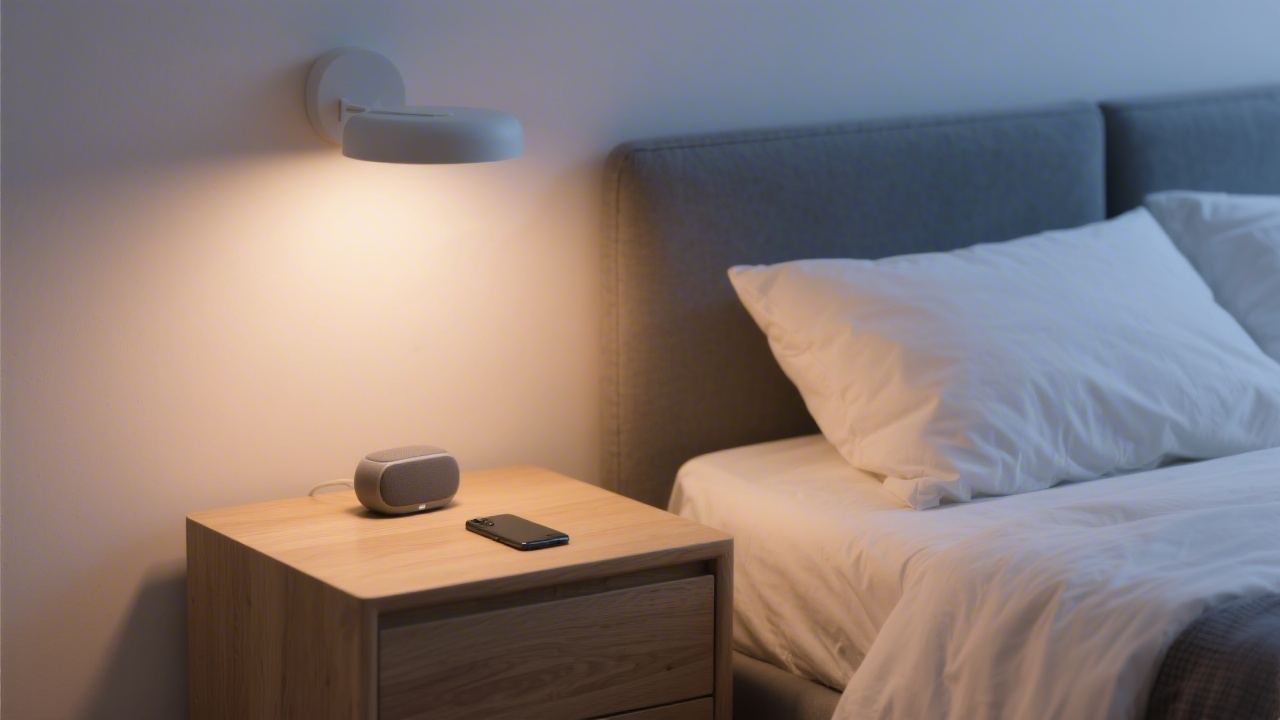
- Smart speaker allowed (voice-only interaction, no screen)
- Sleep tracker permitted (passive, no active engagement before bed)
Tier 2: Moderate (for people with occasional sleep difficulties)
- Phone charged outside the bedroom, or at minimum across the room from the bed
- No social media or news within 60 minutes of bed
- Work email: scheduled final check by 9 PM
- TV streaming: low-arousal content (documentaries, slow-paced shows) permitted up to 30 minutes before bed; no action, competition, or news
- E-reader: permitted in bed (lower blue light, no social engagement)
- Podcasts: permitted (audio-only, no screen required)
Tier 3: Light (for people who sleep reasonably well and want to optimize)
- Phone on nightstand but face-down and on Do Not Disturb
- Reduce highest-arousal content (competitive social media, live news) to 30 minutes before bed
- Dim all screens to 30-50% brightness after sunset
- Night mode on all screens
By Technology Category
Smartphones
The highest-risk device for sleep disruption — maximum portability, highest variable reward density, present in the bedroom for most adults. The phone's sleep risk comes from social media, email, and short-form video primarily. Voice calls, podcasts, and music apps are low-risk. See our detailed guide on screen time before bed and sleep for the complete mechanism overview.
Laptops and Computers
Moderate risk. The posture required to use a laptop (upright at a desk) is different from the reclined, in-bed scrolling that causes the most sleep disruption. The work-email problem is the primary laptop sleep risk. Using a laptop for entertainment (streaming, non-competitive games) in the hour before bed is lower risk than social media but higher risk than TV at distance. Blue light emission is significant — Night Shift/Night Mode and reduced brightness help.
Television
Lower risk than phones. The larger screen at greater distance means lower retinal blue light dose. Passive consumption doesn't trigger variable reward loops. Content matters: action movies, live sports, and news are high-arousal; nature documentaries, gentle comedy, and slow-paced drama are low-arousal. Falling asleep to TV disrupts sleep architecture — if you drift off to TV, use a sleep timer.
Smart Speakers (Alexa, Google Home)
Low risk, potentially sleep-positive. Voice interaction eliminates screen exposure. Sleep sounds, white noise, guided meditation, and audiobooks play through speakers without requiring any visual engagement. The "Brief Mode" setting (shorter responses) reduces stimulating content. Sleep timer for music and audio content is a valuable use case.
Sleep Trackers and Wearables
Sleep trackers (Oura, Whoop, Fitbit) are passive during sleep and sleep-positive when used to inform behavior. The risk is orthosomnia — becoming so focused on tracking data that anxiety about sleep quality itself disrupts sleep. Check tracker data in the morning, not before bed. Weekly trends are more meaningful than nightly scores.
E-Readers
Lower risk than tablets. Purpose-built e-readers (Kindle Paperwhite, Kobo) use e-ink displays that emit substantially less blue light than LCD/OLED screens. Reading fiction on an e-reader in warm mode, at low brightness, for 20–40 minutes before bed is one of the most effective evidence-based wind-down activities. Actively preferable to either social media or nothing (some people find the absence of the phone causes anxiety that also delays sleep).
Building Your System
The most durable sleep-technology balance uses structural design rather than willpower. Start with sleep hygiene tips foundations — mattress, pillow, room temperature, darkness. Then layer in the technology rules that fit your tier. Apply one change per week rather than all at once; this produces better long-term adherence. For the science behind how to fall asleep faster, our complete guide covers implementation specifics.
Frequently Asked Questions
Is any technology good for sleep?
Yes: sleep trackers (used correctly), smart speakers for audio sleep content, e-readers on low brightness in night mode, white noise machines, smart bulbs set to dim warm color in the evening, and sleep meditation apps (audio-only) all support rather than disrupt sleep.
Should everyone follow the strict tier?
Only people with significant sleep difficulties need strict rules. Most adults can achieve good sleep quality with the moderate tier. The strict tier is a therapeutic level appropriate for insomnia or major sleep disruption, not a universal recommendation.
How long until technology changes improve sleep?
Environmental changes (phone out of bedroom) show effects within 3–7 days. Behavioral changes (social media cutoff) show consistent effects by 2 weeks. Full sleep architecture improvements (better REM, more slow-wave sleep) typically consolidate at 3–4 weeks of consistent behavior change.
Can sleep technology replace good sleep habits?
No. Sleep trackers, smart mattresses, and apps are information tools and minor optimizers. The foundation is consistent sleep timing, a dark cool environment, and pre-sleep deactivation. Technology supports these but doesn't substitute for them.
What's the single most impactful technology change for sleep?
Charging your phone outside the bedroom. Research consistently shows this produces the largest sleep improvement per unit of effort — it eliminates nocturnal checking, removes blue light from the sleep environment, and ends the in-bed scrolling habit in a single structural change.
Struggling with sleep? Your mattress matters too.
A supportive, pressure-relieving mattress reduces the time it takes to fall — and stay — asleep. The Saatva Classic is our top-rated pick for deep, restorative sleep.
Our Top Mattress Pick
The Saatva Classic consistently ranks #1 for comfort, support, and long-term durability.