
 by
by Voted best luxury innerspring mattress with exceptional lumbar support and white-glove delivery.
Check Price & Availability FAQPage", "mainEntity": [{"@type": "Question", "name": "How is sleep apnea diagnosed?", "acceptedAnswer": {"@type": "Answer", "text": "Sleep apnea is diagnosed with a sleep study — either a home sleep apnea test (HSAT) or an in-laboratory polysomnography (PSG). Both measure apneas and hypopneas per hour (AHI). A physician evaluates results and confirms diagnosis. An AHI of 5 or above in adults with symptoms meets criteria for OSA diagnosis."}}, {"@type": "Question", "name": "What is a home sleep apnea test?", "acceptedAnswer": {"@type": "Answer", "text": "A home sleep apnea test is a portable device worn at home overnight that measures airflow, respiratory effort, and blood oxygen saturation. It is appropriate for uncomplicated, high-probability OSA and produces a Respiratory Event Index (REI) or AHI score. It costs significantly less than in-lab testing and requires no overnight stay."}}, {"@type": "Question", "name": "What is polysomnography?", "acceptedAnswer": {"@type": "Answer", "text": "Polysomnography is the gold-standard in-laboratory sleep study that simultaneously records brain waves (EEG), eye movements (EOG), muscle activity (EMG), heart rhythm (ECG), airflow, respiratory effort, oxygen saturation, and limb movements. It provides the most comprehensive sleep assessment and is required when home testing is contraindicated or inconclusive."}}, {"@type": "Question", "name": "What AHI score indicates sleep apnea?", "acceptedAnswer": {"@type": "Answer", "text": "In adults, AHI below 5 is normal. AHI 5–14 indicates mild OSA. AHI 15–29 indicates moderate OSA. AHI 30 or above indicates severe OSA. However, diagnosis also requires the presence of symptoms or cardiovascular comorbidities — an AHI of 5–14 without symptoms is not always treated."}}, {"@type": "Question", "name": "Can I get a sleep apnea diagnosis without a sleep study?", "acceptedAnswer": {"@type": "Answer", "text": "No. Clinical suspicion based on symptoms is not sufficient for diagnosis. A formal sleep study is required to measure AHI and exclude other sleep disorders. Some physicians use pre-test probability tools (STOP-BANG, Epworth) to determine urgency, but these do not replace diagnostic testing."}}]}If you or a bed partner suspects sleep apnea based on snoring, witnessed breathing pauses, or excessive daytime sleepiness, the path from suspicion to diagnosis is well-defined — but knowing which type of sleep study is appropriate and how to interpret the results is not always straightforward. This guide walks through the full diagnostic process.
Editor’s Pick: Saatva Adjustable Base Plus
Head elevation (7–45°) reduces soft-tissue collapse in the airway — shown to lower AHI scores in positional and mild OSA. The Saatva Adjustable Base Plus adds lumbar support and zero-gravity preset for full-night positioning.
Step 1: Pre-Test Assessment
Before ordering a sleep study, clinicians use validated screening tools to estimate pre-test probability of OSA:
STOP-BANG questionnaire: 8 yes/no questions covering Snoring, Tiredness, Observed apneas, blood Pressure, BMI >35, Age >50, Neck circumference >40cm, and Gender (male). Score ≥3 = intermediate risk; ≥5 = high risk. Sensitivity exceeds 90% for moderate-to-severe OSA at a cutoff of 3.
Epworth Sleepiness Scale: 8-item questionnaire measuring likelihood of dozing in passive situations. Score >10 indicates excessive daytime sleepiness warranting evaluation. Score >16 indicates severe sleepiness often associated with significant OSA.
These tools guide clinical decision-making but do not replace objective testing. If you have classic symptoms — snoring with witnessed apneas and daytime sleepiness — pursue diagnosis regardless of screening score.
Step 2: Choosing the Right Sleep Study
Home Sleep Apnea Test (HSAT)
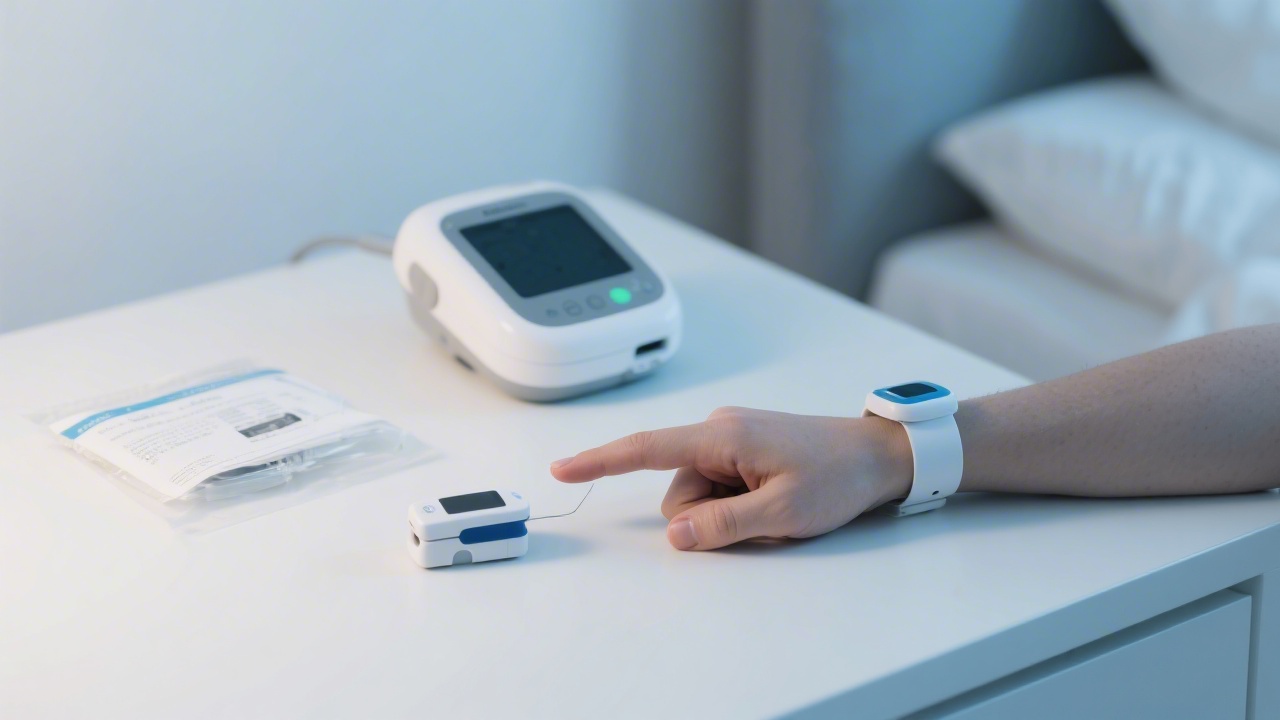
The HSAT has become the standard first-line diagnostic for straightforward OSA cases. Key characteristics:
- What it measures: Airflow (nasal pressure transducer), respiratory effort (effort belts), and blood oxygen saturation (pulse oximetry). Some devices add heart rate and snoring microphones.
- What it produces: Respiratory Event Index (REI) or AHI — number of apneas and hypopneas per hour of recording time (not sleep time, which slightly underestimates true AHI).
- Appropriate for: Adults with high pre-test probability of moderate-to-severe OSA, no significant cardiopulmonary comorbidities, no suspected central sleep apnea or parasomnias, no severe insomnia.
- Cost: $150–$300 out of pocket; often covered by insurance when criteria are met.
- Limitations: Cannot diagnose central apnea, measure sleep stages, detect parasomnias, or identify limb movement disorders. Fails or is non-diagnostic in approximately 15–20% of patients.
In-Laboratory Polysomnography (PSG)
PSG remains the gold standard and is required in specific clinical situations:
- Inconclusive or failed HSAT
- Suspected central sleep apnea or complex sleep apnea
- Significant heart failure, COPD, or neuromuscular disease
- Suspected parasomnia (sleepwalking, REM sleep behavior disorder)
- Periodic limb movement disorder or narcolepsy evaluation
- Children (pediatric OSA diagnosis requires PSG)
PSG records 16+ channels simultaneously and provides complete characterization of sleep architecture (how much time in each sleep stage), all respiratory events, oxygen desaturation events, limb movements, and cardiac rhythm. A registered polysomnographic technologist monitors the study in real time and can intervene if needed.
Step 3: Understanding Your AHI Score
| AHI Range | Classification | Typical Management |
|---|---|---|
| <5 | Normal | Lifestyle/behavioral interventions if symptomatic |
| 5–14 | Mild OSA | Positional therapy, oral appliance, CPAP if symptomatic |
| 15–29 | Moderate OSA | CPAP first-line; oral appliance if CPAP-intolerant |
| ≥30 | Severe OSA | CPAP required; surgery for CPAP failures |
AHI measures events per hour of sleep time. A score of 30 means breathing is stopping or critically restricted 30 times every hour — once every two minutes throughout the night.
Step 4: What Happens After Diagnosis
Diagnosis initiates treatment planning. Your sleep physician will review AHI, oxygen desaturation nadir, sleep stage distribution, and symptom severity together to determine treatment priority.
For moderate-to-severe OSA, CPAP titration is typically the next step — either auto-titrating CPAP (APAP) started empirically or a CPAP titration study in the lab. Oral appliance referral to a dental sleep medicine specialist is arranged for CPAP-intolerant patients with mild-to-moderate OSA.
Positional OSA — where supine AHI is at least double non-supine AHI — may be managed with positional therapy as a primary or adjunctive treatment. Head elevation via an adjustable base complements both CPAP and positional approaches.
For the full treatment overview, see our obstructive sleep apnea guide. For symptom recognition before testing, see our sleep apnea symptoms guide.
Special Populations
Women: Present with atypical symptoms more often and are frequently under-referred for testing. If you are a woman with fatigue, insomnia, and morning headaches — even without loud snoring — OSA is still on the differential.
Older adults: OSA prevalence exceeds 50% in adults over 65. Symptoms may be attributed to aging. New cognitive decline or nocturia in this group warrants OSA evaluation.
Cardiovascular disease patients: New atrial fibrillation, treatment-resistant hypertension, or unexplained heart failure is an indication for OSA evaluation regardless of other symptoms.
Editor’s Pick: Saatva Adjustable Base Plus
Head elevation (7–45°) reduces soft-tissue collapse in the airway — shown to lower AHI scores in positional and mild OSA. The Saatva Adjustable Base Plus adds lumbar support and zero-gravity preset for full-night positioning.
Frequently Asked Questions
How is sleep apnea diagnosed?
Sleep apnea is diagnosed with a home sleep apnea test or in-laboratory polysomnography. An AHI of 5 or above in adults with symptoms meets criteria for OSA diagnosis.
What is a home sleep apnea test?
A portable device worn at home overnight that measures airflow, respiratory effort, and blood oxygen saturation. Appropriate for uncomplicated, high-probability OSA.
What is polysomnography?
The gold-standard in-laboratory sleep study recording 16+ channels including brain waves, heart rhythm, airflow, and oxygen saturation simultaneously.
What AHI score indicates sleep apnea?
AHI below 5 is normal. AHI 5–14 indicates mild OSA. AHI 15–29 indicates moderate OSA. AHI 30 or above indicates severe OSA.
Can I get a sleep apnea diagnosis without a sleep study?
No. A formal sleep study is required to measure AHI and confirm diagnosis. Symptom screening tools guide referral but do not replace objective testing.