
 by
by Voted best luxury innerspring mattress with exceptional lumbar support and white-glove delivery.
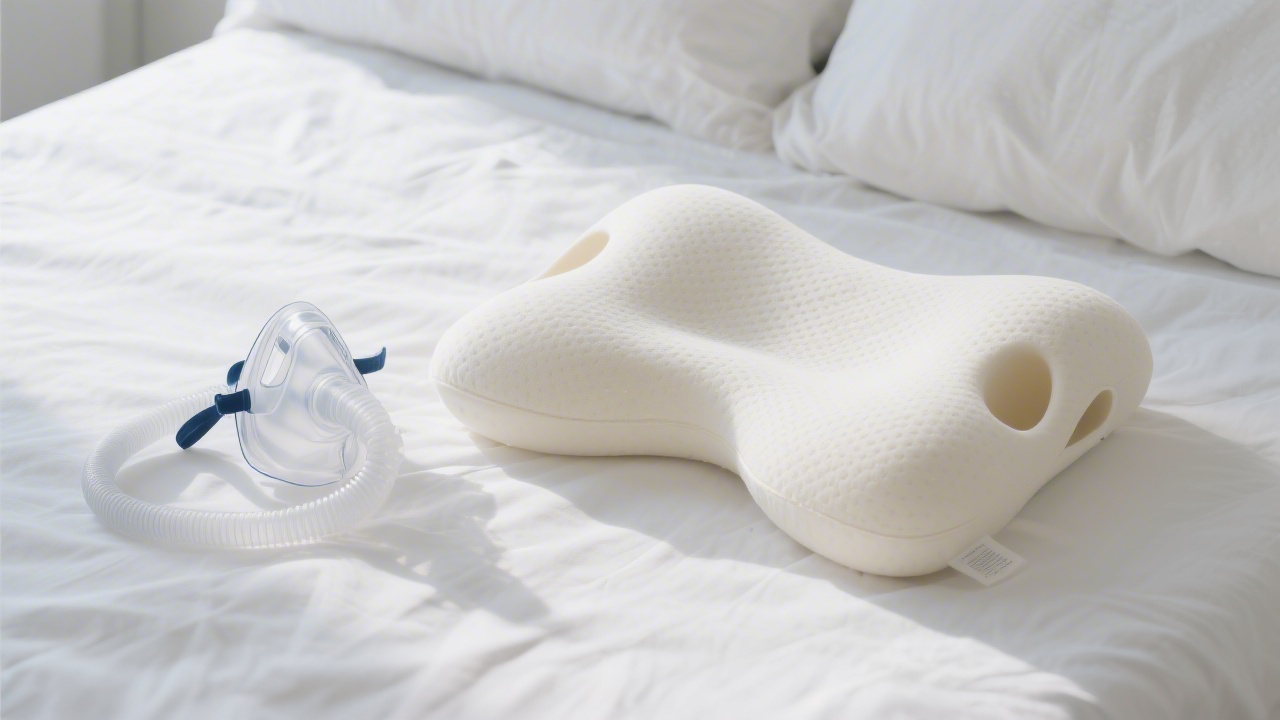
Check Price & Availability FAQPage", "mainEntity": [{"@type": "Question", "name": "What kind of pillow is best for sleep apnea?", "acceptedAnswer": {"@type": "Answer", "text": "The best pillow for sleep apnea depends on whether you use CPAP. CPAP users need a pillow with cutouts or contoured recesses to accommodate the mask without displacement or air leakage. Non-CPAP users benefit most from a wedge pillow or adjustable base providing 7–30 degree head elevation to reduce airway collapse."}}, {"@type": "Question", "name": "Do CPAP pillows actually help?", "acceptedAnswer": {"@type": "Answer", "text": "Yes. Studies show that standard pillows cause mask displacement in 35–50% of CPAP users, leading to air leaks that reduce therapy effectiveness. CPAP-specific pillows with mask cutouts reduce mask leak by measurable amounts and improve reported sleep comfort in CPAP users."}}, {"@type": "Question", "name": "What angle should a sleep apnea pillow be?", "acceptedAnswer": {"@type": "Answer", "text": "For non-CPAP positional management, 7–15 degrees is the range studied for AHI reduction. Higher elevation (30–45 degrees) reduces snoring further but requires an adjustable base or wedge rather than a standard pillow to maintain safely throughout the night."}}, {"@type": "Question", "name": "Can a wedge pillow replace a CPAP machine?", "acceptedAnswer": {"@type": "Answer", "text": "No. A wedge pillow can reduce OSA severity in mild-to-moderate positional cases but cannot replace CPAP for moderate-to-severe OSA. It is a useful adjunct therapy — some patients reduce their required CPAP pressure with elevation, improving comfort and compliance."}}, {"@type": "Question", "name": "What is the best pillow for side sleeping with sleep apnea?", "acceptedAnswer": {"@type": "Answer", "text": "For side sleepers with sleep apnea who use CPAP, a contoured CPAP pillow with side cutouts (like CPAP Max or Contour CPAP Pillow) prevents mask pressure and maintains alignment. For non-CPAP side sleepers, a standard firm-to-medium pillow that keeps the head level with the spine (typically 4–6 inches thick) is appropriate."}}]}Sleep apnea pillows serve two distinct purposes — and conflating them leads to choosing the wrong product. The first purpose is CPAP mask accommodation: pillows that prevent mask displacement and pressure ulcers during CPAP therapy. The second is positional/elevation support: pillows that reduce airway collapse through head elevation and lateral positioning.
Editor’s Pick: Saatva Adjustable Base Plus
Head elevation (7–45°) reduces soft-tissue collapse in the airway — shown to lower AHI scores in positional and mild OSA. The Saatva Adjustable Base Plus adds lumbar support and zero-gravity preset for full-night positioning.
Two Types of Sleep Apnea Pillow (and Who Needs Each)
Type 1: CPAP Accommodation Pillows
CPAP users face a unique challenge: standard pillows push against the mask when side sleeping, creating air leaks, pressure ulcers on the nose bridge, and mask displacement that wakes the patient. CPAP accommodation pillows solve this with:
- Side cutouts: Recessed areas on each side that allow the mask to sit without contact pressure
- Lower profile: Keeps the head lower, reducing the angle between face and CPAP hose
- Stable foam: Memory foam that doesn’t compress enough to push the mask
Key options in this category:
- Contour CPAP Pillow 2.0: Two-position design with bilateral cutouts, medium-firm memory foam. Best for full-face mask users. Widely regarded as the reference standard.
- CPAP Max Pillow: Softer feel, deeper cutouts, better for nasal pillows and nasal masks. Lower profile suits back sleepers using CPAP.
- Mediflow Water CPAP Pillow: Water-based adjustable support with cutouts. Customizable height is useful for CPAP users between standard sizes.
Type 2: Positional/Elevation Pillows
For patients managing OSA without CPAP — or those using positional therapy as an adjunct — the goal is head elevation and/or lateral positioning support.
- Wedge pillows: Provide 30–45 degree incline for full upper body elevation. Most clinically studied for OSA management. Effective but can cause neck extension if the wedge angle is too steep without a compensating head pillow.
- Cervical/contoured pillows: Maintain neutral head alignment in lateral position, preventing the neck flex that can worsen snoring. Useful for side sleepers who snore without OSA.
- Body pillows: Support full lateral position maintenance through the night. Effective for positional snorers who roll supine unconsciously.
The Head Elevation Evidence
Clinical studies on head-of-bed elevation (HOB) for OSA consistently show meaningful benefit in mild-to-moderate cases. A 2012 study in CHEST found that 7.5-degree head elevation reduced AHI by 31% in non-CPAP OSA patients. A 30-degree elevation produced 50% AHI reduction in the same cohort. The mechanism: elevation reduces venous pooling in upper airway tissues (reducing edema-related obstruction) and counteracts gravitational tongue prolapse.
The limitation of wedge pillows is compliance — maintaining the elevated position throughout the night is difficult with a passive pillow stack. An adjustable base that elevates the entire head of the mattress is the most reliable solution for full-night HOB elevation.
CPAP Pillow Buying Criteria
When evaluating CPAP pillows, assess these factors in order:
- Mask type compatibility: Full-face masks require deeper, wider cutouts than nasal pillows. Check that the cutout geometry matches your mask style.
- Height/loft: Most CPAP users benefit from a lower-profile pillow (3–5 inches) to reduce hose tension and mask angle. Measure your shoulder width and preferred sleeping position.
- Support firmness: Memory foam with slow rebound maintains cutout shape throughout the night. Fast-rebound foam collapses and allows mask contact.
- Cover washability: CPAP equipment accumulates bacteria. Pillow covers must be machine washable at minimum weekly.
Integration with Adjustable Base
The most effective setup for OSA management combines an adjustable base with the appropriate pillow. The adjustable base handles elevation (a function no pillow can maintain reliably through the night), while the pillow handles neck alignment and, for CPAP users, mask accommodation.
For CPAP users, the combination of adjustable base elevation at 7–15 degrees plus CPAP at prescribed pressure produces better outcomes than CPAP alone in multiple small studies — likely because HOB elevation reduces required CPAP pressure, improving comfort and mask seal.
Also see: best mattresses for sleep apnea and our positional therapy guide for the complete positional toolkit.
Editor’s Pick: Saatva Adjustable Base Plus
Head elevation (7–45°) reduces soft-tissue collapse in the airway — shown to lower AHI scores in positional and mild OSA. The Saatva Adjustable Base Plus adds lumbar support and zero-gravity preset for full-night positioning.
Frequently Asked Questions
What kind of pillow is best for sleep apnea?
CPAP users need a pillow with cutouts to accommodate the mask. Non-CPAP users benefit most from a wedge pillow or adjustable base providing head elevation to reduce airway collapse.
Do CPAP pillows actually help?
Yes. Standard pillows cause mask displacement in 35–50% of CPAP users. CPAP-specific pillows with mask cutouts reduce mask leak and improve sleep comfort.
What angle should a sleep apnea pillow be?
7–15 degrees for AHI reduction in positional management. Higher elevation (30–45 degrees) reduces snoring further but requires an adjustable base rather than a pillow.
Can a wedge pillow replace a CPAP machine?
No. A wedge pillow can reduce OSA severity in mild-to-moderate positional cases but cannot replace CPAP for moderate-to-severe OSA.
What is the best pillow for side sleeping with sleep apnea?
CPAP side sleepers need a contoured CPAP pillow with side cutouts. Non-CPAP side sleepers benefit from a firm-to-medium pillow keeping the head level with the spine.