
 by
by Sleep apnea treatment in 2026 has expanded substantially beyond the CPAP machines of 20 years ago. From sophisticated auto-titrating devices to FDA-approved nerve stimulation implants, from oral appliances fitted by dental sleep specialists to weight loss interventions that can eliminate the condition entirely — the landscape of effective options is now genuinely broad. This guide covers every clinically validated option with effectiveness data and qualification criteria.
Our Recommendation
Saatva Adjustable Base Plus — a proven foundation that addresses what you can control at home while you pursue clinical support.
Understanding the Diagnosis First
Effective treatment begins with an accurate diagnosis. The apnea-hypopnea index (AHI) — the number of apnea and hypopnea events per hour of sleep — classifies severity: mild (5 to 14 events/hour), moderate (15 to 29), and severe (30 or more). Treatment recommendations vary by severity and are informed by whether the apnea is primarily obstructive (airway collapse despite respiratory effort), central (absent respiratory drive), or mixed.
Diagnosis requires either a home sleep apnea test (HSAT) or in-lab polysomnography. You cannot self-diagnose sleep apnea based on symptoms alone. See our guide on when to see a sleep doctor if you are in the assessment phase.
CPAP Therapy
AHI reduction: 70-90% | Evidence: Strongest available | First-line for moderate-severe OSA
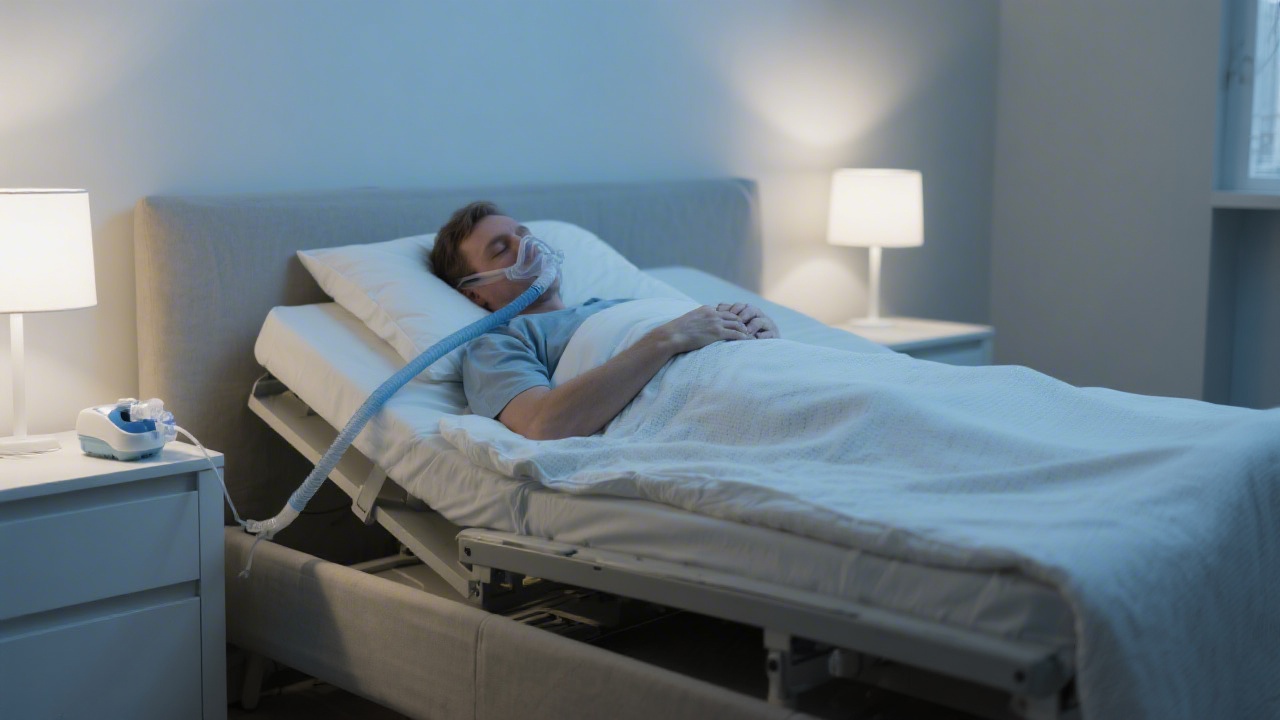
Continuous positive airway pressure delivers pressurized air through a mask (nasal, nasal pillow, or full-face) to pneumatically splint the upper airway open. It is the most effective OSA treatment across severity levels when used consistently.
Modern CPAP Technology
Auto-CPAP (APAP): Algorithms continuously adjust pressure based on detected airflow limitation, delivering the minimum effective pressure each night. Improves comfort versus fixed-pressure CPAP and is now the standard prescription format for most OSA patients. Pressure range typically 4 to 20 cmH2O.
Heated humidification: Significantly reduces nasal dryness, congestion, and morning dry mouth — the most common adherence-limiting symptoms. Virtually all modern CPAP devices include integrated heated humidifiers with adjustable levels.
Ramp feature: Allows pressure to start low and gradually reach prescribed pressure over 5 to 45 minutes, easing pressure tolerance during sleep onset.
Data-capable devices: ResMed AirSense and Philips DreamStation devices upload nightly therapy data to cloud platforms, allowing clinicians to remotely monitor AHI, mask leak, and usage hours between appointments. This enables early identification of mask problems and compliance issues before they become dropout.
Adherence and Troubleshooting
The primary CPAP challenge is adherence. Common solutions: mask fitting by a respiratory therapist (mask choice significantly affects comfort), chin strap for mouth breathing (prevents pressure leak), EPR (expiratory pressure relief) setting for patients who struggle exhaling against pressure, and CPAP warming in cold environments to prevent condensation. If CPAP remains intolerable after optimization, BiPAP or oral appliance therapy should be considered.
BiPAP (Bilevel Positive Airway Pressure)
Indicated for: CPAP-intolerant patients, central/complex apnea, respiratory comorbidities
BiPAP delivers separate pressures for inhalation (IPAP) and exhalation (EPAP), with the differential (typically 4 to 6 cmH2O) making exhalation easier. Preferred over CPAP for patients with high pressure requirements, central sleep apnea component, obesity hypoventilation syndrome, or COPD. Advanced bilevel devices (ASV — adaptive servo-ventilation) address treatment-emergent central sleep apnea and complex sleep apnea syndrome.
Oral Appliance Therapy (Mandibular Advancement Devices)
AHI reduction: 40-60% average | Best for: Mild-moderate OSA, CPAP intolerant | Evidence: A
Custom-fitted MADs advance the mandible 5 to 10 mm forward, enlarging posterior airspace. Most effective when prescribed and titrated by a dentist with training in dental sleep medicine. The AASM endorses MADs as an alternative to CPAP for mild-to-moderate OSA and for CPAP-intolerant patients with severe OSA. A 2015 Cochrane review confirmed significant AHI reduction versus sham. For further detail on MADs and other non-CPAP approaches, see our complete CPAP alternatives guide.
Hypoglossal Nerve Stimulation (Inspire)
AHI reduction: ~70-80% at 12 months | Best for: Moderate-severe CPAP-intolerant patients | FDA-approved 2014
Inspire involves implanting a small device (outpatient surgery, 2 to 3 hours, general anesthesia) that monitors breathing and stimulates the hypoglossal nerve during inhalation to maintain tongue-base and pharyngeal muscle tone. The STAR trial (pivotal RCT, N=126) found 68 percent treatment success at 12 months. Five-year extension data shows maintained efficacy and 87 percent usage compliance — far higher than CPAP.
Current qualification criteria: AHI 15 to 65, CPAP failure, BMI under 32 (some protocols up to 35), age 22+, no complete concentric palatal collapse on drug-induced sleep endoscopy (DISE). The device must be deactivated during MRI examinations (some newer iterations are conditionally MRI-compatible).
Upper Airway Surgery
Variable efficacy by procedure | Best selected via drug-induced sleep endoscopy
Multiple surgical approaches target different anatomical sites. The right procedure depends on where the obstruction occurs — identifiable through DISE (drug-induced sleep endoscopy). Key procedures:
- Uvulopalatopharyngoplasty (UPPP): Resection of uvula, posterior soft palate, and sometimes tonsils. Success rate 50 to 65 percent; highly variable based on patient selection and collapse pattern.
- Maxillomandibular advancement (MMA): Skeletal surgery advancing both jaws 10 mm forward. Success rate above 85 percent — the most effective surgical procedure for OSA. Reserved for appropriate anatomical candidates due to complexity.
- Tonsillectomy: First-line pediatric OSA surgery; effective in adults with tonsillar hypertrophy.
- Nasal surgery (septoplasty, turbinate reduction): Rarely sufficient alone for OSA but improves CPAP tolerance significantly when nasal obstruction is a barrier.
Weight Loss
OSA reduction: ~26% AHI reduction per 10% body weight loss
Adipose tissue in the parapharyngeal region and neck increases upper airway collapsibility. Weight loss is the only intervention that addresses this root cause. Bariatric surgery (Roux-en-Y gastric bypass, sleeve gastrectomy) produces the most dramatic OSA improvements — studies show 70 to 80 percent mean AHI reduction in OSA patients who achieve 30+ percent body weight loss. All patients who achieve significant weight loss should repeat a diagnostic sleep study to confirm whether treatment can be discontinued or reduced.
Positional Therapy and Sleep Position Optimization
For patients with positional OSA — AHI at least twice as high in the supine versus lateral position — maintaining lateral sleeping can reduce AHI into the normal range. Commercial positional therapy devices using vibration feedback (NightShift, Nightbalance) outperform the tennis ball technique in compliance and efficacy. Head elevation via an adjustable base reduces supine AHI by 20 to 40 percent in positional patients, with minimal patient burden. The Saatva Adjustable Base Plus offers precise head elevation from 0 to 58 degrees, making it practical for integrating positional therapy into any treatment strategy.
Treatment Selection Framework
For mild OSA (AHI 5-14) without significant symptoms: lifestyle modification, weight loss, positional therapy, or oral appliance. For moderate OSA (AHI 15-29): CPAP first-line; oral appliance or Inspire if CPAP intolerant; surgery if appropriate anatomy confirmed by DISE. For severe OSA (AHI 30+): CPAP first-line; Inspire if CPAP intolerant and qualifying criteria met; MMA for appropriate surgical candidates. All patients benefit from addressing sleep position optimization as an adjunct to primary therapy.
Start With What You Control
Clinical support takes time. A properly supportive mattress delivers results from night one.
See Saatva Adjustable Base Plus →
Affiliate link. We earn a commission at no extra cost to you.
Frequently Asked Questions
What is the first-line treatment for sleep apnea?
CPAP (continuous positive airway pressure) therapy is the first-line treatment recommended for moderate-to-severe obstructive sleep apnea (AHI above 15) across all major guidelines including AASM, the American Thoracic Society, and the American Academy of Otolaryngology. For mild OSA (AHI 5-14) with symptomatic daytime sleepiness, CPAP or oral appliance therapy are both recommended. Treatment choice also depends on patient preference, anatomy, and comorbidities.
How quickly does sleep apnea treatment work?
CPAP effects are immediate — first night use typically eliminates or dramatically reduces apneic events. Subjective improvements in daytime alertness and mood often appear within the first week of consistent use. However, physiological consequences of chronic OSA (cardiovascular, metabolic) improve over months to years of consistent therapy. Oral appliances typically produce maximal benefit after 4 to 8 weeks as titration and adaptation occur.
Can sleep apnea go away on its own?
Sleep apnea very rarely resolves without intervention. Spontaneous resolution is more common in children (where tonsillar/adenoid growth is often the cause, and both can normalize after removal) and in adults who achieve significant weight loss (which can reduce or resolve OSA in obese patients). In adults at normal weight, anatomical contributors (retrognathia, narrow palate) typically do not change without surgical intervention.
What happens if sleep apnea is left untreated?
Untreated moderate-to-severe OSA is associated with substantially increased risk of hypertension (OSA is present in approximately 50 percent of hypertensive patients), atrial fibrillation, stroke, type 2 diabetes, and all-cause mortality. The Sleep Heart Health Study found an adjusted hazard ratio of 2.87 for cardiovascular disease mortality in severe OSA versus no OSA. Quality of life impacts include excessive daytime sleepiness, cognitive impairment, depression, and increased accident risk.
Is BiPAP better than CPAP for sleep apnea?
BiPAP (bilevel positive airway pressure) delivers different pressures on inhalation and exhalation, making it easier to breathe out against pressure. It is preferred over CPAP for: central sleep apnea, complex sleep apnea syndrome, patients who cannot tolerate CPAP exhalation pressure, and patients with comorbid respiratory conditions (COPD, obesity hypoventilation syndrome). For standard obstructive sleep apnea, CPAP and BiPAP produce equivalent outcomes; BiPAP is costlier and is not routinely prescribed as first-line for OSA.