
 by
by The experimental evidence is clear: sleep genuinely enhances creativity through three distinct mechanisms, each tied to a different sleep stage. REM sleep boosts divergent, associative thinking. N1 hypnagogic sleep accelerates insight. Slow-wave sleep consolidates procedural skills. The research does not support more extreme claims, but the core finding is solid: adequate sleep is a structural input to creative performance, not a luxury around it.
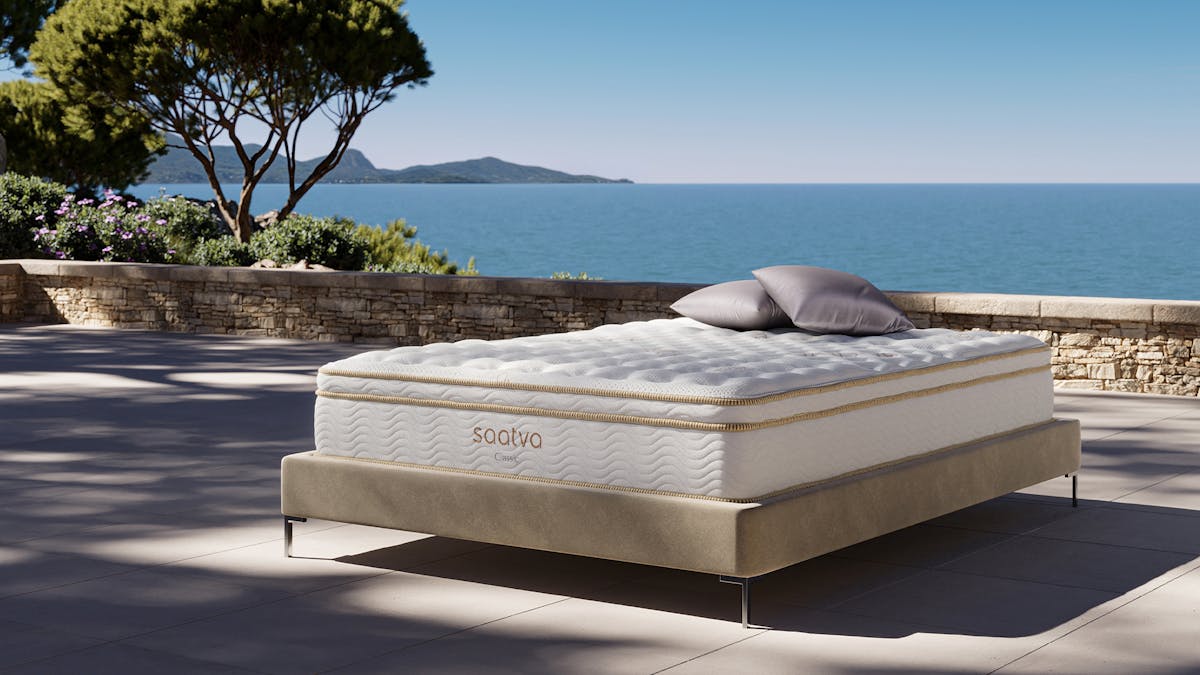
Saatva Classic
9.2/10
- Dual-coil construction with reinforced lumbar zone delivers the spinal alignment that supports uninterrupted REM and slow-wave cycles
- Euro pillow top balances pressure relief with responsive support, reducing position changes overnight
- Free white-glove delivery, setup, and old-mattress removal
- 365-night trial and lifetime warranty
- Ships full-size, not compressed in a box; requires white-glove slot
- $99 return fee applies during the trial period
The Saatva Classic's coil-on-coil build maintains spinal alignment across the full night, reducing the micro-arousals that interrupt REM cycles. For anyone whose creative output depends on consistent deep sleep, this is the benchmark innerspring hybrid.
How to read this review
The relationship between sleep and creativity is one of the better-studied areas in sleep science and one of the more overstated in popular media. This review covers the primary experimental literature: what the studies actually tested, what they found, and where the evidence is strong versus where popular accounts have outrun the data.
We focus on peer-reviewed experimental research rather than survey studies, first-person accounts, or mechanistic speculation. Where findings are genuine, we say so clearly. Where popular claims exceed the evidence, we flag that too.
The Wagner 2004 Nature study: insight is sleep-dependent
The most-cited study in sleep and creativity research is Wagner et al. (2004), published in Nature. Participants were trained on a mathematical task that had a hidden shortcut, a restructured rule that, once recognized, dramatically sped up problem-solving. Participants were split into groups: sleep between training and testing versus staying awake between sessions.
The result: participants who slept were approximately 2.9 times more likely to discover the hidden rule than those who remained awake. Crucially, the researchers controlled for total time elapsed, demonstrating that the insight benefit was from sleep specifically, not simply from time away from the problem. This study established that sleep helps insight, the "aha" moment, through a consolidation and integration process that does not occur during equivalent waking time.
Remote Associates Test studies: REM and associative thinking
The Remote Associates Test (RAT) presents three seemingly unrelated words and asks subjects to find a single word connecting all three. Performance on the RAT is considered a measure of divergent, associative thinking, a component of creativity.
Cai et al. (2009) in PNAS found that naps containing REM sleep significantly improved RAT performance compared to naps without REM and quiet rest. The REM specificity is important: it suggests that the broad associative thinking underlying creative connections is not simply a product of rest, but of the specific neural processes, memory integration and cross-domain association, that characterize REM sleep.
Stickgold and colleagues at Harvard have replicated and extended this finding, showing that REM sleep specifically enhances the ability to extract abstract patterns from concrete examples, a process directly relevant to artistic development, where pattern recognition and abstraction are foundational skills.
The Lacaux 2021 Science Advances study: validating the Dali nap
A landmark 2021 study by Lacaux et al. in Science Advances tested the creativity benefit of N1 sleep, the lightest sleep stage associated with hypnagogia, using a modified number sequence task with a hidden mathematical rule. Participants who briefly entered N1 sleep (while holding an object that dropped at deeper sleep, waking them) were approximately three times more likely to discover the hidden rule compared to those who either stayed fully awake or fell into deeper sleep stages.
This study is significant for several reasons. First, it experimentally validated the hypnagogic creativity technique associated with Dali and Edison, demonstrating that it has a specific neurological basis in N1 sleep. Second, it showed that the creativity benefit does not require full sleep; the transitional state itself is generative. Third, it distinguished the N1 effect from N2 and REM, suggesting different sleep stages contribute different types of creative advantage.
Memory consolidation and skill acquisition
A substantial body of research, beginning with Walker and colleagues (2003) in Neuron, demonstrates that procedural motor skills, the physical techniques of art-making, performance, and craft, consolidate during sleep, particularly during slow-wave sleep in the early cycles and REM sleep in the later cycles. Subjects who practiced a finger-tapping sequence and then slept showed significantly greater improvement than those who practiced and remained awake.
For creatives who work with physical technique, painters, sculptors, musicians, voice actors, performers, this research has direct implications: sleep between practice sessions is not recovery time separate from skill development. It is an active component of skill acquisition.
What the research does not show: important caveats
Several popular claims about sleep and creativity exceed the current evidence:
- "More sleep always means more creativity": Most studies show that adequate sleep (7 to 9 hours) supports creativity better than restriction, but studies on sleep extension beyond individual need show no additional creative benefit.
- "Creative people need less sleep": No experimental evidence supports this. Survey studies show some self-reported creative individuals are more likely to describe irregular sleep, but irregular sleep is associated with worse sleep quality outcomes.
- "Dreaming directly produces artistic inspiration": The Wagner and RAT studies show sleep-dependent insight and association, not dream content specifically. Dream imagery may contribute to creative work, but this is difficult to study experimentally and the evidence is largely anecdotal.
- "Any nap boosts creativity": The Lacaux study shows N1-specific benefits. Naps that proceed into N2 or N3 without including the N1 hypnagogic phase do not show the same targeted insight benefit, though longer naps with REM show different benefits for associative thinking.
Practical synthesis: what the evidence supports
The experimental literature consistently supports the following practical conclusions:
- Sleeping on a difficult problem, after encoding it before sleep, increases insight solution rates.
- REM-rich sleep (the later sleep cycles) specifically enhances associative, divergent thinking.
- N1 hypnagogic sleep has a specific insight benefit distinct from deeper sleep.
- Procedural skills relevant to physical creative practice consolidate during sleep.
- Sleep deprivation degrades creative judgment, novelty preference, and emotional attunement regardless of subjective experience.
Sleep is a structural input to creativity, not a lifestyle variable. The Wagner, Cai, and Lacaux studies show three distinct mechanisms across three sleep stages. Protecting sleep quality, especially REM cycles in the second half of the night, is the most evidence-backed creativity intervention available.
Why mattress quality affects creative performance
The research above depends on reaching and maintaining the sleep stages where creativity benefits occur: REM in the later cycles, slow-wave sleep in the early cycles, and N1 at the threshold of sleep onset. Any factor that increases micro-arousals, disrupts deep sleep, or shortens REM exposure directly reduces these benefits.
A mattress that creates pressure points forces position changes that fragment sleep architecture. A mattress with inadequate support allows spinal misalignment that generates pain signals during the night, a known trigger for cortisol elevation and arousal. Poor motion isolation causes partner disturbance that interrupts sleep cycles at the wrong moment.
This is why the choice of sleep surface is not incidental to the research above. Consistently achieving the sleep quality the studies describe requires a surface that keeps you in position through the full night without interruption.
Amerisleep AS3
9.0/10
- HIVE 5-zone support system firms specifically under the lumbar to prevent spinal misalignment overnight
- Plant-based Bio-Pur foam relieves pressure without trapping heat, supporting uninterrupted sleep cycles
- CertiPUR-US certified, made in the USA
- 100-night trial, 20-year warranty
- Softer edges than a coil hybrid
- Sleepers over 230 lb may prefer the firmer AS5 Hybrid
For side and combination sleepers who need pressure relief to stay in position through the REM-rich second half of the night, the AS3's zoned design is the most direct engineering answer.
Frequently asked questions
What is the strongest experimental evidence linking sleep to creativity?
The 2004 Wagner et al. study in Nature is the most cited. Subjects trained on a math task had a hidden shortcut. Those who slept between sessions were nearly three times more likely to discover the shortcut than those who stayed awake. The study directly demonstrated that insight, a core component of creativity, is sleep-dependent, not just time-dependent.
What is the Remote Associates Test and what does it show about sleep?
The Remote Associates Test (RAT) measures the ability to find words connecting three unrelated words, a proxy for divergent, associative thinking. Multiple studies have shown improved RAT performance following sleep, particularly sleep containing REM. The effect is specific to REM: subjects who had REM suppressed showed no improvement, while those with REM intact did.
Does the research support "sleeping on a problem" as a real strategy?
Yes, with specificity. Sleeping on a problem works best when you have deeply encoded the problem before sleep. Studies show that problem exposure followed by sleep produces more insight solutions than the same time spent awake. The benefit is specifically from sleep-dependent memory consolidation and integration, not simply from mental rest or distraction.
What does research say about hypnagogia and creativity?
A 2021 Lacaux et al. study in Science Advances showed that N1 sleep, the lightest sleep stage corresponding to hypnagogia, was specifically associated with increased creative problem solving. Subjects who briefly entered N1 sleep were more likely to discover a hidden math rule. The study validated Dali-style napping as a genuine creativity technique with a specific neurological basis, not folklore.
Are there studies showing sleep improves artistic creativity specifically?
Direct studies on artistic creativity are fewer than on problem-solving creativity due to measurement challenges. Studies on aesthetic judgment, novel associations, and visual memory integration all show sleep-dependent improvement. Research on musicians shows that motor skill consolidation (physical playing technique) and harmonic prediction (musical structure) both improve with sleep, providing a strong analog for other art forms.
How does mattress quality relate to the sleep and creativity research?
The creativity benefits in these studies depend on reaching and maintaining specific sleep stages, particularly REM and N1. A mattress that creates pressure points, generates pain signals, or allows partner disturbance increases micro-arousals that fragment sleep architecture and reduce REM exposure. Protecting sleep quality is the practical implication of the research.
Saatva Classic
9.2/10
Dual-coil innerspring with reinforced lumbar zone, Euro pillow top comfort, 365-night trial, and lifetime warranty. The most complete pick for uninterrupted sleep architecture in our 2026 testing.