
 by
by Our Top Mattress Pick for Better Sleep
The Saatva Classic is engineered for spinal alignment and temperature regulation — two non-negotiables for restorative sleep at any stage of a habit-building journey.
Why Environment Beats Willpower for Sleep
Behavioral sleep advice — wind down, avoid screens, relax — requires ongoing willpower to execute. Willpower is finite, context-dependent, and collapses under stress, which is precisely when good sleep is most needed. Environment design requires willpower once (to set it up) and then operates passively, night after night, without relying on motivation or decision-making.
The sleep environment is not just a backdrop to your sleep — it is an active input into your circadian system, your autonomic nervous system state, and your cortical arousal level. Getting the environment right does more work than any behavioral intervention you can overlay on top of it.
Temperature: The Highest-Leverage Variable
Core body temperature must drop by 1-2°F to initiate and maintain sleep. The bedroom acts as a thermal regulator: a cool environment facilitates the core temperature drop; a warm environment inhibits it. The optimal range is 65-68°F (18-20°C) for most adults, though individual variation exists.
The Temperature Habit Stack
Set a smart thermostat schedule: drop to 67°F at 9 PM, return to comfortable waking temperature at 6:30 AM. This requires no nightly decision. If a smart thermostat is not available, the habit of adjusting the thermostat or opening a window as part of the brushing-teeth anchor (see Sleep Habit Stacking) achieves the same result with minimal friction.
For people who run cold, a warm bath or shower 60-90 minutes before bed produces a paradoxical cooling effect: the heat dilates peripheral blood vessels, accelerating heat loss from the core after you exit the shower. This is one of the most reliably sleep-onset-improving habits in the research literature.
Light: The Circadian Remote Control
The suprachiasmatic nucleus (your master circadian clock) uses light as its primary zeitgeber (time-giver). Light in the blue-white spectrum signals daytime; its absence signals nighttime. Artificial light at night is the most common circadian disruptor in modern environments.
The Two-Phase Light Habit
Phase 1 (2 hours before bed): Switch all overhead lights to warm-toned lamps or dim to below 10 lux. Install smart bulbs on a 9 PM schedule if possible. Use blue-light-blocking glasses if overhead lights cannot be controlled.
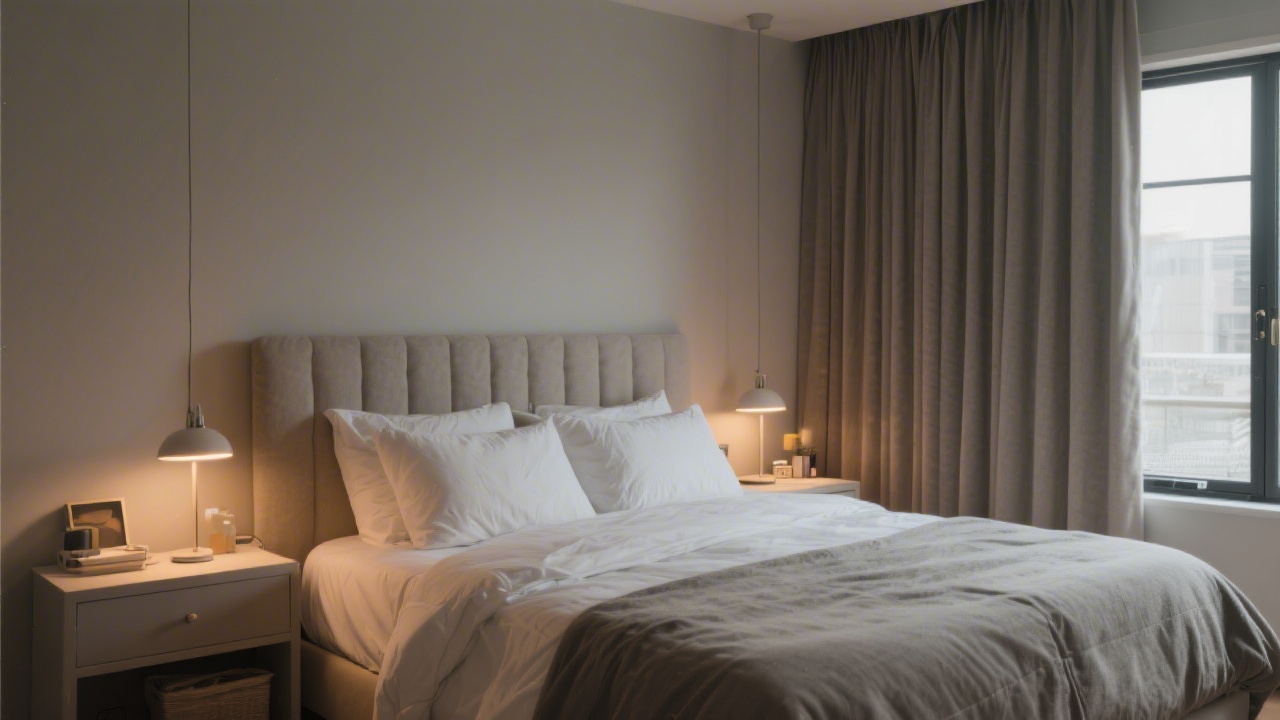
Phase 2 (immediate bedroom): Blackout curtains for morning light elimination. A sleep mask as a portable backup for travel. Zero light sources (LEDs, charger indicators) in the sleeping space. These passive changes require no nightly compliance — they work regardless of how tired or unmotivated you are.
Sound: Engineering for Continuity
Sleep continuity — uninterrupted sleep architecture cycling through light, deep, and REM stages — is disrupted primarily by unpredictable noise peaks. A constant low-level ambient sound masks these peaks without being stimulating enough to prevent sleep onset.
The environment habit: place a white noise machine (not a phone app — phone in another room) or run a fan at consistent low volume. Set it before entering the bedroom as part of the pre-sleep sequence. Once habituated (typically 3-7 days), the sound becomes a conditioned cue for sleep itself, adding a pavlovian element to its mechanical masking function.
Scent and Tactile Environment
Lavender aromatherapy has modest but consistent evidence for reducing sleep onset latency in non-clinical populations. More importantly, a consistent scent in the sleeping environment can become a conditioned cue that activates sleep-associated physiology. A diffuser on a timer, or a consistent bedding detergent, creates this association passively.
Bedding and mattress surface temperature and pressure distribution also matter. A surface that causes micro-awakenings due to pressure points creates a sleep environment that works against the habits built on top of it. Investing in a mattress with appropriate pressure relief and temperature regulation is an environment optimization, not a luxury purchase.
The One-Time Setup Protocol
Dedicate two hours to environment optimization rather than distributing changes across weeks. In a single session: install blackout curtains, program a thermostat schedule, place a white noise machine, remove all light-emitting devices from the bedroom, add a charging station outside the bedroom, and set smart bulb schedules. This one-time investment eliminates dozens of future willpower expenditures.
Related guides: Sleep Habit Stacking, Nighttime Phone Habits, Sleep Schedule Maintenance, Sustainable Sleep Improvement.
Frequently Asked Questions
What is the single most impactful sleep environment habit?
Temperature control is consistently ranked highest in sleep research. Setting bedroom temperature to 65-68°F (18-20°C) before sleep onset improves sleep architecture — specifically the ratio of slow-wave (deep) sleep to lighter stages — more reliably than most behavioral interventions.
How does automatic light dimming improve sleep?
Light exposure in the evening suppresses melatonin secretion proportionally to its intensity and blue-light content. Automatic smart bulb schedules or simple habits like switching to lamps at 8 PM can increase melatonin onset by 30-60 minutes, which advances sleep pressure and makes falling asleep easier.
Does white noise actually help sleep?
White noise masks the irregular sound spikes (a car, a voice, a door) that trigger cortical arousals during sleep. It does not necessarily improve deep sleep directly, but by reducing arousals — especially in light sleep stages — it can meaningfully improve continuity. Pink noise (lower frequency emphasis) may have a slight edge for deep sleep promotion.
How important is blackout curtain installation?
Light exposure during sleep — even at low levels perceived through closed eyelids — can reduce melatonin levels and fragment sleep architecture. This matters especially for people who wake early (5-6 AM) in summer when ambient light is already bright. Blackout curtains address the problem passively without requiring nightly behavioral compliance.
What environment habits should be automated vs. manual?
Automate anything temperature, light, and sound related — these require zero willpower once set up. Keep manual only the habits that benefit from intentionality: your wind-down routine, your journaling or reading, your breathing practice. Automation eliminates decision fatigue for the passive conditions; manual retention preserves the conscious signal that sleep is now the priority.
Our Top Mattress Pick for Better Sleep
The Saatva Classic is engineered for spinal alignment and temperature regulation — two non-negotiables for restorative sleep at any stage of a habit-building journey.
Key Takeaways
Sleep Environment Habits is a topic that depends heavily on individual needs and preferences. The most important thing is to consider your specific situation — your body type, sleep position, and personal comfort preferences — before making any decisions. When in doubt, take advantage of trial periods to test before committing.